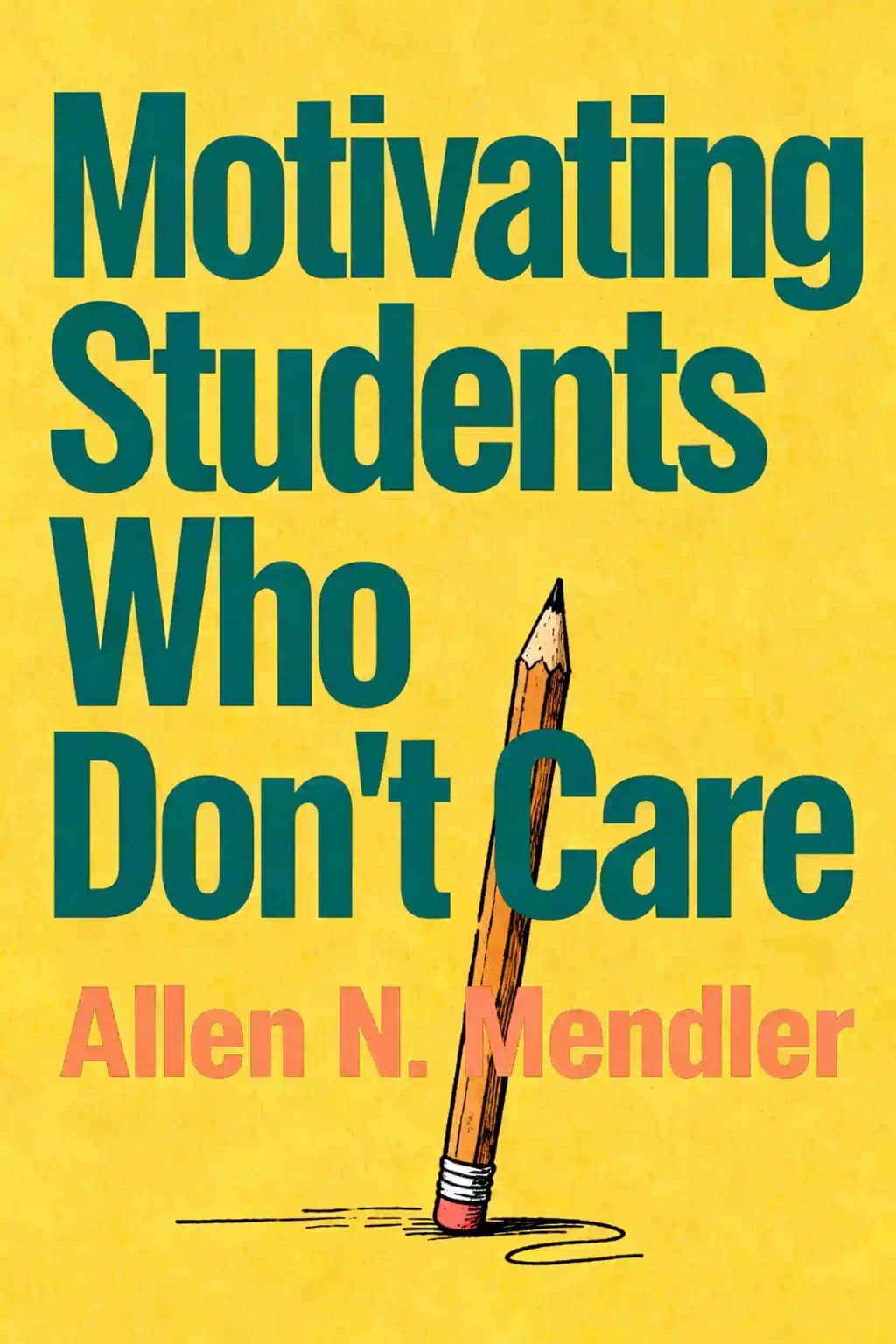
Discover why educators call "Motivating Students Who Don't Care" a "treasure trove of ideas" for reigniting classroom enthusiasm. Updated post-pandemic, Dr. Mendler's acclaimed strategies bridge the gap between disengagement and curiosity, transforming reluctant learners through psychological insight rather than punishment.
Allen N. Mendler, author of Motivating Students Who Don’t Care, is a celebrated educator, school psychologist, and behavior management expert renowned for his transformative approaches to engaging disengaged learners. Specializing in educational psychology and classroom strategies, Mendler’s work draws from over two decades of experience in special education, juvenile detention centers, and global teacher training programs. His book combines actionable techniques for reigniting student motivation with insights from his co-authored bestseller Discipline with Dignity, a foundational text in modern classroom management.
A trailblazer in youth advocacy, Mendler has authored 15+ books, including Power Struggles: Successful Techniques for Educators and Connecting with Students, which are widely used in professional development curricula.
Recognized with the Crazy Horse Award for his impact on at-risk youth, he contributes regularly to Edutopia and trains educators through workshops endorsed by institutions like the Bureau of Education and Research. His methods, translated into multiple languages, continue to shape inclusive, resilience-focused education globally.
Motivating Students Who Don't Care provides actionable strategies for educators to engage disinterested learners. The book emphasizes five processes: emphasizing effort, fostering confidence, valuing student input, building teacher-student relationships, and sparking enthusiasm. Mendler combines psychological insights with practical classroom techniques, addressing systemic and emotional barriers to motivation.
K-12 teachers, administrators, and education specialists seeking proven methods to connect with unmotivated students will benefit. The strategies are particularly relevant for educators facing challenges with apathy, behavioral issues, or low academic confidence.
Yes—the book offers evidence-based, classroom-tested approaches that prioritize effort over innate ability and reframe student-teacher dynamics. Its focus on reducing anxiety and fostering hope makes it especially valuable in post-pandemic educational settings.
Mendler advocates for consistent, respectful interactions that prioritize mutual trust. Techniques include personalized feedback, shared goal-setting, and recognizing non-academic strengths. He argues that students engage when they feel valued beyond grades.
Yes—the second edition includes updated methods for integrating digital tools to enhance engagement, such as gamified learning platforms and collaborative online projects, while cautioning against over-reliance on screens.
He reframes apathy as a protective mechanism against failure. Strategies include private check-ins, connecting lessons to personal interests, and offering controlled choices to rebuild agency.
Some reviewers note the strategies assume institutional support and may be challenging in under-resourced schools. Others request more examples of real-world implementation beyond theoretical frameworks.
Unlike punitive or reward-based systems, Mendler’s approach centers on intrinsic motivation through emotional connection. It complements works like The Growth Mindset Coach but adds specific tactics for resistant learners.
While designed for K-12, concepts like effort-focused feedback, relationship-building, and relevance-driven instruction are adaptable for college instructors facing disengaged students.
New content addresses post-pandemic classroom dynamics, digital learning integration, and trauma-informed practices. Case studies and reflection questions enhance practicality.
저자의 목소리로 책을 느껴보세요
지식을 흥미롭고 예시가 풍부한 인사이트로 전환
핵심 아이디어를 빠르게 캡처하여 신속하게 학습
재미있고 매력적인 방식으로 책을 즐기세요
Students are inherently motivated but learn to be unmotivated after repeated failure.
Our job is excavation, not creation.
Empty praise damages motivation.
Motivation increases when adults treat students respectfully.
Learning requires risk-taking in safe environments.
Motivating Students Who Don't Care의 핵심 아이디어를 이해하기 쉬운 포인트로 분해하여 혁신적인 팀이 어떻게 창조하고, 협력하고, 성장하는지 이해합니다.
Motivating Students Who Don't Care을 빠른 기억 단서로 압축하여 솔직함, 팀워크, 창의적 회복력의 핵심 원칙을 강조합니다.

생생한 스토리텔링을 통해 Motivating Students Who Don't Care을 경험하고, 혁신 교훈을 기억에 남고 적용할 수 있는 순간으로 바꿉니다.
무엇이든 물어보고, 목소리를 선택하고, 진정으로 공감되는 인사이트를 함께 만들어보세요.

샌프란시스코에서 컬럼비아 대학교 동문들이 만들었습니다
"Instead of endless scrolling, I just hit play on BeFreed. It saves me so much time."
"I never knew where to start with nonfiction—BeFreed’s book lists turned into podcasts gave me a clear path."
"Perfect balance between learning and entertainment. Finished ‘Thinking, Fast and Slow’ on my commute this week."
"Crazy how much I learned while walking the dog. BeFreed = small habits → big gains."
"Reading used to feel like a chore. Now it’s just part of my lifestyle."
"Feels effortless compared to reading. I’ve finished 6 books this month already."
"BeFreed turned my guilty doomscrolling into something that feels productive and inspiring."
"BeFreed turned my commute into learning time. 20-min podcasts are perfect for finishing books I never had time for."
"BeFreed replaced my podcast queue. Imagine Spotify for books — that’s it. 🙌"
"It is great for me to learn something from the book without reading it."
"The themed book list podcasts help me connect ideas across authors—like a guided audio journey."
"Makes me feel smarter every time before going to work"
샌프란시스코에서 컬럼비아 대학교 동문들이 만들었습니다

Motivating Students Who Don't Care 요약을 무료 PDF 또는 EPUB으로 받으세요. 인쇄하거나 오프라인에서 언제든 읽을 수 있습니다.
Picture a classroom where half the students have their heads down, earbuds in, completely checked out. The teacher pleads, cajoles, threatens-nothing works. This isn't an isolated incident in a struggling school; it's become the daily reality in classrooms everywhere. What's happened to the natural curiosity every child is born with? That toddler who couldn't stop asking "why?" has transformed into a teenager who can't be bothered to lift a pencil. The shift isn't mysterious-it's the result of a culture that increasingly values instant gratification over earned achievement, possessions over character, and entertainment over engagement. But here's the truth that changes everything: students aren't born unmotivated. They learn to be unmotivated after repeated experiences of failure, powerlessness, and disconnection. Which means motivation can be relearned when we understand what extinguished it in the first place. When a student says "I don't care," they're rarely telling the truth. That indifference is armor, carefully constructed to protect something vulnerable underneath. Some students refuse to try because trying and failing feels worse than not trying at all-at least then they can tell themselves they could have succeeded if they'd wanted to. Others have discovered that refusal is power. In a world where adults control nearly everything, "you can't make me" becomes a twisted form of autonomy. Then there's the invisible crisis: depression and anxiety in children. One in five kids experiences a mental health challenge in any given year, yet most receive no treatment. These internal struggles manifest as academic disengagement long before anyone recognizes them as psychological distress. The "lazy" student might be battling intrusive thoughts; the "defiant" one might be using anger to mask overwhelming sadness. Understanding this psychology changes everything. When we see refusal as protection rather than defiance, we can respond with strategies that address the underlying need. The student who won't complete assignments isn't rejecting learning-they're protecting themselves from feeling stupid, powerless, or overwhelmed.