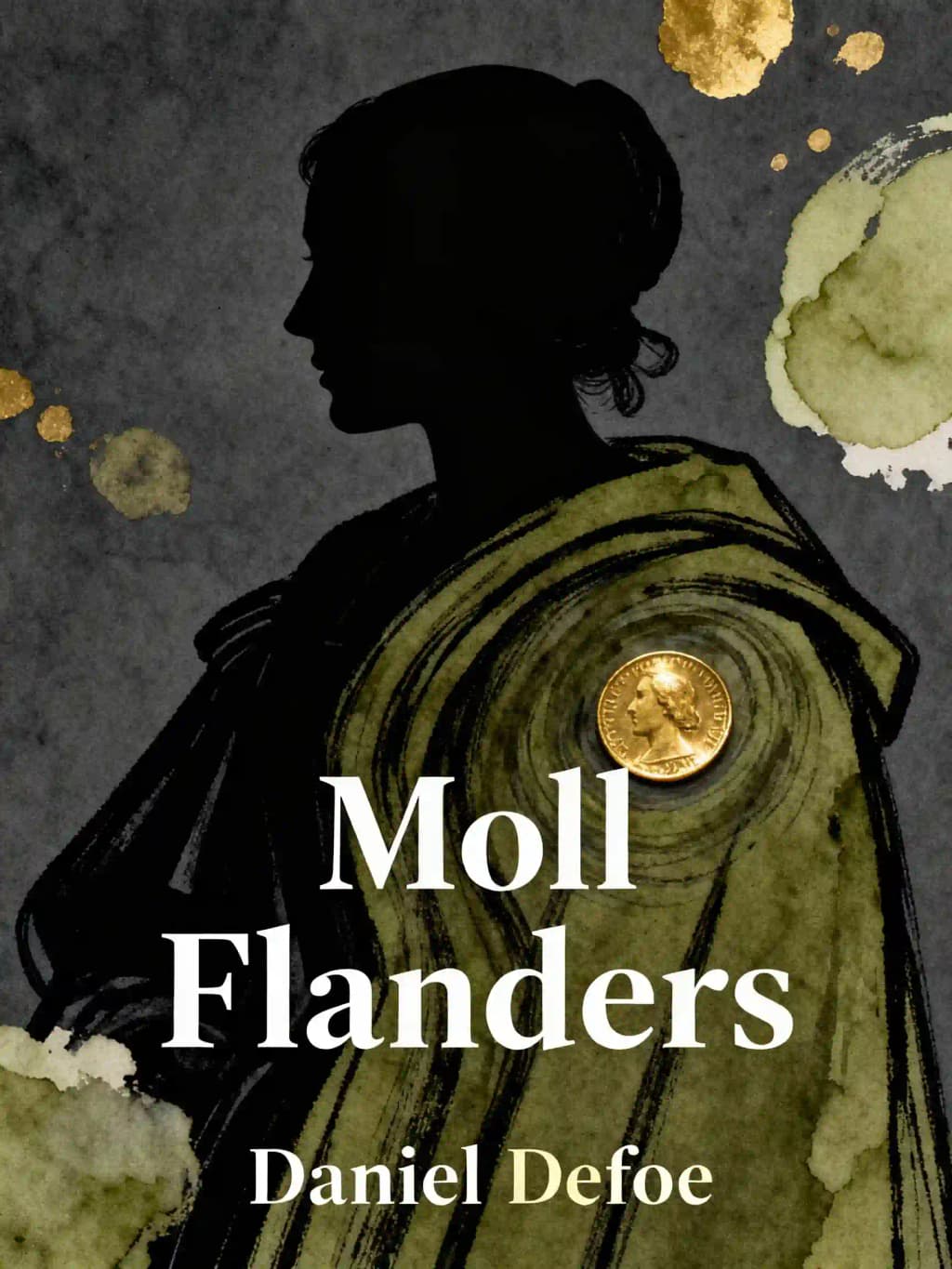
Born in prison, Moll Flanders survives as thief, prostitute, and accidental bigamist in Defoe's groundbreaking 1722 novel. With its scandalous 183-word title and unflinching portrayal of female survival, this pioneering work once faced police censorship yet remains startlingly modern three centuries later.
Daniel Defoe (1660–1731), author of Moll Flanders, was a pioneering English novelist and political writer whose works helped shape modern realist fiction. Born in London to a Presbyterian family, Defoe drew on his experiences as a merchant, journalist, and social commentator to craft gritty narratives exploring survival, morality, and societal hypocrisy.
Moll Flanders (1722), a seminal work of 18th-century picaresque fiction, exemplifies his focus on complex antiheroes navigating England’s class divisions—a theme informed by Defoe’s prison stint for seditious libel and firsthand observations of London’s underworld. His groundbreaking novel Robinson Crusoe (1719) established him as a master of adventure literature, while A Journal of the Plague Year (1722) showcased his journalistic precision in fictionalized historical accounts.
Defoe’s innovative use of first-person narration and psychological depth in Moll Flanders cemented its status as a cornerstone of English literature, with the novel remaining widely studied in academic curricula and adapted into multiple films and stage productions.
Moll Flanders follows the tumultuous life of its protagonist, Moll, who navigates 17th-century England through marriages, criminal exploits, and social survival. Born in prison, Moll ascends from poverty via strategic alliances, theft, and deception, ultimately seeking redemption. The novel explores themes of gender inequality, economic desperation, and moral ambiguity, framed as Moll’s retrospective confessional. Defoe blends picaresque adventure with social critique.
This novel appeals to readers interested in classic literature, feminist narratives, and social history. Scholars of 18th-century fiction, students analyzing themes of identity and survival, and those exploring early feminist perspectives will find it compelling. Its unflinching portrayal of a woman’s struggle for autonomy resonates with modern discussions on gender and class.
Yes—Defoe’s gritty realism and Moll’s complex character offer timeless insights into human resilience and societal constraints. While episodic, the novel’s exploration of morality, survival, and female agency remains relevant. Critics praise its candid depiction of poverty and its challenge to patriarchal norms, though some find Moll’s repentance abrupt.
Moll rejects passive femininity by marrying five times, engaging in theft, and prioritizing financial security over societal expectations. Defoe portrays her as a pragmatist navigating a male-dominated world, emphasizing women’s resourcefulness. Scholar Swaminathan notes Moll’s friendships with marginalized women further defy period norms.
Crime becomes Moll’s survival mechanism amid poverty and limited opportunities. Her thefts and disguises critique systemic inequality, though Defoe condemns her actions morally. The novel juxtaposes criminality with societal hypocrisy, as Moll’s exploits mirror the corruption of the elite.
Moll achieves financial stability and repentance late in life, returning to England with her Lancashire husband. However, her “happy” ending is ambiguous—her wealth stems partly from inherited and stolen gains, leaving her redemption morally complex.
Moll evolves from an orphaned girl to a cunning survivor, adopting roles like gentlewoman, thief, and penitent. Her shifting identities—often tied to marriage or crime—reflect her adaptability in a rigid class system. Defoe uses this fluidity to critique societal labels.
Wealth symbolizes freedom and security in a society where women lack inheritance rights. Moll’s marriages and thefts are economic strategies, underscoring Defoe’s critique of materialism. As scholar Kuhlisch notes, Moll “defines her identity through her economic activities”.
Morality is transactional: Moll condemns her crimes but prioritizes survival. Defoe frames her story as a cautionary tale, yet humanizes her struggles, prompting readers to question societal vs. personal ethics. The preface emphasizes moral instruction despite Moll’s vice.
Critics debate the novel’s disjointed structure and Moll’s sudden repentance. Some argue Defoe’s moralizing clashes with Moll’s agency, while others find the focus on survival over character depth limiting. Modern analyses critique colonial undertones in Moll’s Maryland subplot.
Moll’s defiance of gender roles—asserting economic independence, rejecting passivity, and forming female alliances—positions her as an early feminist figure. Defoe highlights systemic barriers facing women, though her resourcefulness remains controversial within feminist discourse.
저자의 목소리로 책을 느껴보세요
지식을 흥미롭고 예시가 풍부한 인사이트로 전환
핵심 아이디어를 빠르게 캡처하여 신속하게 학습
재미있고 매력적인 방식으로 책을 즐기세요
Thus you see my beginning again, and though I was now in a station of life which might be supposed to be perfectly easy and agreeable, yet I wanted one thing, which indeed made all the rest of no value; I mean I wanted what I had not, viz., a settled prospect of living and a home where I might depend upon being safe from disaster.
I was now a widow, and not very old, viz., about thirty-four, and though I was not rich, I was not despicable; I had saved about twelve hundred pounds at my husband's death, and I was not of a humour to sit still and do nothing.
I was tricked once by a schoolmaster, who I went to be taught French and Latin by, and he got me with child; but that is a story by itself.
Give me not poverty, lest I steal.
The devil carried me out and laid his bait for me.
Moll Flanders의 핵심 아이디어를 이해하기 쉬운 포인트로 분해하여 혁신적인 팀이 어떻게 창조하고, 협력하고, 성장하는지 이해합니다.
Moll Flanders을 빠른 기억 단서로 압축하여 솔직함, 팀워크, 창의적 회복력의 핵심 원칙을 강조합니다.

생생한 스토리텔링을 통해 Moll Flanders을 경험하고, 혁신 교훈을 기억에 남고 적용할 수 있는 순간으로 바꿉니다.
무엇이든 물어보고, 목소리를 선택하고, 진정으로 공감되는 인사이트를 함께 만들어보세요.

샌프란시스코에서 컬럼비아 대학교 동문들이 만들었습니다
"Instead of endless scrolling, I just hit play on BeFreed. It saves me so much time."
"I never knew where to start with nonfiction—BeFreed’s book lists turned into podcasts gave me a clear path."
"Perfect balance between learning and entertainment. Finished ‘Thinking, Fast and Slow’ on my commute this week."
"Crazy how much I learned while walking the dog. BeFreed = small habits → big gains."
"Reading used to feel like a chore. Now it’s just part of my lifestyle."
"Feels effortless compared to reading. I’ve finished 6 books this month already."
"BeFreed turned my guilty doomscrolling into something that feels productive and inspiring."
"BeFreed turned my commute into learning time. 20-min podcasts are perfect for finishing books I never had time for."
"BeFreed replaced my podcast queue. Imagine Spotify for books — that’s it. 🙌"
"It is great for me to learn something from the book without reading it."
"The themed book list podcasts help me connect ideas across authors—like a guided audio journey."
"Makes me feel smarter every time before going to work"
샌프란시스코에서 컬럼비아 대학교 동문들이 만들었습니다

Moll Flanders 요약을 무료 PDF 또는 EPUB으로 받으세요. 인쇄하거나 오프라인에서 언제든 읽을 수 있습니다.
Born in a prison cell to a condemned thief, Moll Flanders enters the world already marked by society's judgment. Her mother, awaiting transportation to the American colonies, leaves behind an infant who will spend her entire life navigating the brutal economics of survival in 18th-century England. What happens when the world offers you nothing but demands everything? Moll's story forces us to confront this question with unflinching honesty. In a society where women had virtually no legitimate means of self-support, where poverty was treated as moral failure rather than systemic injustice, Moll's choices become a mirror reflecting the hypocrisies of her age-and perhaps our own. Her journey from abandoned orphan to convicted criminal to prosperous plantation owner spans continents and decades, yet the central tension remains constant: how do we judge those who break the rules when the rules themselves are broken?