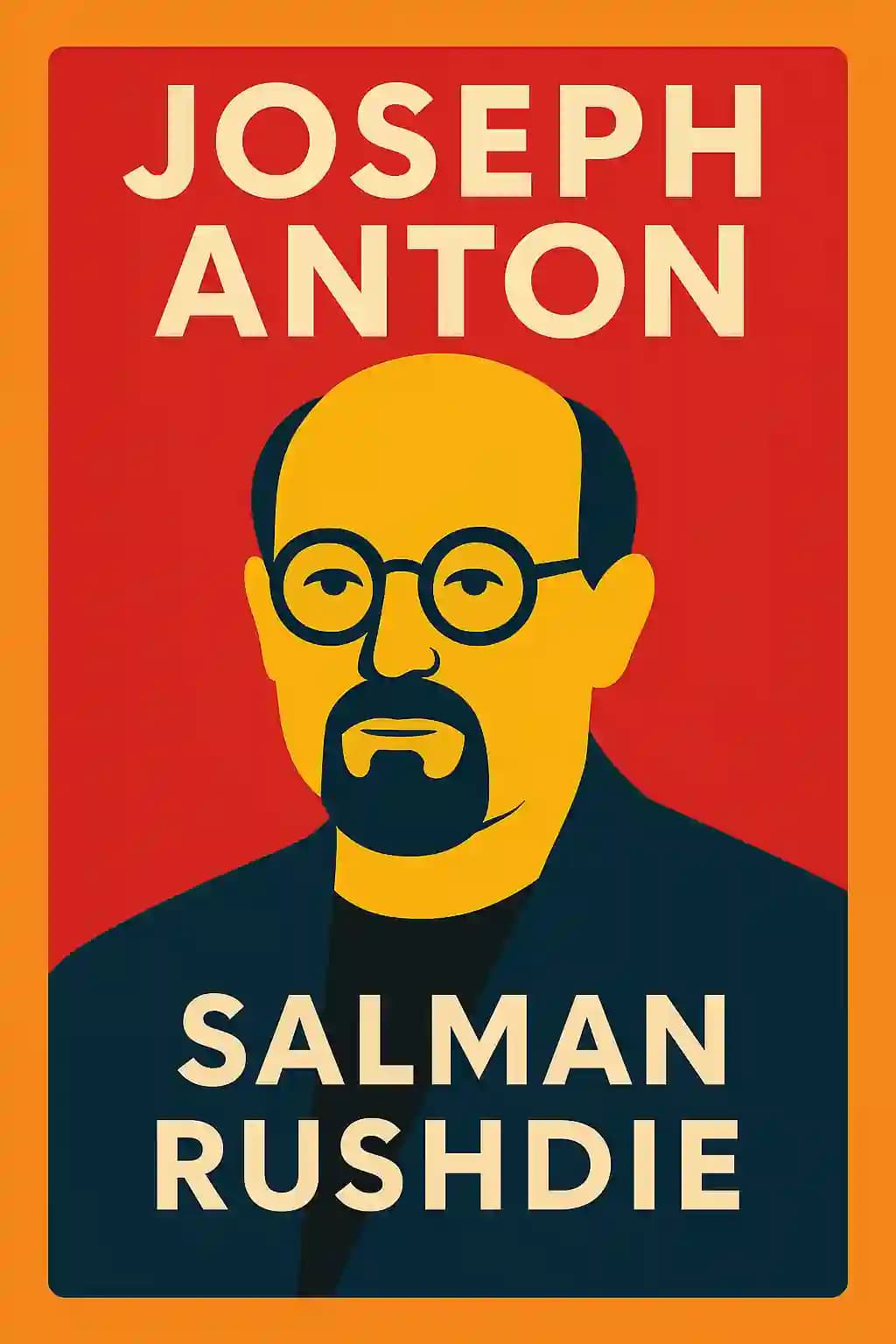
When Rushdie's "Satanic Verses" triggered a death sentence from Iran's Ayatollah, he vanished into "Joseph Anton" - his pseudonym and memoir of nine years in hiding. What price for free expression? The book Michiko Kakutani called "a palpable sense" of living under fatwa.
Salman Rushdie, the Booker Prize-winning author of Joseph Anton: A Memoir, is a seminal figure in contemporary literature renowned for his mastery of magical realism and allegorical storytelling. Born in Bombay in 1947 and educated at Cambridge, Rushdie’s works blend historical insight with fantastical narratives to explore themes of identity, migration, and political upheaval.
His works include Midnight’s Children (winner of the Booker Prize and later the “Best of the Booker”) and The Satanic Verses. His memoir Joseph Anton—named for the pseudonym he adopted during the decade-long fatwa issued against him in 1989—chronicles his life under threat, offering a gripping reflection on free speech and resilience.
A prolific writer, Rushdie’s later novels like The Golden House and Victory City continue to cement his legacy as a global literary voice. His works have been translated into over 40 languages, with Midnight’s Children adapted into a film and stage production.
In 2023, he released Knife: Meditations After an Attempted Murder, detailing his recovery from a 2022 attack, further underscoring his enduring influence and courage.
Joseph Anton: A Memoir chronicles Salman Rushdie’s life under a fatwa issued after his novel The Satanic Verses (1988) sparked global controversy. Using the pseudonym “Joseph Anton” (inspired by Joseph Conrad and Anton Chekhov), Rushdie details his nine years in hiding, armed police protection, and battles for free speech. The memoir explores resilience, creativity under duress, and the clash between religious fundamentalism and artistic freedom.
This book appeals to readers interested in literary freedom, modern political history, and memoirs of survival. Fans of Rushdie’s novels, advocates for free expression, and those exploring tensions between secularism and religious authority will find it compelling. It also offers insights for writers grappling with censorship or identity crises under external threats.
Yes—Rushdie’s candid account blends personal vulnerability with sharp critiques of ideological extremism. Its exploration of creativity amid danger and unflinching defense of free speech remain urgent in today’s climate. However, its length (over 600 pages) and dense political debates may challenge casual readers.
Rushdie adopted “Joseph Anton” as an alias during his hiding, combining the names of writers Joseph Conrad and Anton Chekhov. The title reflects his dual identity: a private man (“Salman”) versus a public symbol (“Rushdie”) of free speech.
The memoir frames Rushdie’s ordeal as a pivotal moment for global free expression, highlighting government hesitancy, media sensationalism, and intellectual solidarity. Rushdie argues that suppressing art to avoid offense enables authoritarianism, asserting literature’s right to challenge dogma.
Despite threats, Rushdie published Haroun and the Sea of Stories (1990), Imaginary Homelands (1991), The Moor’s Last Sigh (1995), and The Ground Beneath Her Feet (1999). These works showcase his continued creativity and thematic focus on displacement and cultural hybridity.
He candidly discusses turbulent marriages, estrangement from his son Zafar, and friendships with writers like Martin Amis and Christopher Hitchens. The memoir contrasts his private struggles with his public role as a “cause célèbre”.
Rushdie uses third-person narration to separate his lived experience from the mythologized “Rushdie” persona. This stylistic choice underscores the dislocation between his humanity and the politicized symbol he became.
Some reviewers note excessive detail about bureaucratic battles and uneven pacing. Others argue it sidesteps deeper introspection about the Satanic Verses controversy’s cultural impact, prioritizing polemics over self-analysis.
The memoir’s themes—cancel culture, religious intolerance, and “offense” as censorship—mirror modern conflicts over expression. Rushdie’s defense of art’s right to provoke remains a benchmark in discussions about creative liberty.
“A poem cannot stop a bullet. A novel can’t defuse a bomb. But good art can change the world by changing what people know, see, and feel.” This line encapsulates Rushdie’s belief in literature’s power to challenge oppressive narratives.
Unlike his magical realist fiction, this memoir is grounded in stark reality but retains his lyrical prose. It complements Imaginary Homelands (essays on migration and identity) and The Satanic Verses (the controversy’s origin point).
저자의 목소리로 책을 느껴보세요
지식을 흥미롭고 예시가 풍부한 인사이트로 전환
핵심 아이디어를 빠르게 캡처하여 신속하게 학습
재미있고 매력적인 방식으로 책을 즐기세요
"It doesn't feel good," he replied simply, thinking to himself, "I'm a dead man."
"I'm a dead man."
his novel "must perform the crisis it describes."
"Where they burn books they will in the end burn people too."
"How fragile civilization is," he wrote, "how easily, how merrily a book burns!"
Joseph Anton의 핵심 아이디어를 이해하기 쉬운 포인트로 분해하여 혁신적인 팀이 어떻게 창조하고, 협력하고, 성장하는지 이해합니다.
Joseph Anton을 빠른 기억 단서로 압축하여 솔직함, 팀워크, 창의적 회복력의 핵심 원칙을 강조합니다.

생생한 스토리텔링을 통해 Joseph Anton을 경험하고, 혁신 교훈을 기억에 남고 적용할 수 있는 순간으로 바꿉니다.
무엇이든 물어보고, 목소리를 선택하고, 진정으로 공감되는 인사이트를 함께 만들어보세요.

샌프란시스코에서 컬럼비아 대학교 동문들이 만들었습니다
"Instead of endless scrolling, I just hit play on BeFreed. It saves me so much time."
"I never knew where to start with nonfiction—BeFreed’s book lists turned into podcasts gave me a clear path."
"Perfect balance between learning and entertainment. Finished ‘Thinking, Fast and Slow’ on my commute this week."
"Crazy how much I learned while walking the dog. BeFreed = small habits → big gains."
"Reading used to feel like a chore. Now it’s just part of my lifestyle."
"Feels effortless compared to reading. I’ve finished 6 books this month already."
"BeFreed turned my guilty doomscrolling into something that feels productive and inspiring."
"BeFreed turned my commute into learning time. 20-min podcasts are perfect for finishing books I never had time for."
"BeFreed replaced my podcast queue. Imagine Spotify for books — that’s it. 🙌"
"It is great for me to learn something from the book without reading it."
"The themed book list podcasts help me connect ideas across authors—like a guided audio journey."
"Makes me feel smarter every time before going to work"
샌프란시스코에서 컬럼비아 대학교 동문들이 만들었습니다

Joseph Anton 요약을 무료 PDF 또는 EPUB으로 받으세요. 인쇄하거나 오프라인에서 언제든 읽을 수 있습니다.
On Valentine's Day 1989, a BBC reporter asked Salman Rushdie how it felt to be sentenced to death by Ayatollah Khomeini. "It doesn't feel good," he replied simply, while thinking, "I'm a dead man." This moment marked the beginning of an extraordinary saga - a novelist forced underground for over a decade, protected by armed guards, his very existence becoming a symbol in the global conflict between religious extremism and freedom of expression. "Joseph Anton" - Rushdie's alias during hiding, combining the names of Joseph Conrad and Anton Chekhov - chronicles this astonishing journey. Despite its grave subject matter, the memoir maintains Rushdie's characteristic wit and literary flair, offering both a political thriller and a deeply personal account of a writer determined to reclaim his life and identity.