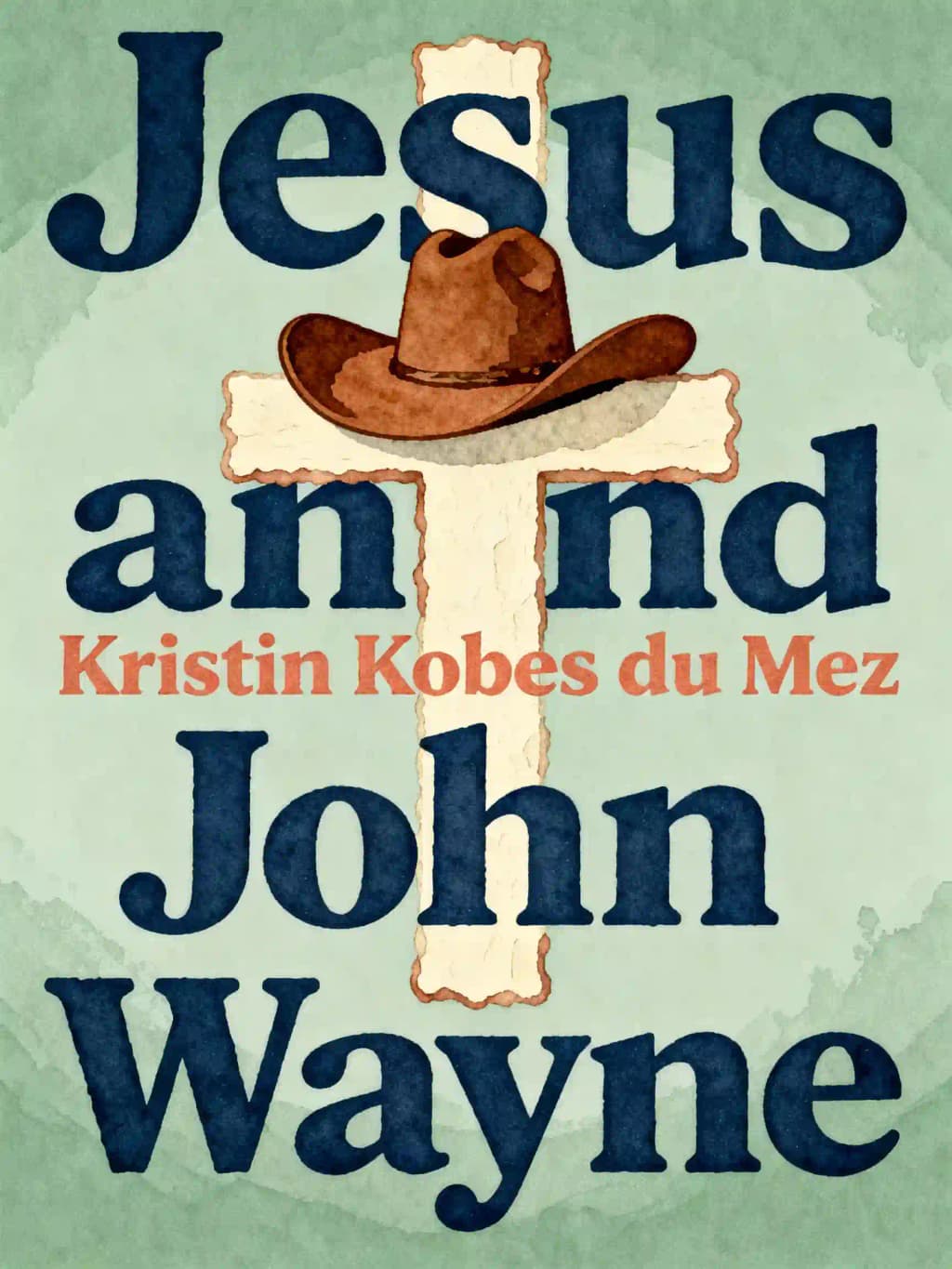
How did rugged masculinity and militant Christianity lead to Trump? This New York Times bestseller reveals how white evangelicalism traded Jesus for John Wayne, sparking controversy and earning praise as "paradigm-influencing" by Christianity Today. A shocking expose of faith corrupted by power.
Kristin Kobes Du Mez is the New York Times bestselling author of Jesus and John Wayne: How White Evangelicals Corrupted a Faith and Fractured a Nation and a professor of history and gender studies at Calvin University.
A historian specializing in the intersection of religion, gender, and politics in modern America, she holds a PhD in American history from the University of Notre Dame. Her work, including her earlier book A New Gospel for Women, critically examines evangelical culture and its societal impact.
Du Mez’s research has been featured in The Washington Post, NPR, and The Boston Globe, and she has written for outlets like The New York Times and NBC News. In 2024, she released the documentary For Our Daughters, which expands on her analysis of systemic issues within evangelical institutions.
Jesus and John Wayne reached #4 on the New York Times nonfiction paperback bestseller list and is widely regarded as a defining critique of Christian nationalism’s influence on American politics.
Jesus and John Wayne explores how white American evangelicals reconceptualized Christian masculinity over the 20th century, embracing militant ideals tied to figures like John Wayne and Donald Trump. Du Mez argues this shift corrupted theological integrity, normalized patriarchal authority, and fueled evangelical support for political leaders prioritizing power over piety.
This book is essential for readers examining evangelicalism’s ties to politics, gender roles, or Christian nationalism. Historians, theologians, and activists will gain insights into how militarized masculinity and cultural conservatism reshaped modern evangelical identity.
Yes. The book received critical acclaim, including the 2021 Orwell Award, for its rigorously researched analysis of evangelicalism’s ideological evolution. It clarifies why many white evangelicals supported Trump despite his moral controversies.
Du Mez contends that white evangelicals prioritized “rugged masculinity” over biblical teachings, fostering a culture of authoritarianism, militarism, and gender hierarchy. This framework, she argues, made Trump’s brutish persona palatable as a “defender” of evangelical values.
The book traces decades of evangelical leaders equating muscular leadership with divine mandate, framing Trump as a modern “John Wayne” figure who could protect traditional values against secular threats—even if his behavior conflicted with Christian ethics.
Prominent figures include John Wayne, Billy Graham, James Dobson, Mark Driscoll, and Donald Trump. Du Mez critiques their roles in promoting hyper-masculine theology and political alliances that prioritized cultural dominance.
The term describes an evangelical ideal merging physical toughness, patriarchal authority, and militant resolve. Du Mez shows how this replaced Jesus’s pacifist teachings with a warrior ethos aligned with American nationalism.
Some evangelicals argue Du Mez overemphasizes cultural trends over doctrinal theology or oversimplifies diverse evangelical viewpoints. Others reject her linkage between toxic masculinity and systemic issues like clergy abuse.
Du Mez documents how evangelical institutions promoted strict gender binaries, framing men as “warriors” and women as submissive helpers. This ideology, she argues, enabled abuses of power and suppressed women’s leadership.
The book covers Cold War militarism, the rise of megachurches, the “Promise Keepers” movement, and 21st-century political activism. These contexts show how evangelicals intertwined faith with conservative cultural battles.
The book is cited as a key resource for understanding evangelicalism’s role in eroding church-state separation. It highlights how theological rhetoric has been weaponized for partisan agendas.
The title contrasts Jesus’s teachings with John Wayne’s hyper-masculine archetype, symbolizing evangelicalism’s shift from spiritual humility to cultural combativeness. Du Mez argues this tension defines modern evangelical identity.
저자의 목소리로 책을 느껴보세요
지식을 흥미롭고 예시가 풍부한 인사이트로 전환
핵심 아이디어를 빠르게 캡처하여 신속하게 학습
재미있고 매력적인 방식으로 책을 즐기세요
Christianity was 'under siege.'
Graham trained 'like a prizefighter'.
Wayne never actually served in the military.
Boys needed guns and sports, while girls needed to learn submission.
Jesus and John Wayne의 핵심 아이디어를 이해하기 쉬운 포인트로 분해하여 혁신적인 팀이 어떻게 창조하고, 협력하고, 성장하는지 이해합니다.
Jesus and John Wayne을 빠른 기억 단서로 압축하여 솔직함, 팀워크, 창의적 회복력의 핵심 원칙을 강조합니다.

생생한 스토리텔링을 통해 Jesus and John Wayne을 경험하고, 혁신 교훈을 기억에 남고 적용할 수 있는 순간으로 바꿉니다.
무엇이든 물어보고, 목소리를 선택하고, 진정으로 공감되는 인사이트를 함께 만들어보세요.

샌프란시스코에서 컬럼비아 대학교 동문들이 만들었습니다
"Instead of endless scrolling, I just hit play on BeFreed. It saves me so much time."
"I never knew where to start with nonfiction—BeFreed’s book lists turned into podcasts gave me a clear path."
"Perfect balance between learning and entertainment. Finished ‘Thinking, Fast and Slow’ on my commute this week."
"Crazy how much I learned while walking the dog. BeFreed = small habits → big gains."
"Reading used to feel like a chore. Now it’s just part of my lifestyle."
"Feels effortless compared to reading. I’ve finished 6 books this month already."
"BeFreed turned my guilty doomscrolling into something that feels productive and inspiring."
"BeFreed turned my commute into learning time. 20-min podcasts are perfect for finishing books I never had time for."
"BeFreed replaced my podcast queue. Imagine Spotify for books — that’s it. 🙌"
"It is great for me to learn something from the book without reading it."
"The themed book list podcasts help me connect ideas across authors—like a guided audio journey."
"Makes me feel smarter every time before going to work"
샌프란시스코에서 컬럼비아 대학교 동문들이 만들었습니다

Jesus and John Wayne 요약을 무료 PDF 또는 EPUB으로 받으세요. 인쇄하거나 오프라인에서 언제든 읽을 수 있습니다.
When Donald Trump spoke at a small Christian college in Iowa in 2016, he didn't sound like a traditional Christian candidate. He boasted about his wealth, warned about immigrants, and claimed Christianity was "under siege." Despite his crude language and questionable morals, white evangelicals embraced him enthusiastically-81% would eventually vote for him. This wasn't a bizarre aberration or hypocritical compromise. It was the culmination of decades of evangelical culture-building that had gradually transformed Jesus from a gentle shepherd into a warrior king more reminiscent of John Wayne than the Sermon on the Mount. Trump's appeal to evangelicals wasn't despite his aggressive masculinity and authoritarian tendencies-it was precisely because of them. Over seventy-five years, evangelicals had constructed a militant masculine ideal through books, music, films, and consumer products that celebrated a particular vision of Christian manhood defined by toughness, authority, and willingness to use force in defense of faith, family, and nation.