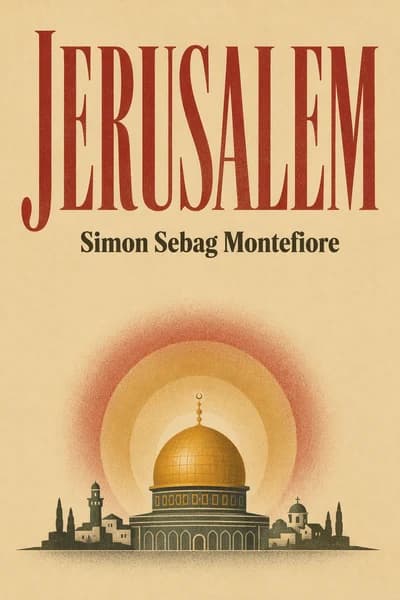
Jerusalem: 3,000 years of faith, blood, and power condensed into one masterful biography. Praised by Bill Clinton as 2011's best read, Montefiore's award-winning narrative reveals how one city became the battleground where history's greatest dramas - and humanity's deepest conflicts - continue to unfold.
Simon Sebag Montefiore is the internationally bestselling historian and novelist behind Jerusalem: The Biography, a landmark work exploring the sacred city’s tumultuous 3,000-year legacy. A Cambridge-educated historian with a PhD on Catherine the Great, Montefiore specializes in epic narratives that bridge political intrigue, dynastic sagas, and religious conflicts.
His acclaimed biographies—The Romanovs and Stalin: The Court of the Red Tsar—have won prestigious awards including the Costa Biography Award and British Book Awards History Book of the Year, solidifying his reputation for meticulous research and vivid storytelling.
A Fellow of the Royal Society of Literature, Montefiore has hosted BBC documentary series on Jerusalem, Rome, and Istanbul, bringing historical scholarship to global audiences. His Moscow Trilogy novels, including Sashenka and One Night in Winter, intertwine fictional drama with authentic historical detail. Translated into 48 languages, Jerusalem: The Biography became a #1 Sunday Times bestseller and won the Jewish Book Council’s Book of the Year, with over 600,000 copies sold in China alone.
Jerusalem: The Biography chronicles the 3,000-year history of Jerusalem through wars, empires, and religious transformations. Simon Sebag Montefiore uses vivid storytelling to explore how this city became a holy site for Judaism, Christianity, and Islam, highlighting pivotal figures like King David, Herod, and Saladin. The book spans from ancient times to the 1967 Six-Day War, emphasizing its role as a contested spiritual and political symbol.
This book is ideal for history enthusiasts, readers interested in Middle Eastern geopolitics, and those curious about interfaith dynamics. Its narrative style appeals to both academics and general audiences, though its dense detail may challenge casual readers. Fans of Montefiore’s prior works, such as The Romanovs, will appreciate his immersive approach.
Yes, for its sweeping scope and balanced perspective. Montefiore avoids partisan takes, instead weaving archival research and personal anecdotes into a gripping chronicle. Critics praise its readability despite the complex subject, though some note limited analysis of modern conflicts. At 600+ pages, it’s a commitment but rewarding for understanding Jerusalem’s enduring legacy.
Montefiore uses a chronological narrative, focusing on people—kings, prophets, conquerors—who shaped Jerusalem. He prioritizes factual storytelling over theological debates, drawing on family archives, archaeological findings, and primary sources. This method avoids modern biases, offering a mosaic of conquests, love stories, and spiritual quests.
The book begins with King David’s reign (circa 1000 BCE) and ends with Israel’s 1967 capture of East Jerusalem. An epilogue touches on contemporary tensions but avoids detailed political analysis. Key eras include Roman rule, Islamic caliphates, Crusader kingdoms, and Ottoman governance, illustrating the city’s cyclical destruction and rebirth.
Yes, Montefiore examines Judaism, Christianity, and Islam without favoring one. He details how each faith’s myths and rituals intertwined with Jerusalem’s identity, from the Temple Mount’s significance to Jesus’ crucifixion and Muhammad’s Night Journey. The book underscores how religious rivalries fueled conflicts but also fostered moments of coexistence.
As a descendant of Sir Moses Montefiore, a 19th-century Jewish philanthropist linked to Jerusalem, the author incorporates family letters and historical ties. This personal connection adds depth, though he maintains objectivity, acknowledging the city’s “darkness” and contested narratives in interviews.
Some readers find its length daunting and note superficial treatment of 20th-century politics. Others desire more analysis of current Israeli-Palestinian issues. Despite this, most praise its impartiality and ability to humanize historical figures.
Unlike academic texts, Montefiore’s narrative emphasizes drama and biography over theory. It’s broader in scope than Karen Armstrong’s Jerusalem: One City, Three Faiths, blending scholarship with accessible prose. The focus on vivid characters (e.g., Cleopatra, Churchill) sets it apart.
He draws on ancient texts, Ottoman archives, family papers, and modern scholarship. Archaeological discoveries, like Herod’s inscriptions, and interviews with experts enrich the account. This multidisciplinary approach lends authority to his portrait of Jerusalem’s evolution.
Montefiore explains how its association with biblical prophecy (e.g., David’s covenant, Jesus’ resurrection, Muhammad’s ascent) made it a divine “portal” for Jews, Christians, and Muslims. Control of Jerusalem symbolized spiritual legitimacy, attracting pilgrims and conquerors alike.
저자의 목소리로 책을 느껴보세요
지식을 흥미롭고 예시가 풍부한 인사이트로 전환
핵심 아이디어를 빠르게 캡처하여 신속하게 학습
재미있고 매력적인 방식으로 책을 즐기세요
Jerusalem is like 'an old nymphomaniac who squeezes her lovers dry and then turns them into orphans.'
David's genius lay in transforming this practical acquisition into something transcendent.
This golden age proved fleeting.
This disaster-the 'abomination of desolation'-should have ended Jerusalem's story.
The city became what scholar Simon Schama calls a 'portable homeland,' carried in memory and text.
Jerusalem의 핵심 아이디어를 이해하기 쉬운 포인트로 분해하여 혁신적인 팀이 어떻게 창조하고, 협력하고, 성장하는지 이해합니다.
Jerusalem을 빠른 기억 단서로 압축하여 솔직함, 팀워크, 창의적 회복력의 핵심 원칙을 강조합니다.

생생한 스토리텔링을 통해 Jerusalem을 경험하고, 혁신 교훈을 기억에 남고 적용할 수 있는 순간으로 바꿉니다.
무엇이든 물어보고, 목소리를 선택하고, 진정으로 공감되는 인사이트를 함께 만들어보세요.

샌프란시스코에서 컬럼비아 대학교 동문들이 만들었습니다
"Instead of endless scrolling, I just hit play on BeFreed. It saves me so much time."
"I never knew where to start with nonfiction—BeFreed’s book lists turned into podcasts gave me a clear path."
"Perfect balance between learning and entertainment. Finished ‘Thinking, Fast and Slow’ on my commute this week."
"Crazy how much I learned while walking the dog. BeFreed = small habits → big gains."
"Reading used to feel like a chore. Now it’s just part of my lifestyle."
"Feels effortless compared to reading. I’ve finished 6 books this month already."
"BeFreed turned my guilty doomscrolling into something that feels productive and inspiring."
"BeFreed turned my commute into learning time. 20-min podcasts are perfect for finishing books I never had time for."
"BeFreed replaced my podcast queue. Imagine Spotify for books — that’s it. 🙌"
"It is great for me to learn something from the book without reading it."
"The themed book list podcasts help me connect ideas across authors—like a guided audio journey."
"Makes me feel smarter every time before going to work"
샌프란시스코에서 컬럼비아 대학교 동문들이 만들었습니다

Jerusalem 요약을 무료 PDF 또는 EPUB으로 받으세요. 인쇄하거나 오프라인에서 언제든 읽을 수 있습니다.
Jerusalem exists twice-once on earth and once in heaven. For three millennia, this modest town in the Judean hills has captivated humanity's imagination, becoming the most contested real estate on earth. When David captured the Jebusite fortress around 1000 BCE, it was already ancient-Egyptian texts mentioned "Rushalimum" centuries earlier. The small mountain stronghold was valuable for its defensible position and access to the Gihon Spring, the region's only reliable water source. David's genius transformed this practical acquisition into something transcendent. By bringing the Ark of the Covenant to Jerusalem, he made the city sacred. In a famous scene that scandalized his wife Michal, David danced ecstatically before the Ark "with all his might," wearing only a linen ephod. This public display established Jerusalem as both political capital and spiritual center. Rather than slaughtering the conquered Jebusites, David incorporated them into his administration, establishing a pattern of cultural synthesis that would characterize Jerusalem throughout history. His court included Hittites, Moabites, and Philistines alongside Israelites. Though modest in size-covering just nine acres-this settlement represented something revolutionary: the first city established primarily for religious significance rather than economic or strategic value.