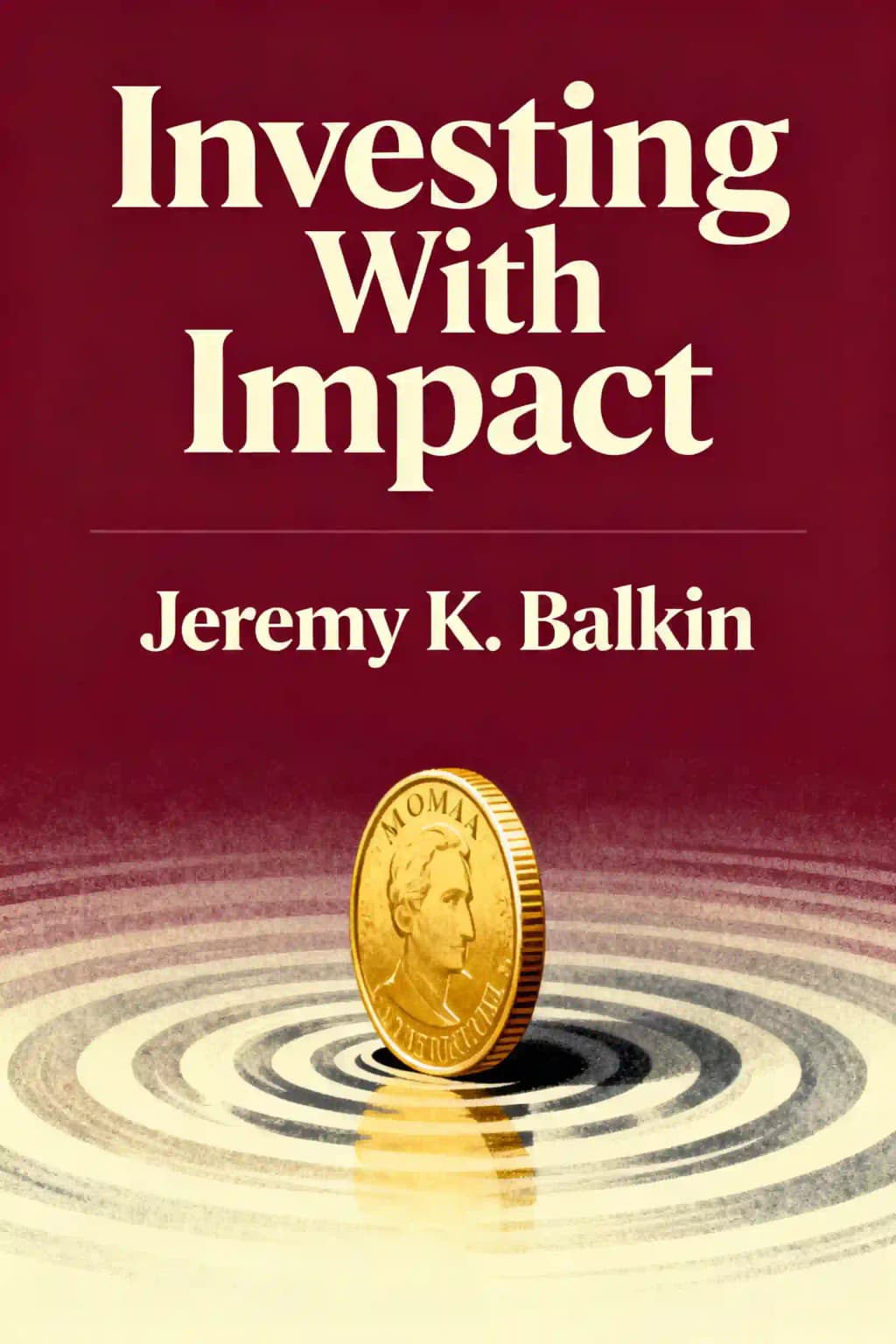
In "Investing With Impact," JPMorgan's Jeremy Balkin - dubbed "the Anti-Wolf of Wall Street" - reveals how finance can transform society through his revolutionary '6E Paradigm.' Can ethical investing actually outperform traditional models? Wall Street's moral compass might surprise you.
Jeremy K. Balkin, award-winning author of Investing with Impact: Why Finance is a Force for Good, is a globally recognized authority on ethical banking and fintech innovation. A senior executive at JPMorgan Chase leading their global fintech strategy, Balkin combines two decades of financial industry experience with a mission to transform capitalism into an engine for social good. His insights stem from spearheading digital payment innovations at major institutions like HSBC and advising organizations ranging from the United Nations to the Samsung Council for Emerging Technology.
Balkin’s work, including his acclaimed follow-up Millennialization of Everything: How to Win When Millennials Rule the World, redefines finance’s role in solving global challenges. His viral TED Talk on ethical banking has garnered over 250,000 views, and he frequently delivers keynotes at forums like Davos and Harvard Business School. Investing with Impact earned the 2016 Axiom Business Book Awards Gold Medal for Business Ethics, solidifying its status as essential reading for professionals seeking to align profit with purpose.
Investing With Impact provides a roadmap for aligning financial goals with social responsibility, arguing that finance can drive positive global change. It covers socially responsible investing (SRI) basics, advanced strategies like shareholder activism, and frameworks like Balkin’s 6 E Paradigm to balance profit with societal impact. The book emphasizes using capital allocation to address environmental, educational, and ethical challenges.
This book is ideal for investors seeking ethical strategies, finance professionals exploring SRI, and millennials interested in values-driven wealth building. It’s also valuable for policymakers studying social impact bonds or corporate leaders aiming to integrate sustainability into business models.
Yes—it won the 2016 Axiom Business Book Award and International Book Award for its actionable insights into ethical finance. Praised by figures like Arianna Huffington, it blends academic rigor with real-world examples, such as using impact investing to improve literacy rates via social impact bonds.
Key ideas include:
The book advocates using ownership stakes to push companies toward ethical practices, such as reducing carbon footprints or improving labor policies. Balkin provides case studies on filing shareholder resolutions and engaging boards to align corporate goals with societal well-being.
Balkin is a fintech innovator and former Global Head of Innovation at J.P. Morgan Payments. A Harvard Kennedy School alumnus, he’s known for TED Talks on ethical capital allocation and coining the phrase “Payments are eating the world.” His work has been featured in The Huffington Post and at Davos.
Balkin highlights millennials’ preference for values-aligned portfolios, urging them to prioritize companies with ESG (environmental, social, governance) metrics. He argues this demographic’s investing power can reshape markets toward sustainability.
This framework expands impact investing by evaluating opportunities based on Ethics, Education, Environment, Equality, Employment, and Economic growth. It helps investors identify ventures that deliver financial returns while addressing systemic issues like climate change or income disparity.
While both books target millennials, Investing With Impact focuses on finance’s role in social change, whereas Millennialization examines broader cultural shifts. Balkin ties both themes together, showing how ethical investing aligns with millennial values like transparency and sustainability.
Some argue the book oversimplifies balancing profit and impact, particularly in volatile markets. Critics note Balkin’s corporate background may downplay systemic barriers to ethical investing, though he acknowledges challenges like greenwashing.
The book suggests aligning job choices with employers’ ESG commitments, such as working for firms prioritizing renewable energy or fair wages. Balkin emphasizes that career-driven capital (e.g., 401(k) investments) can amplify personal impact.
With rising demand for ESG compliance and AI-driven impact metrics, Balkin’s strategies help navigate trends like carbon credit trading and blockchain-based transparency tools. The book’s focus on systemic change resonates amid climate crises and social equity movements.
저자의 목소리로 책을 느껴보세요
지식을 흥미롭고 예시가 풍부한 인사이트로 전환
핵심 아이디어를 빠르게 캡처하여 신속하게 학습
재미있고 매력적인 방식으로 책을 즐기세요
This wasn't merely a financial crisis but a morality crisis.
Banks symbolize trust.
Human morality does.
Wall Street faces an adapt-or-decline ultimatum.
Humans universally desire to live a life of meaning.
Investing with Impact의 핵심 아이디어를 이해하기 쉬운 포인트로 분해하여 혁신적인 팀이 어떻게 창조하고, 협력하고, 성장하는지 이해합니다.
Investing with Impact을 빠른 기억 단서로 압축하여 솔직함, 팀워크, 창의적 회복력의 핵심 원칙을 강조합니다.

생생한 스토리텔링을 통해 Investing with Impact을 경험하고, 혁신 교훈을 기억에 남고 적용할 수 있는 순간으로 바꿉니다.
무엇이든 물어보고, 목소리를 선택하고, 진정으로 공감되는 인사이트를 함께 만들어보세요.

샌프란시스코에서 컬럼비아 대학교 동문들이 만들었습니다
"Instead of endless scrolling, I just hit play on BeFreed. It saves me so much time."
"I never knew where to start with nonfiction—BeFreed’s book lists turned into podcasts gave me a clear path."
"Perfect balance between learning and entertainment. Finished ‘Thinking, Fast and Slow’ on my commute this week."
"Crazy how much I learned while walking the dog. BeFreed = small habits → big gains."
"Reading used to feel like a chore. Now it’s just part of my lifestyle."
"Feels effortless compared to reading. I’ve finished 6 books this month already."
"BeFreed turned my guilty doomscrolling into something that feels productive and inspiring."
"BeFreed turned my commute into learning time. 20-min podcasts are perfect for finishing books I never had time for."
"BeFreed replaced my podcast queue. Imagine Spotify for books — that’s it. 🙌"
"It is great for me to learn something from the book without reading it."
"The themed book list podcasts help me connect ideas across authors—like a guided audio journey."
"Makes me feel smarter every time before going to work"
샌프란시스코에서 컬럼비아 대학교 동문들이 만들었습니다

Investing with Impact 요약을 무료 PDF 또는 EPUB으로 받으세요. 인쇄하거나 오프라인에서 언제든 읽을 수 있습니다.
While twelve million people slept peacefully on September 15, 2008, the global financial system was imploding. The collapse of Lehman Brothers wasn't just a financial catastrophe-it was a moral failure that exposed the ethical bankruptcy at Wall Street's core. This wasn't merely a financial crisis but a morality crisis that would force us to reconsider capitalism itself. The aftermath revealed that twelve of America's thirteen most important financial institutions stood at the brink of failure, threatening to bring down the entire global economy. What went wrong? People misused institutional power in reckless pursuit of greed, causing disastrous socioeconomic consequences. Banks-symbols of trust and the foundation of our social contract-systematically eroded public confidence through predatory lending, deliberately complex financial instruments, and the knowing sale of toxic assets to unsuspecting investors. Richard Fuld became the visible face of this failure, collecting $484 million while leading Lehman Brothers to bankruptcy, epitomizing Wall Street's disconnect from Main Street. The path forward isn't about abandoning capitalism but reclaiming its essence as a force for human flourishing. Making money and doing good aren't mutually exclusive-they're symbiotic. The financial system doesn't need new labels like "inclusive capitalism" or "capitalism 2.0." Human morality needs repair.