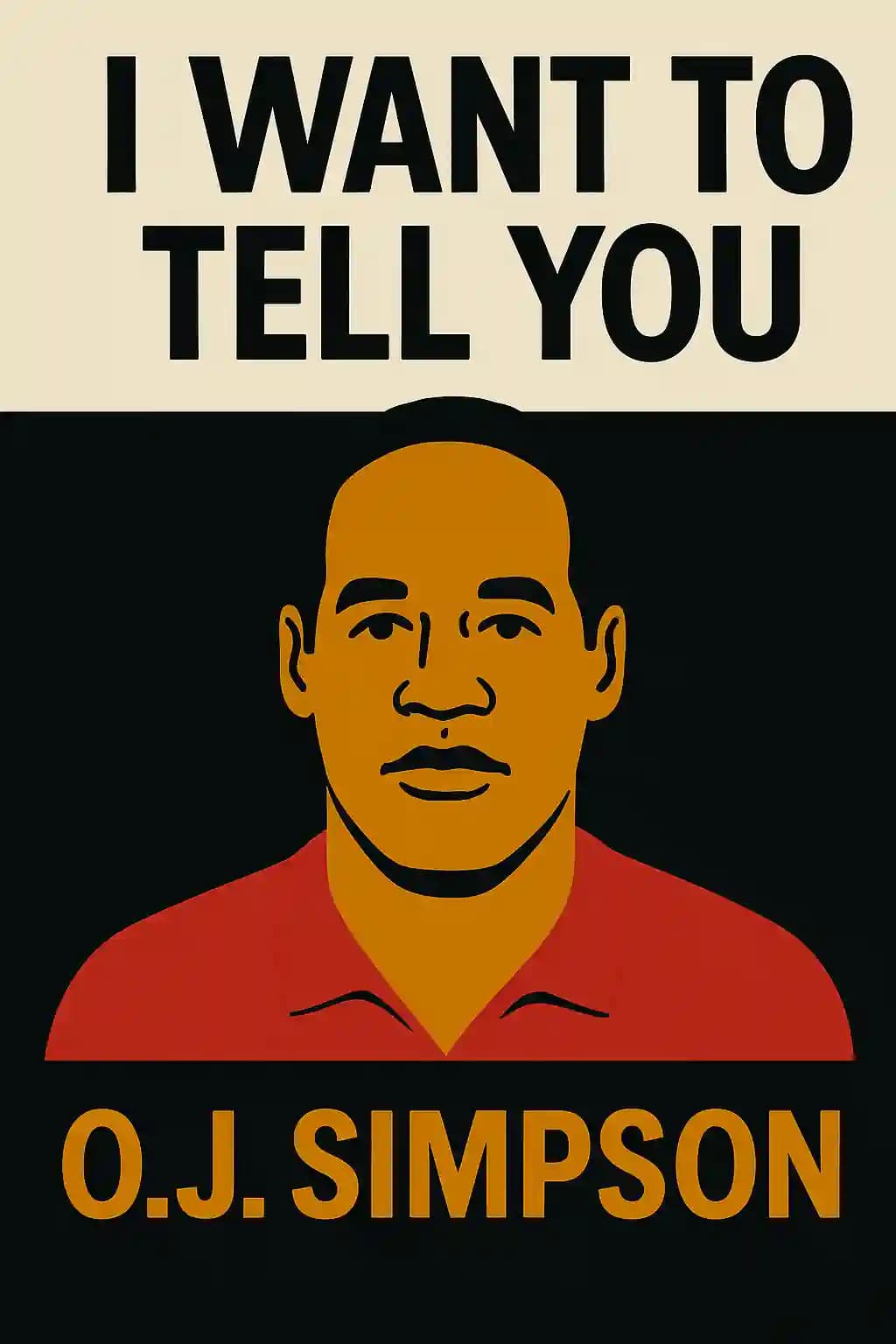
O.J. Simpson's mid-trial memoir answers 300,000 public letters, becoming an audiobook phenomenon despite controversy. When a 12-year-old fan wrote, "Even if you did kill them, I'd still be your fan," it revealed America's disturbing obsession with celebrity over justice.
Orenthal James Simpson (1947–2024), author of I Want to Tell You, was a Pro Football Hall of Fame running back and polarizing cultural figure. The book—a memoir penned during his 1994 murder trial—documents his perspective on media scrutiny and public judgment, themes rooted in his experience as a celebrity defendant.
Simpson’s athletic prestige included the 1968 Heisman Trophy, an unbroken NFL record of 143.1 rushing yards per game (1973), and roles in films like The Naked Gun franchise. His later controversial work, If I Did It, offered a hypothetical account of the events central to his trial.
Despite his 1995 acquittal, Simpson’s legacy remains inextricably tied to the trial that captivated global media. His football achievements, including induction into both the College and Pro Football Halls of Fame, contrast sharply with his later legal troubles, which included a 2008 armed robbery conviction. I Want to Tell You endures as a primary-source narrative from one of America’s most debated public figures.
"I Want to Tell You" is O.J. Simpson's first public response after his 1994 arrest for the murders of Nicole Brown Simpson and Ronald Goldman. The book juxtaposes Simpson’s personal commentary and reflections with letters from over 300,000 supporters, addressing his innocence, relationship with Nicole, parenting, media scrutiny, and racism. It frames itself as an "emotional and factual self-portrait" of his mindset during incarceration.
This book targets true crime enthusiasts, students of high-profile legal cases, or those analyzing Simpson’s shifting narratives. Readers interested in media manipulation, celebrity trials, or the psychology of denial will find value. However, it offers minimal insight for casual readers due to its self-serving tone and factual inconsistencies.
Only for academic or case-specific research. The book lacks substantive revelations and is widely criticized as a financial ploy. Its portrayal of Simpson’s "loving" marriage to Nicole starkly contradicts his later hypothetical murder confession in If I Did It, exposing glaring credibility issues. Libraries—not purchases—are recommended for access.
Simpson depicts Nicole as a devoted mother and partner, calling their marriage "full of love" and praising her parenting. This contrasts sharply with If I Did It, where he labels her "unstable" and "coked-out". The discrepancy between both books underscores Simpson’s unreliable narratives.
Critics highlight Simpson’s evasive language—he states, "I want to state that I did not commit these crimes" but avoids direct denials like "I didn’t kill them". His refusal to engage with the term "kill" and the book’s financial motive ("The second reason is financial") further undermine credibility.
I Want to Tell You (1995) portrays Simpson as a victim of injustice and Nicole as an ideal partner, while If I Did It (2007) hypothesizes the murders and vilifies her. Reading both exposes irreconcilable narratives: one romanticizes their marriage; the other implies her instability provoked violence.
Key themes include:
The structure alternates Simpson’s jail-cell reflections with curated fan letters, framing him as a misunderstood figure. This design implicitly contrasts public sympathy with legal accusations, serving his narrative of persecution.
Simpson denies guilt generically ("I did not commit these horrible crimes") but never explicitly denies killing Nicole or Goldman. When responding to letters accusing him of murder, he substitutes "kill" with vague phrases like "do such a thing," revealing linguistic evasion.
The text exemplifies crisis management in celebrity scandals, showing how public figures curate sympathetic narratives. Its contradictions with If I Did It also offer case studies in manipulative storytelling. For researchers, it underscores how high-profile defendants leverage media to sway opinion.
Simpson critiques the justice system’s "racism" and media bias while sidestepping case specifics. He frames himself as a target of public hysteria, writing, "I’m judged before the trial even starts"—shifting focus from evidence to systemic grievance.
Ethical issues include profiting from tragedy (Simpson admits the "financial" motive) and manipulating reader empathy via cherry-picked letters. Critics argue it exploits Nicole and Goldman’s deaths for image rehabilitation.
저자의 목소리로 책을 느껴보세요
지식을 흥미롭고 예시가 풍부한 인사이트로 전환
핵심 아이디어를 빠르게 캡처하여 신속하게 학습
재미있고 매력적인 방식으로 책을 즐기세요
If they want to get you, they're going to get you.
I am one hundred percent not guilty.
I loved Nicole.
I'll never hear my children say 'Mommy' again.
I want to tell you의 핵심 아이디어를 이해하기 쉬운 포인트로 분해하여 혁신적인 팀이 어떻게 창조하고, 협력하고, 성장하는지 이해합니다.
I want to tell you을 빠른 기억 단서로 압축하여 솔직함, 팀워크, 창의적 회복력의 핵심 원칙을 강조합니다.

생생한 스토리텔링을 통해 I want to tell you을 경험하고, 혁신 교훈을 기억에 남고 적용할 수 있는 순간으로 바꿉니다.
무엇이든 물어보고, 목소리를 선택하고, 진정으로 공감되는 인사이트를 함께 만들어보세요.

샌프란시스코에서 컬럼비아 대학교 동문들이 만들었습니다
"Instead of endless scrolling, I just hit play on BeFreed. It saves me so much time."
"I never knew where to start with nonfiction—BeFreed’s book lists turned into podcasts gave me a clear path."
"Perfect balance between learning and entertainment. Finished ‘Thinking, Fast and Slow’ on my commute this week."
"Crazy how much I learned while walking the dog. BeFreed = small habits → big gains."
"Reading used to feel like a chore. Now it’s just part of my lifestyle."
"Feels effortless compared to reading. I’ve finished 6 books this month already."
"BeFreed turned my guilty doomscrolling into something that feels productive and inspiring."
"BeFreed turned my commute into learning time. 20-min podcasts are perfect for finishing books I never had time for."
"BeFreed replaced my podcast queue. Imagine Spotify for books — that’s it. 🙌"
"It is great for me to learn something from the book without reading it."
"The themed book list podcasts help me connect ideas across authors—like a guided audio journey."
"Makes me feel smarter every time before going to work"
샌프란시스코에서 컬럼비아 대학교 동문들이 만들었습니다

I want to tell you 요약을 무료 PDF 또는 EPUB으로 받으세요. 인쇄하거나 오프라인에서 언제든 읽을 수 있습니다.
In the summer of 1994, America became transfixed by what would become known as "the trial of the century." A beloved football legend, familiar face in Hertz commercials, and Hollywood actor found himself at the center of a double murder case that would forever alter how we understand celebrity, race relations, and media in America. Written while awaiting trial, "I Want To Tell You" emerged from O.J. Simpson's desire to respond to over 300,000 letters sent to him after his arrest. The book provides a rare glimpse into his thoughts during imprisonment and became an instant bestseller, with first-day sales exceeding 150,000 copies. Whether you believe in his innocence or guilt, this personal account offers a fascinating psychological portrait of a man whose fall from grace remains one of the most dramatic in American cultural history. What happens when someone who lived in the spotlight for decades suddenly finds himself in a very different kind of public scrutiny?