1장
The Beautiful Terrible Dance: Finding Grace in Life's Contradictions
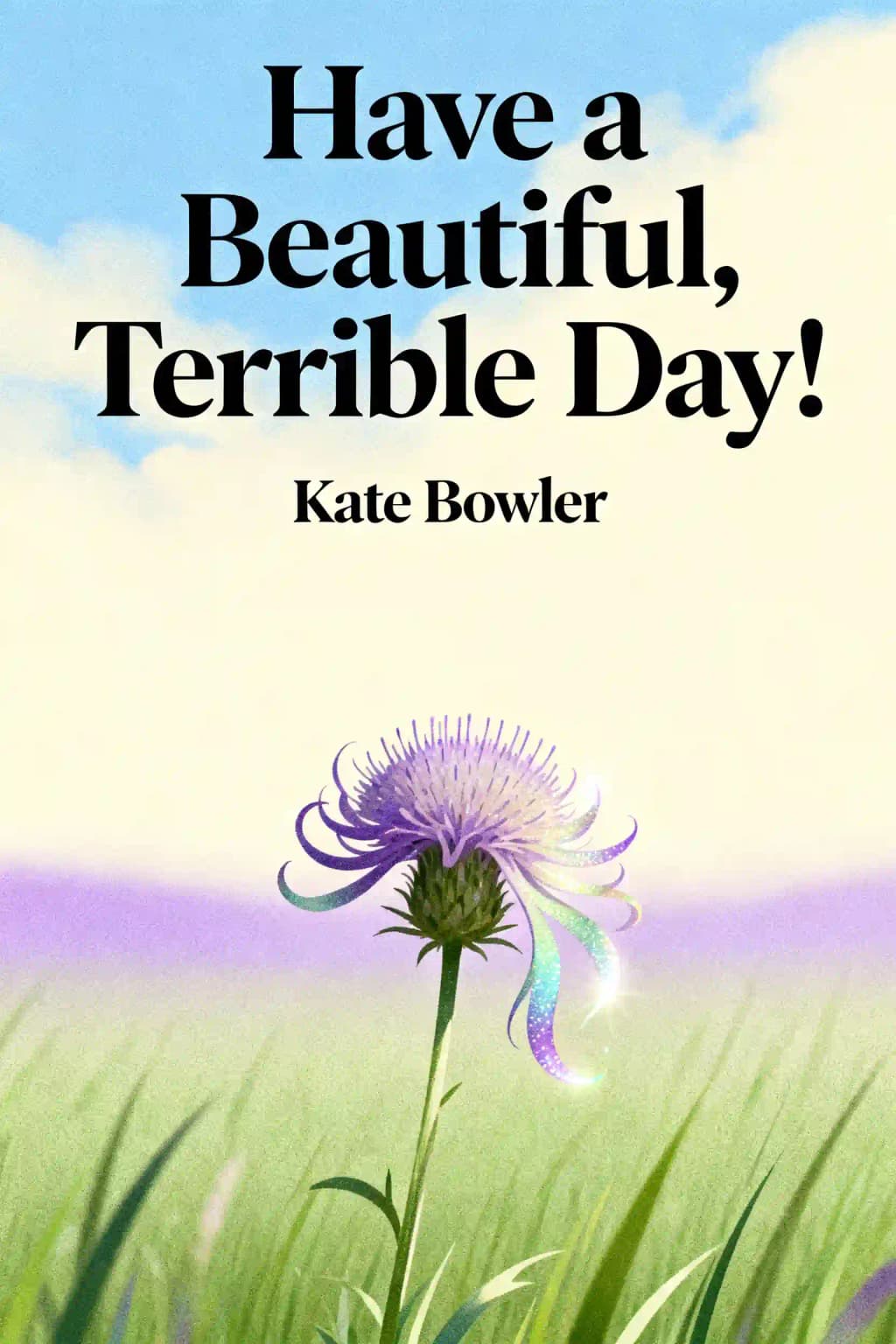
In a world that often demands we choose between joy and sorrow, Kate Bowler offers a revolutionary alternative: embrace them both. Her collection of blessings for beautiful, terrible days has resonated with readers seeking honest prayers that acknowledge life's contradictions rather than glossing over them. The book has become a touchstone for those navigating grief, anxiety, and uncertainty while still searching for meaning. Celebrities from Brene Brown to Glennon Doyle have praised Bowler's ability to articulate what most of us can only feel-that profound wisdom emerges when we stop trying to separate our experiences into neat categories of good and bad. As Bowler herself discovered through her own battle with Stage IV cancer, the most authentic spiritual life happens when we allow beauty and difficulty to coexist, creating a sacred space where both our vulnerability and resilience can flourish.
2장
Suspended Between Anxiety and Gratitude
We live suspended between anxiety and gratitude, nodding at bad news headlines while still marveling at sunsets. Our moods swing between tight jitteriness and thawed awe as we navigate a world where both worry and wonder coexist. Those middle-of-the-road feelings have vanished, replaced by unpredictable currents carrying us through stomach-clenching drops and soaring views. We are simultaneously feathers and stone.
This emotional rollercoaster stems from three varieties of fear shaping our experience. First, apocalyptic awareness-we witness the increasing fragility of structures supporting our lives: weakening democracy, environmental erosion, racial injustice, institutional mistrust. "Apocalyptic" feels destructive and terrifying but also means "that which is revealed." We glimpse catastrophic possibilities and simultaneously want to look away while knowing we can't.
Second, anxious awareness-most of us wear anxiety like a second skin, constantly questioning what could happen and second-guessing our choices. Our thoughts loop endlessly: What do others think? What should I do? What did I do wrong? How can I stay safe? We feel perpetually exposed, understanding vigilance intimately and feeling naked without it.
Third, painful awareness-some face fear locked inside their bodies through physical and emotional pain that threatens to wash them away. While others chitchat about weather, they barely have language for their experience. They try crying, talking, silence, sleeping, screaming-nothing works entirely, everything works a little. During brief moments of normalcy, they wonder: What is more real than this pain? What is truer about me than this?
Bowler wrote this book during a dark season of physical pain-lightning delivered intravenously, washing over her in waves. For about an hour each morning when her brain was clear, she wrote these blessings, unable to research or write longer works. She needed to place her faith alongside her reality of fear, pain, and fear of pain.
3장
The Gift of Awareness and Vulnerability
Being Christian doesn't mean dismissing fear but understanding it more intimately. When Bowler was twenty-five, she bought a bungalow with her husband despite their meager graduate student stipend. Her Mennonite family rebuilt the collapsing shed in their backyard. Years later, after her Stage IV cancer diagnosis, these same people showed up to build her a fence. She realized the shed would likely outlive her, and all her lovely plans had been stripped to the studs.
Before cancer, she believed she could quiet fear with tidy individualism and store-bought solutions. Now she understands our fundamental "facticity"-we are thrown into circumstances beyond our control, unwilling passengers rather than drivers. American culture values choice above all, celebrating those who are "self-made." But people with less independence often feel the shame of limitation. Even at her most durable, she should have seen how many people it took to build her life.
Our shared humanity is defined by our fragility-we're united in our vulnerability. None of us can truly afford the lives we have. American individualism and the self-help industry promised we could stand alone, but our dreams were built from toothpicks. We understand instinctively that we cannot win this game of solitaire. As Pastor Nadia Bolz-Weber discovered in AA, recovery requires community-"The Rowing Club" where sometimes we pull the oar and sometimes we must be willing to be carried.
There's a perfect word for our fragile, dependent state: precarity. From Latin meaning "obtained by entreaty or prayer," it describes a condition where we cannot achieve things alone but must rely on God or neighbor. Instead of pretending to be self-mastering winners, we can admit we're dependent beings who need help every few minutes. Dorothy Day received a letter from a Caribbean priest who wrote: "Here we want precarity in everything except the church." Their food distribution center was nearly collapsing, propped up by poles. "Someday it will fall on our heads and that will be funny," he said, refusing to stop feeding people to build a more secure church.
4장
The Miracle of Being Carried
In Luke 5, friends carry a paralyzed man to Jesus, and when blocked by crowds, dismantle a roof to lower him down. It's a miracle when we let ourselves be lowered into the unknown, admitting our fears. It's a miracle when we carry others' stretchers instead of worrying about groceries. And the greatest miracle is being the paralyzed man who walks out the door.
If Bowler is lucky, her shingles will last, chemotherapy will hold, and love will do most of the work. She'll look up through the gaping hole to the blue sky, no longer surprised by the fundamental Christian truth that the roof always, always caves in.
The blessings in this book are meant to calibrate our daily fears and anxieties. We want to be aware but not overwhelmed, allowing love to be more real than catastrophizing. These entries are meant to be thumbed through as needed-readers shouldn't feel bad about not reading them in order. The chapters are descriptively labeled so you can find themes matching your situation.
A few years ago during Lent, Bowler realized she needed a new way to say "Bless us in this new way of being," so she started saying, "Have a beautiful, terrible day!" It made her laugh and felt honest. So here's to beautiful, terrible days, with a blessing: "Blessed are we, the anxious, with eyes wide open to the lovely and the awful. Blessed are we, the aware, knowing the only sane thing is to admit our fear. Blessed are we, the hopeful, eyes searching the horizon, ready for the next miracle. Yes, blessed are we, the grateful, awake to this beautiful, terrible day."
5장
When Control Slips Through Our Fingers
When everything feels out of control, the sanest response is to admit it. Maybe your life genuinely is out of control with few choices. Let's breathe and repeat Paul's promises to the Romans: Nothing can separate you from God's love. Not death nor life. Not angels nor demons. Not present or future. No powers that rule. Nothing in creation. You remain in the center of God's love.
There was a time when we had a grip on things, decent plans, theories about keeping balance on this spinning planet. And then. And then. And then. Life shook us loose. We found ourselves hurtling through darkness we couldn't fathom (but surely it was there all along), truth echoing: we come undone, things fall, gravity itself fails.
At this speed, invitations to smell roses or welcome surprises sound dainty, belonging to another time. We're throwing an anchor into the ether-Lord, will you catch it? Tether it. Pull us into your orbit. Let our eyes adjust to the truth of this beautiful, terrible world we share. When the ground pitches and our stomachs lurch, convince us that the vastness of this universe is somehow a comfort, no matter how tiny our place.
This bounded space of today is a gift to hold with both hands, like a cherished face. We must let our thoughts be kind as we sweep over the hours ahead-the sights and sounds of our ridiculous, favorite people. Let us squirrel away each image as treasure. It's a trick learned in sadness: steal from the future and make it ours now, feeling every imaginable love to close the gap between time and space.
Without a soft gaze, we'll notice only laundry and thirty-four undelivered tasks. But when we see and hold it all as if our life had been cleaned, polished, then suddenly returned to us, we find happiness in these inconceivably precious hours. As the day begins, may all things ordinary and commonplace be translated into reminders that each is somehow shimmering.
6장
The Productivity Trap and the Pain of Presence
You could be working right now, but you're reading this instead. Perhaps you've confused doing something spiritual with being productive. Christianity will likely make your life less efficient, not more-we'll give away more money and time, root for losing teams, and hear God in the silence between tasks.
Our productivity is out of control, filling every second with tasks that make the next one work. Even our downtimes are scheduled so far in advance they can't anticipate real life. Oh, but the joy of knocking out a gazillion tasks! The thrill of racing around bases and sliding into the next one!
Are we made for this? Or has this gift begun to govern us? We need to slow down, though the thrumming in our hearts says we'll resist. We want to know what beautiful things surface between breaths. What we call inefficiency, might God call rest? What we consider time-wasting might be another path to virtue we can't define as we speed blearily to the finish.
There are days, weeks, even years where we feel lost to pain. The world becomes small, barely manageable, and tragically boring. Our future seems painted over in greasy black paint, options exhausted and others' goodwill depleted.
Pain-ours or others'-requires incredible work because solutions aren't obvious. Suffering endures after we've tried our best ideas. We need supernatural curiosity to ask: What works? What else can I try? Who can I ask?
We only have a minute before pain rushes in and washes us away. Did we have a personality before? Hobbies? Pain has come to live with us and there isn't room for both. It stops our movements, intrudes on thoughts, crowds days with ragged necessities, and robs sleep of tomorrow's hope. It steals from others too-we see the ache in loved ones' eyes before they hide it.
We're exhausted from this heavy lifting, running on borrowed energy. So we pray plainly: Please send help. Make the pain subside. Remind us of good questions: Is there something new to try? Who else can help? What old solution could work again? And meanwhile, give us strength for what we cannot avoid, then tuck us in when we're spent.
7장
The Judgment Reflex and the Marriage Mystery
We're living in a moment of little compassion for others' politics, drowning in disgust. Nurses teach us about overcoming judgment-they don't ask if patients caused their own illness or wonder if treating them puts themselves at risk. Instead, they cultivate tremendous empathy, tending to all regardless of who they are or what they've done.
Kids play on playgrounds without anyone asking who they voted for or whether they deserve compassion when they fall. We want to love what's good, act justly, love mercy, and walk humbly-but every soft opinion has calcified into someone else's certainty. All our bones are on the outside now.
We need saving from disdain, disgust, and algorithms that sort friends into demographics. We need spurring to swift action against broken systems that break people for profit. We need our rage quickened when it directs our best efforts, but never let us forget our deepest story is love.
One of the funniest things about meeting long-married people is how quickly they announce it. "I HAVE BEEN WITH LINDA FOR FORTY-FIVE YEARS!" Marriage requires making promises before knowing if we can follow through-declaring before witnesses that love conquers all when we may eventually feel conquered by circumstances instead.
We peer into the future and, seeing nothing much at all, decide we see ourselves there-older, changed, and loved. That takes tremendous courage and hope. However we've experienced marriage-as refuge or not, partnership or not-let's bless it. Unconditional love is rare. When we see it in ourselves or others, let's draw close like warming by a fire, learning about God's long covenants of love.
Marriage is sacred because we promise and God promises. We hold on to what holds us. Of all endeavors it is the most awe-inspiring and hardest to fulfill, for only after the wedding can the marriage begin. Every person is a foreign country, even to themselves. Marriage is an unveiling at the borderline where desires meet, where sharp corners chafe and are rubbed smooth. In married love, an old joke can be fully reconstituted with just one word or glance, no footnotes required. It's a miracle when we set aside our predictable self-sabotage for a love that brings us back to each other.
8장
The Hunger for Wholeness and the Pain That Endures
We always imagined that faith and goodness would stop the ache of want. That we'd refine our ambitions and sanctify our desires until we felt full. Isn't that the benefit of being Christian-self-satisfied bliss?
Perhaps it's more honest to admit we were born hungry and that hunger doesn't stop. Let's inventory what makes us feel incomplete. Is it friendship or love we want? A new dream? Release from addiction or limiting cycles?
When life's mess is strewn everywhere-laundry growing mildew, shoes all over the floor-we stare at the facts of our lives. These are the choices we made and those made for us. Friends might congratulate us on well-chosen loves and sacrifices, but here we are, somehow incomplete.
Sometimes our emptiness rings with a name. Someone gone, someone elsewhere. We'd starve if we let ourselves hunger, so instead we check email and run errands-playing checkers with our lives while the world plays chess. We need restoration of every contentment possible for creatures with numbered days. We need desires that make us reach for more of what brings life. We didn't invent hope. It was given to us. Now we must learn what to hope for.
In a Renaissance painting of Icarus drowning, the world continues undisturbed-a shepherd gazes at the sky while sheep graze, a ship sails away. As W.H. Auden noted, suffering "takes place while someone else is eating or opening a window or just walking dully along." This is the way of suffering-we're drowning while others look skyward, we're terrified while help sails in the opposite direction.
This pain threatens to carry us away. We drag air into our lungs, watching ourselves breathe, seeing ourselves from above as despair pulls us toward the rocks. We row without oars, knowing with sudden certainty that we can't endure much longer. The great deception is believing only this pain endures.
But Jesus reaches for us. He steadies us, repeating our names. He anchors this boat and slows the current. While we insist we'll never survive, he never poisons us with the lie that "God gives you what you can handle." Instead, he promises-an oath made in his blood-that this suffering will never outlast his love. We need to hear again about how love goes on forever. We need to hear truly about love stronger than even this.
9장
Learning to Rest in a World That Never Stops
We're not exactly a Sabbath culture. We're RUN AROUND IN EVERY DIRECTION people. Most of our running isn't even for ourselves-diaper pickup, doctor's appointments, did anyone remember milk? When we can't set work aside, we become like paper thinning to the touch.
It's not like we didn't know. Our bodies know it too. Rest. We were promised rest beyond relaxation, recreation, or exhausted sleep. Rest grounded in knowing we were never designed to carry it all, never meant to be the command center of the cosmos, never meant to solve everything or be left to our own devices for even one whole day.
As we stop, we feel our own beginning-that little sigh. We are made to rest. We need our hands held. We need to be led to that moment of pause like settling onto a park bench. This unfinished world was created with our unfinishedness in mind. We can write all our errands in the dirt beside our feet and let the wind chase them away. Here we are in another limited day, hemmed in by the inevitable panic of minutes and hours. So let's pause. What a thing, being brought here to steal moments together.
Envy is useless. It wearies us, distracts us, and is gratitude's archenemy. Yet isn't envy so understandable sometimes? Others have the relationships, health, and work we want. They have better looks, charisma, hair. Your friend was on an incredible trip while you were stuck with miserable problems.
Few admit to jealousy. We hide our envy, our achiness, our need for more. But noticing resentment can be a good sign-we're ready to examine it as a study in light and shadows. Our envy expresses our need, our hope that God might infuse our reality with more brilliance.
We've been propped on our toes, peering over fences but mostly staring at peeling paint. Hoping has become longing. Wanting has become needing. We see love everywhere but here. There's a naturalness to how others experience joys popping up like tender spring grasses. Their earth seems always warm, autumn seedlings breaking open to bring life everywhere. We chew our lips as neighbors roll their eyes at relationships, children, plans-gifts we would tear open like Christmas presents.
We need our hearts scattered like dandelions, drifting over these walls and settling where good things grow. Contentment and wonder, surprise and adventure, comfort in hands that know love's value and cost. Envy will blow away on another breeze as we wait here for the blooms.
10장
The Sacred Seasons: Finding Meaning in Lent and Advent
Lent marks the forty days leading to Jesus's death and resurrection, a practice begun in the fourth century to prepare Christians for the holiest, hardest days of their faith story.
During Lent, we ask God to show us the world as it truly is. We begin with the reality of our finitude marked on our foreheads on Ash Wednesday-from dust we came, to dust we'll return. Then we walk through a dress rehearsal of the Great Descent, the church descending to the depths with our savior.
Lent can become a favorite part of the church calendar. Suddenly, we're all on the losing team, looking at each other with wonder, horror, and awe, telling the truth: life is beautiful and hard for everyone. The cross isn't the end, but this grief season acknowledges Jesus's sacrifice. Our savior knew pain, grief, and despair, as do we. Easter is coming, but for now, we sit in our broken dreams' ashes, knowing God sits with us.
Many observe Lent by giving something up-alcohol, meat, chocolate, social media-or taking up something new, like a prayer practice. Perhaps your Lenten practice could simply be reading an entry from this book daily. Remember, you get Sundays off-little breaks to rest and celebrate even amid suffering. Holy Week culminates the Lenten journey, remembering Jesus's final days, death, and resurrection. Through Lent's hard truths, we practice spiritual honesty while awaiting God's promised future.
Advent, the four-week season leading to Christmas, is characterized by anticipation rather than the mixed anticipation and dread of Lent. It's "like watching a slow dawn" where God appears unexpectedly as a helpless child rather than a majestic ruler. Advent is a season of "charity and conscience and hospitality" that tells the story of an immigrant family finding no room, drawing on historical Christmas customs of social inversion where rich and poor, insider and outsider switch places. Advent's bittersweet nature reminds us of absent loved ones while offering blessings for the four Sundays-hope, love, joy, peace-plus Christmas Eve, Jesus's birth, Christmas Day, and Epiphany.
11장
Finding Beauty in the Terrible: A Spiritual Practice
Kate Bowler contrasts people with "an incredible eye for detail" like her mother-in-law who delights in highway landscaping with her own tendency toward inattention. She acknowledges her need to cultivate not just looking, but "beholding" the beauty around her.
Beauty sometimes "sneaks up on you" with a tenderness that "hurts." Beauty brings a kind of grief because "its perfection rings so true it calls out everything else that has ever fallen short." Yet this is simply the way of it: "beauty will always be crushingly lovely." We are reminded that "We are grass. We are fireflies. We are the day that the Lord has made."
Emily Dickinson knew the beauty of stillness, describing that moment of pause as when a soul is admitted into its own company-a "finite infinity." That quiet feels elusive to us. We ache to know our souls' calm, but also, isn't there something on Netflix? Let me check texts first. Soon we're swimming in notifications without direction. Nothing is more precious than our attention, yet we give it away without knowing its cost. In our attention economy, peace is the first casualty.
This is the moment-the microsecond pause before habitual override sends us into motion again, barreling ahead instead of paying attention to our bodies' limitations and the spirit's wisdom. We're in the blessed in-between, a transition phase that isn't anything yet. It's a pivot point we shouldn't waste with mindless scrolling or news checking.
Stop. Stay. This is the sacred space of nothing-yet, where we become aware something's pulling at us. We need to be present in these whirring seconds, at this tiny crossroads, slowing enough to wonder: Is that you tapping my shoulder? All right. I'm listening.