Can a 39-year-old neuroscientist with zero musical talent learn guitar? Gary Marcus's journey challenges everything we believe about innate talent, inspiring thousands to pick up instruments later in life. Featured in The New York Times bestseller list, it's the science of reinvention through music.
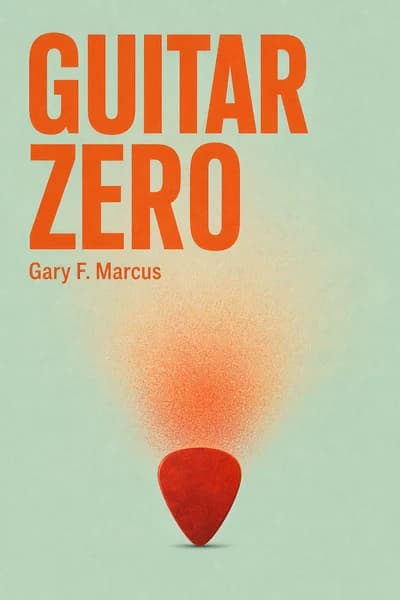
Gary Fred Marcus is a cognitive psychologist, neuroscientist, and New York Times bestselling author of Guitar Zero: The New Musician and the Science of Learning, which explores the neuroscience of musical mastery through his personal journey to learn guitar in midlife.
A professor emeritus at New York University and founder of machine learning startups Geometric Intelligence (acquired by Uber) and Robust.AI, Marcus bridges cognitive science with artificial intelligence in his work. His expertise in language acquisition and neural development—honored with the Robert L. Fantz Award—informs the book’s examination of adult skill acquisition, blending memoir with cutting-edge research on neuroplasticity.
Marcus’s acclaimed publications include Kluge: The Haphazard Construction of the Human Mind, analyzing evolutionary psychology’s quirks, and Rebooting AI: Building Artificial Intelligence We Can Trust, co-authored with Ernest Davis. A frequent contributor to The New Yorker and The New York Times, his insights on AI ethics and cognitive science have reached global audiences through TED Talks and NPR appearances. Guitar Zero has been celebrated as a paradigm-shifting work in understanding lifelong learning, securing its place on the New York Times Best Seller list while being cited in over 400 academic studies.
Guitar Zero explores cognitive psychologist Gary F. Marcus’s journey to learn guitar at age 39, blending memoir with neuroscience. It challenges myths about innate musical talent, emphasizing neuroplasticity, deliberate practice, and strategies like metronome training. The book examines how adults can master new skills through structured learning, interviews musicians, and analyzes music’s cognitive foundations—from rhythm perception to emotional expression.
Aspiring musicians, psychology enthusiasts, and lifelong learners seeking evidence-based insights into skill acquisition. Adults intimidated by learning instruments later in life will find actionable advice on overcoming challenges like rhythm deficiencies. Educators and cognitive science students gain perspective on memory, neural adaptation, and teaching methodologies.
Yes, for its unique blend of personal narrative and scientific rigor. Marcus’s relatable struggles (e.g., “congenital arrhythmia”) humanize research on auditory processing and motor skill development. Critics praise its accessibility, though some desire deeper technical neuroscience. The book’s takeaways on persistence and incremental progress resonate beyond music.
Unlike method-focused guides, Marcus prioritizes cognitive science, using guitar as a case study for broader skill acquisition. It contrasts with This Is Your Brain on Music by centering adult learners’ challenges. The book also integrates memoir, like Oliver Sacks’s works, while offering Suzuki-inspired teaching frameworks.
Some reviewers note uneven depth in neuroscientific explanations, prioritizing narrative over technical detail. Others question Marcus’s focus on吉他 over broader instrument applicability. However, its strengths in demystifying adult learning outweigh these gaps.
Marcus documents setbacks like botched performances and rhythmic “disasters,” framing them as essential for growth. He advocates for embracing plateau periods and using feedback loops (e.g., recording sessions) to refine technique.
Principles like chunking complex tasks (e.g., chord progressions) and spaced repetition transfer to language learning, sports, or coding. Marcus’s emphasis on “brain-friendly” pacing informs productivity and habit-forming strategies.
With AI reshaping education, its human-centric insights on motivation and tailored learning counter algorithm-driven platforms. The book’s neuroplasticity findings align with modern lifelong learning trends and anti-ageism in skill development.
A NYU psychology professor, cognitive scientist, and science communicator. Author of Kluge and The Birth of the Mind, he researches language, genetics, and neural development. His New Yorker essays and TED Talks bridge academia and public discourse.
Less technical than The Algebraic Mind but more personal than Kluge, it merges memoir with accessible science. Unlike his AI-focused works, Guitar Zero targets creative skill-building, though all share themes of cognitive adaptability.
저자의 목소리로 책을 느껴보세요
지식을 흥미롭고 예시가 풍부한 인사이트로 전환
핵심 아이디어를 빠르게 캡처하여 신속하게 학습
재미있고 매력적인 방식으로 책을 즐기세요
Are musicians born or made?
Effective learning happens in the 'zone of proximal development'.
Guitar captured his heart despite being brutally difficult.
Music is more learned than hardwired.
People like Theodore Roosevelt and Sigmund Freud lived perfectly normal lives despite being amusical.
Guitar zero의 핵심 아이디어를 이해하기 쉬운 포인트로 분해하여 혁신적인 팀이 어떻게 창조하고, 협력하고, 성장하는지 이해합니다.
Guitar zero을 빠른 기억 단서로 압축하여 솔직함, 팀워크, 창의적 회복력의 핵심 원칙을 강조합니다.

생생한 스토리텔링을 통해 Guitar zero을 경험하고, 혁신 교훈을 기억에 남고 적용할 수 있는 순간으로 바꿉니다.
무엇이든 물어보고, 목소리를 선택하고, 진정으로 공감되는 인사이트를 함께 만들어보세요.

샌프란시스코에서 컬럼비아 대학교 동문들이 만들었습니다
"Instead of endless scrolling, I just hit play on BeFreed. It saves me so much time."
"I never knew where to start with nonfiction—BeFreed’s book lists turned into podcasts gave me a clear path."
"Perfect balance between learning and entertainment. Finished ‘Thinking, Fast and Slow’ on my commute this week."
"Crazy how much I learned while walking the dog. BeFreed = small habits → big gains."
"Reading used to feel like a chore. Now it’s just part of my lifestyle."
"Feels effortless compared to reading. I’ve finished 6 books this month already."
"BeFreed turned my guilty doomscrolling into something that feels productive and inspiring."
"BeFreed turned my commute into learning time. 20-min podcasts are perfect for finishing books I never had time for."
"BeFreed replaced my podcast queue. Imagine Spotify for books — that’s it. 🙌"
"It is great for me to learn something from the book without reading it."
"The themed book list podcasts help me connect ideas across authors—like a guided audio journey."
"Makes me feel smarter every time before going to work"
샌프란시스코에서 컬럼비아 대학교 동문들이 만들었습니다

Guitar zero 요약을 무료 PDF 또는 EPUB으로 받으세요. 인쇄하거나 오프라인에서 언제든 읽을 수 있습니다.
Ever been told you're tone-deaf? Unmusical? Hopeless at rhythm? Gary Marcus heard all of this-and he's a Harvard-trained cognitive psychologist who should know better than to believe it. Yet at 38, after a lifetime of musical humiliation (picture a fourth-grader butchering "Hot Cross Buns" on the recorder), he did something audacious: he decided to learn guitar from scratch. Not dabble. Not noodle around. Actually *learn*-with the rigor of a scientist conducting an experiment on himself. What he discovered challenges everything we think we know about talent, age, and the supposed "windows" for learning complex skills. His journey became a landmark in music education, now studied at Juilliard and Berklee, because it asks a question that haunts millions of us: Is it ever too late to become who we might have been?