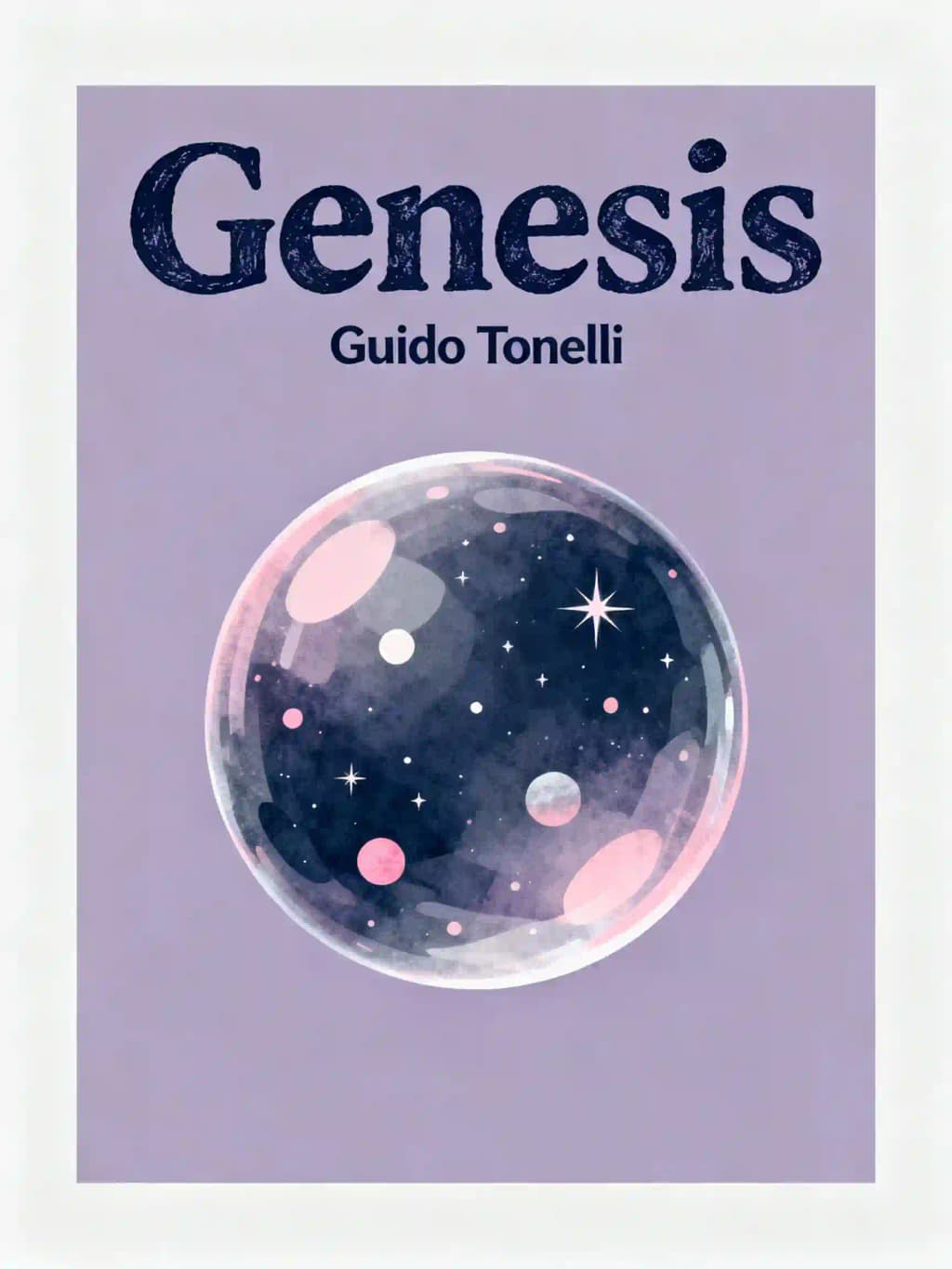
In "Genesis," Higgs boson discoverer Guido Tonelli brilliantly weaves scientific revelation with ancient mythology, explaining our universe's birth through the seven-day creation framework. This bestselling journey makes quantum physics accessible while honoring humanity's eternal quest to understand our cosmic origins.
Guido Tonelli, author of Genesis: The Story of How Everything Began, is an acclaimed Italian particle physicist and one of the leading scientists behind the Higgs boson discovery at CERN. A professor of general physics at the University of Pisa and visiting scientist at CERN, Tonelli merges groundbreaking research with philosophical inquiry in this exploration of cosmic origins.
Blending cosmology, particle physics, and existential themes, Genesis distills 13.8 billion years of universal evolution into a compelling narrative, informed by his frontline work at the Large Hadron Collider.
A decorated researcher awarded the Enrico Fermi Prize and the Special Breakthrough Prize in Fundamental Physics, Tonelli has authored multiple Italian bestsellers including La nascita imperfetta delle cose (The Imperfect Birth of Things) and Tempo. Il sogno di uccidere Chronos (Time: The Dream of Killing Chronos). His interdisciplinary approach extends to collaborations like the SciArt SwitzerlAnd initiative, bridging physics with cultural discourse. Genesis became an instant bestseller in Italy and has been translated into multiple languages, cementing Tonelli’s reputation as a master science communicator.
This book details the universe’s origins, starting with quantum fluctuations in a primordial void, the inflaton particle’s rapid expansion, and the Higgs boson’s critical role in creating mass. Tonelli combines cosmological milestones—like star formation and Earth’s emergence—with mythological parallels, presenting a sweeping scientific journey from the Big Bang to human existence.
Science enthusiasts, cosmology students, and general readers curious about the universe’s origins will find value. Tonelli’s accessible explanations of complex physics (e.g., Higgs boson mechanics) cater to non-specialists, while his integration of Greek mythology appeals to lovers of interdisciplinary narratives.
Yes—it’s an acclaimed bestseller praised for making cosmology engaging. Tonelli’s lucid prose and creative metaphors (e.g., comparing cosmic birth to Hesiod’s Theogony) simplify abstract concepts, though some may find technical sections dense. Ideal for readers seeking a scientifically grounded yet poetically framed origin story.
Key ideas include:
Tonelli, a lead Higgs boson researcher, describes it as the “cosmic architect”赋予particles mass. He contextualizes its discovery at CERN and its critical function in enabling matter aggregation—from atoms to galaxies—while debunking myths about its “God particle” nickname.
The framework mirrors creation myths but represents scientific phases: early universe formation, light emergence, galaxy development, and Earth’s birth. This structure bridges ancient storytelling and modern cosmology, emphasizing humanity’s timeless quest to understand origins.
Tonelli parallels Greek myths (e.g., Hesiod’s Chaos) with scientific theories like Georges Lemaître’s Big Bang. This approach highlights how ancient narratives and modern physics both seek to explain cosmic beginnings, fostering a dialogue between cultural heritage and empirical inquiry.
Central themes include:
Critics praise its lyrical prose and ability to simplify complex physics, though some note density in technical sections. Readers appreciate its interdisciplinary scope, with Publishers Weekly calling it a “visionary scientific account” and Goodreads reviewers highlighting its “lasting appeal” despite challenging passages.
It synthesizes recent advances like dark matter research and gravitational wave detection, contextualizing them within humanity’s quest to understand origins. Tonelli emphasizes tools like the Large Hadron Collider and super-telescopes as modern “creation myths” reshaping our cosmic narrative.
Some readers find sections on quantum mechanics and field theory overly technical for casual audiences. However, most agree Tonelli’s storytelling and analogies mitigate complexity, making it a compelling primer on cosmology.
While both simplify complex concepts, Genesis uniquely interweaves mythological motifs (e.g., Hesiod’s Chaos) with physics. Tonelli’s focus on metaphorical storytelling contrasts with Hawking’s more technical approach, offering a fresh lens for readers valuing narrative richness alongside scientific rigor.
저자의 목소리로 책을 느껴보세요
지식을 흥미롭고 예시가 풍부한 인사이트로 전환
핵심 아이디어를 빠르게 캡처하여 신속하게 학습
재미있고 매력적인 방식으로 책을 즐기세요
Your calculations are correct, but your physics is abominable.
Chaos was first of all.
Everything happens in an instant.
Modern cosmology has become a collective scientific adventure.
The most astonishing discovery is that our universe appears to be a zero-energy system.
Genesis의 핵심 아이디어를 이해하기 쉬운 포인트로 분해하여 혁신적인 팀이 어떻게 창조하고, 협력하고, 성장하는지 이해합니다.
Genesis을 빠른 기억 단서로 압축하여 솔직함, 팀워크, 창의적 회복력의 핵심 원칙을 강조합니다.

생생한 스토리텔링을 통해 Genesis을 경험하고, 혁신 교훈을 기억에 남고 적용할 수 있는 순간으로 바꿉니다.
무엇이든 물어보고, 목소리를 선택하고, 진정으로 공감되는 인사이트를 함께 만들어보세요.

샌프란시스코에서 컬럼비아 대학교 동문들이 만들었습니다
"Instead of endless scrolling, I just hit play on BeFreed. It saves me so much time."
"I never knew where to start with nonfiction—BeFreed’s book lists turned into podcasts gave me a clear path."
"Perfect balance between learning and entertainment. Finished ‘Thinking, Fast and Slow’ on my commute this week."
"Crazy how much I learned while walking the dog. BeFreed = small habits → big gains."
"Reading used to feel like a chore. Now it’s just part of my lifestyle."
"Feels effortless compared to reading. I’ve finished 6 books this month already."
"BeFreed turned my guilty doomscrolling into something that feels productive and inspiring."
"BeFreed turned my commute into learning time. 20-min podcasts are perfect for finishing books I never had time for."
"BeFreed replaced my podcast queue. Imagine Spotify for books — that’s it. 🙌"
"It is great for me to learn something from the book without reading it."
"The themed book list podcasts help me connect ideas across authors—like a guided audio journey."
"Makes me feel smarter every time before going to work"
샌프란시스코에서 컬럼비아 대학교 동문들이 만들었습니다

Genesis 요약을 무료 PDF 또는 EPUB으로 받으세요. 인쇄하거나 오프라인에서 언제든 읽을 수 있습니다.
Close your eyes and try to picture absolute nothingness. Can't do it, can you? That's because true emptiness doesn't exist-not even at the beginning. The void that preceded our universe wasn't empty silence but a seething cauldron of virtual particles winking in and out of existence, energy fields trembling around zero. From this quantum chaos, everything emerged. For forty thousand years, humans have wrestled with this mystery through stories: the Kuba people imagined Mbombo vomiting out celestial bodies during cosmic indigestion, while the Fulani envisioned the universe born from a single drop of milk. These weren't primitive fantasies but sophisticated attempts to answer the question that still haunts us: where did all this come from? When Galileo pointed his telescope skyward in 1610, he shattered more than astronomical misconceptions. His observations-mountains scarring the Moon's surface, moons orbiting Jupiter, countless stars invisible to the naked eye-demolished the notion that truth came from authority rather than observation. This wasn't just a new way of looking at the sky; it was a fundamental reimagining of how we know anything at all. Science became a self-correcting conversation with reality, welcoming challenges and embracing the possibility of being wrong. Yet this power came with a price: increasingly complex mathematics and specialized language that can feel like an impenetrable fortress to outsiders. The irony is that understanding our cosmic origins requires grappling with conditions so extreme that our everyday intuitions fail us completely. How do you visualize temperatures billions of degrees hotter than the Sun's core? How do you comprehend timescales measured in billionths of a second? Two complementary approaches converge on the answer: particle physics recreates the universe's fiery birth in accelerators like CERN's Large Hadron Collider, while astronomers peer through super-telescopes at light that began its journey billions of years ago. Remarkably, these entirely different methods tell the same story-one more startling than any ancient myth.