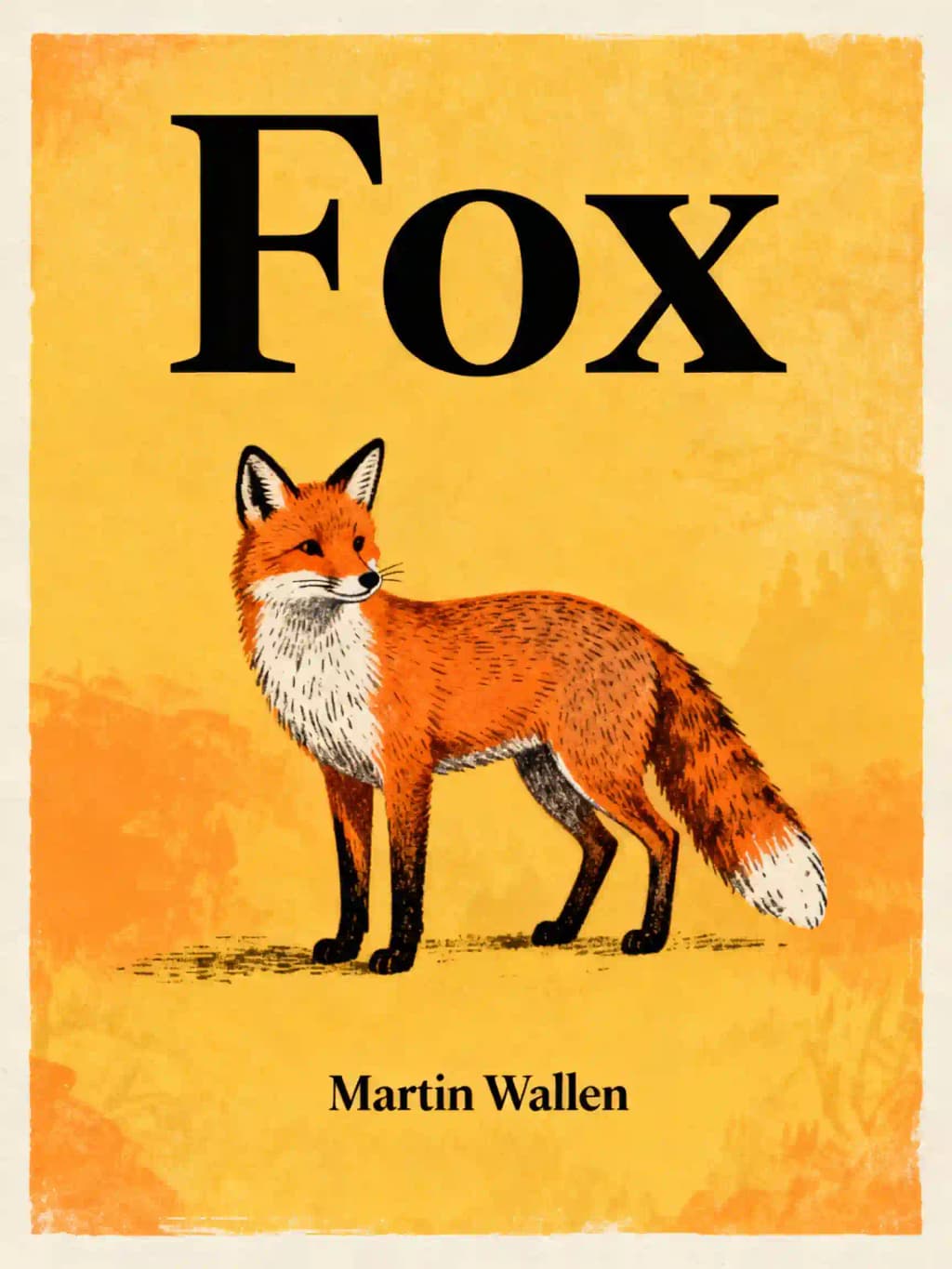
Unmasking the fox: from Aristotle's "cold and earthy" villain to beloved trickster. Wallen's richly illustrated exploration challenges centuries of bias, revealing why this cunning shapeshifter captivates cultures worldwide. What makes us both fear and adore this misunderstood creature?
Martin Wallen, author of Fox: A Cultural History of this Mystical Animal, is a professor emeritus of English at Oklahoma State University and a respected scholar of human-animal relationships in literature and culture.
Specializing in the symbolic roles of animals like dogs, foxes, and squid, Wallen bridges zoological history with cultural analysis, drawing from his academic research to explore how societies project meaning onto the natural world.
His works, including Squid and Whose Dog Are You? The Technology of Dog Breeds and The Aesthetics of Modern Human-Canine Relations, examine intersections of biology, mythology, and human identity. Fox, part of Reaktion Books’ celebrated Animal series, merges natural history with folklore, philosophy, and literary criticism to unravel the fox’s enduring mystique.
Wallen’s experimental edition of Coleridge’s The Rime of the Ancient Mariner further underscores his innovative approach to textual and ecological studies. His writings are frequently cited in academic discussions on animal symbolism and environmental humanities.
Fox by Martin Wallen explores the complex duality of foxes as both misunderstood pests and enigmatic symbols across cultures. The book examines their ecological habits, literary portrayals, and cultural significance, from British countryside behaviors to their role as disruptors in folklore (e.g., Chinese tales of fox spirits luring men). It also analyzes how terms like “foxy” entered modern vernacular.
This book is ideal for readers interested in animal symbolism, cultural anthropology, or environmental studies. Academics, wildlife enthusiasts, and fans of interdisciplinary analysis will appreciate its blend of natural history, literary criticism, and exploration of human-animal relationships.
Yes, for its unique interdisciplinary approach. Wallen combines ecological observations with deep cultural analysis, offering fresh insights into how foxes challenge human perceptions. The book’s balance of scientific detail and folklore makes it accessible yet scholarly.
Key themes include:
Unlike Wallen’s Whose Dog Are You? (focusing on dog breeds and human identity), Fox emphasizes wild animals as cultural mirrors. Both books analyze human-animal relationships but differ in scope—Fox spans global folklore, while Whose Dog Are You? examines domesticated breeds.
Some may find its academic tone overly dense for casual readers. Critics might argue it occasionally prioritizes cultural analysis over concrete solutions for human-fox conflicts, though this reflects the book’s focus on perception over policy.
Wallen traces “foxy” to 16th-century England, where foxes symbolized cunning allure. The term evolved into 20th-century slang, reflecting societal fears of feminine seduction and independence, paralleling fox stereotypes in folklore.
The book provides frameworks for:
As urbanization intensifies human-animal interactions, Wallen’s insights help reframe debates about wildlife management. Its analysis of misinformation (e.g., disease-spread myths) aligns with modern discussions about ecological coexistence.
While not explicitly detailed in sources, Wallen’s global approach likely contrasts Japanese kitsune (wise fox spirits) with Western “vermin” narratives, emphasizing how regional myths shape species perception.
“Foxing” refers to the microbial process that sours beer during fermentation. Wallen uses this term to illustrate how foxes became metaphors for decay and unpredictability in human endeavors.
While no official guides are mentioned, the book’s structured chapters and thematic clarity make it suitable for academic discussion. Key topics for analysis include symbolism, ecological ethics, and comparative mythology.
저자의 목소리로 책을 느껴보세요
지식을 흥미롭고 예시가 풍부한 인사이트로 전환
핵심 아이디어를 빠르게 캡처하여 신속하게 학습
재미있고 매력적인 방식으로 책을 즐기세요
Foxes occupy a unique position in our collective imagination.
Modern scientific names for foxes reveal ancient biases.
Aristotle classified the fox as antipodal to humans.
The fox's ability to thrive...making them true taxonomic troublemakers.
Fox myths include the fox as embodiment of primal forces.
Fox의 핵심 아이디어를 이해하기 쉬운 포인트로 분해하여 혁신적인 팀이 어떻게 창조하고, 협력하고, 성장하는지 이해합니다.
Fox을 빠른 기억 단서로 압축하여 솔직함, 팀워크, 창의적 회복력의 핵심 원칙을 강조합니다.

생생한 스토리텔링을 통해 Fox을 경험하고, 혁신 교훈을 기억에 남고 적용할 수 있는 순간으로 바꿉니다.
무엇이든 물어보고, 목소리를 선택하고, 진정으로 공감되는 인사이트를 함께 만들어보세요.

샌프란시스코에서 컬럼비아 대학교 동문들이 만들었습니다
"Instead of endless scrolling, I just hit play on BeFreed. It saves me so much time."
"I never knew where to start with nonfiction—BeFreed’s book lists turned into podcasts gave me a clear path."
"Perfect balance between learning and entertainment. Finished ‘Thinking, Fast and Slow’ on my commute this week."
"Crazy how much I learned while walking the dog. BeFreed = small habits → big gains."
"Reading used to feel like a chore. Now it’s just part of my lifestyle."
"Feels effortless compared to reading. I’ve finished 6 books this month already."
"BeFreed turned my guilty doomscrolling into something that feels productive and inspiring."
"BeFreed turned my commute into learning time. 20-min podcasts are perfect for finishing books I never had time for."
"BeFreed replaced my podcast queue. Imagine Spotify for books — that’s it. 🙌"
"It is great for me to learn something from the book without reading it."
"The themed book list podcasts help me connect ideas across authors—like a guided audio journey."
"Makes me feel smarter every time before going to work"
샌프란시스코에서 컬럼비아 대학교 동문들이 만들었습니다

Fox 요약을 무료 PDF 또는 EPUB으로 받으세요. 인쇄하거나 오프라인에서 언제든 읽을 수 있습니다.
What animal has been called both devil and deity, villain and gentleman, vermin and divine messenger? The fox occupies a singular position in human consciousness-neither fully wild nor remotely domesticated, neither hero nor villain in any simple sense. With 21 species scattered across continents, from the Arctic fox of frozen tundras to the fennec fox of scorching deserts, these creatures have thrived alongside humanity while maintaining an essential wildness that both fascinates and frustrates us. J.K. Rowling once revealed her Patronus is a fox, describing it as "mercurial, playful and impossible to catch"-a fitting metaphor for an animal that has infiltrated every corner of human culture yet slips through our attempts to truly understand it. Why do foxes occupy such contradictory spaces in our imagination? Perhaps because they mirror something uncomfortable in ourselves: the tension between civilization and instinct, between what we claim to be and what we secretly are.