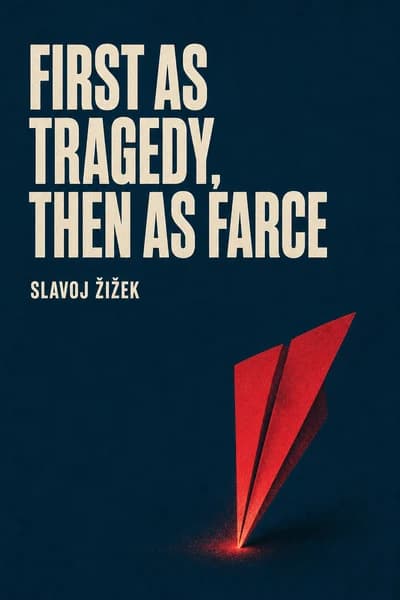
First As Tragedy, Then As Farce
First As Tragedy, Then As Farce 개요
Zizek's provocative analysis dissects how 9/11 and the 2008 financial crisis exposed liberalism's fatal flaws. Hailed as "the most dangerous philosopher in the West," his spellbinding critique challenges capitalism's moral failures while offering a radical vision for the Left's reinvention.

First As Tragedy, Then As Farce의 핵심 주제
- ideological state apparatus
- crisis of capitalism
- post-ideological politics
- systemic failure
- shock doctrine
First As Tragedy, Then As Farce의 명언
This anti-ideological self-description is itself pure ideology.
Capitalism constantly enchants subjects with dreams of freedom.
Crises often reinforce existing power structures.
The danger is a narrative that lets us continue dreaming.
Our era proclaims itself post-ideological while being thoroughly embedded in ideology.
First As Tragedy, Then As Farce의 등장인물
- Slavoj ZizekAuthor and philosopher analyzing global crises
- Francis FukuyamaThinker who declared the 'end of history'
- Alan GreenspanFormer Fed Chair who found a 'flaw' in his model
- Alain BadiouPhilosopher who critiques capitalism's meaning
First As Tragedy, Then As Farce 요약 다운로드
First As Tragedy, Then As Farce 요약을 무료 PDF 또는 EPUB으로 받으세요. 인쇄하거나 오프라인에서 언제든 읽을 수 있습니다.
이 책에 대한 FAQ
First as Tragedy, Then as Farce analyzes modern crises through Slavoj Žižek’s Marxist-Hegelian lens, arguing that events like 9/11 (tragedy) and the 2008 financial crash (farce) expose capitalism’s failures. The book critiques systemic ideology, advocates for reinventing communism, and dissects how crises paradoxically strengthen oppressive systems. Split into political analysis and philosophical exploration, it blends pop culture references with dense theory.
This book suits readers interested in Marxist theory, Lacanian psychoanalysis, or critiques of global capitalism. Ideal for those comfortable with academic philosophy and Žižek’s signature style—mixing high theory with references to films like The Baader Meinhof Complex and Starbucks’ branding. Not recommended for casual readers seeking light commentary.
Yes, for its incisive critique of capitalism’s cyclical crises and bold advocacy for communist renewal. While Žižek’s writing is dense and digressive, his analysis of ideology’s hidden mechanisms—like how “rights” under capitalism mask systemic control—offers fresh perspectives. Critics note his lack of concrete solutions, but the book remains a provocative primer on modern leftist thought.
The title references Marx’s observation that history repeats—first as tragedy (9/11’s geopolitical shock), then as farce (2008’s absurd financial collapse). Žižek argues both events stem from capitalism’s contradictions, with the latter exposing the system’s inability to self-correct.
Žižek posits that capitalism thrives on crises: disasters like 2008 reinforce ideological control by framing austerity or bailouts as inevitable. He compares this to “fetishistic disavowal,” where society acknowledges systemic flaws yet perpetuates them.
Žižek’s “communist hypothesis” urges reimagining leftist politics beyond 20th-century failures. It emphasizes radical equality and collective action to dismantle capitalism’s structural violence, rejecting both liberal reformism and Stalinist authoritarianism.
Ideology, for Žižek, is an invisible framework shaping perceptions of freedom and crisis. He argues capitalist ideology normalizes inequality—e.g., framing unemployment as personal failure rather than systemic exploitation—to maintain power.
- “The true utopia is the belief that the existing global system can reproduce itself indefinitely.”
- “Crises are not accidental disturbances but the system’s way of stabilizing itself.”
These lines underscore Žižek’s critique of capitalist realism and crisis exploitation.
He dissects films (The Baader Meinhof Complex), consumer trends (Starbucks’ “Ethos Water”), and political spectacles (Obama’s 2008 campaign) to illustrate abstract concepts like “symbolic efficiency” and ideological performativity.
Critics argue Žižek offers vague alternatives to capitalism and overrelies on philosophical jargon. Others note his analysis of 2008 lacks concrete economic solutions, leaning too heavily on theoretical provocation.
As of 2025, its critique of capitalism’s crisis-driven resilience remains urgent amid climate collapse, AI-driven labor shifts, and wealth inequality. Žižek’s call for ideological reinvention resonates with contemporary movements for economic justice.
Less technical than The Sublime Object of Ideology (1989) but more politically urgent, it distills his core ideas—ideology critique, Lacanian psychoanalysis—into a concise manifesto. Ideal for newcomers to his work.


