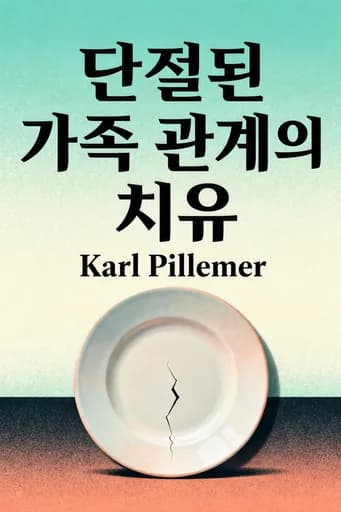
Discover why 65 million Americans suffer silently through family estrangements. Karl Pillemer's groundbreaking research reveals the hidden epidemic of fractured families and offers revolutionary reconciliation strategies that prioritize healing over blame. "Better than any estrangement book this year," raves top reviewer Elyse Walters.
Karl Pillemer, Ph.D., author of Fault Lines: Fractured Families and How to Mend Them, is a renowned gerontologist, family sociologist, and Professor of Human Development at Cornell University. A leading expert on aging and intergenerational relationships, Pillemer draws on decades of research as Director of the Cornell Institute for Translational Research on Aging and the Cornell Legacy Project. His work bridges academic insights with practical solutions for family dynamics, particularly addressing the hidden epidemic of estrangement explored in Fault Lines.
Pillemer’s expertise extends to his bestselling book 30 Lessons for Living: Tried and True Advice from the Wisest Americans, which distills life wisdom from older generations. His research-driven approach combines national survey data from the Cornell Reconciliation Project with intimate interviews, offering evidence-based strategies for healing family rifts. Recognized with the Maxwell A. Pollack Award for Contributions to Healthy Aging, Pillemer has authored over 170 scientific publications and frequently translates complex social science into accessible guidance.
Fault Lines builds on his ten-year study of 65 million Americans affected by family estrangement, cementing Pillemer’s reputation as a trusted voice in resolving generational conflict. His books have become essential resources for therapists, caregivers, and families seeking reconciliation frameworks.
Fault Lines explores family estrangement—its causes, emotional toll, and pathways to reconciliation. Drawing on Karl Pillemer’s decade-long Cornell Reconciliation Project, the book combines interviews with 1,300+ Americans, social science research, and actionable strategies to mend fractured families. It addresses triggers like conflicts over values or inheritance and offers tools to rebuild relationships.
This book is essential for individuals navigating family estrangement, therapists, social workers, and anyone interested in family dynamics. It also provides insights for researchers studying relational conflict, offering evidence-based methods to address rifts and promote healing.
Yes—Fault Lines stands out for its blend of personal narratives, rigorous research, and practical advice. It provides a rare roadmap for reconciliation, making it invaluable for those seeking to heal family divides or understand the complexities of estrangement.
Karl Pillemer, Ph.D., is a renowned gerontologist and professor at Cornell University. He specializes in family dynamics and aging, authoring bestsellers like 30 Lessons for Living. His work merges academic research with real-world applications, earning recognition as a leading voice on intergenerational relationships.
Estrangement often stems from unresolved conflicts over values, financial disputes, inheritance disagreements, or clashes involving romantic partners. Pillemer notes that single events—like a heated argument—can escalate into permanent rifts if not addressed constructively.
The book emphasizes readiness for reconciliation, empathetic communication, and releasing past grievances. Strategies include initiating contact cautiously, setting boundaries, and focusing on shared goals rather than rehashing old conflicts.
Pillemer’s landmark study surveyed 1,300+ Americans and conducted in-depth interviews to analyze estrangement causes and reconciliation success factors. It revealed that 27% of participants experienced estrangement, highlighting its prevalence and emotional impact.
Fault Lines explains that seemingly minor incidents—like a misunderstood comment—can become tipping points, especially when underlying tensions exist. These events often symbolize deeper issues, making resolution feel urgent yet challenging.
A notable quote frames reconciliation as a societal necessity: “Peace in society depends on peace in the family” (St. Augustine). Pillemer also stresses, “Healing begins when we stop waiting for apologies and focus on mutual understanding”.
The book highlights loneliness, guilt, and grief as core struggles, exacerbated by societal stigma. Pillemer reassures readers they’re not alone, offering testimonials from those who rebuilt relationships despite initial despair.
While praised for its compassionate approach, some may find the focus on reconciliation overly optimistic in cases of abuse or toxicity. Pillemer acknowledges reconciliation isn’t always possible but provides alternatives for emotional closure.
Unlike his books on aging wisdom (30 Lessons for Living), Fault Lines tackles fractured relationships head-on. It retains his signature blend of research and storytelling but delves deeper into conflict resolution strategies.
As technology and mobility strain family bonds, Pillemer’s insights remain critical. The book equips readers to navigate modern relational challenges, offering timeless tools for fostering connection in an increasingly fragmented world.
저자의 목소리로 책을 느껴보세요
지식을 흥미롭고 예시가 풍부한 인사이트로 전환
핵심 아이디어를 빠르게 캡처하여 신속하게 학습
재미있고 매력적인 방식으로 책을 즐기세요
I thought I was the only one.
I am done.
Sometimes, you have to do an ROI on relationships.
I really, truly don't remember being told 'I love you' at all.
Beneficial for me to let her in.
Fault Lines의 핵심 아이디어를 이해하기 쉬운 포인트로 분해하여 혁신적인 팀이 어떻게 창조하고, 협력하고, 성장하는지 이해합니다.
Fault Lines을 빠른 기억 단서로 압축하여 솔직함, 팀워크, 창의적 회복력의 핵심 원칙을 강조합니다.

생생한 스토리텔링을 통해 Fault Lines을 경험하고, 혁신 교훈을 기억에 남고 적용할 수 있는 순간으로 바꿉니다.
무엇이든 물어보고, 목소리를 선택하고, 진정으로 공감되는 인사이트를 함께 만들어보세요.

샌프란시스코에서 컬럼비아 대학교 동문들이 만들었습니다
"Instead of endless scrolling, I just hit play on BeFreed. It saves me so much time."
"I never knew where to start with nonfiction—BeFreed’s book lists turned into podcasts gave me a clear path."
"Perfect balance between learning and entertainment. Finished ‘Thinking, Fast and Slow’ on my commute this week."
"Crazy how much I learned while walking the dog. BeFreed = small habits → big gains."
"Reading used to feel like a chore. Now it’s just part of my lifestyle."
"Feels effortless compared to reading. I’ve finished 6 books this month already."
"BeFreed turned my guilty doomscrolling into something that feels productive and inspiring."
"BeFreed turned my commute into learning time. 20-min podcasts are perfect for finishing books I never had time for."
"BeFreed replaced my podcast queue. Imagine Spotify for books — that’s it. 🙌"
"It is great for me to learn something from the book without reading it."
"The themed book list podcasts help me connect ideas across authors—like a guided audio journey."
"Makes me feel smarter every time before going to work"
샌프란시스코에서 컬럼비아 대학교 동문들이 만들었습니다

Fault Lines 요약을 무료 PDF 또는 EPUB으로 받으세요. 인쇄하거나 오프라인에서 언제든 읽을 수 있습니다.
Christopher Robin Milne lived every child's fantasy-his adventures with Winnie-the-Pooh enchanted millions. Yet behind the storybook magic lay a devastating truth: he spent decades estranged from his father, A.A. Milne, convinced his parent had "stolen his childhood" for profit and fame. He didn't speak to his mother for the last ten years of her life. While celebrity family rifts occasionally surface in tabloids, millions experience similar fractures in complete silence. What makes family estrangement uniquely painful is the profound isolation-sufferers genuinely believe they're the only ones whose family has shattered beyond repair. Karl Pillemer's Cornell Family Reconciliation Project reveals a stunning reality: approximately 67 million Americans are currently estranged from family members. That's roughly one in four people. Yet most suffer alone, convinced something is fundamentally wrong with them. The numbers tell a sobering story: 10 percent are cut off from parents or children, 8 percent from siblings, and 9 percent from extended family. Most of these rifts last years, not months-half extend beyond four years. Perhaps most striking, estrangement respects no boundaries of race, education, geography, or income. It's a genuinely democratic form of suffering.