1장
The Deception That Shook the World
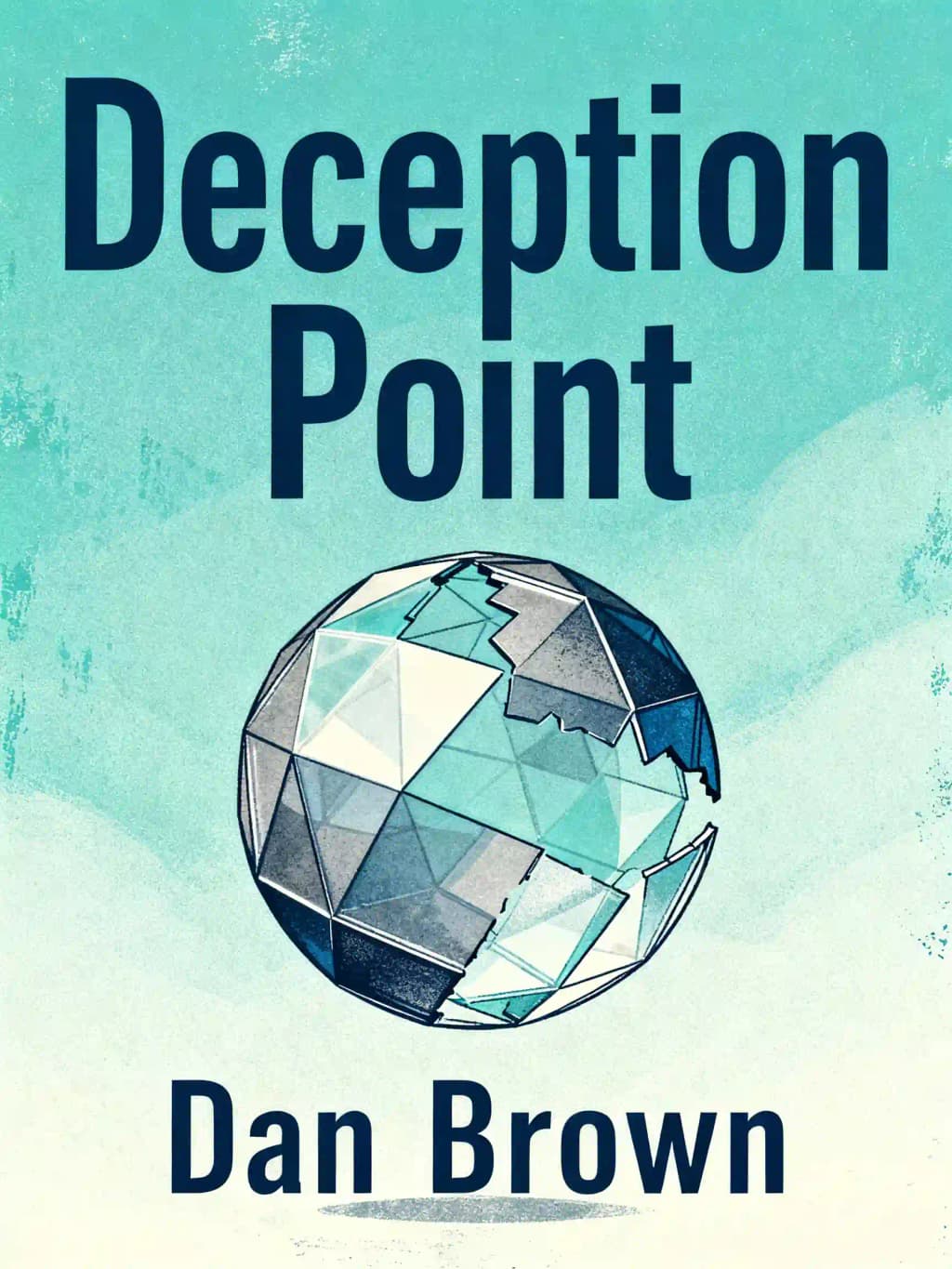
In the high-stakes world of American politics, few novels have captured the intersection of science, power, and conspiracy like Dan Brown's "Deception Point." Since its publication, this techno-thriller has remained a favorite among readers seeking intellectual stimulation wrapped in heart-pounding suspense. Former President Barack Obama even listed it among his vacation reads, praising its "perfect blend of scientific intrigue and political machination." The book's exploration of NASA, intelligence agencies, and the manipulation of public perception feels increasingly relevant in our era of information warfare and scientific skepticism. As you settle in for this journey through arctic ice fields, ocean depths, and Washington's corridors of power, prepare yourself for a story where nothing-not even a meteorite from space-is quite what it seems.
2장
A Discovery That Changes Everything
The Arctic Circle: a vast, frozen wasteland where temperatures plummet to lethal levels and katabatic winds scream across ice shelves with hurricane force. It's here that NASA makes an extraordinary discovery-a meteorite embedded deep within the Milne Ice Shelf containing fossilized evidence of extraterrestrial life. The timing couldn't be more perfect for President Zachary Herney, whose reelection campaign is floundering against Senator Sedgewick Sexton's relentless attacks on NASA's budget overruns.
Into this political powder keg steps Rachel Sexton, a data analyst for the National Reconnaissance Office and estranged daughter of Senator Sexton. When the President personally summons her to authenticate NASA's discovery, Rachel finds herself whisked away to the Arctic aboard Air Force One, then transferred via fighter jet to a remote research station on the Milne Ice Shelf.
The President's strategy is brilliant in its simplicity: by having independent civilian experts verify the meteorite-including the famous oceanographer Michael Tolland, astrophysicist Corky Marlinson, and Rachel herself-he ensures the discovery's credibility against inevitable accusations of political manipulation. These civilian witnesses would make the announcement unassailable.
At the habisphere erected over the extraction site, Rachel examines the evidence with growing amazement. The eight-ton meteorite contains numerous fossils of bug-like creatures, visible to the naked eye-far more convincing than NASA's controversial 1996 Mars meteorite claim. The extraction hole, the carbon dating, the chemical analysis-everything points to an authentic meteorite that fell to Earth in 1716, now recovered from 300 feet beneath the ice.
"This changes everything we know about life in the universe," Tolland explains, his eyes reflecting the wonder they all feel. The implications are staggering-proof that we are not alone, validation for billions in space exploration funding, and a devastating blow to Senator Sexton's anti-NASA campaign.
Yet as Rachel prepares her endorsement for the White House, strange inconsistencies begin to surface. Why is there bioluminescent plankton in the extraction pit's water? How could ocean organisms reach a glacial ice shelf supposedly isolated from the sea? These questions lead Rachel and her newfound allies down a path of discovery far more dangerous than they could possibly imagine.
3장
The Deadly Truth Beneath the Ice
"Something is very wrong here," glaciologist Norah Mangor declares, her voice cutting through the Arctic wind as she examines readings from her refractometer. The water in the meteorite extraction shaft contains salt-impossible for a landlocked glacier. When Rachel suggests frozen pockets of saltwater might have been trapped in the ice, Norah dismisses the theory with scientific precision: "Brine interstices only form in seasonal ice, not in glacial ice like this."
To settle the matter, Norah leads Rachel, Tolland, and Corky away from the habisphere to conduct ground-penetrating radar tests of the surrounding ice. Two hundred yards from the NASA dome, they make a horrifying discovery-the radar reveals not only the body of missing paleontologist Wailee Ming floating in the extraction shaft, but something far more damning: a perfectly cylindrical tunnel of sea ice extending from the meteorite shaft all the way down to the ocean below.
The implications hit them like a physical blow. Someone drilled up through the ice shelf from underneath and planted the meteorite. The fossils, while genuine, aren't extraterrestrial at all-they're the remains of deep-sea creatures deliberately positioned to mimic alien life.
"NASA faked the whole thing," Corky whispers, his scientific certainty crumbling before his eyes.
Before they can process this revelation, shots ring out across the ice. Two black-clad figures emerge from the darkness, methodically executing Norah with military precision. Rachel, Tolland, and Corky flee across the ice sheet, pursued by killers whose advanced equipment and tactical discipline suggest government-sanctioned assassins.
In a desperate bid to escape, Tolland releases a weather balloon that drags them across the ice toward the edge of the glacier. Their pursuers follow relentlessly, finally cornering them on an ice outcropping hanging precariously over the Arctic Ocean. With cold calculation, the soldiers toss a concussion grenade that separates the ice shelf, sending Rachel and her companions plummeting toward the frigid waters below.
As the massive ice slab crashes into the ocean, Rachel faces the terrifying reality: powerful forces within the U.S. government are willing to commit murder to protect a scientific fraud of unprecedented scale. But why? And who could orchestrate such an elaborate deception?
4장
Politics, Power, and NASA's Future
While Rachel fights for survival in the Arctic, Washington D.C. buzzes with anticipation of the President's announcement. Senator Sedgewick Sexton, a charismatic widower whose campaign has gained momentum by attacking NASA's budget excesses, prepares for what he believes will be another opportunity to criticize the space agency.
"When schools can't afford textbooks, we're spending fifteen billion dollars a year taking pictures of space dust," Sexton proclaims during a CNN interview with Presidential Senior Adviser Marjorie Tench. With calculated bravado, he declares that if anyone found proof of extraterrestrial life, he would "eat his hat."
What Sexton doesn't realize is that he's walking into a carefully laid trap. Behind closed doors, he meets with representatives from private aerospace companies who offer substantial campaign contributions in exchange for his promise to privatize NASA if elected. These companies stand to make billions from acquiring NASA's technologies and contracts-a classic example of political corruption disguised as free-market reform.
Imagine the scene: six powerful men in Sexton's apartment, cognac in hand, discussing how they'll carve up NASA's assets once Sexton reaches the White House. "With your help," Sexton tells them, "soon I'll be in a position to make sure all of you can launch your dreams." The irony is palpable-while publicly attacking NASA's waste, he privately plots to sell it off to the highest bidders.
Meanwhile, Gabrielle Ashe, Sexton's ambitious young campaign assistant (and former lover), begins to question her loyalty. After being approached by Marjorie Tench with evidence of Sexton's corruption, Gabrielle embarks on her own investigation. She discovers that NASA's PODS satellite director, Chris Harper, was coerced into lying about fixing critical software-the very software that supposedly discovered the meteorite.
"Administrator Ekstrom and Ms. Tench came to me," Harper confesses to Gabrielle. "They said they needed me to fix a piece of software that had failed...but the software was still failing when they announced it was fixed."
The political chess game grows increasingly complex. President Herney, despite his public image of warmth and integrity, has orchestrated a masterful political maneuver: using NASA's discovery to destroy Sexton's campaign while simultaneously securing NASA's future funding. But did the President know the meteorite was fake? Or is he an unwitting participant in a deception orchestrated by others?
5장
Survival Against All Odds
The frigid Arctic waters close over Rachel's head as the ice slab carrying her, Tolland, and Corky plunges into the ocean. Their specialized NASA survival suits keep them dry-crucial in preventing immediate hypothermia-but they have minutes, not hours, before the cold claims their lives.
Drifting on the massive ice floe, they face the grim reality of their situation. Miles from shore, in water too cold for survival, pursued by killers who believe them dead, they have no way to communicate their discovery to the world. As consciousness begins to fade, Rachel uses her ice axe to pound an SOS in Morse code, hoping against hope that intelligence satellites might detect the pattern.
In a moment that feels like divine intervention, a Los Angeles-class nuclear submarine surfaces beside them. The USS Charlotte, secretly stationed in the Arctic for classified operations, detected Rachel's SOS through its sonar array. As the submarine crew pulls their hypothermic bodies from the water, Rachel realizes they've been given a second chance-not just to survive, but to expose the truth.
Aboard the submarine, Rachel attempts to contact NRO Director William Pickering, her mentor and the one person she trusts implicitly. Instead, she reaches Marjorie Tench, who dismisses her claims as delusion and threatens legal action if she continues making accusations. When Rachel learns the President has already begun his meteorite announcement, she feels a crushing sense of defeat.
But the story takes another dramatic turn when Tolland suggests they verify their suspicions about the meteorite's terrestrial origin. The submarine captain agrees to transport them to Tolland's research vessel, the Goya, where ship geologist Xavia can analyze their meteorite sample.
On the Goya, floating above a volatile underwater volcano called a "megaplume," Xavia confirms their worst fears: the rock's chemical composition proves it formed on Earth, not in space. The titanium and zirconium ratios are inconsistent with meteorites but match perfectly with ocean-floor rocks.
Their triumph is short-lived. The Delta Force team that tried to kill them earlier tracks them to the ship and launches a devastating attack, destroying the Coast Guard helicopter sent to rescue them and killing Xavia. In the chaos that follows, Rachel becomes trapped in Tolland's submersible as it sinks into the ocean depths, while Tolland himself dives into shark-infested waters in a desperate attempt to save her.
"I'm going to die alone underwater," Rachel thinks as the submersible descends into darkness, its hatch jammed and water seeping in-a nightmare scenario for someone with hydrophobia. In this moment of extreme peril, Rachel's character is fully revealed: despite her terror, she maintains her analytical mind and fighting spirit, searching for any possible escape.
6장
The Mastermind Revealed
As Rachel and Tolland desperately fight for survival aboard the rapidly sinking Goya, buffeted by fierce Arctic winds and freezing spray, the architect of the elaborate conspiracy finally emerges from the shadows. William Pickering - Rachel's longtime mentor, trusted father figure, and director of the National Reconnaissance Office - steps deliberately from the military attack helicopter onto the ship's ice-slicked deck. His familiar face, usually a source of comfort and guidance for Rachel, now fills her with horror.
"I did what I had to do for my country," Pickering explains with the same measured, analytical tone he once used in intelligence briefings. His motivation stems from a deep-seated fear about NASA's potential dismantling by Senator Sexton, which would have transferred crucial space assets to private corporations. In Pickering's carefully constructed worldview, these companies posed an existential threat, likely to auction off military secrets and surveillance capabilities to foreign powers or terrorist organizations. "Space is the military high ground," he declares with unwavering conviction. "We cannot let it become a corporate free-for-all. The risks to national security are simply too great."
The revelation hits Rachel like a physical blow. This man, who had guided her career and shaped her understanding of public service, had orchestrated an elaborate fraud that left a trail of murdered scientists and nearly claimed her own life. The scope of the deception proves even more staggering - neither NASA's administrators nor President Herney had any knowledge of the artifice. They were unwitting pawns in Pickering's game, genuinely believing in the meteorite's authenticity. Through a complex network of military allies and covert operatives, Pickering had orchestrated the meteorite's placement beneath the ice, manipulated NASA's discovery process, and systematically eliminated anyone who glimpsed the truth.
"Sometimes the only way to save what you love is to make the right sacrifice," Pickering tells her, his voice softening as he invokes the memory of his daughter Diana, killed during a classified military operation. Her death had profoundly shaped his worldview, convincing him that personal loss was sometimes necessary for national gain. His twisted form of patriotism serves as a chilling example of how even the noblest intentions can spawn monstrous actions when unchecked by moral constraints or democratic oversight.
As Pickering moves to eliminate the final witnesses to his scheme, nature intervenes with devastating force. The underwater volcano beneath the Goya erupts violently, creating a massive vortex that begins inexorably pulling the ship toward destruction. In the ensuing chaos, Rachel and Tolland manage to escape via helicopter, while Pickering remains aboard the doomed vessel. In a final image of both defiance and acceptance, he kneels at the railing as the ship is dragged backward into the abyss.
The scene carries both tragic weight and poetic justice - a man who devoted his life to protecting his country, ultimately destroyed by his own inability to trust the democratic institutions he claimed to serve. As the Goya disappears into the roaring whirlpool, Pickering's final thoughts turn to Diana, the devastating personal loss that perhaps pushed this brilliant but damaged man toward such extreme measures in service of his distorted vision of patriotic duty.
7장
The Politics of Truth
While Rachel and Tolland fight desperately for survival in the Arctic waters, Senator Sexton orchestrates what he believes will be his crowning political moment in Washington. Armed with what he thinks is damning evidence of NASA's deception, Sexton strategically chooses the Washington Monument as his stage - a deliberate choice to frame himself against this symbol of American honesty and leadership. He meticulously arranges a press conference, carefully timing it to maximize media coverage during prime evening news hours.
"Ladies and gentlemen," he announces to the gathered press with barely contained triumph, "I have just received information from a highly reliable source confirming that the NASA meteorite is a fraud-a desperate deception aimed at saving a failing space agency and a floundering President." His delivery is practiced, his confidence absolute, playing to the cameras with the skill of a seasoned politician.
What Sexton doesn't realize is that Gabrielle Ashe, his former aide and confidante, has executed a devastating switch. In place of his evidence against NASA, she has substituted explicit photographs documenting their affair - including compromising images from his Senate office. The moment when Sexton distributes these envelopes becomes a study in political self-destruction. Reporters' expressions shift from anticipation to shock to barely concealed amusement as the contents become clear. Within minutes, news networks begin broadcasting his downfall in real-time, social media explodes with commentary, and decades of political ambition crumble in mere moments.
Meanwhile, President Herney grapples with a complex moral dilemma in the White House. The meteorite itself is genuine, but NASA's path to its discovery is paved with deception. The PODS satellite program, trumpeted as a technological triumph, never actually functioned. Instead, NASA had intercepted intelligence about a discovery by a Canadian geologist, quietly acquired the meteorite, and constructed an elaborate fiction about its detection. The truth threatens not just NASA's reputation but the integrity of Herney's entire administration.
In a pivotal Oval Office conversation with Gabrielle, Herney demonstrates the leadership philosophy that defines his character. "There's just no substitute for the truth," he says, weighing the political costs against his moral compass. Despite advisers urging him to maintain the deception, Herney calls a press conference. He acknowledges NASA's wrongdoing comprehensively, detailing both the genuine nature of the meteorite and the agency's deceptive practices in claiming its discovery.
This decision creates a striking contrast in political leadership styles. Sexton, even as his daughter faces mortal danger, continues plotting political advantage, leaking selective information to the press and attempting to spin the situation to his benefit. His behavior exemplifies the worst of political opportunism - willing to sacrifice family, truth, and national interests for personal gain.
Herney's approach, though politically risky, proves remarkably effective. His candid admission resonates with an American public weary of political spin. As Sexton's scandal simultaneously erupts, the contrast becomes even starker. The President's honest acknowledgment of institutional failure, coupled with a commitment to reform, transforms a potential career-ending crisis into a demonstration of authentic leadership.
8장
Finding Truth in a World of Deception
As the dust settles, Rachel and Tolland recover in the White House, their ordeal finally over. The meteorite-now revealed as a terrestrial rock containing deep-sea fossils rather than extraterrestrial life-is quietly dropped into the Atlantic Ocean, sinking to the depths from which it originally came. This symbolic return to nature serves as a powerful reminder of how even the most elaborate deceptions ultimately return to their origins.
In the Lincoln Bedroom, Tolland awaits Rachel with Chinese kissing fish in a crystal bowl and white lilies stolen from the Rose Garden. The kissing fish, known for their lifelong partnerships, symbolize the lasting bond formed between them. Their connection, forged through shared trauma and mutual respect, offers hope that something beautiful can emerge from deception and danger. "I don't know what the future holds," Tolland tells her, "but I know I want to face it with you." Their relationship represents a triumph of authenticity over artifice.
This personal resolution mirrors the larger themes of the novel, weaving together individual and societal implications. In a world where truth is manipulated for political advantage, where scientific discoveries become pawns in power games, authentic human connection remains our most reliable compass. Rachel and Tolland have seen through multiple layers of deception-not just the meteorite fraud, but also the false personas and motivations of those around them: from Senator Sexton's manufactured public image to William Pickering's misguided patriotism. Their ability to recognize genuine truth in each other offers a path forward through the labyrinth of lies.
The novel leaves us with profound questions about science, politics, and truth that echo contemporary challenges. When scientific discoveries become political tools, how can we preserve the integrity of both? The meteorite deception demonstrates how even respected institutions can be corrupted by power and ambition. In an era of sophisticated deception, how do we distinguish fact from fiction? The answer lies partly in following Rachel's example: combining technical expertise with intuitive understanding. And perhaps most importantly, how do we maintain our moral compass when powerful forces attempt to manipulate our perception of reality? The story suggests that personal relationships and unwavering ethical principles provide crucial anchoring.
These questions resonate far beyond the novel's final pages, reflecting urgent contemporary concerns. In our own world of deepfakes, misinformation campaigns, and politicized science, the ability to discern truth has never been more crucial. The novel's exploration of data manipulation at NASA parallels real-world concerns about institutional integrity and scientific credibility. Like Rachel Sexton, we must learn to look beneath the surface, question convenient narratives, and remember that even the most convincing deceptions eventually crumble before persistent inquiry and unwavering integrity. The story ultimately suggests that truth, while sometimes obscured, remains discoverable through a combination of scientific rigor, emotional intelligence, and moral courage.
9장
The Price of Power and the Value of Truth
The meteorite deception ultimately reveals the complex moral calculus of those in power. For William Pickering, fabricating evidence of extraterrestrial life was justified by national security concerns-preventing military space technology from falling into private hands. For NASA Administrator Ekstrom, claiming credit for a discovery they didn't make seemed a small price to pay for preserving an agency he believed essential to America's future. Even President Herney, though unaware of the meteorite fraud, manipulated the timing of the announcement for maximum political impact.
What makes these characters compelling is that none are purely villainous. Each believes their actions serve a greater good, demonstrating how easily ethical boundaries blur when high stakes meet good intentions. As Rachel observes, "The road to hell is paved with good intentions-and apparently decorated with NASA logos."
The novel's exploration of scientific ethics feels particularly relevant today. When Corky Marlinson insists the meteorite must be genuine because "the science checks out," he demonstrates how easily experts can be fooled when presented with carefully manufactured evidence that confirms their expectations. His reluctance to question data that supports his worldview mirrors real-world challenges in scientific integrity.
Similarly, the political machinations surrounding NASA's funding reflect ongoing debates about government investment in science. Senator Sexton's populist argument that NASA's budget would be better spent on education resonates with many voters, while the President's defense of pure scientific research without immediate practical applications represents a more idealistic view. The novel refuses to provide simple answers to these complex policy questions.
In the end, "Deception Point" suggests that truth itself has intrinsic value beyond political or scientific utility. When President Herney chooses honesty despite its potential cost, when Rachel and Tolland risk their lives to expose deception, they affirm that integrity matters-not just as an abstract principle, but as the foundation for genuine progress, whether in science, politics, or personal relationships.
As we close the final page, we're left with a cautionary tale about the fragility of truth in a world where technology makes deception increasingly sophisticated. Yet it's also a story of hope-that individual courage, critical thinking, and human connection can ultimately prevail against even the most elaborate conspiracies. In Rachel and Tolland's survival and newfound relationship, we find reassurance that truth, though sometimes buried deep beneath layers of deception, eventually finds its way to the surface.