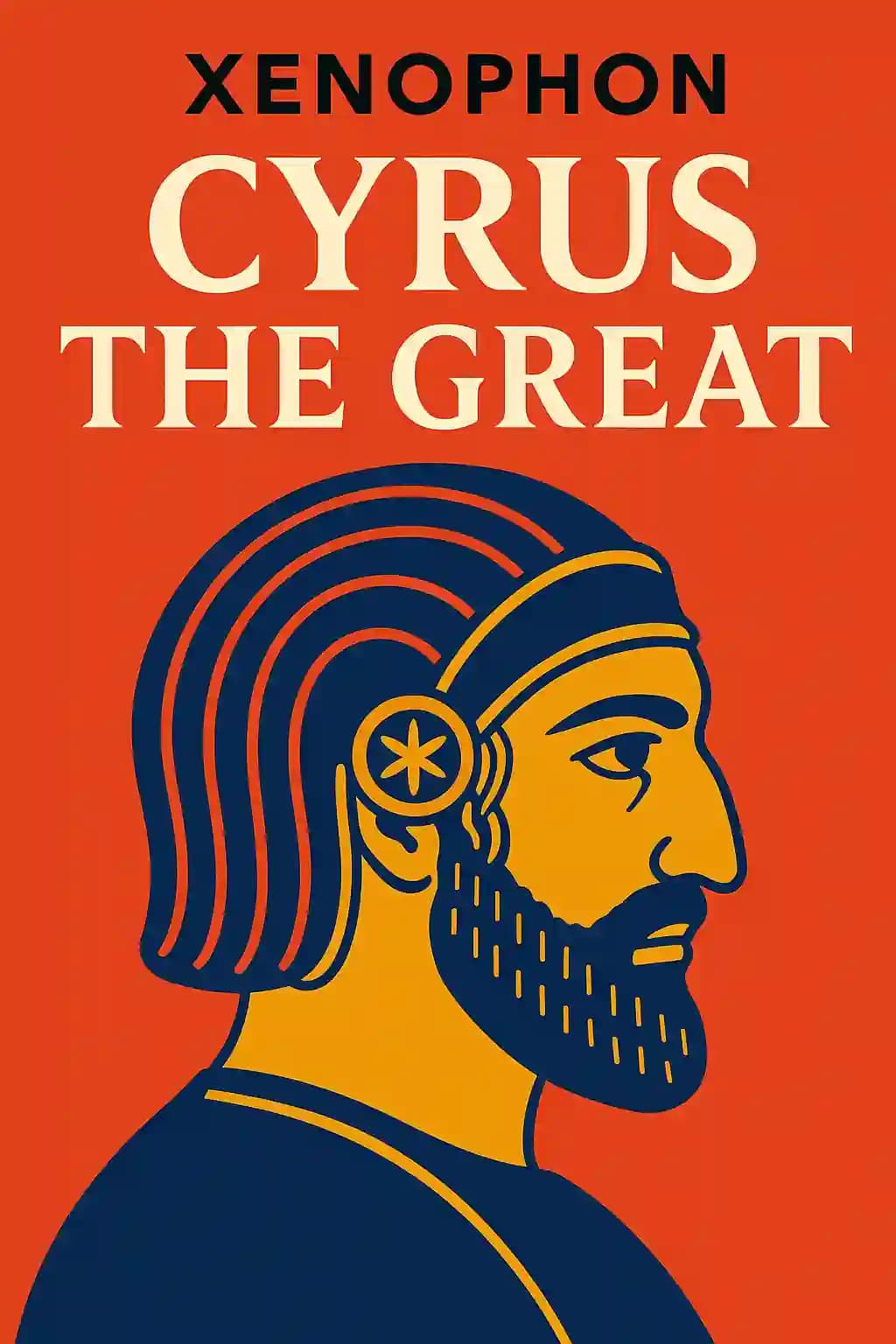
Before Machiavelli's "Prince," Xenophon's ancient masterpiece taught leadership through Cyrus the Great's conquests. Alexander the Great and Julius Caesar devoured this military classic that reveals: How did one ruler's strategies for diverting rivers and winning hearts create history's most admired empire?
Xenophon of Athens (c. 430–354 BCE), the visionary historian behind Cyropaedia (The Education of Cyrus), was a pioneering military strategist, philosopher, and chronicler of classical antiquity. A student of Socrates and a mercenary commander, Xenophon’s works blend historical narrative with philosophical insights on leadership, ethics, and governance. Cyropaedia—a fusion of biography, political theory, and didactic literature—examines Cyrus the Great’s rise to power, reflecting Xenophon’s firsthand experience leading the Ten Thousand Greek mercenaries in Persia, as detailed in his acclaimed memoir Anabasis.
Renowned for his lucid prose and tactical expertise, Xenophon authored foundational texts including Hellenica (continuing Thucydides’ history of Greece) and Memorabilia (defending Socrates’ teachings). His analysis of leadership in Cyropaedia influenced figures like Alexander the Great, who reportedly used Xenophon’s writings as military guides.
A key voice in Socratic philosophy and ancient historiography, Xenophon’s works remain essential to understanding Greco-Persian relations and classical thought. His Anabasis, celebrated for its gripping account of survival and strategy, has been translated into dozens of languages and studied for over two millennia as a masterpiece of adventure literature.
Cyrus the Great (or Cyropaedia) chronicles the life and leadership of Cyrus II of Persia, blending history and philosophy to explore how he built the ancient world’s largest empire. Xenophon highlights Cyrus’s military ingenuity, diplomatic skill, and ability to inspire loyalty, using his campaigns—such as subduing the Armenian Kingdom and negotiating with the Chaldaeans—to illustrate timeless principles of governance and virtue. The work doubles as a treatise on ideal leadership.
This book suits students of leadership, military strategy, or classical history. Leaders seeking insights into ethical governance, educators analyzing ancient political philosophy, and readers interested in biographical accounts of influential historical figures will find value. Its blend of narrative and moral lessons also appeals to fans of Stoic philosophy or historical fiction.
Yes, as one of antiquity’s most studied leadership manuals, it offers timeless lessons on justice, moderation, and strategic thinking. Xenophon’s portrayal of Cyrus’s trial of the Armenian king and his mercy toward allies showcases nuanced ethical dilemmas, making it relevant for modern decision-makers. However, its idealized narrative lacks historical rigor, prioritizing philosophical themes over factual precision.
Cyrus’s leadership emphasizes adaptability, moral discernment, and fostering loyalty. For example, he spares the Armenian king after his son Tigranes argues for redemption, demonstrating mercy alongside strategic alliance-building. Xenophon also highlights Cyrus’s logistical prowess, such as diverting the Euphrates to capture Babylon, and his focus on unifying diverse cultures under shared principles.
Cyrus adopts a pragmatic yet principled view of justice. When the Armenian king defies tribute payments, Cyrus holds a public trial, weighing punishment against potential loyalty. By sparing the king and integrating his army, he balances retribution with long-term alliance-building—a theme echoing throughout his campaigns.
Tigranes, the Armenian king’s son, acts as a moral foil, convincing Cyrus to show mercy by arguing that his father’s folly could become a lesson in loyalty. His advocacy highlights Xenophon’s belief in redemption and the value of wise counsel, contrasting his father’s short-sightedness with Cyrus’s capacity for forgiveness.
The book details tactical innovations like securing high ground against the Chaldaeans and psychological warfare to destabilize enemies. Cyrus prioritizes minimizing casualties through clever maneuvers (e.g., diverting rivers to infiltrate Babylon) over brute force, emphasizing preparation, terrain mastery, and understanding adversaries’ motivations.
Scholars note Xenophon’s idealization of Cyrus, overlooking documented Persian excesses to frame him as a paragon of virtue. The final chapter’s abrupt account of Persia’s post-Cyrus decline also sparks debate—some interpret it as a caution against complacency, others as a narrative inconsistency.
Unlike Herodotus’s Histories, which blends ethnography and myth, Xenophon focuses on leadership philosophy, offering a didactic rather than purely historical account. It parallels Plato’s Republic in exploring ideal governance but grounds theories in Cyrus’s (real or embellished) actions.
Its themes—adapting to change, ethical leadership, and cultural integration—resonate in modern contexts like organizational management and geopolitical strategy. Cyrus’s emphasis on meritocracy over brute force, as seen in his integration of Armenian forces, mirrors contemporary inclusive leadership models.
The “trial” of the Armenian king symbolizes the balance between justice and pragmatism, while the Euphrates diversion represents innovative problem-solving. Cyrus’s empire itself serves as a metaphor for the fragility of power structures reliant solely on one leader’s virtue.
The book predates concepts like emotional intelligence and servant leadership but mirrors their principles. Cyrus’s empathy toward allies and strategic foresight align with modern frameworks like Jim Collins’s Level 5 Leadership, making it a precursor to contemporary management theories.
저자의 목소리로 책을 느껴보세요
지식을 흥미롭고 예시가 풍부한 인사이트로 전환
핵심 아이디어를 빠르게 캡처하여 신속하게 학습
재미있고 매력적인 방식으로 책을 즐기세요
Wealth preserved through ethical principles endures, while riches gained through exploitation vanish.
The journey to transform the world began within.
Our ancestors showed courage but gained little.
Leadership means making people all they ought to be.
Followers remain loyal only when their self-interest aligns with their leader's actions.
Xenophon's Cyrus the Great의 핵심 아이디어를 이해하기 쉬운 포인트로 분해하여 혁신적인 팀이 어떻게 창조하고, 협력하고, 성장하는지 이해합니다.
생생한 스토리텔링을 통해 Xenophon's Cyrus the Great을 경험하고, 혁신 교훈을 기억에 남고 적용할 수 있는 순간으로 바꿉니다.
무엇이든 묻고, 학습 스타일을 선택하고, 나에게 맞는 인사이트를 함께 만들어보세요.

샌프란시스코에서 컬럼비아 대학교 동문들이 만들었습니다
"Instead of endless scrolling, I just hit play on BeFreed. It saves me so much time."
"I never knew where to start with nonfiction—BeFreed’s book lists turned into podcasts gave me a clear path."
"Perfect balance between learning and entertainment. Finished ‘Thinking, Fast and Slow’ on my commute this week."
"Crazy how much I learned while walking the dog. BeFreed = small habits → big gains."
"Reading used to feel like a chore. Now it’s just part of my lifestyle."
"Feels effortless compared to reading. I’ve finished 6 books this month already."
"BeFreed turned my guilty doomscrolling into something that feels productive and inspiring."
"BeFreed turned my commute into learning time. 20-min podcasts are perfect for finishing books I never had time for."
"BeFreed replaced my podcast queue. Imagine Spotify for books — that’s it. 🙌"
"It is great for me to learn something from the book without reading it."
"The themed book list podcasts help me connect ideas across authors—like a guided audio journey."
"Makes me feel smarter every time before going to work"
샌프란시스코에서 컬럼비아 대학교 동문들이 만들었습니다

Xenophon's Cyrus the Great 요약을 무료 PDF 또는 EPUB으로 받으세요. 인쇄하거나 오프라인에서 언제든 읽을 수 있습니다.
Imagine a leader so effective that his empire stretched from India to Greece, whose governance principles influenced figures from Alexander the Great to Thomas Jefferson. While modern executives chase the latest management fads, Xenophon's account of Cyrus the Great remains perhaps history's most profound leadership manual. Unlike Machiavelli's cynical approach (which his work partly inspired), Cyrus understood that sustainable leadership requires both wisdom and ethical conduct. He created history's first true multicultural empire not through brutal domination but through psychological insight, strategic brilliance, and moral clarity. His story offers timeless wisdom for anyone seeking to lead with both effectiveness and integrity. Born into Persia's warrior culture, Cyrus learned to respond to danger with calculated composure rather than emotional reaction. While royal birth provided opportunity, it was his personal qualities that enabled his extraordinary achievements. The young prince understood early that wealth preserved through ethical principles endures, while riches gained through exploitation vanish. This wisdom came partly from observing failed empires where brutal exploitation led to constant rebellion. What truly distinguished Cyrus was his insatiable curiosity about both people and governance systems. Merchants visiting his father's court found themselves engaged in lengthy conversations with the young prince about distant lands and customs. He sought wisdom from diverse traditions - Babylonian astronomers, Greek philosophers, Median priests - earning the nickname "Well of Knowledge" for his genuine desire to understand different perspectives.
What separated Cyrus from ordinary commanders was his ability to envision possibilities others couldn't see. When addressing his officers, he promised swift victories that would bring honor and wealth to Persia - a departure from traditional Persian warfare that reflected deeper strategic insight. His vision manifested in tactical innovations. When outnumbered by Assyrian forces, Cyrus persuaded his uncle to upgrade from light to heavy infantry - a transformation that proved decisive. He excelled at combining different military traditions while maintaining strategic patience, careful not to reveal ambitions that might alarm his officers. During an Assyrian advance delay, Cyrus recognized that inactivity breeds internal tensions. He proposed advancing into enemy territory, skillfully framing it to his uncle as a way to sustain their forces on enemy resources rather than depleting Median supplies. Cyrus understood that "battles are decided more by the morale of troops than by bodily strength" - a principle modern military psychology confirms. He balanced respect for command with strategic necessity, committing to lead from the front rank, declaring it "the only place where a true commander can feel at home during battle."
Cyrus's father taught him that followers stay loyal when their interests align with their leader's actions. He applied this insight by tailoring his message - emphasizing tactical advantages to nobles and advancement opportunities to commoners. Cyrus minimized rank distinctions by having officers and commoners share tents and meals, transforming potential class tensions into cooperation through equal treatment. He recognized that facing a common enemy unites people, noting that in danger, soldiers see each other as allies rather than rivals. Above all, Cyrus understood that true leadership develops others. His father's wisdom - that guiding others to fulfill their potential surpasses personal achievement - became the foundation of his empire-building approach.
Cyrus excelled at building diverse coalitions through diplomacy. After defeating the Assyrians, he publicly recognized and promoted heroes based on merit, regardless of background - showing others that excellence would be rewarded. When Hyrcanian ambassadors offered alliance against Assyria, Cyrus trusted their word without demanding hostages, seeing them as a sign of his destined success. This calculated trust repeatedly expanded his coalition. He made his army dependent on conquest for survival by avoiding supply trains, ensuring their interests aligned with strategic goals. After victories, Cyrus earned loyalty by prioritizing rewards to critical allies. He insisted officers wait until allies finished fighting before claiming spoils, noting "We can gain a fortune in that precious stuff called loyalty by being generous." His most powerful coalition-building move was freeing and arming the strongest captives, incorporating them into his army as equals. "Whenever you can, act as a liberator," he advised, believing that "Freedom, dignity, and wealth - these three together constitute the great happiness of humanity."
When allies returned with captured horses while his Persians lagged behind, Cyrus seized the chance to modernize his army's mobility. He acknowledged to officers that Persian infantry couldn't effectively chase enemies - "We'll pursue them with all the speed of stumps in an orchard." Anticipating resistance to cavalry adoption, he preemptively addressed concerns, reminding officers of their existing horsemanship from hunting. His masterful innovation emerged during Babylon's siege. While ostensibly ordering trenches for blockade, he secretly planned to divert the Euphrates River, creating a dry riverbed entrance. During Babylon's festival, as inhabitants celebrated drunkenly, his forces entered through the drained riverbed. By dawn, Cyrus had captured the ancient world's greatest city with minimal bloodshed. Cyrus also pioneered a multicultural empire that respected local customs while maintaining central control. He appointed regional governors but kept direct authority over imperial citadels and garrisons - balancing local autonomy with strategic power. This pattern of anticipating and addressing concerns before they became opposition defined his leadership approach.
Cyrus's distinction lay in his ethical approach to power. After conquering Babylon, he chose a plain chair over the Assyrian throne - symbolically rejecting tyranny. When freed prisoners bowed, he immediately declared their freedom. His leadership merged mercy with pragmatism. Rather than destroy defeated Egyptian forces, he offered them alliance with better pay. When his uncle confronted him about unauthorized cavalry use, he humbly acknowledged his mistake - demonstrating his commitment to truth over ego. His philosophy extended to wealth management. When Croesus criticized his generosity, Cyrus explained that enriching friends created "living treasuries" more valuable than hoarded wealth. In his final counsel, he advised his heir that the empire's strength lay in faithful friends won through kindness - a principle that defined his rule and endures today.
Cyrus transformed the world through mental acuity and moral character rather than physical might. He understood that leadership required building flexible systems, not rigid structures. When his uncle requested military assistance, Cyrus assembled an army with revolutionary organizational changes, selecting leaders based on merit rather than birth - a principle that would define his empire. The qualities that defined Cyrus - strategic vision, psychological insight, coalition-building, innovation, and ethical leadership - remain relevant today. Modern leaders face different challenges but need the same core abilities: envisioning possibilities, understanding human motivation, building diverse alliances, transforming limitations into advantages, and maintaining ethical standards despite power's temptations. Cyrus's greatest legacy was proving that effective leadership doesn't require sacrificing moral principles. In an era when many equated power with brutality, he demonstrated that sustainable empire-building demands wisdom, justice, and respect for human dignity. His example shows that lasting influence comes from creating systems where diverse peoples can flourish - a lesson as vital today as in ancient Persia.