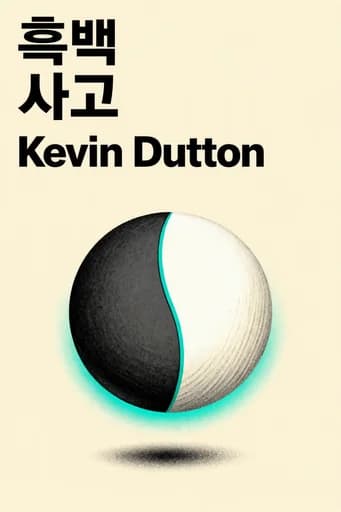
In "Black-and-White Thinking," Kevin Dutton reveals how our binary brains sabotage modern decision-making. Endorsed by Sir Philip Pullman as "entirely convincing," this eye-opening exploration explains Brexit, political extremism, and why your brain's evolutionary shortcuts might be your biggest liability.
Kevin Dutton is a research psychologist, bestselling author, and expert in cognitive psychology and social influence, best known for Black and White Thinking: The Burden of a Binary Brain in a Complex World.
A longtime academic at Oxford and Cambridge Universities, his work explores how polarized thinking shapes human behavior, drawing from his studies of psychopathic traits and persuasion.
Dutton’s fascination with rigid mental frameworks stems partly from observing his father, a charismatic London market trader whose psychopathic tendencies inspired his research. His other notable works include The Wisdom of Psychopaths, which examines the advantages of psychopathic traits in high-pressure professions, and Flipnosis, a study of split-second persuasion translated into 18 languages.
Co-author of The Good Psychopath’s Guide to Success with SAS veteran Andy McNab, Dutton frequently appears on platforms like Channel 4’s Psychopath Night and co-hosts the Psycho Schizo Espresso podcast. His SPICE model of social influence is used by military and corporate leaders to optimize decision-making.
Black and White Thinking synthesizes decades of research into why humans default to binary choices—a concept he popularized through TED-style talks and collaborations with Oxford Elite Performance.
Black-and-White Thinking explores how the human brain defaults to binary categorization as an evolutionary survival mechanism, examining both its advantages (quick decisions) and pitfalls (oversimplification). Dutton blends psychology, philosophy, and real-world examples like Brexit and COVID-19 policy debates to illustrate how rigid thinking shapes societal and personal choices.
This book appeals to psychology enthusiasts, leaders navigating complex decisions, and anyone seeking to recognize cognitive biases. It’s particularly relevant for readers interested in persuasion tactics, social dynamics, or improving emotional resilience in polarized environments.
Yes, for its insightful analysis of mental shortcuts and their societal impacts. Reviews praise its depth but note occasional repetitiveness. Readers gain actionable frameworks to identify and mitigate binary thinking in relationships, politics, and career decisions.
Dutton argues binary thinking evolved to help early humans quickly assess threats and opportunities. While effective for survival, this "cognitive shortcut" becomes problematic in modern contexts requiring nuanced judgment, such as gender identity debates or ethical dilemmas.
The book analyzes Brexit’s divisive rhetoric, COVID-19 policy polarization, and historical events like the Cold War. These cases demonstrate how binary frameworks amplify conflict and hinder compromise.
Co-developed by Dutton, the SPICE model identifies five persuasion principles: Simplicity, Perceived self-interest, Incongruity, Confidence, and Empathy. It’s used to dissect how leaders, marketers, and conspiracy theorists exploit binary narratives.
Dutton critiques rigid gender classifications as a cultural example of black-and-white thinking. He highlights evolving social norms to argue for spectrum-based perspectives, though some readers desire deeper exploration of this topic.
Critics note repetitive explanations and uneven depth in applying concepts to contemporary issues. Some argue Dutton’s focus on academic theories overshadows practical solutions for overcoming cognitive biases.
While both books examine extreme cognition, The Wisdom of Psychopaths focuses on harnessing traits like fearlessness for success. Black-and-White Thinking broadens the scope to societal polarization, offering a more systematic critique of mental rigidity.
Yes. Dutton provides tools to recognize oversimplification in high-stakes environments like finance or healthcare. Techniques include "cognitive recalibration" to balance intuition with analytical thinking, fostering adaptability in leadership.
These lines underscore the tension between evolutionary instincts and modern demands for nuance.
As AI and global crises amplify information overload, Dutton’s framework helps navigate misinformation and ideological echo chambers. The book equips readers to engage constructively in debates about technology, climate, and equity.
저자의 목소리로 책을 느껴보세요
지식을 흥미롭고 예시가 풍부한 인사이트로 전환
핵심 아이디어를 빠르게 캡처하여 신속하게 학습
재미있고 매력적인 방식으로 책을 즐기세요
Everyone has a right to run!
I was just doing my job-sorting things into boxes.
Life proceeds in imperceptible grains, yet our attention fixates only on heaps.
Black-And-White Thinking의 핵심 아이디어를 이해하기 쉬운 포인트로 분해하여 혁신적인 팀이 어떻게 창조하고, 협력하고, 성장하는지 이해합니다.
Black-And-White Thinking을 빠른 기억 단서로 압축하여 솔직함, 팀워크, 창의적 회복력의 핵심 원칙을 강조합니다.

생생한 스토리텔링을 통해 Black-And-White Thinking을 경험하고, 혁신 교훈을 기억에 남고 적용할 수 있는 순간으로 바꿉니다.
무엇이든 물어보고, 목소리를 선택하고, 진정으로 공감되는 인사이트를 함께 만들어보세요.

샌프란시스코에서 컬럼비아 대학교 동문들이 만들었습니다
"Instead of endless scrolling, I just hit play on BeFreed. It saves me so much time."
"I never knew where to start with nonfiction—BeFreed’s book lists turned into podcasts gave me a clear path."
"Perfect balance between learning and entertainment. Finished ‘Thinking, Fast and Slow’ on my commute this week."
"Crazy how much I learned while walking the dog. BeFreed = small habits → big gains."
"Reading used to feel like a chore. Now it’s just part of my lifestyle."
"Feels effortless compared to reading. I’ve finished 6 books this month already."
"BeFreed turned my guilty doomscrolling into something that feels productive and inspiring."
"BeFreed turned my commute into learning time. 20-min podcasts are perfect for finishing books I never had time for."
"BeFreed replaced my podcast queue. Imagine Spotify for books — that’s it. 🙌"
"It is great for me to learn something from the book without reading it."
"The themed book list podcasts help me connect ideas across authors—like a guided audio journey."
"Makes me feel smarter every time before going to work"
샌프란시스코에서 컬럼비아 대학교 동문들이 만들었습니다

Black-And-White Thinking 요약을 무료 PDF 또는 EPUB으로 받으세요. 인쇄하거나 오프라인에서 언제든 읽을 수 있습니다.
A murder case is solved by insect fragments. Four-month-old babies distinguish cats from dogs. Your brain sorts the world into boxes before you're even conscious of it. This isn't learned behavior-it's survival architecture built into your neural wiring over millions of years. When entomologist Lynn Kimsey examined bug remnants from a car radiator in 2003, she had no idea her taxonomic expertise would send a man to death row. Vincent Brothers claimed he was in Ohio when his family was murdered in California, but those insect fragments told a different story. Species from the East Coast, the Southwest, and California proved the rental car had made the cross-country journey. Kimsey's casual remark afterward reveals something profound: "I was just doing my job-sorting things into boxes." We're all doing that job, every moment of every day. Without this categorization instinct, you'd wake each morning as if on an alien planet, questioning whether the garden sprinkler is dangerous or if you should put your head in the washing machine. Categories transform chaos into predictability, allowing us to navigate the world without existential paralysis. This isn't just convenient-it's the difference between functioning and freezing.