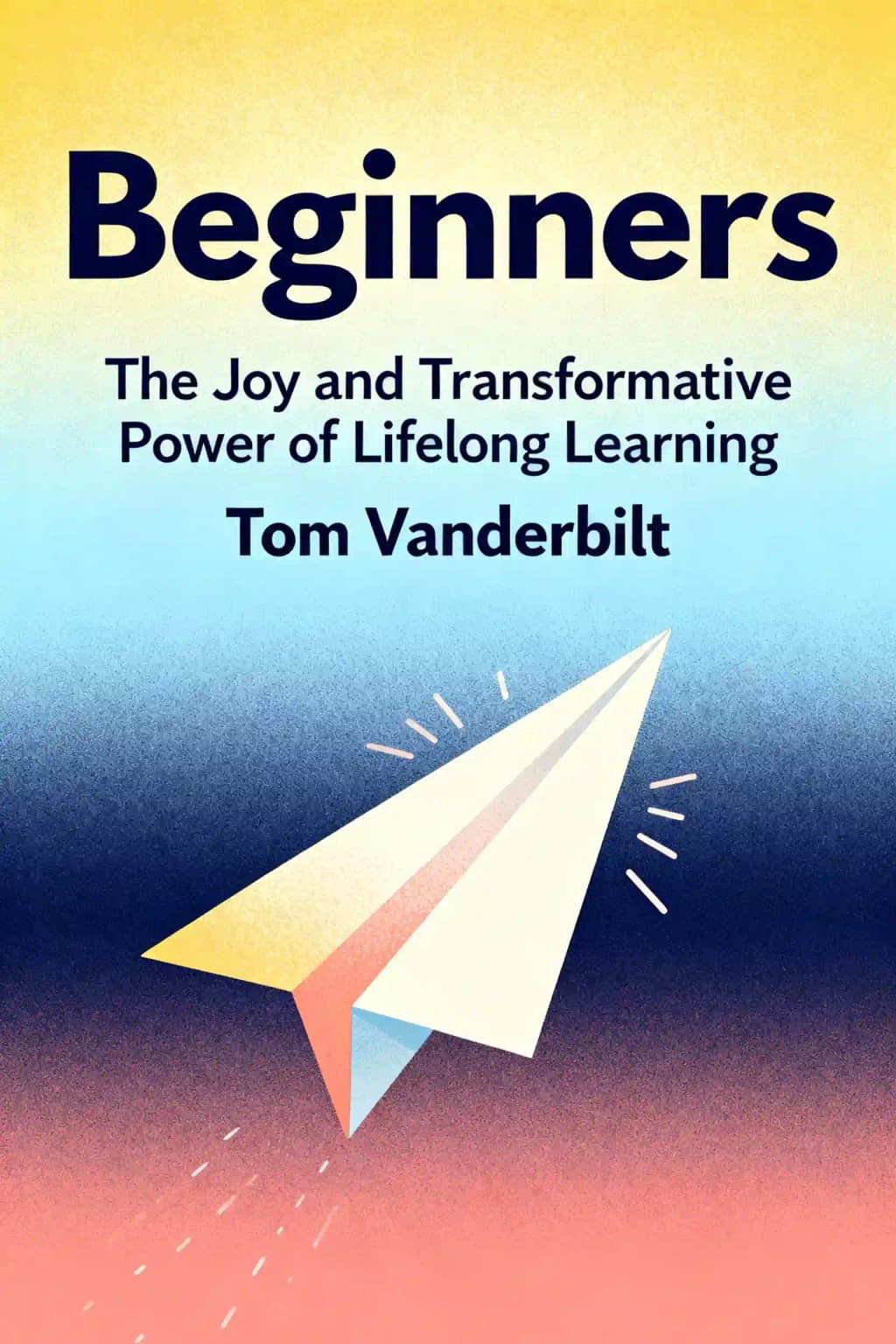
Discover why challenging yourself as a beginner transforms your brain. Vanderbilt's 2020 sensation reveals how learning alongside his daughter reshaped his perspective on growth. Embracing Nietzsche's "child at play" philosophy might be our most powerful antidote to stagnation. Ready to start something new?
Tom Vanderbilt is the bestselling author of Beginners: The Joy and Transformative Power of Lifelong Learning and an acclaimed journalist renowned for dissecting everyday phenomena through deep research and engaging storytelling.
A Brooklyn-based writer with bylines in Wired, The New York Times, and Artforum, Vanderbilt combines investigative rigor with personal narrative. This is clearly seen in Beginners, which blends memoir, psychology, and self-improvement to explore adult learning.
Vanderbilt's work is rooted in curiosity—whether unraveling traffic patterns in Traffic: Why We Drive the Way We Do (and What It Says About Us), a New York Times bestseller translated into 18 languages, or decoding taste algorithms in You May Also Like: Taste in an Age of Endless Choice.
A frequent speaker and media contributor, Vanderbilt has collaborated with institutions like NYU’s Rudin Center for Transportation and the Canadian Centre for Architecture. Beginners, praised for its humorous yet insightful take on skill-building, reflects his belief in reinvention at any age. His books have been featured on NPR, TEDx, and major bestseller lists, solidifying his reputation as a thinker who transforms mundane topics into cultural touchstones.
Beginners explores the cognitive, emotional, and social benefits of learning new skills as an adult, blending personal experiments (like chess and singing) with neuroscience and psychology. Tom Vanderbilt argues that embracing beginnerhood fosters resilience, creativity, and joy, challenging the notion that mastery is reserved for the young.
This book suits lifelong learners, professionals facing career transitions, and anyone seeking personal growth. It’s particularly valuable for those feeling stagnant or intimidated by new challenges, offering practical insights into overcoming the fear of failure.
Key ideas include:
Both books advocate for diverse skill exploration, but Beginners focuses on the emotional journey of starting anew, while Range emphasizes broad skill application for specialization. Vanderbilt’s work complements Epstein’s with its emphasis on psychological rewards.
Yes. Vanderbilt demonstrates how learning new skills boosts adaptability and confidence, critical for career pivots. The book’s case studies, like a marketing exec learning pottery, show how lateral thinking enhances professional agility.
Some reviewers note the anecdotes occasionally overshadow scientific depth, and the focus on hobby-based learning may undersell high-stakes skill acquisition. However, its motivational tone balances these gaps.
With AI reshaping job markets, Vanderbilt’s emphasis on adaptability and continuous learning aligns with trends in reskilling. The book’s lessons on embracing uncertainty resonate in fast-evolving industries.
Both books decode everyday systems (driving, learning) through interdisciplinary research. While Traffic examines collective behavior, Beginners turns inward, exploring individual growth through curiosity.
Yes. Vanderbilt cites studies on neuroplasticity, skill acquisition (e.g., 10,000-hour rule nuances), and psychological barriers like the “fixed mindset,” grounding his narrative in credible evidence.
The 288-page book takes 6–8 hours for most readers. For quicker insights, Blinkist’s 15-minute summary captures core concepts, though the full text offers richer anecdotes.
저자의 목소리로 책을 느껴보세요
지식을 흥미롭고 예시가 풍부한 인사이트로 전환
핵심 아이디어를 빠르게 캡처하여 신속하게 학습
재미있고 매력적인 방식으로 책을 즐기세요
Learning new skills isn't just for career advancement-it's vital for brain health and personal growth.
We are all, at some point, beginners.
Walking skill correlates more with experience than age.
Experts can become trapped by their knowledge.
Beginners의 핵심 아이디어를 이해하기 쉬운 포인트로 분해하여 혁신적인 팀이 어떻게 창조하고, 협력하고, 성장하는지 이해합니다.
Beginners을 빠른 기억 단서로 압축하여 솔직함, 팀워크, 창의적 회복력의 핵심 원칙을 강조합니다.

생생한 스토리텔링을 통해 Beginners을 경험하고, 혁신 교훈을 기억에 남고 적용할 수 있는 순간으로 바꿉니다.
무엇이든 물어보고, 목소리를 선택하고, 진정으로 공감되는 인사이트를 함께 만들어보세요.

샌프란시스코에서 컬럼비아 대학교 동문들이 만들었습니다
"Instead of endless scrolling, I just hit play on BeFreed. It saves me so much time."
"I never knew where to start with nonfiction—BeFreed’s book lists turned into podcasts gave me a clear path."
"Perfect balance between learning and entertainment. Finished ‘Thinking, Fast and Slow’ on my commute this week."
"Crazy how much I learned while walking the dog. BeFreed = small habits → big gains."
"Reading used to feel like a chore. Now it’s just part of my lifestyle."
"Feels effortless compared to reading. I’ve finished 6 books this month already."
"BeFreed turned my guilty doomscrolling into something that feels productive and inspiring."
"BeFreed turned my commute into learning time. 20-min podcasts are perfect for finishing books I never had time for."
"BeFreed replaced my podcast queue. Imagine Spotify for books — that’s it. 🙌"
"It is great for me to learn something from the book without reading it."
"The themed book list podcasts help me connect ideas across authors—like a guided audio journey."
"Makes me feel smarter every time before going to work"
샌프란시스코에서 컬럼비아 대학교 동문들이 만들었습니다

Beginners 요약을 무료 PDF 또는 EPUB으로 받으세요. 인쇄하거나 오프라인에서 언제든 읽을 수 있습니다.
Picture this: I'm sitting in a New York City chess club, heart racing, trying to project menace across the board. My opponent and I shake hands. I'm channeling psychological warfare when a woman appears with chocolate milk-for my opponent Ryan, who is eight years old. Thirty moves later, he dispatches me with ease. This humbling experience was part of my deliberate journey into "beginnerdom"-learning chess alongside my daughter, who eventually surpassed me despite our four-decade age gap. There's something radical about choosing to be a beginner again in our achievement-obsessed culture. The proposition is simple yet transformative: learning new skills as an adult isn't just possible but essential-not because you'll master them, but because the very act of being a beginner reignites joy, curiosity, and neural pathways you thought were closed forever. When was the last time you learned something completely new? Most parents dutifully shuttle children between piano lessons, soccer practice, and coding camps while never engaging in learning themselves. When I asked chess parents if they played, most responded with apologetic shrugs. If chess was so beneficial for children's development, why were adults avoiding it? I realized I'd spent years acquiring "knowing that" knowledge as a journalist while neglecting "knowing how"-procedural skills that engage different parts of the brain.