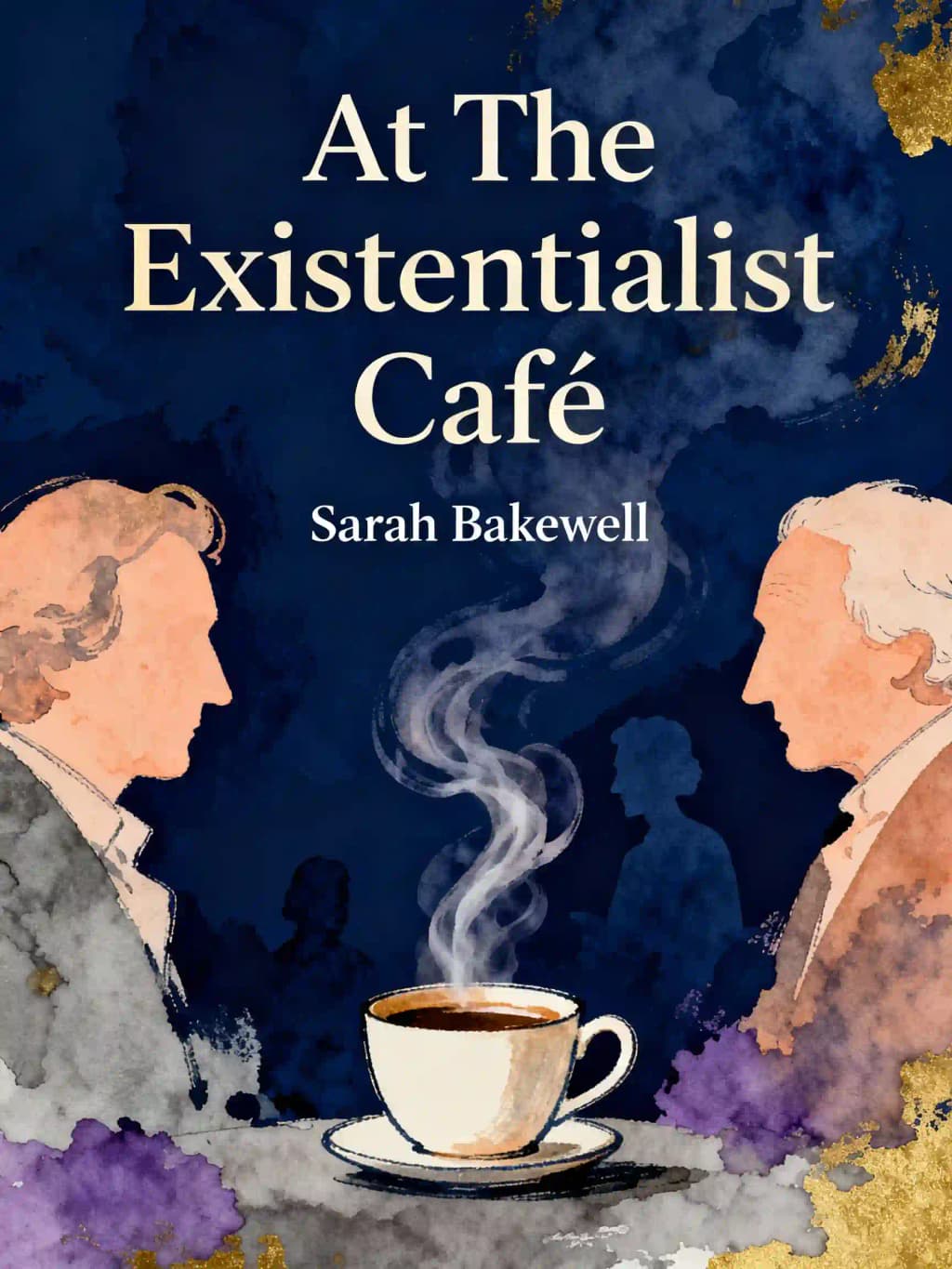
Journey into a Parisian cafe where existentialist philosophy was born over apricot cocktails. Named a NY Times Best Book of 2016, Bakewell's masterpiece humanizes Sartre and Beauvoir, revealing how their radical ideas on freedom still fuel today's liberation movements.
Sarah Bakewell, the acclaimed author of At the Existentialist Café: Freedom, Being, and Apricot Cocktails, is an award-winning historical biographer celebrated for her accessible explorations of philosophy and intellectual history.
A former curator of early printed books at London’s Wellcome Library, Bakewell combines rigorous scholarship with vivid storytelling. This skill has been honed through works like How to Live: A Life of Montaigne—winner of the National Book Critics Circle Award—and The English Dane.
Her fascination with existentialism began in her teens, inspiring her to craft this group biography of Sartre, de Beauvoir, and their contemporaries, which was named a New York Times Ten Best Book of 2016 and shortlisted for the PEN Hessell-Tiltman Prize. A recipient of the Windham-Campbell Prize for nonfiction, Bakewell’s insights also extend to her latest work, Humanly Possible, and her role teaching creative non-fiction at the University of Oxford.
At the Existentialist Café has been translated into over 20 languages, cementing Bakewell’s reputation as a bridge between complex ideas and modern readers.
At the Existentialist Café by Sarah Bakewell explores the lives and ideas of 20th-century existentialist philosophers like Jean-Paul Sartre, Simone de Beauvoir, and Martin Heidegger. Blending biography and intellectual history, it traces how their radical philosophies on freedom, authenticity, and human existence evolved amid personal struggles, wartime upheavals, and heated debates. Bakewell illuminates complex concepts through vivid storytelling, showing how these thinkers reshaped modern thought.
This book is ideal for readers curious about existentialism but intimidated by dense academic texts. Philosophy enthusiasts, history buffs, and fans of narrative nonfiction will appreciate Bakewell’s accessible style. It’s also recommended for those interested in how WWII-era intellectuals grappled with ethics, politics, and the human condition.
Yes—Bakewell’s engaging prose makes existentialism relatable without oversimplifying its depth. The book balances rigorous analysis with humorous anecdotes (like Sartre’s love of apricot cocktails) and critiques the philosophers’ contradictions. It’s a New York Times Top 10 Book of 2016, praised for revitalizing interest in existentialist thought.
Key figures include Jean-Paul Sartre, Simone de Beauvoir, Maurice Merleau-Ponty, Martin Heidegger, and Albert Camus. Bakewell highlights their collaborations, rivalries, and ideological clashes, while contextualizing their work within events like the French Resistance and Cold War politics. Lesser-known thinkers like Karl Jaspers and Edmund Husserl also appear.
Bakewell connects these themes to the philosophers’ lives, such as Beauvoir’s feminist existentialism and Heidegger’s controversial Nazi ties.
She candidly examines their flaws—Sartre’s manipulative relationships, Heidegger’s fascism, and Beauvoir’s complex feminism. By linking their philosophies to their imperfections, Bakewell humanizes them, showing how existentialism isn’t about abstract ideas but lived realities.
Bakewell critiques existentialism’s individualism, its occasional nihilism, and the movement’s failure to address systemic oppression adequately. She also dissects Heidegger’s political compromises and Sartre’s later support for Stalinism, highlighting tensions between their ideals and actions.
The war forced existentialists to confront ethical extremes: Sartre and Beauvoir joined the French Resistance, while Heidegger’s Nazi affiliation tainted his legacy. Bakewell shows how occupation, collaboration, and survival intensified debates about freedom, morality, and human nature.
Bakewell avoids jargon, using anecdotes (like Sartre’s mescaline experiments) and witty prose to demystify terms like “bad faith” or “being-for-itself.” She also ties concepts to everyday dilemmas, such as finding purpose in a chaotic world.
Like How to Live (a Montaigne biography), this book blends biography and philosophy with irreverence and clarity. However, it focuses on collaborative intellectual movements rather than individual thinkers, offering a broader cultural lens.
Bakewell argues existentialism’s focus on autonomy, anxiety, and meaning resonates in modern crises like climate change and political polarization. The book encourages readers to confront uncertainty courageously—a timely message for 2025.
저자의 목소리로 책을 느껴보세요
지식을 흥미롭고 예시가 풍부한 인사이트로 전환
핵심 아이디어를 빠르게 캡처하여 신속하게 학습
재미있고 매력적인 방식으로 책을 즐기세요
Constant choosing brings pervasive anxiety—"the dizziness of freedom."
"God is dead."
"Return to the things themselves."
Existence precedes any statements about it.
We must affirm every moment of life without resentment.
At the Existentialist Café의 핵심 아이디어를 이해하기 쉬운 포인트로 분해하여 혁신적인 팀이 어떻게 창조하고, 협력하고, 성장하는지 이해합니다.
At the Existentialist Café을 빠른 기억 단서로 압축하여 솔직함, 팀워크, 창의적 회복력의 핵심 원칙을 강조합니다.

생생한 스토리텔링을 통해 At the Existentialist Café을 경험하고, 혁신 교훈을 기억에 남고 적용할 수 있는 순간으로 바꿉니다.
무엇이든 물어보고, 목소리를 선택하고, 진정으로 공감되는 인사이트를 함께 만들어보세요.

샌프란시스코에서 컬럼비아 대학교 동문들이 만들었습니다
"Instead of endless scrolling, I just hit play on BeFreed. It saves me so much time."
"I never knew where to start with nonfiction—BeFreed’s book lists turned into podcasts gave me a clear path."
"Perfect balance between learning and entertainment. Finished ‘Thinking, Fast and Slow’ on my commute this week."
"Crazy how much I learned while walking the dog. BeFreed = small habits → big gains."
"Reading used to feel like a chore. Now it’s just part of my lifestyle."
"Feels effortless compared to reading. I’ve finished 6 books this month already."
"BeFreed turned my guilty doomscrolling into something that feels productive and inspiring."
"BeFreed turned my commute into learning time. 20-min podcasts are perfect for finishing books I never had time for."
"BeFreed replaced my podcast queue. Imagine Spotify for books — that’s it. 🙌"
"It is great for me to learn something from the book without reading it."
"The themed book list podcasts help me connect ideas across authors—like a guided audio journey."
"Makes me feel smarter every time before going to work"
샌프란시스코에서 컬럼비아 대학교 동문들이 만들었습니다

At the Existentialist Café 요약을 무료 PDF 또는 EPUB으로 받으세요. 인쇄하거나 오프라인에서 언제든 읽을 수 있습니다.
What happens when three young philosophers walk into a Parisian bar and order apricot cocktails? In 1932, that seemingly mundane moment sparked a philosophical revolution. Raymond Aron, fresh from Berlin, excitedly described phenomenology to Jean-Paul Sartre and Simone de Beauvoir: "If you are a phenomenologist, you can talk about this cocktail and make philosophy out of it!" Sartre reportedly turned pale with excitement. Within weeks, he'd devoured Edmund Husserl's work and arranged his own trip to Berlin. This conversation birthed existentialism-a philosophy rejecting abstract theories for lived experience, one that would dominate intellectual life for decades and fundamentally reshape how we understand freedom, authenticity, and what it means to be human. By the late 1940s, existentialism had become a cultural phenomenon. Sartre's 1945 lecture drew such crowds that women fainted in the heat. The Catholic Church banned his works while Marxists attacked his emphasis on individual freedom. Yet condemnation only enhanced existentialism's appeal among the young, who adopted black turtlenecks and gathered in Left Bank cafes, treating philosophy not as academic exercise but as a way of life.