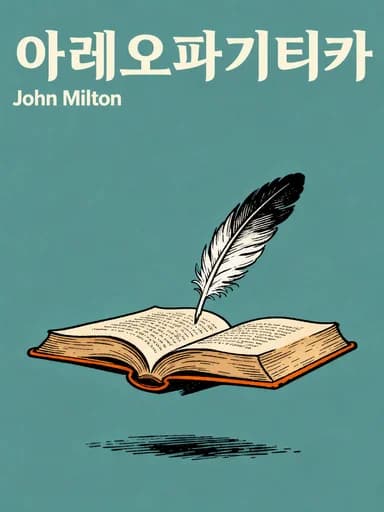
Before censorship was a hot-button issue, Milton's "Areopagitica" (1644) boldly defied Parliament's publishing restrictions. This revolutionary pamphlet - cited alongside Mill's "On Liberty" - established the intellectual foundation for free speech that would later inspire Blake, Wordsworth, and modern democratic principles.
John Milton (1608–1674), author of Areopagitica, was a visionary English poet, polemicist, and civil servant whose works shaped debates on free expression and moral choice. Known for his epic poem Paradise Lost—a landmark of English literature exploring humanity’s fall—Milton blended classical scholarship with radical political advocacy.
Areopagitica, his 1644 prose pamphlet, passionately argues against government censorship, asserting that truth emerges through open debate.
Drawing from his role as Secretary for Foreign Tongues under Oliver Cromwell’s Commonwealth, Milton championed civil liberties while navigating England’s religious and political upheavals. His later works, including Paradise Regained and Samson Agonistes, further examine themes of redemption and resilience, often composed after he lost his sight in 1652.
Milton’s writings, celebrated for their intellectual rigor and lyrical power, remain foundational in Western literature and political thought. Paradise Lost alone has inspired countless adaptations and is widely regarded as the greatest epic poem in the English language.
Areopagitica (1644) is John Milton’s seminal defense of free speech and unlicensed publishing, written to protest England’s 1643 Licensing Order requiring government pre-approval for all printed works. Milton argues that censorship stifles intellectual growth, equating book bans to “slaughtering reason itself”. He asserts truth emerges through open debate, not suppression, and critiques state overreach using classical allusions to Athenian democracy. This polemic remains a cornerstone of free expression philosophy.
This book is essential for students of political philosophy, free speech advocates, and historians exploring democratic thought. Milton’s arguments resonate with modern debates on censorship, making it valuable for policymakers, journalists, and activists. Its dense prose suits readers comfortable with classical references, though its core ideas remain accessible to anyone passionate about civil liberties.
Yes. Despite its 17th-century context, Areopagitica offers timeless insights into free expression’s role in moral and intellectual progress. Milton’s critique of pre-publication censorship—and his belief in truth’s resilience—directly informs modern human rights frameworks. At just 30 pages, it’s a concise yet powerful addition to libertarian literature.
Milton contends censorship:
The title references Athens’ Areopagus, a hill symbolizing democratic discourse. Milton contrasts Parliament’s censorship with ancient Greece’s tradition of open debate, urging lawmakers to emulate Athenian trust in civic reason. This metaphor positions free speech as a pillar of enlightened governance.
While opposing pre-publication licensing, Milton supported post-publication penalties for “libelous or atheistic” works. This contradiction reflects his Puritan beliefs, where moral accountability followed—rather than preceded—expression. Modern free speech advocates often critique this duality.
Milton’s arguments prefigure modern “marketplace of ideas” theories, influencing First Amendment jurisprudence. His warnings against state control parallel discussions on internet censorship, fake news, and algorithmic bias. The text is frequently cited in legal challenges to book bans and content moderation laws.
Key lines include:
Milton condemns the law as a regressive overreach, arguing Parliament’s post-revolutionary crackdown on dissent mirrored the monarchy it overthrew. He warns licensing corrupts civic trust and enables ideological gatekeeping, asserting “a forbidden writing is thought to be a certain spark of truth”.
Scholars note Milton’s exclusion of Catholic texts from his free speech ideal and his support for post-hoc blasphemy laws. Others argue his focus on educated discourse overlooks marginalized voices. Despite these gaps, the work’s defense of press freedom remains globally influential.
Unlike John Stuart Mill’s On Liberty, which systematizes free expression principles, Milton’s work is a polemic rooted in Reformation politics. However, both share foundational ideas: truth thrives in debate, and censorship infantilizes societies. Modern comparisons often highlight Milton’s focus on pre-publication bans versus contemporary digital-era challenges.
In an era of AI-driven content moderation and global censorship laws, Milton’s warnings against centralized control of ideas remain urgent. The text underscores free speech as non-negotiable for innovation and democracy—a principle tested by disinformation crises and authoritarian tech policies.
저자의 목소리로 책을 느껴보세요
지식을 흥미롭고 예시가 풍부한 인사이트로 전환
핵심 아이디어를 빠르게 캡처하여 신속하게 학습
재미있고 매력적인 방식으로 책을 즐기세요
For books are not absolutely dead things, but do contain a potency of life in them to be as active as that soul was whose progeny they are; nay, they do preserve as in a vial the purest efficacy and extraction of that living intellect that bred them.
Where there is much desire to learn, there of necessity will be much arguing, much writing, many opinions; for opinion in good men is but knowledge in the making.
Let her and Falsehood grapple; who ever knew Truth put to the worse, in a free and open encounter?
I deny not, but that it is of greatest concernment in the church and commonwealth, to have a vigilant eye how books demean themselves as well as men; and thereafter to confine, imprison, and do sharpest justice on them as malefactors.
Areopagitica의 핵심 아이디어를 이해하기 쉬운 포인트로 분해하여 혁신적인 팀이 어떻게 창조하고, 협력하고, 성장하는지 이해합니다.
Areopagitica을 빠른 기억 단서로 압축하여 솔직함, 팀워크, 창의적 회복력의 핵심 원칙을 강조합니다.

생생한 스토리텔링을 통해 Areopagitica을 경험하고, 혁신 교훈을 기억에 남고 적용할 수 있는 순간으로 바꿉니다.
무엇이든 물어보고, 목소리를 선택하고, 진정으로 공감되는 인사이트를 함께 만들어보세요.

샌프란시스코에서 컬럼비아 대학교 동문들이 만들었습니다
"Instead of endless scrolling, I just hit play on BeFreed. It saves me so much time."
"I never knew where to start with nonfiction—BeFreed’s book lists turned into podcasts gave me a clear path."
"Perfect balance between learning and entertainment. Finished ‘Thinking, Fast and Slow’ on my commute this week."
"Crazy how much I learned while walking the dog. BeFreed = small habits → big gains."
"Reading used to feel like a chore. Now it’s just part of my lifestyle."
"Feels effortless compared to reading. I’ve finished 6 books this month already."
"BeFreed turned my guilty doomscrolling into something that feels productive and inspiring."
"BeFreed turned my commute into learning time. 20-min podcasts are perfect for finishing books I never had time for."
"BeFreed replaced my podcast queue. Imagine Spotify for books — that’s it. 🙌"
"It is great for me to learn something from the book without reading it."
"The themed book list podcasts help me connect ideas across authors—like a guided audio journey."
"Makes me feel smarter every time before going to work"
샌프란시스코에서 컬럼비아 대학교 동문들이 만들었습니다

Areopagitica 요약을 무료 PDF 또는 EPUB으로 받으세요. 인쇄하거나 오프라인에서 언제든 읽을 수 있습니다.
What drives someone to risk everything for a principle? In 1644, John Milton-a devout Puritan scholar who had spent years supporting Parliament against the monarchy-did something shocking: he turned against his own allies. Parliament had just passed a law requiring all books to receive government approval before publication, ostensibly to fight royalist propaganda. But when Milton published controversial views on divorce and found himself targeted by this very law, he experienced censorship firsthand. His response wasn't quiet compliance but a soaring defense of intellectual freedom that would echo through centuries. "Areopagitica," named after the ancient Athenian court where citizens debated freely, became more than a protest against book licensing-it became a revolutionary vision of how truth itself emerges. Milton's path to radicalism began in privilege. Born in 1608 to a wealthy London scrivener, he received the finest education money could buy-private tutors, St. Paul's School, and Cambridge. But instead of pursuing the expected clerical career, Milton made a bold choice: dedicating himself entirely to scholarship and poetry. For six years, he lived in his father's country home, reading voraciously and writing works like "Comus" that showcased his extraordinary gifts. His Continental tour brought encounters that shaped his thinking profoundly-particularly meeting the elderly, blind Galileo, imprisoned for his scientific views. This meeting would haunt Milton when he later lost his own sight, becoming a living symbol of how authority crushes inquiry. Yet Milton's life took an unexpected turn in 1643. He returned from a journey with a seventeen-year-old bride, Mary Powell, who fled back to her family within weeks. The rejection devastated him, prompting Milton to write "The Doctrine and Discipline of Divorce"-arguing that incompatibility justified ending marriage. The backlash was fierce. Clergy denounced him from pulpits. The Stationers' Company complained he'd violated licensing laws. Suddenly, this establishment intellectual found himself censored by his own political allies. This personal crisis became the crucible for "Areopagitica." Milton understood censorship not as abstraction but as lived experience-the silencing of ideas that challenged orthodoxy, even when those ideas deserved hearing.