1장
Dreams of a Nation, Realities of Leadership
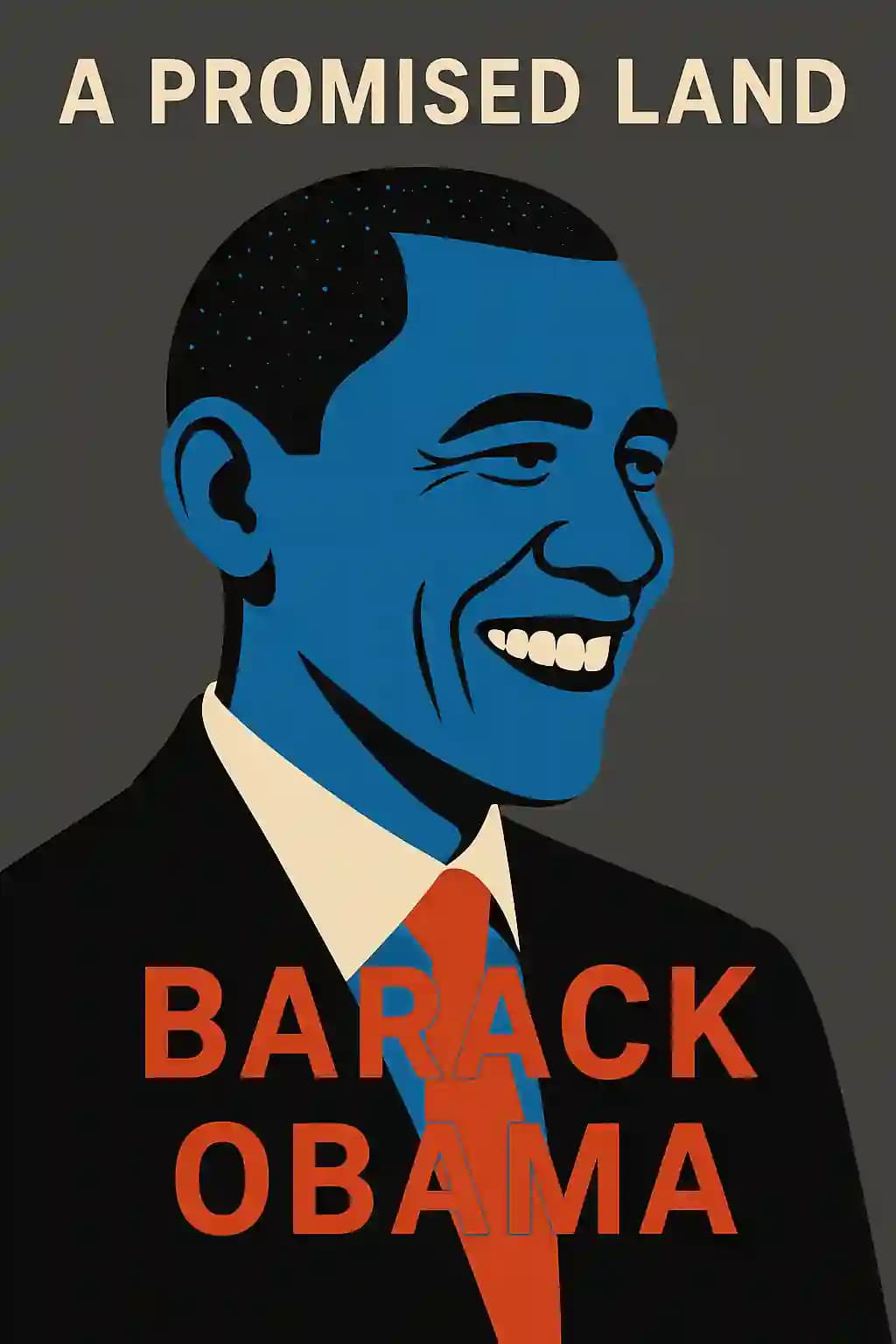
When Barack Obama burst onto the national stage with his electrifying 2004 Democratic Convention speech, few could have predicted his meteoric rise to the presidency just four years later. Yet his memoir "A Promised Land" reveals that Obama's journey wasn't simply a tale of political ambition, but rather a complex exploration of American identity, democratic ideals, and the weight of leadership during one of the most challenging periods in modern American history. Endorsed by cultural icons from Oprah Winfrey to Bruce Springsteen, this deeply personal account has become not just a political memoir but a cultural touchstone that sold nearly 900,000 copies in its first day of release-a testament to Obama's enduring influence on American consciousness.
2장
The Unlikely Journey: From Community Organizer to Presidential Candidate
Barack Obama's path to the presidency defied conventional political wisdom. Unlike most politicians who climb predictable ladders of power, Obama's journey began in the streets of Chicago's South Side, where he worked as a community organizer after graduating from Columbia University. This formative experience shaped his political philosophy in ways that would later define his presidency.
"I don't come from a political family," Obama writes, reflecting on his unconventional background. His mother, though politically aware and passionate about social justice, never joined campaigns. His absent Kenyan father offered little guidance. What drove Obama was an intellectual curiosity and deep questioning about his place in America-questions about race, class divisions, and the contradictions he observed in American society.
These questions led him first to community organizing, then to Harvard Law School, and eventually to the Illinois State Senate. Obama describes his early political career with refreshing candor, acknowledging his initial struggles with the compromises required in politics. His first campaign loss-a crushing defeat to Bobby Rush for a congressional seat-taught him painful but necessary lessons about political timing and authenticity.
When Obama decided to run for the U.S. Senate in 2004, even his closest advisors were skeptical. Yet his victory, followed by his electrifying keynote address at the Democratic National Convention, catapulted him into national consciousness. "Before that night in Boston," he reflects, "I thought I understood media power from seeing Axelrod's ads boost my campaign, but the convention speech exposure was entirely different-an unfiltered transmission to millions."
The leap from freshman senator to presidential candidate came sooner than anyone expected, including Obama himself. When asked about his presidential ambitions just months into his Senate term, he laughed it off, explaining he'd just arrived, ranked ninety-ninth in seniority, and didn't even know where the Capitol restrooms were. Yet by 2006, the possibility had taken root, driven not by personal ambition alone but by a sense that America was ready for a different kind of leadership.
Obama's decision to run for president wasn't made lightly. His wife Michelle initially opposed the idea, reminding him how politics exposed their family and questioning when it would ever be enough. "I don't want you to run for president, at least not now," she told him firmly. Obama couldn't blame her-he had involved his staff before seeking her blessing, putting her in an impossible position. This tension between family obligations and political calling would remain a constant theme throughout his presidency.
3장
The Campaign That Changed American Politics
Obama's 2008 presidential campaign revolutionized American politics through its grassroots organization, digital innovation, and message of hope and change. In Iowa, campaign manager David Plouffe built an operation strong enough to challenge Hillary Clinton's established political machine in just six months. Field director Paul Tewes opened offices in all ninety-nine Iowa counties, each staffed by young organizers who embedded themselves in local communities.
"These young organizers reminded me of my own community organizing days in Chicago," Obama writes, "pointing me back to why I'd entered politics-not for power and positioning but for community and connection." Their dedication paid off with a decisive victory in the Iowa caucuses, sending shockwaves through the political establishment.
The campaign's financial strategy proved equally revolutionary. While Hillary Clinton had cultivated a national donor base for decades, Obama discovered America's hunger for change was stronger than anticipated. Small donations poured in-ten, twenty, hundred-dollar increments from college students pledging their Starbucks budgets or grandmas collecting from sewing circles. These millions from small donors allowed the campaign to compete everywhere while infusing it with grassroots energy.
Yet the path to nomination wasn't smooth. After losing the New Hampshire primary, Obama discovered a quality that would prove useful throughout his presidency: he often felt steadiest when things were going to hell. This resilience carried the campaign through the bitter primary battle with Clinton and the controversy surrounding Obama's former pastor, Reverend Jeremiah Wright, whose inflammatory sermons threatened to derail the campaign.
The general election brought different challenges, particularly the selection of Sarah Palin as John McCain's running mate. Though Palin became a late-night comedy punchline after disastrous media interviews, Obama recognized her power lay elsewhere. She drew massive crowds, inflaming them with nativist rhetoric and suggesting Obama didn't see America as they did. Through Palin, Obama writes, "the dark spirits long lurking at the Republican Party's edges-xenophobia, anti-intellectualism, conspiracy theories, and antipathy toward Black and brown folks-found their way to center stage."
Despite these challenges, Obama's campaign maintained its focus on economic issues as the 2008 financial crisis unfolded. The collapse of Lehman Brothers and subsequent market panic created both an opportunity and a test for Obama's leadership. In a critical White House meeting with President Bush and congressional leaders, Obama demonstrated his command of the issues while McCain appeared unprepared-a moment that helped solidify Obama's image as the steadier leader during crisis.
4장
The Weight of History: Becoming the First Black President
Throughout his memoir, Obama grapples with the historical significance of becoming America's first Black president. He recalls W.E.B. Du Bois's concept of "double consciousness"-the sense of always looking at oneself through others' eyes-and how this took on new meaning during his campaign and presidency.
"Though I had learned from Du Bois's writing and wrestled with my mixed-race status," Obama writes, "I had never personally felt this sense of divided identity or had others question my fundamental 'American-ness'-at least not until I ran for president." The campaign brought waves of rumors questioning his nationality and background-from false claims about Indonesian madrassas to conspiracy theories about his citizenship.
On election night, as 200,000 people gathered in Chicago's Grant Park to celebrate his victory, Obama felt the weight of history. His favorite photograph from that evening isn't from the park itself but one he received years later showing a small gathering at the Lincoln Memorial during his speech-"the giant marble figure shining brightly behind them as they listened to the radio, contemplating who we are as a people and the arc of democracy."
The inauguration crystallized this historical moment. Walking through the Capitol to take the oath of office, Obama thought about the enslaved people who had helped build the structure, about civil rights marchers who had faced dogs and fire hoses, about his own grandfather who once had to ride in the back of the bus. The ceremony itself reflected this complicated history-using Lincoln's Bible for the oath while the invocation was delivered by Rick Warren, a pastor whose views on gay rights Obama disagreed with but who represented an important constituency in American life.
Yet Obama resisted being defined solely as a "Black president." He sought to govern as president for all Americans while acknowledging the special significance his election held for Black Americans and other minorities. This balancing act-honoring the historical milestone while not being limited by it-would characterize much of his approach to racial issues during his presidency.
5장
Crisis Management: The Economic Collapse and Healthcare Reform
Obama took office facing the worst economic crisis since the Great Depression. In a mid-December briefing, his economic team revealed the catastrophic scale: financial institutions failing, the stock market down 40%, foreclosures on 2.3 million homes, and household wealth dropping 16%-five times worse than after the 1929 crash. "If you watched cable news," his press secretary Robert Gibbs explained, "you'd be worried about you too."
The Recovery Act became Obama's first major legislative achievement-a nearly $800 billion package combining emergency payments, tax cuts, and infrastructure investments. Though economists like Christina Romer argued they needed even more ("a trillion dollars"), political reality constrained their ambitions. Despite Obama's campaign rhetoric about transcending partisanship and his genuine efforts at outreach, Republican cooperation proved a mirage. The bill passed the House without a single Republican vote-the opening salvo in what Obama describes as "McConnell and Boehner's eight-year strategy of total obstruction."
Beyond the immediate crisis response, Obama remained determined to pursue healthcare reform-a goal that had eluded presidents for decades. This commitment was deeply personal. He remembered rushing three-month-old Sasha to the emergency room for viral meningitis, thought of his friend Bobby who avoided doctors because insurance would cost him a week's fishing catch, and most painfully, recalled his mother's battle with cancer while fighting her insurer over a preexisting condition claim.
The fight for the Affordable Care Act consumed much of Obama's first two years, facing opposition not just from Republicans but skepticism within his own party. When Massachusetts Republican Scott Brown won Ted Kennedy's Senate seat in a special election, many declared healthcare reform dead. Yet through parliamentary maneuvering and Nancy Pelosi's legislative skill, the bill passed in March 2010-more than a year after Obama's first White House summit on the issue.
"This celebration meant more to me than election night," Obama writes about the passage, "a promise fulfilled rather than just made." After everyone left, past midnight, he thought about Ted Kennedy and his mom. "It was a good day."
6장
Foreign Policy Challenges: Wars, Terrorism, and the Arab Spring
Obama inherited two wars and the ongoing fight against al-Qaeda. Though he had opposed the Iraq War from the beginning, he now faced the responsibility of bringing it to a responsible conclusion while refocusing on Afghanistan, which he considered "a war of necessity." This led to one of his most difficult decisions-sending 30,000 additional troops to Afghanistan in 2009, a decision that disappointed many supporters who expected a quicker withdrawal from both conflicts.
The hunt for Osama bin Laden represented a key priority from Obama's first days in office. When intelligence located a compound in Abbottabad, Pakistan that might house the al-Qaeda leader, Obama faced a momentous decision-whether to launch a risky raid into Pakistani territory. After weighing the options, he authorized the mission, which succeeded in killing bin Laden on May 1, 2011.
"For Americans, the raid offered catharsis-the closest thing to a V-Day in a war without formal surrenders," Obama writes. Yet even in this moment of triumph, he found himself questioning American priorities: "Was this unity of purpose only possible when killing terrorists? I found myself imagining what America might accomplish if we brought the same expertise and determination to education, housing, poverty, or climate change."
The Arab Spring presented different challenges. When protests erupted across the Middle East in early 2011, Obama had to balance America's stated commitment to democracy and human rights against its strategic relationships with authoritarian regimes. The situation in Libya proved particularly difficult, as Muammar Gaddafi threatened a massacre in Benghazi. Despite military leaders' reluctance to engage in another Middle Eastern conflict, Obama authorized a limited intervention alongside European and Arab allies.
"Despite political risks and Gates' compelling arguments against intervention," Obama writes, "I knew without American leadership, Gaddafi would lay siege to Benghazi, potentially killing tens of thousands."
7장
The Partisan Divide: Governing in an Era of Polarization
Throughout his presidency, Obama confronted an unprecedented level of partisan opposition that surprised even seasoned Washington observers. The rise of the Tea Party movement, which Obama describes as "substantially funded by Koch brother affiliates and conservative billionaires" but representing "genuine populist anger from Americans who'd suffered from economic decline," transformed Republican politics and made compromise increasingly difficult. This grassroots conservative movement gained momentum in 2009, organizing protests against government spending and healthcare reform, while bringing a new wave of confrontational politicians to Washington.
Obama's attempts at bipartisanship repeatedly met fierce resistance. When he invited Republicans to a healthcare summit at Blair House in February 2010, they arrived with props and talking points rather than substantive alternatives. The seven-hour televised meeting, intended to demonstrate good-faith negotiation, instead highlighted the deep ideological divide. During critical budget negotiations, Speaker John Boehner struggled to control the more extreme elements of his caucus who threatened to force a government default by refusing to raise the debt ceiling. These negotiations in 2011 marked a particularly tense period, with the nation coming within days of default before a last-minute agreement was reached.
The 2010 midterm elections delivered what Obama calls "a shellacking"-Democrats lost sixty-three House seats in the worst beating since FDR's second term. The election saw the defeat of many moderate Democrats, particularly in suburban and rural districts, fundamentally altering the political landscape. Though Obama maintained that his policies were correct, he acknowledged failing to rally the nation behind them effectively. The election marked a turning point in his presidency, forcing a more defensive posture focused on protecting achievements rather than pursuing bold new initiatives. This shift was evident in subsequent legislative battles over financial regulation, climate change, and immigration reform.
Perhaps most troubling to Obama was the emergence of "birtherism"-conspiracy theories questioning his American citizenship that gained traction despite overwhelming evidence. These theories, which began circulating during the 2008 campaign, reached new heights when Donald Trump became their most prominent promoter. Obama saw this movement as offering "an elixir for racial anxiety to millions uncomfortable with a Black man in the White House." The persistence of these theories, despite the release of Obama's long-form birth certificate in 2011, highlighted deeper racial tensions in American society and foreshadowed the political dynamics that would shape the 2016 election. The birther movement also complicated Obama's ability to address racial issues directly, as any such discussion risked further polarizing an already divided electorate.
8장
Personal Reflections: Family, Legacy, and the Presidency's Toll
Throughout "A Promised Land," Obama reflects candidly on how the presidency affected his family life and personal well-being. The White House bubble created both privileges and constraints. Secret Service protection meant his daughters could no longer have normal childhoods with impromptu trips or unplanned activities. Michelle struggled with the loss of privacy and autonomy, though she excelled in her public role and created initiatives like "Let's Move!" to combat childhood obesity.
Obama describes a recurring dream that captured his feelings about the presidency's constraints: "I'm on the streets of an unnamed pleasant city neighborhood with trees and storefronts. Sometimes I'm on a bike, but usually walking, when suddenly I realize no one recognizes me. My security detail is gone. I have nowhere to be. My choices have no consequence... I feel like I've won the lottery."
Despite these challenges, Obama found joy in small moments-coaching Sasha's fourth-grade basketball team, hosting intimate dinners with artists and intellectuals, attending concerts in the East Room featuring performers from Stevie Wonder to Paul McCartney. He maintained personal rituals like morning workouts and evening walks to preserve his mental health amid constant crisis.
As his first term progressed, Obama grew more comfortable with the presidency's demands while maintaining perspective about its limitations. When his daughter Malia asked him what he planned to do about tigers-her favorite animal since childhood-he recognized both the awesome power and inherent constraints of his office. "Since you're the president, you should try to save them," she insisted. Michelle simply shrugged: "You are the president."
This balance between ambition and realism, between the desire to transform America and the recognition of political constraints, defines Obama's reflections throughout "A Promised Land." The memoir ends with the bin Laden raid in May 2011, leaving readers to anticipate a second volume covering the remainder of his presidency. But even in this first installment, Obama provides a thoughtful, nuanced account of leadership during crisis-a testament to both America's enduring promise and the difficult work required to fulfill it.
9장
The Audacity of Hope: Obama's Enduring Vision for America
Despite the partisan battles and policy setbacks, Obama's memoir reveals his unwavering belief in America's capacity for positive change. This optimism wasn't naive-it was tempered by a clear-eyed assessment of the country's historical contradictions and ongoing challenges. From the racial inequalities that persisted through generations to the economic disparities exposed by the 2008 financial crisis, Obama confronted these realities while maintaining faith in the nation's ability to progress. As he told young people in Prague during a 2009 speech on nuclear disarmament: "Human destiny will be what we make of it."
Obama's vision of America was always inclusive-embracing citizens of all backgrounds, faiths, and political persuasions. His own background as the son of a Kenyan father and Kansas-born mother, raised in Hawaii and Indonesia, shaped this worldview profoundly. Even when facing virulent opposition, from birthers questioning his citizenship to congressional leaders vowing to make him a one-term president, he maintained respect for the democratic process and constitutional norms. His approach to governance emphasized pragmatism over ideological purity, seeking workable solutions rather than perfect ones, as demonstrated in his willingness to adopt Republican ideas in healthcare reform and his openness to compromise on fiscal issues.
The historical significance of his presidency wasn't lost on Obama. When he spoke at the Edmund Pettus Bridge in Selma alongside civil rights veterans who had been beaten there decades earlier, he saw himself as part of what Dr. Otis Moss Jr. had described as "the Joshua generation"-those who would build upon the Moses generation's sacrifices to bring America closer to its promised land. This connection to historical struggles for justice informed his policy decisions, from the creation of DACA to the expansion of LGBTQ+ rights and healthcare access.
"I'm convinced," Obama writes in the preface, "that the pandemic we're currently living through is both a manifestation of and a mere interruption in the relentless march toward an interconnected world. In that world-of global supply chains, instantaneous capital transfers, social media, transnational terrorist networks, climate change, mass migration, and ever-increasing complexity-we will learn to live together, cooperate with one another, and recognize the dignity of others, or we will perish." This observation reflects his consistent emphasis on global interdependence and collective responsibility.
Throughout his presidency and beyond, Obama championed a progressive yet pragmatic approach to governance. His administration's achievements-from the Recovery Act to the Paris Climate Accord-demonstrated how government could address complex challenges through evidence-based policymaking and international cooperation. Even in areas where progress proved elusive, such as immigration reform and gun control, Obama's approach emphasized the importance of sustained engagement with democratic institutions rather than abandoning them.
This vision-of an America that can overcome its divisions to address shared challenges-remains Obama's most enduring contribution to American political discourse. His belief in the possibility of bridging racial, cultural, and ideological divides while confronting global challenges continues to resonate with many Americans. Whether it can prevail against the forces of nationalism, tribalism, and fear remains the central question of American politics today, as the country grapples with deepening polarization and evolving threats to democratic norms.
10장
The Unfinished Work: Obama's Legacy and America's Future
"A Promised Land" ends midway through Obama's presidency, leaving readers to contemplate his ultimate legacy. The achievements documented in this volume-preventing economic depression, passing healthcare reform, killing Osama bin Laden-represent significant accomplishments. Yet Obama himself acknowledges the unfinished nature of his work, particularly on climate change, immigration reform, and economic inequality.
What emerges most clearly from Obama's memoir is not a catalog of policy victories but a model of leadership grounded in thoughtful deliberation, moral purpose, and respect for democratic institutions. In an era of increasing polarization and declining faith in government, Obama maintained his belief that politics could be noble and that public service represented the highest calling.
"If I remain hopeful," he writes, "it's because I've learned to place my faith in my fellow citizens, especially those of the next generation, whose conviction in the equal worth of all people seems to come as second nature, and who insist on making real those principles that their parents and teachers told them were true but perhaps never fully believed themselves."
In this sense, "A Promised Land" is not merely a historical account but an invitation to continue the work of perfecting America-to recognize both how far the country has come and how much further it has to go. Obama's journey from community organizer to president demonstrates the possibilities of American democracy while his candid reflections on the presidency's limitations remind us that progress requires collective effort beyond any single leader.
As Obama stood at the Lincoln Memorial on the eve of his inauguration, looking out at the same spot where Martin Luther King Jr. had shared his dream nearly fifty years earlier, he felt the weight of history on his shoulders. But he also felt something else-the hope that his presidency might represent not an end but a beginning, another step in America's long journey toward fulfilling its founding promise of liberty and justice for all.