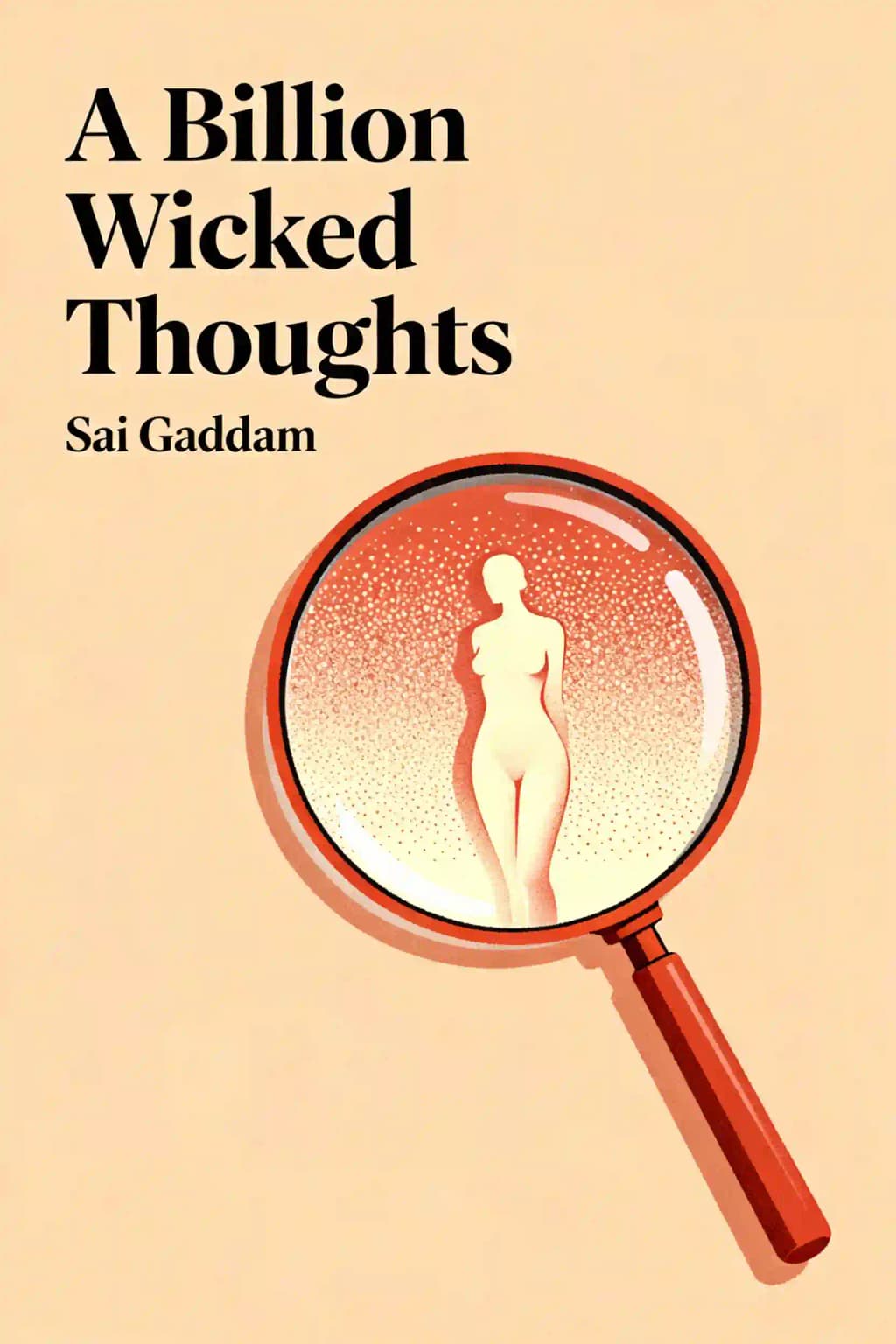
A Billion Wicked Thoughts
What the Internet Tells Us About Sexual Relationships
A Billion Wicked Thoughts 개요
What do 400 million searches reveal about our darkest desires? Neuroscientists Ogas and Gaddam analyzed internet behavior on an unprecedented scale, uncovering shocking gender differences in attraction that even Jordan Peterson misinterpreted. Peek behind society's curtain into the raw truth of human sexuality.
A Billion Wicked Thoughts의 핵심 주제
- digital footprints
- sexual brain architecture
- evolutionary psychology
- anonymous behavior analysis
- gendered desire patterns
A Billion Wicked Thoughts의 명언
Everyone has strong feelings about sexuality, making objective study difficult.
Online, people freely express desires they'd never reveal publicly.
The Internet functions as an unprecedented digital genie.
The sexual brain will challenge both politically correct and socially conservative sensibilities.
Men's visual motivation is so compelling that even highly educated professionals risk their careers to indulge it.
A Billion Wicked Thoughts의 등장인물
- Ogi OgasComputational neuroscientist and co-author
- Sai GaddamComputational neuroscientist and co-author
- Alfred KinseyPioneering sex researcher known for interviews
- Kenneth GergenSocial psychologist who studied anonymity
- Donald SymonsEvolutionary psychologist and framework pioneer
저자 소개
A Billion Wicked Thoughts의 저자 소개
Sai Gaddam is the co-author of A Billion Wicked Thoughts and a computational neuroscientist specializing in AI, neuroscience, and human sexual behavior. With a Ph.D. in Computational Neuroscience from Boston University, Gaddam partnered with neuroscientist Ogi Ogas to analyze over 400 million internet searches, revealing hidden patterns of human desire and fundamental differences between male and female sexuality through evolutionary psychology.
Based in Mumbai, India, Gaddam is co-founder and CEO of Comini Learning, advising enterprises on AI strategy and ethical data practices.
He also co-authored Journey of the Mind (2022), exploring consciousness evolution across species. A sought-after speaker at tech and business conferences, Gaddam is currently developing a book on the neuroscience of anger. A Billion Wicked Thoughts has been praised as the most significant exploration of human sexuality since Alfred Kinsey's groundbreaking research in the 1950s.
A Billion Wicked Thoughts: What the Internet Tells Us About Sexual Relationships 요약 다운로드
A Billion Wicked Thoughts: What the Internet Tells Us About Sexual Relationships 요약을 무료 PDF 또는 EPUB으로 받으세요. 인쇄하거나 오프라인에서 언제든 읽을 수 있습니다.
이 책에 대한 FAQ
A Billion Wicked Thoughts is a research-based exploration of human sexual desire using internet data analysis. Neuroscientists Ogi Ogas and Sai Gaddam examined over 400 million web searches, romance novels, pornography consumption patterns, and online personal ads to understand the fundamental differences between male and female sexuality. The book reveals how men and women are wired with distinct sexual cues and arousal patterns.
Ogi Ogas is a neuroscientist who studies computational models of memory, learning, and vision, and currently serves as project head of the Dark Horse Project at Harvard Graduate School of Education. Sai Gaddam specializes in large-scale data analysis and machine learning, working as a data mining consultant in India after completing doctoral research at Boston University. Together, they combined their expertise to analyze sexual behavior patterns through internet data.
A Billion Wicked Thoughts is ideal for readers interested in evolutionary psychology, behavioral science, and human sexuality from a data-driven perspective. It appeals to professionals in psychology, relationship counseling, and marketing, as well as curious individuals seeking to understand gender differences in desire. However, those seeking practical relationship advice or explicit neuroscience may find it less satisfying than expected.
A Billion Wicked Thoughts offers valuable insights into sexual differences through unprecedented data analysis, making it worthwhile for understanding human desire patterns. The book's strength lies in its massive dataset and fresh approach to sexuality research. However, critics note it sometimes overstates gender differences, lacks actual neuroscience despite the authors' credentials, and presents findings that reinforce traditional beliefs rather than challenge them.
According to Ogas and Gaddam, male sexual desire operates like a "reckless hunter" responding to single visual cues—functioning as an "or gate" where one stimulus triggers arousal. Female desire resembles a "cautious detective agency," requiring multiple simultaneous psychological and emotional cues to activate—operating as an "and gate." Men form sexual interests during adolescence that rarely change, while women's desires remain plastic and shift throughout life.
The "Power of Or" describes male arousal, where a single visual stimulus—one image, one body part, one scenario—can trigger sexual response. The "Power of And" characterizes female desire, requiring the convergence of multiple elements: emotional connection, context, psychological factors, and physical attraction working together simultaneously. This framework explains why men respond to brief visual content while women prefer lengthy romance narratives that build layered context.
Ogas and Gaddam found that men are powerfully driven by specific visual cues—youth indicators, body proportions, and explicit imagery—explaining pornography's male-dominated audience. Women, conversely, show less response to purely visual stimuli, with Playgirl magazine's failure illustrating this difference. However, the authors note that approximately one-third of pornography website users are actually women, suggesting the gender divide is less absolute than initially presented.
Critics argue A Billion Wicked Thoughts overstates gender differences while lacking actual neuroscience despite the authors' credentials. The book sometimes presents misleading data, such as initially listing male and female porn preferences separately before revealing significant crossover. Some reviewers found the writing "irritatingly cutesy" and accused the authors of confirming preconceived traditional beliefs rather than offering groundbreaking insights. The research methodology is also questioned as unsophisticated analysis rather than rigorous scientific investigation.
The book examines millions of romance novels as windows into female psychological arousal patterns. Ogas and Gaddam identify that women respond to narratives featuring dominant male "alpha" characters—barons, billionaires, even dangerous figures—combined with emotional complexity and relationship context. This contrasts sharply with male pornography's focus on immediate visual gratification, demonstrating that women require the "250-page book that requires hours to digest" to achieve what men accomplish with brief video clips.
A Billion Wicked Thoughts reveals that gay pornography is almost indistinguishable from straight pornography in structure and visual cues. Gay men respond to the same visual triggers as heterosexual men—specific body types, youth cues, and explicit imagery—demonstrating that sexual orientation changes the gender of attraction but not the fundamental arousal mechanisms. This finding supports the book's thesis that male sexual brains operate similarly regardless of orientation.
While Alfred Kinsey's groundbreaking research interviewed 18,000 people about their sexual behaviors in the 1950s, Ogas and Gaddam analyzed billions of online behaviors—over 400 million searches and 650,000 individual search histories. This approach offers unprecedented scale and the advantage of observing actual behavior rather than self-reported experiences. However, unlike Kinsey's comprehensive methodology, A Billion Wicked Thoughts focuses primarily on internet data, potentially missing populations with limited online sexual expression.
A Billion Wicked Thoughts helps readers understand why partners may have fundamentally different arousal patterns and expectations. Recognizing that men respond to visual cues while women need emotional context, psychological buildup, and multiple simultaneous factors can reduce relationship frustration. The book emphasizes that these differences are neurologically rooted rather than personal failings, offering perspective for navigating sexual compatibility. However, several reviewers note the book provides more explanation than actionable relationship advice.