The brain is more active than you think
We treat sleep like a shutdown, but your brain is actually busy processing emotions. Learn how this dynamic network organizes itself to create who you are.

The brain is more active than you thinkのベスト引用
The self is actually the pattern of how we flow through our mental landscape; it’s like a river where the identity isn't the water or the bank, but the movement of the water through the bank.

このオーディオレッスンはBeFreedコミュニティメンバーが作成しました
The brain


よくある質問
Self-organization refers to the brain's ability to create complex, orderly patterns of activity without a central "boss" or master neuron directing every cell. Much like a flock of birds moving in perfect sync without a leader, the brain uses its physical connections—the functional connectome—to create "attractors." These attractors are specific patterns of neural activity that the brain naturally gravitates toward, allowing 100 billion neurons to coordinate into meaningful thoughts rather than random noise.
Attractor states can be visualized as "valleys" or "grooves" in a mental landscape. When the brain’s activity begins, it naturally "flows" into these stable valleys. These states represent different mental modes, such as a "resting state" or a "problem-solving state." The brain stays organized by making these attractors "orthogonal," meaning they are mathematically distinct and do not overlap. This ensures that when the brain is in one state, such as "performing a task," it doesn't accidentally trigger a different, unrelated state.
The brain is "stochastic," meaning it possesses a constant jiggle of energy or "noise" that prevents us from getting stuck in a single thought forever. This noise provides the "kick" necessary to push our mental "marble" out of one valley and into another. Additionally, chemicals called neuropeptides act like the "weather" or "atmosphere" of the brain. Unlike fast-acting neurotransmitters, neuropeptides diffuse slowly and can change the "depth" or "friction" of the valleys, making certain mental states—like anxiety or calm—easier or harder to exit.
Yes, through a process described as "mental gardening" or "landscaping," humans can influence their neural trajectories. Because the brain follows a "predictive coding-based learning rule," consistently practicing certain mental states—like focus or gratitude—actually deepens those specific "valleys" over time, making them the most energy-efficient paths for the brain to take. We can also use "environmental nudges," such as changing our surroundings or practicing cognitive shifts, to push our mental activity out of negative, "sticky" attractors and back toward a healthy resting state.
This framework views these conditions as "different geometries" rather than "broken parts." In chronic pain, the "pain valley" may become so deep that the brain’s activity struggles to roll back to the "home" or resting state, even after the physical injury has healed. In the case of autism, research suggests that the "flow fields" or "currents" that pull the brain toward certain states, such as social processing, might be shaped differently, leading the brain to spend more or less time in specific attractor basins compared to a typically developing brain.
もっと発見
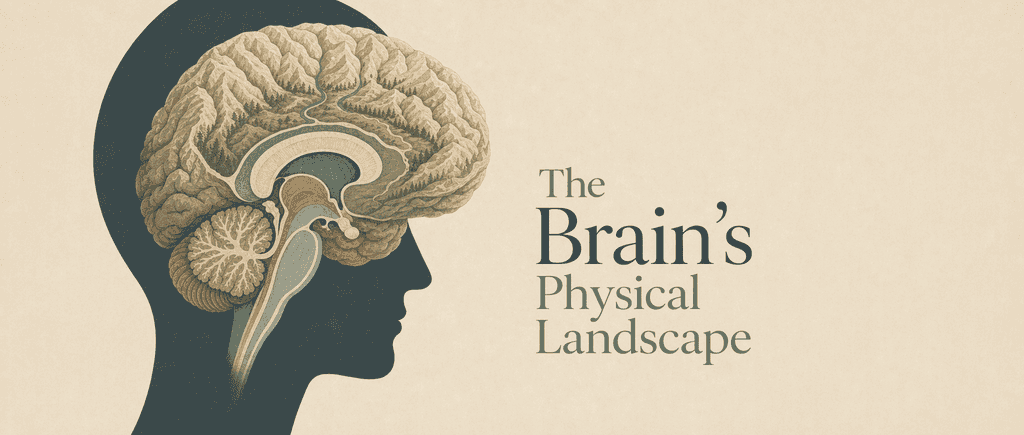
The Brain's Physical Landscape
Understanding the brain's physical architecture is the foundation for mastering neuroscience and psychology. This plan is ideal for students or professionals seeking a clear, structural map of how neural biology translates into human behavior.

The Biological Machine: Tuning Your Mind
This plan is essential for professionals and students looking to master their cognitive architecture rather than being controlled by it. It is ideal for anyone seeking to improve decision-making, memory retention, and habit formation through a biological lens.

Understanding human mind
This learning plan bridges the gap between biological neuroscience and practical psychology to reveal how our brains construct reality. It is ideal for curious minds, professionals, and students seeking to master their cognitive processes and understand the hidden drivers of human behavior.

Before the Alarm Clock
Modern productivity often ignores the biological reality of how our bodies actually recover. This plan is essential for high-performers and chronic sleepers who want to move beyond basic rest and master their internal rhythms for sustained energy.

Neuropsychology & Brain Science Research
This learning plan bridges the gap between biological architecture and complex human behavior. It is designed for students, researchers, or healthcare professionals seeking a comprehensive understanding of how modern technology and clinical case studies inform our knowledge of the mind.

The Organized Mind: Reclaiming Focus
In an era of constant distraction, cognitive fatigue often prevents high-level execution. This plan is designed for professionals and creators who need to reclaim their attention and transform chaotic workloads into structured, productive rhythms.

Biohack my sleep for oeak daily energy
In an era of chronic burnout, mastering your rest is the ultimate competitive advantage. This plan is designed for high-performers and professionals who want to leverage biological science to eliminate fatigue and unlock peak daily energy.

Quiet the Evening Mind
This learning plan is designed for high-performers and chronic overthinkers who struggle to shut down their brains at the end of the day. By combining cognitive-behavioral insights with practical environmental shifts, it provides a roadmap for anyone looking to transform nighttime dread into genuine restoration.
"Instead of endless scrolling, I just hit play on BeFreed. It saves me so much time."


"I never knew where to start with nonfiction—BeFreed’s book lists turned into podcasts gave me a clear path."


"Perfect balance between learning and entertainment. Finished ‘Thinking, Fast and Slow’ on my commute this week."
"Crazy how much I learned while walking the dog. BeFreed = small habits → big gains."
"Reading used to feel like a chore. Now it’s just part of my lifestyle."

"Feels effortless compared to reading. I’ve finished 6 books this month already."
"BeFreed turned my guilty doomscrolling into something that feels productive and inspiring."

"BeFreed turned my commute into learning time. 20-min podcasts are perfect for finishing books I never had time for."
"BeFreed replaced my podcast queue. Imagine Spotify for books — that’s it. 🙌"

"It is great for me to learn something from the book without reading it."
"The themed book list podcasts help me connect ideas across authors—like a guided audio journey."
"Makes me feel smarter every time before going to work"
"Instead of endless scrolling, I just hit play on BeFreed. It saves me so much time."
"I never knew where to start with nonfiction—BeFreed’s book lists turned into podcasts gave me a clear path."
"Perfect balance between learning and entertainment. Finished ‘Thinking, Fast and Slow’ on my commute this week."
"Crazy how much I learned while walking the dog. BeFreed = small habits → big gains."
"Reading used to feel like a chore. Now it’s just part of my lifestyle."
"Feels effortless compared to reading. I’ve finished 6 books this month already."
"BeFreed turned my guilty doomscrolling into something that feels productive and inspiring."
"BeFreed turned my commute into learning time. 20-min podcasts are perfect for finishing books I never had time for."
"BeFreed replaced my podcast queue. Imagine Spotify for books — that’s it. 🙌"
"It is great for me to learn something from the book without reading it."
"The themed book list podcasts help me connect ideas across authors—like a guided audio journey."
"Makes me feel smarter every time before going to work"
"Instead of endless scrolling, I just hit play on BeFreed. It saves me so much time."
"I never knew where to start with nonfiction—BeFreed’s book lists turned into podcasts gave me a clear path."
"Perfect balance between learning and entertainment. Finished ‘Thinking, Fast and Slow’ on my commute this week."
"Crazy how much I learned while walking the dog. BeFreed = small habits → big gains."
"Reading used to feel like a chore. Now it’s just part of my lifestyle."
"Feels effortless compared to reading. I’ve finished 6 books this month already."
"BeFreed turned my guilty doomscrolling into something that feels productive and inspiring."
"BeFreed turned my commute into learning time. 20-min podcasts are perfect for finishing books I never had time for."
"BeFreed replaced my podcast queue. Imagine Spotify for books — that’s it. 🙌"
"It is great for me to learn something from the book without reading it."
"The themed book list podcasts help me connect ideas across authors—like a guided audio journey."
"Makes me feel smarter every time before going to work"
"Instead of endless scrolling, I just hit play on BeFreed. It saves me so much time."
"I never knew where to start with nonfiction—BeFreed’s book lists turned into podcasts gave me a clear path."
"Perfect balance between learning and entertainment. Finished ‘Thinking, Fast and Slow’ on my commute this week."
"Crazy how much I learned while walking the dog. BeFreed = small habits → big gains."
"Reading used to feel like a chore. Now it’s just part of my lifestyle."
"Feels effortless compared to reading. I’ve finished 6 books this month already."
"BeFreed turned my guilty doomscrolling into something that feels productive and inspiring."
"BeFreed turned my commute into learning time. 20-min podcasts are perfect for finishing books I never had time for."
"BeFreed replaced my podcast queue. Imagine Spotify for books — that’s it. 🙌"
"It is great for me to learn something from the book without reading it."
"The themed book list podcasts help me connect ideas across authors—like a guided audio journey."
"Makes me feel smarter every time before going to work"