Waiting to feel ready is a trap. Learn how to build self-assurance through small actions and nervous system regulation to handle any situation.

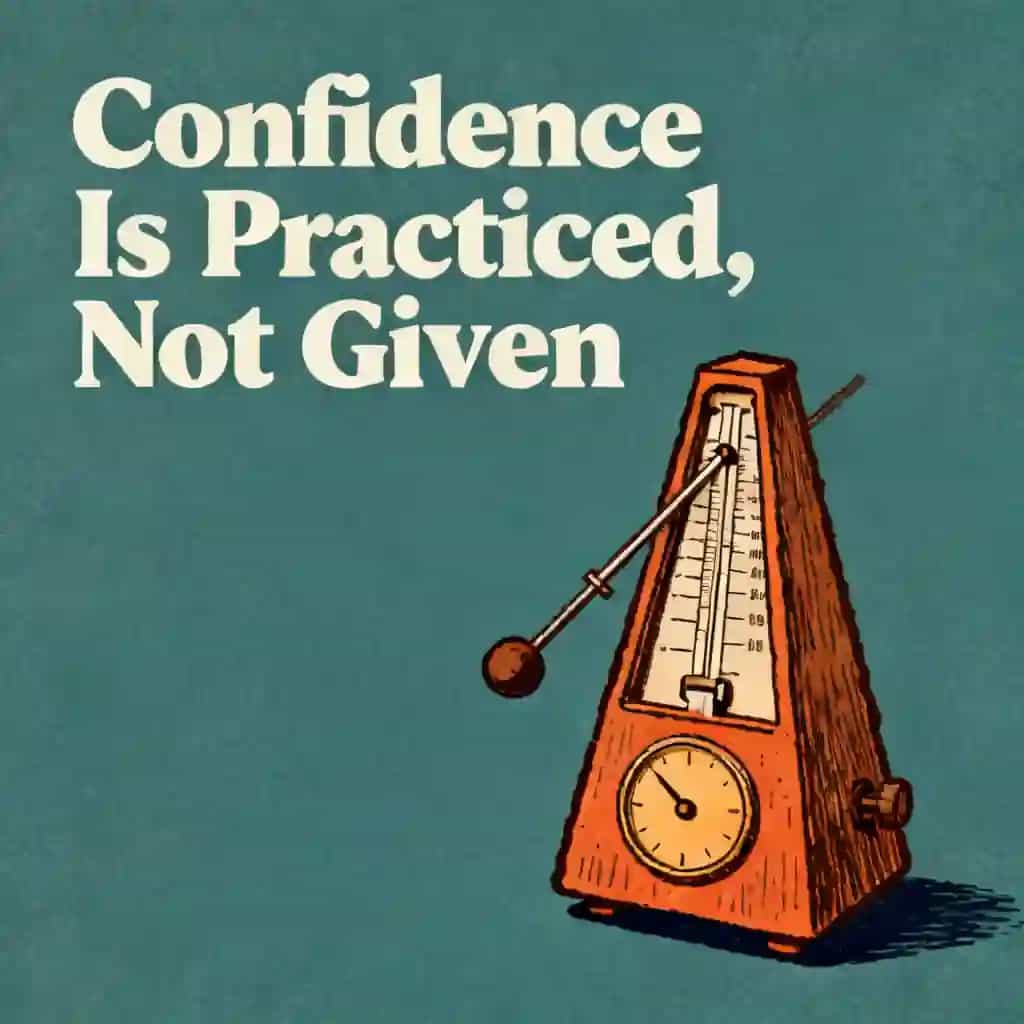
Confidence is not an innate personality trait you’re born with; it is a skill built through the reputation you acquire with yourself by keeping small, daily promises.
"Instead of endless scrolling, I just hit play on BeFreed. It saves me so much time."
"I never knew where to start with nonfiction—BeFreed’s book lists turned into podcasts gave me a clear path."
"Perfect balance between learning and entertainment. Finished ‘Thinking, Fast and Slow’ on my commute this week."
"Crazy how much I learned while walking the dog. BeFreed = small habits → big gains."
"Reading used to feel like a chore. Now it’s just part of my lifestyle."
"Feels effortless compared to reading. I’ve finished 6 books this month already."
"BeFreed turned my guilty doomscrolling into something that feels productive and inspiring."
"BeFreed turned my commute into learning time. 20-min podcasts are perfect for finishing books I never had time for."
"BeFreed replaced my podcast queue. Imagine Spotify for books — that’s it. 🙌"
"It is great for me to learn something from the book without reading it."
"The themed book list podcasts help me connect ideas across authors—like a guided audio journey."
"Makes me feel smarter every time before going to work"

Lena: You know, Miles, I was thinking about how many times I’ve opted out of something—a conversation, a project, even a hobby—just because I didn’t "feel" confident enough yet. It’s like we’re all waiting for this magical lightning bolt of courage to hit us before we start.
Miles: Exactly, Lena. And that’s actually the biggest myth we carry around. We tend to think confidence is this innate personality trait you’re either born with or you’re not. But the reality is much more empowering: it’s actually a skill. It’s something you build through action and small, daily choices rather than just waiting for a feeling to show up.
Lena: That is such a compassionate reframe. It’s not about "faking it" or having all the answers, but about trusting yourself to handle whatever comes your way.
Miles: Right, and it starts with how we treat our own nervous system and the promises we keep to ourselves. Let’s explore how we can start building that unshakeable self-assurance from the ground up.
Lena: So, Miles, if confidence isn’t that lightning bolt we’re all waiting for, where does the foundation actually sit? I remember you mentioning it’s about the promises we keep to ourselves. That feels so much more internal than just "acting" tough.
Miles: It really is. There’s this powerful definition from the psychologist Nathaniel Branden—he’s the one who wrote *The Six Pillars of Self-Esteem*. He describes self-esteem as "the reputation we acquire with ourselves." I love that framing because it takes the focus off what the world thinks and puts it squarely on how we show up for our own life.
Lena: "The reputation we acquire with ourselves." That’s a bit convicting, isn't it? It makes me think about all those tiny "micro-promises" I break. Like saying I’ll wake up at 7:00 and then hitting snooze four times—or telling myself I’ll drink more water and then reaching for a third coffee.
Miles: Exactly. We often think it’s the big stuff—the promotions or the public speeches—that builds our confidence. But the brain is actually an evidence-gathering machine. Every time you set a small goal and follow through, you’re essentially handing your brain a piece of paper that says, "See? I’m someone who does what I say I’m going to do." Over time, those papers pile up into a massive file of proof. That’s what creates unshakeable assurance. It’s not a mood; it’s a track record.
Lena: It’s interesting you distinguish between self-esteem and self-confidence, though. I think people use those interchangeably all the time.
Miles: They do, but there’s a nuance that’s really helpful to understand. Self-confidence is usually task-specific. You might be incredibly confident at, say, baking a cake or coding a website because you’ve done it a thousand times. But self-esteem is identity-based. It’s that deep-seated sense of worthiness that stays with you even when you’re doing something you’re *not* good at yet.
Lena: Ah, so that explains why someone can be a total powerhouse in the boardroom—super confident in their professional skills—but then feel completely unworthy or insecure in their personal relationships.
Miles: Precisely. And research published in the *Personality and Social Psychology Bulletin* actually shows that when your self-esteem is stable and identity-based, your body handles stress differently. They found that people with a strong internal self-concept actually have lower cortisol responses during stressful moments. Their bodies literally stay calmer under pressure because their "reputation with themselves" isn't on the line every time they make a mistake.
Lena: So, instead of trying to "fake" the confidence for a specific task, we should be looking at recalibrating that identity. But that sounds... well, it sounds a lot harder than just standing up straight.
Miles: It’s deeper work, for sure. Most advice tells you to "fake it until you make it," but as we’ve discussed, that can feel like a lie to your own nervous system. Real transformation happens when you move from forced behavior to what experts call "identity alignment." That’s when your actions, your values, and your internal script all start pulling in the same direction.
Lena: I love that idea of identity alignment. It feels less like wearing a mask and more like finally taking one off. But for a lot of us, that internal script is pretty loud—and it’s not always saying nice things.
Miles: Right, the "inner critic." We’ve all got one. But here’s a fascinating insight from neuroscience: that critic isn't actually trying to sabotage you. It’s usually an overactive safety mechanism. Think of it like a smoke detector that’s so sensitive it goes off every time you toast a piece of bread. It’s trying to protect you from the "danger" of social rejection or failure, because to our primitive brain, being ostracized from the group once meant literal physical peril.
Lena: So when I’m about to speak up in a meeting and my throat gets dry and my heart starts racing—that’s just my brain’s way of saying, "Wait! Don't do it! They might not like you, and then we’ll be kicked out of the tribe!"
Miles: Exactly. Dr. Joseph LeDoux has done some incredible research on the amygdala showing that perceived social threats—like criticism or rejection—activate the exact same neural pathways as actual physical danger. Your brain literally doesn't know the difference between a mountain lion and a judgmental look from your boss.
Lena: That makes me feel so much better. It’s not that I’m "weak"—it’s just that my biology is doing its job a little too well.
Miles: Exactly. It’s conditioning, not a character flaw. And the way out isn't to fight the biology, but to work with it. We have to create a sense of internal safety so the "smoke detector" can finally calm down. Once the nervous system feels safe, that’s when the "reputation with ourselves" can actually start to improve.
Lena: So, it’s a two-way street. We build the reputation through small actions, but we also have to manage the physiological "alarm" that tries to stop us from taking those actions in the first place.
Miles: You've hit the nail on the head. It’s a loop. And as we move forward, we can look at how to actually hack that loop—how to calm the body so the mind can lead, and how to use the mind to prove to the body that we’re actually safe.
Lena: Miles, something you said earlier really stuck with me—the idea that the most successful people are often the ones struggling the most with self-doubt. It feels so counterintuitive. If you have all the "proof" of your success, why doesn't the imposter syndrome just go away?
Miles: It’s actually what some neuroscientists call a "feature" of the high-achiever's brain, not a bug. There’s a specific part of the brain called the anterior cingulate cortex—the ACC. Think of it as your internal error-detection system. Its job is to scan for discrepancies between where you are and where you’re "supposed" to be.
Lena: Like a mental spell-checker that’s always running?
Miles: Precisely. And in high-achievers, that spell-checker is turned up to eleven. You’ve spent years in high-stakes environments where mistakes actually matter. So, your ACC becomes hyper-tuned to detect even the tiniest "error"—an ambiguous look from a colleague, a slightly awkward pause in a conversation, or a goal that wasn't met perfectly.
Lena: So the more you achieve, the more "stakes" you have, and the more your brain starts scanning for anything that could go wrong to protect that success?
Miles: Exactly. It’s the "Achievement-Sensitivity Ratchet." Every time you move up a level—get the promotion, launch the business, gain more visibility—your ACC recalibrates. It says, "Okay, the stakes are higher now, so I need to be even *more* vigilant." This is why success doesn't always lead to more confidence. Often, it leads to more noise.
Lena: That is so fascinating. So the "imposter syndrome" isn't a lack of evidence of my competence—it’s just my error-detection system flagging the gap between my internal uncertainty and my external results.
Miles: Right. Your brain sees that gap and goes, "Wait, something’s wrong here! I feel like a mess inside, but everyone outside thinks I’m a pro. Discrepancy! Error! Danger!" It doesn't realize that *everyone* feels like a bit of a mess inside. It just sees the "error" and fires the alarm.
Lena: It’s like being a world-class athlete and having a coach who only ever shows you tapes of your mistakes. You’re getting better, but all you *see* is what’s wrong.
Miles: That’s a perfect analogy. And for high-achievers, this creates an enormous "cognitive tax." You’re spending a huge portion of your mental energy just managing that internal noise—reviewing past conversations, rehearsing future ones, trying to make sure no one sees the "discrepancy." It’s exhausting.
Lena: I’ve definitely felt that. It’s that post-event processing, right? Lying in bed at 2:00 AM wondering if I sounded "stupid" when I said that one thing in a meeting that happened ten hours ago.
Miles: Yes! Post-Event Processing, or PEP, is a major maintenance mechanism for social anxiety and insecurity. It’s not actually problem-solving, even though it feels like it. It’s just rumination that reinforces the idea that social situations are dangerous. You’re essentially training your brain to become an expert in your own perceived flaws.
Lena: So, if the ACC is just doing its job, how do we actually "recalibrate" it? We can't just tell it to stop, can we?
Miles: Not directly. You can't think your way out of a circuit that operates below the level of conscious thought. But you *can* use what’s called "inhibitory learning." This is the core of modern exposure therapy. The goal isn't to erase the fear or the doubt—the brain doesn't really have a "delete" button for memories. Instead, you create a new, competing memory—a "safety association."
Lena: So, like, I speak up in a meeting, I feel the fear, but I do it anyway, and... nothing bad happens?
Miles: Exactly. And you have to be very deliberate about it. You have to tell your brain, "Okay, I’m predicting that if I speak up, everyone will think I’m incompetent." Then you do it. And then—this is the key step—you consciously record the "expectancy violation." You show your brain the proof: "I spoke up, and actually, two people nodded, and the meeting moved on. My prediction was wrong."
Lena: You’re basically acting like a scientist running an experiment on your own fears.
Miles: That’s exactly what it is. And over time, those "safety memories" stored in your ventromedial prefrontal cortex—the part of the brain that handles emotional regulation—start to get stronger than the "threat memories" in your amygdala. You still feel the doubt, but the "safety brake" is strong enough to keep you moving forward.
Lena: It’s so empowering to realize that the goal isn't to be "fearless." It’s just to have a stronger "brake."
Miles: Right. And as we’ve seen in the research from people like Dr. Stephen Porges and his Polyvagal Theory, this all starts with the body. If your nervous system is in a "threat state," your higher reasoning—your ability to run those experiments—actually shuts down. You literally can't think confidently if your body feels like it’s being hunted.
Lena: So we have to soothe the body first before we can retrain the brain. It’s like trying to teach a child math while they’re in the middle of a temper tantrum—it’s just not going to happen until they calm down.
Miles: Exactly. We have to "regulate to communicate"—both with others and with ourselves. Once the body feels safe, the ACC can stop screaming, and we can start doing the work of building that identity-based confidence.
Lena: Miles, we keep coming back to this idea that confidence starts in the body. I think for a lot of people—myself included—we’ve been taught to just "push through" the physical symptoms of anxiety. You know, the shaky hands, the racing heart. But you’re saying that’s actually working against our biology?
Miles: It really is. It’s like trying to drive with the parking brake on. You might move, but you’re burning out the engine. If your nervous system is in what’s called a "sympathetic" state—that fight-or-flight mode—your brain is prioritized for survival, not for nuanced social interaction or creative thinking.
Lena: So when I’m nervous and I tell myself, "Just calm down, Lena, it’s not a big deal," my brain is basically ignoring me because the body is sending "Danger!" signals?
Miles: Exactly. The body has a "bottom-up" influence on the brain that’s incredibly powerful. This is where Polyvagal Theory comes in. Dr. Stephen Porges discovered that our vagus nerve—the main highway of our parasympathetic nervous system—is constantly scanning the environment for cues of safety or threat. If it doesn't find enough "safety cues," it puts us into a state of "neuroception" of threat.
Lena: "Neuroception." I love that term. It’s like an unconscious surveillance system.
Miles: It is! And when we’re in that state, our "social engagement system" actually shuts down. We lose the ability to make natural eye contact, our vocal tone becomes flatter, and we become hyper-sensitive to "error signals" in others. We literally become *less* socially capable when we’re trying too hard to be "confident" while our body is panicking.
Lena: That explains so much. No wonder "faking it" feels so stiff and awkward. You’re trying to use your "social engagement system" while your body has already clocked out for survival mode.
Miles: Right. So the first step to unshakeable confidence is actually learning how to "tone" your nervous system. And one of the fastest ways to do that is through the breath. There’s a study from *Medical Hypotheses* by Jerath and colleagues that shows how specific breathing patterns can improve "vagal tone"—essentially making your "parasympathetic brake" stronger and more responsive.
Lena: Is this the "box breathing" I’ve heard about? Or the 4-7-8 method?
Miles: Those are great, but for confidence specifically, the key is the *exhalation*. When you exhale longer than you inhale, you’re sending a direct signal to your brain that you are safe. Think about it—when does a mammal exhale slowly and deeply? Only when it’s resting or eating. You can't do that if a predator is nearby.
Lena: So by manually extending my exhale, I’m "hacking" the system to tell my brain the coast is clear.
Miles: Exactly. A simple protocol is inhaling for four counts and exhaling for six or eight. If you do that even for two minutes before a "scary" event, you’re shifting your physiological baseline. You’re not "faking" calm; you’re *creating* it.
Lena: I’ve also heard about using cold water. Is that actually a thing, or just a wellness trend?
Miles: It’s a very real physiological hack called the "Diving Reflex." If you splash ice-cold water on your face—specifically around your eyes and nose—it triggers an immediate drop in heart rate. It’s an evolutionary survival mechanism that forces the body into a parasympathetic state. It’s like a "reset button" for an anxiety spiral.
Lena: Okay, so we’ve got the breath and the cold water to calm the "alarm." But what about when we’re actually *in* the situation? I can't exactly splash water on my face in the middle of a dinner party.
Miles: That’s where grounding techniques and posture come in. And I’m not talking about "power posing" like a superhero—that’s been largely debunked as a hormonal "hack." I’m talking about what neuroscientists call "Embodied Cognition." The idea that our physical geometry influences our mental state.
Lena: So, how we carry ourselves actually changes how we think?
Miles: Yes. When we’re insecure, we tend to "collapse"—we hunch our shoulders, we cross our arms, we look down. We’re essentially trying to protect our vital organs. It’s a "defeated" posture. But if we can gently open up—roll the shoulders back, lift the chin parallel to the ground, keep the hands visible—we’re signaling to our own brain, "I am safe enough to be vulnerable. I don't need to hide."
Lena: It’s an act of physical courage that then creates mental courage.
Miles: Exactly. And another great "in-the-moment" tool is the 3-3-3 rule. When you feel that "self-focused attention"—where you’re obsessed with how you look or sound—you immediately redirect your attention outward. Name three things you see, three things you hear, and move three parts of your body. It pulls you out of the internal "threat simulation" and back into the actual room.
Lena: I love that. It’s such a relief to know that confidence isn't just about "mind over matter." It’s about "body supporting mind."
Miles: It’s a partnership. And once you start building that "reputation with yourself"—as someone who can manage their own physiological state—that deep-seated self-esteem starts to grow. You realize, "I can handle the *feeling* of being nervous." And once you’re not afraid of the feeling, the fear loses its power.
Lena: That’s the "unshakeable" part, isn't it? It’s not that the wind stops blowing—it’s that you’ve built a foundation that can handle the storm.
Lena: Miles, I was thinking about the "Confidence-Competence Loop" we touched on. It’s that idea that we have to *do* the thing to get the confidence, but we need the confidence to *do* the thing. It feels like a classic "chicken and the egg" problem. How do we actually break into that circle?
Miles: It’s a great question, and honestly, it’s where most people get stuck. We wait to "feel" ready. But the psychology of self-belief—what Albert Bandura called "Self-Efficacy"—shows that the feeling follows the action, almost every single time. The secret to breaking the loop is to start with "Micro-Wins."
Lena: Micro-wins. So, not jumping straight to the TED Talk, but maybe just asking one question in a staff meeting?
Miles: Exactly. You want to find the "Sweet Spot of Discomfort." If a task is a 10 out of 10 on the "terrifying" scale, your nervous system will likely shut down and you’ll just reinforce the fear. But if you find something that’s a 3 or 4—something that makes your heart race a little but is ultimately doable—that’s where the growth happens.
Lena: It’s like progressive overload in weightlifting. You don't start with the 300-pound barbell; you start with the 5-pounders and gradually add more.
Miles: Precisely. And every time you successfully complete that "Level 3" task, your brain gets a hit of dopamine. That dopamine does two things: it makes you feel good, and it actually helps "myelinate" the neural pathways associated with that action. You’re literally making the "courage circuit" in your brain faster and more efficient.
Lena: So, the more I do these small, scary things, the easier they actually become—neurologically speaking?
Miles: Yes! This is why "systematic desensitization" is so effective. You’re essentially teaching your amygdala that these situations aren't actually life-threatening. You’re "pruning" the old insecurity pathways and building new, high-speed highways for confidence.
Lena: I love the idea of "pruning" the insecurity. It makes it feel so much more manageable. But what happens when we *do* have a setback? Because, let’s be honest, we’re not going to win every time. If I try to speak up and I totally fumble my words, doesn't that just kill the loop?
Miles: Not if you have a "Growth Mindset." This is the work of Dr. Carol Dweck. If you have a "Fixed Mindset," you see failure as a verdict on your soul—"I fumbled my words, therefore I’m a failure." But with a Growth Mindset, you see it as *data*. "I fumbled my words, which means I need more practice in this area."
Lena: So the failure isn't the end of the loop; it’s just a "recalibration point."
Miles: Exactly. In fact, some of the most confident people I know are the ones who have failed the most. Because they’ve proven to themselves that they can survive the "worst-case scenario." They’ve realized that fumbling their words didn't actually end the world. That "mastery experience" of recovering from a mistake is actually a more powerful confidence-builder than just getting it right the first time.
Lena: That’s a huge shift. So we shouldn't be aiming for perfection; we should be aiming for "B-minus work" just to get the ball rolling, as one of the sources suggested.
Miles: I love that "B-minus work" tip. It’s the ultimate antidote to perfectionism—which, let’s be real, is just "fear in a tuxedo." Perfectionism keeps us in the "waiting" phase because we’re afraid to do anything that isn't flawless. But B-minus work gets you into the loop. It gives you evidence. It gives you data.
Lena: And once you have the evidence, your "identity script" starts to change. You stop being "the one who stays quiet" and start becoming "the one who shows up."
Miles: Right. And that’s when the loop becomes self-sustaining. Success leads to self-efficacy, which leads to more motivation, which leads to taking on bigger challenges. But you have to keep a "Proof Portfolio." Because of our brain’s "negativity bias," we tend to remember the one time we failed and forget the fifty times we succeeded.
Lena: So, literally keeping a log of our wins? Even the small ones?
Miles: Absolutely. At the end of every day, write down three things you did well. "I made eye contact with the barista." "I sent that email I was avoiding." "I spoke up for thirty seconds in the meeting." It might feel silly at first, but you’re literally training your brain to notice the evidence of your own competence. You’re building the "file" that your ACC can reference when it starts to doubt you.
Lena: It’s like being your own defense attorney, building a case against your inner critic.
Miles: Exactly. "Your Honor, I submit Exhibit A: The email sent at 9:00 AM." It sounds simple, but it’s one of the most effective ways to shift your internal reputation. You stop relying on how you *feel* and start relying on what you *know* to be true about your actions.
Lena: Miles, we’ve talked about the "inner critic" being this overactive smoke detector, but even when we know that, it’s still *so* loud sometimes. It feels so personal when that voice says, "You’re going to mess this up" or "Nobody wants to hear what you have to say." How do we actually stop "fusing" with those thoughts?
Miles: That "fusion" is exactly the problem. We treat our thoughts like they’re objective news reports rather than just... mental weather. One of the most powerful tools in the psychology of confidence is "Cognitive Distancing." It’s the ability to step back and look *at* your thoughts rather than *from* them.
Lena: Like being a "thought-observer" instead of a "thought-believer"?
Miles: Precisely. And one of the easiest ways to do this is a simple linguistic hack: change your pronouns. There’s research showing that when we talk to ourselves in the third person—using our own name—it actually activates the brain’s self-control centers and reduces emotional reactivity.
Lena: So instead of thinking, "I’m so nervous, I’m going to fail," I should think, "Lena is feeling nervous right now"?
Miles: Exactly. "Lena is having the thought that she might fail." See how much space that creates? It’s not a fact about your soul anymore; it’s just a temporary experience "Lena" is having. It turns you into a coach rather than a victim of your own mind.
Lena: It’s almost like you’re talking to a friend. Which brings up another huge point from the sources—the difference between self-esteem and self-compassion.
Miles: Yes! This is so important. We’ve been told for decades that "high self-esteem" is the goal. But self-esteem can be really fragile because it’s often based on comparison—feeling "better than" others or meeting certain standards. The moment you fail or someone else does better, your self-esteem takes a hit.
Lena: Right, it’s like a fair-weather friend. It’s only there when things are going well.
Miles: But self-compassion? That’s your "ride or die" friend. Dr. Kristin Neff has done incredible research showing that self-compassion—treating yourself with the same kindness you’d show a struggling friend—leads to much more stable confidence. It’s not about being "the best"; it’s about being *on your own side*, especially when things go wrong.
Lena: I love that. "Being on your own side." It’s such a grounded way to think about confidence. Because if I know I’m not going to beat myself up if I fail, I’m actually *more* likely to take the risk.
Miles: Exactly! Shame is a "freeze" response. When you berate yourself for a mistake, your brain’s threat system goes into overdrive, and you actually become *less* capable of learning or trying again. But self-compassion lowers cortisol and increases heart rate variability—it puts you back into a "growth" state.
Lena: It’s the "Courtroom Method" we saw in the sources. When that inner critic makes an accusation, like "You’re not qualified for this," you don't just accept it. You take it to court.
Miles: Right. You look at the "Evidence For" and the "Evidence Against." Okay, maybe I made one mistake last week—that’s the evidence for. But I also have five years of experience, a glowing performance review, and a genuine desire to learn—that’s the evidence against. The "verdict" usually ends up being: "The accusation is false. I’m not unqualified; I’m just a human who’s still learning."
Lena: It’s about being *accurate* rather than just "positive."
Miles: Yes! Confident people aren't necessarily "positive" all the time; they’re just more realistic. They don't let their failures define their entire identity. They see a mistake as a single data point, not a universal truth.
Lena: This also links back to the "As If" principle. It’s not about being fake; it’s about "Behavioral Activation." Acting "as if" you have the quality you want until your brain eventually catches up.
Miles: William James, the father of American psychology, was huge on this. He argued that if you want a quality, you act as if you already have it. Not to trick others, but to resolve the "cognitive dissonance" in your own brain. Your brain *hates* it when your actions and beliefs don't match. So if you keep *acting* like a confident person—standing tall, speaking clearly, taking risks—your brain eventually goes, "Well, I guess we’re a confident person now," and updates your self-image to match.
Lena: It’s a "rehearsal" for the person you want to become.
Miles: Exactly. And that rehearsal is much easier when you’re doing it with a voice of compassion rather than a voice of criticism. You’re not "forcing" yourself to be perfect; you’re just "stepping into" a new version of yourself, and giving yourself permission to stumble along the way.
Lena: Miles, we’ve covered a lot about the internal work, but for a lot of people, the "final boss" of confidence is social interaction. Networking events, parties, even just speaking up in a group—that’s where the "social evaluation threat" feels most intense. How do we take all these internal tools and actually use them out in the world?
Miles: Social confidence is definitely a specific skill set. And the most evidence-based way to build it is through "Gradual Exposure." You have to systematically confront those feared situations, but in a way that’s manageable. It’s about building an "Exposure Hierarchy."
Lena: So, ranking our fears from "one" to "ten"?
Miles: Exactly. A "Level 1" might be making eye contact with the cashier at the grocery store. A "Level 5" might be asking a coworker a question about their weekend. And a "Level 10" might be giving a presentation or initiating a conversation with a total stranger at a networking event.
Lena: The key is not to jump straight to Level 10, right? Because if you do that and have a bad experience, you might just retreat even further.
Miles: Precisely. You want to stay at Level 1 until your anxiety naturally starts to drop—until it feels "boring." That’s a sign that your amygdala has learned that eye contact isn't a threat. Then you move to Level 2. You’re building "Inhibitory Learning" at every step.
Lena: I love the idea of making it "boring." It takes the pressure off. But what about "safety behaviors"? I know I’m guilty of these—like checking my phone at a party so I look "busy," or rehearsing exactly what I’m going to say in my head before I speak.
Miles: We all do it! But safety behaviors are actually "confidence killers" in the long run. They give you a temporary sense of relief, but they reinforce the underlying belief that the situation is dangerous. Your brain thinks, "Oh, we only survived that party because we hid behind our phone." It never learns that you would have been fine *without* the phone.
Lena: So, to truly build confidence, we have to drop the safety behaviors and actually "show up" as our messy, uncertain selves.
Miles: Exactly. And that’s where "Mindful Listening" is such a game-changer. Most social anxiety comes from "self-focused attention"—we’re so obsessed with how *we* are coming across that we completely miss what’s actually happening in the conversation.
Lena: We’re basically "performance-monitoring" ourselves in real-time.
Miles: Right! But if you can shift your focus to the other person—becoming genuinely curious about *them*—your own anxiety naturally starts to recede. It’s hard to be intensely self-conscious when you’re truly interested in someone else's story. It’s what I call the "Conversation Tennis" approach—you’re just focused on hitting the ball back, not on how you look while you’re holding the racket.
Lena: "Conversation Tennis." I like that. And it’s okay if there are some "awkward moments," right? That was a big takeaway for me—that even socially confident people have awkward silences.
Miles: Oh, absolutely. The difference is that confident people don't see an awkward silence as a "failure." They just see it as a normal part of human interaction. They might even acknowledge it with a bit of humor. "Well, that was a comfortable silence!" Once you stop fearing the "awkward," it loses its power to paralyze you.
Lena: It’s also about "Nonverbal Communication," isn't it? The eye contact, the open posture... but it’s not about "dominance," it’s about "approachability."
Miles: Exactly. Research shows that nonverbal cues—like natural eye contact for about 60 to 70% of the time, or keeping your palms visible—signal to others that you’re trustworthy and secure. And because of "Embodied Cognition," those same cues signal to *your* brain that you’re safe. It’s a feedback loop that benefits everyone in the interaction.
Lena: And if we do make a mistake—like forgetting someone’s name—we can just "recover gracefully" instead of spiraling into shame.
Miles: Right! "I’m so sorry, I’m drawing a blank on your name—could you remind me?" Most people actually find that honesty refreshing. It shows you’re confident enough to be human. True confidence isn't about being perfect; it’s about being *authentic* and knowing you can handle the "recovery" if things don't go perfectly.
Lena: So, by practicing these small social "experiments," we’re essentially expanding our comfort zone until the "world" doesn't feel quite so threatening anymore.
Miles: That’s it. You’re building a "Proof Portfolio" of social wins. And as those wins accumulate, your "identity script" shifts from "I’m socially awkward" to "I’m someone who can connect with others, even when it’s a little uncomfortable." That’s the real foundation of social confidence.
Lena: Miles, we’ve covered the "why" and the "how," but I’d love to wrap this up with something our listeners can actually *do* starting today. We’ve mentioned a few habits, but if you had to build a "Daily Confidence Playbook," what would be the MVP moves?
Miles: I love that. Let’s look at the most evidence-based, high-impact habits we’ve discussed. If you do nothing else, start with these four "Pillars of Practice."
Lena: Okay, Pillar Number One. I’m guessing it’s something to do with the morning?
Miles: You nailed it. "Confidence Priming." Before you even check your phone, take two minutes for "Action-Based Affirmations." Not those generic "I am a billionaire" ones that your brain rejects, but statements about how you *show up*. "I am someone who tries my best, regardless of the outcome." "I am capable of handling uncertainty today."
Lena: And maybe pairing that with a quick "Confidence Ritual"? Like standing tall or doing some of that diaphragmatic breathing we talked about?
Miles: Absolutely. Inhale for four, exhale for eight. Set the physiological "baseline" before the day even has a chance to stress you out. You’re telling your nervous system, "We’re in charge today."
Lena: I love that. Okay, Pillar Number Two. What’s the "during the day" move?
Miles: "Strategic Micro-Risks." Do one thing every single day that pushes you just slightly outside your comfort zone. Ask a question you’d normally swallow. Make eye contact with a stranger and smile. Order a coffee you’ve never tried. The goal isn't the outcome; the goal is the *act* of taking the risk. You’re collecting "Mastery Experiences."
Lena: It’s like "confidence vitamins." You’re just taking a little dose of courage every day to keep the system strong.
Miles: Exactly. And Pillar Number Three is "Boundary Practice." Confidence and boundaries are two sides of the same coin. Every time you say "no" to something that doesn't align with your values, you’re saying "yes" to your own self-respect. Start small—decline one minor request this week that you’d normally say "yes" to out of obligation.
Lena: "No" is a complete sentence. I have to keep reminding myself of that. It builds that "reputation with ourselves" that we’re someone who protects our own time and energy.
Miles: Precisely. And finally, Pillar Number Four: the "Evening Evidence Log." Before you go to sleep, write down three things you did well. They don't have to be big! "I drank my water." "I handled a difficult email with grace." "I practiced my breathing when I felt stressed." You’re manually overriding your brain’s "negativity bias" and building that file of proof.
Lena: It’s about being our own "Growth Coach." Instead of reviewing the "game film" of our mistakes, we’re highlighting the wins.
Miles: Right. And if you have a setback, apply "Self-Compassion" immediately. Ask yourself, "What would I say to my best friend right now?" Then say that to yourself. It prevents the "shame spiral" and keeps you in a growth state so you can try again tomorrow.
Lena: I also love the "Quarterly Skill-Stacking" idea. Learning something new every few months—even if it’s just a hobby—to prove to ourselves that we’re still capable of being a "beginner" and getting better.
Miles: That’s a huge one. It keeps the "Growth Mindset" alive. Whether it’s learning a new language, a new software, or even just how to cook a complex meal, you’re proving that your abilities aren't "fixed." You’re a dynamic, evolving human being.
Lena: This playbook feels so much more doable than just "trying harder" to be confident. It’s about building a system that supports you.
Miles: It really is. Confidence isn't a destination; it’s a "way of traveling." And when you have these habits in your "toolkit," you realize that you don't need to be fearless to be unshakeable. You just need to be regulated, aligned, and consistent.
Lena: Miles, as we wrap this up, there’s one phrase from the sources that’s really been echoing in my head: "Confidence is not about becoming louder. It’s about becoming congruent."
Miles: That’s such a powerful way to put it. We often think the "confident version" of ourselves is this extroverted, high-energy performer. But true confidence—the unshakeable kind—is just when your outside matches your inside. When your actions match your values, and your body feels safe in its own skin.
Lena: It’s about "Identity Recalibration," isn't it? Moving away from those old "scripts" of insecurity and toward a stable, coherent self-concept. As Jennifer Campbell’s research showed, people with that "self-concept clarity" are just so much more resilient.
Miles: They are. Because they aren't looking to the world for permission to feel okay. They’ve already given that permission to themselves. They’ve built that "reputation with themselves" through thousands of tiny, kept promises.
Lena: And they know that fear is just biology—not a prophecy. The dry throat, the racing heart... it’s just the "smoke detector" doing its job. We can acknowledge the alarm, thank it for trying to protect us, and then keep moving toward what matters.
Miles: Exactly. Unshakeable confidence is the knowledge that you can handle the *feeling* of being afraid. And once you realize that the feeling can't actually stop you, you become unstoppable.
Lena: I hope everyone listening takes away that one simple truth: you don't have to wait to "feel" ready. You can start building your "Proof Portfolio" right now, with one small, regulated action.
Miles: Whether it’s a deep breath, a small "no," or just writing down one thing you did well today—every bit of it counts. You’re not "faking" anything; you’re literally rewiring your brain for courage.
Lena: Thank you so much for this deep dive, Miles. It’s been such a grounded and compassionate look at a topic that can often feel so superficial.
Miles: It’s been a pleasure, Lena. To everyone listening, we encourage you to pick just *one* small habit we talked about today—maybe the morning breathing or the evening win-log—and try it for just three days. See how it feels to start being on your own side.
Lena: And remember, confidence isn't a gift you’re born with; it’s a skill you practice. You’ve got the tools now. We’re rooting for you. Thanks for listening and reflecting with us.