第1章
When Intelligence Leads Us Astray
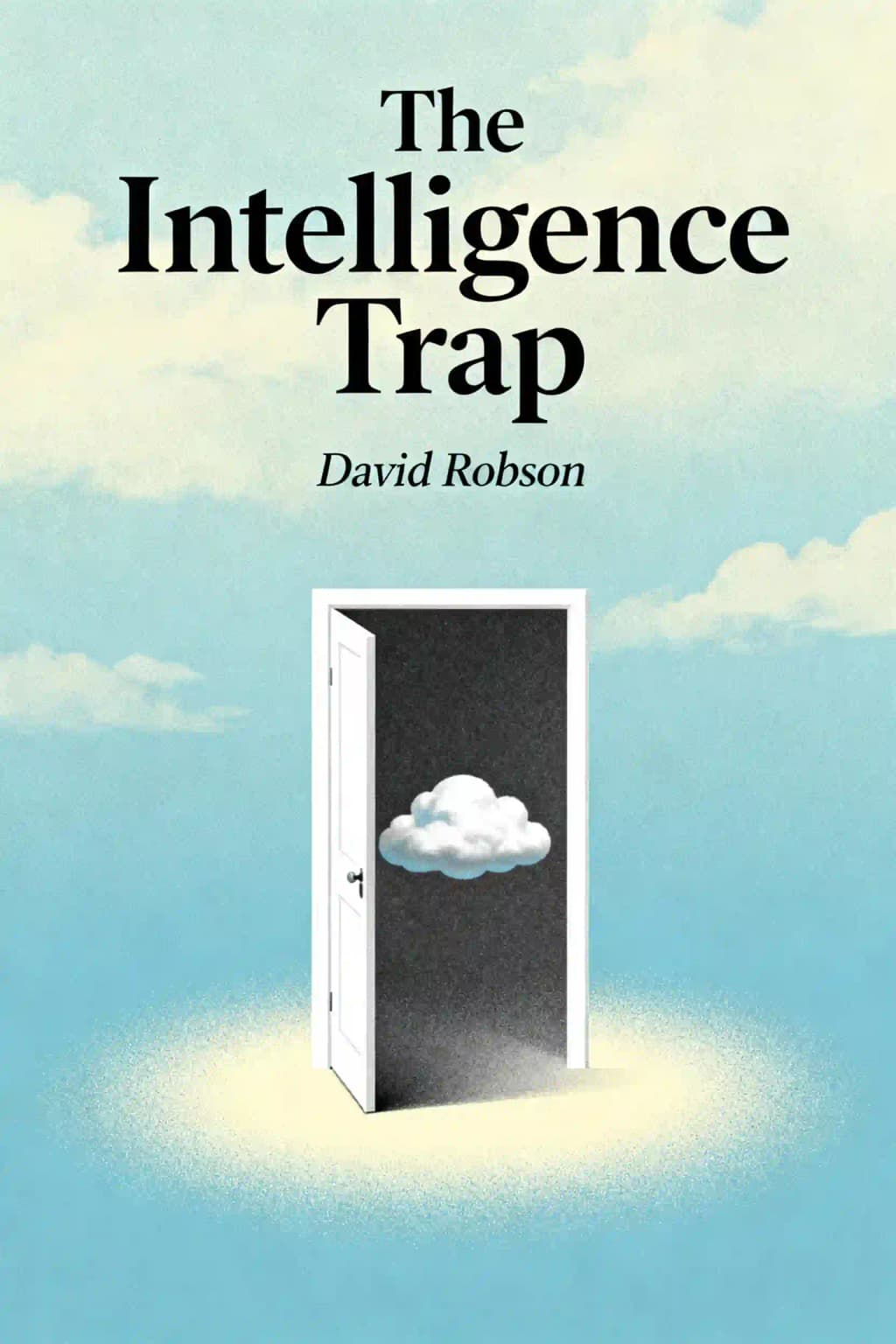
Imagine a brilliant Nobel Prize-winning scientist who believes he's been abducted by aliens. Picture a world-renowned physician who promotes dangerous medical myths. Consider how some of the smartest people you know make the most bewildering decisions in their personal lives. This paradox forms the central question of David Robson's fascinating exploration: why do intelligent people make stupid mistakes, and why are they sometimes even more prone to error than average people? In "The Intelligence Trap," Robson reveals how traditional measures of intelligence-abstract reasoning, factual recall, vocabulary-fail to protect us from cognitive errors. In fact, smart people can be less likely to learn from mistakes, less willing to take advice, more dogmatic, and have larger blind spots in recognizing their own biases. The book has garnered praise from cognitive scientists and psychologists alike, becoming essential reading for anyone seeking to understand why brilliance doesn't guarantee good judgment.
第2章
The Paradox of Intelligence and Rationality
Lewis Terman's famous "Termites" study-tracking 1,500 high-IQ children throughout their lives-revealed a startling truth: exceptional intelligence doesn't guarantee exceptional achievement. While many participants enjoyed comfortable professional lives, few achieved the groundbreaking success Terman anticipated. More troubling was Terman's own intellectual blind spots. Despite his brilliance, he ignored data contradicting his preconceptions, neglected to search for talented children in poorer neighborhoods, and joined organizations advocating compulsory sterilization of those with "undesirable qualities." When challenged by journalist Walter Lippmann, Terman responded with personal attacks rather than reasoned arguments.
This pattern exemplifies what psychologist Keith Stanovich calls "dysrationalia"-high intelligence coupled with poor rational thinking. His decades of research reveal surprisingly weak correlations between intelligence measures and rational thinking skills. SAT scores showed minimal correlation with biases like framing and anchoring, while even temporal discounting-delaying gratification for greater rewards-showed almost no relationship with intelligence. Philosophers with PhDs proved just as susceptible to these biases as anyone else.
More intelligent people actually demonstrated a larger "bias blind spot," expecting to outperform others on cognitive tasks while remaining equally vulnerable to biases. Stanovich's "rationality quotient" test, combining measures of cognitive biases, probabilistic reasoning, and anti-science attitudes, showed only modest correlation with intelligence measures.
Real-world studies confirmed that rationality scores were three times more important than intelligence in predicting negative life outcomes. High-IQ individuals were equally likely to face financial distress, miss mortgage payments, or accumulate credit card debt despite typically having higher-paying jobs-suggesting their financial troubles stem from poor decision-making rather than earning capacity.
Why would evolution favor intelligence paired with irrationality? Hugo Mercier and Dan Sperber suggest human reasoning evolved primarily for social persuasion rather than truth-seeking. If human thought evolved mainly to convince others we're right, motivated reasoning makes sense-we seem more convincing when marshaling evidence for our view while remaining skeptical of opposing arguments. In ancestral small groups, this dynamic would be balanced through regular debate, but in modern technological and social bubbles, our biases go unchecked.
第3章
When Expertise Becomes a Liability
The case of Brandon Mayfield illustrates how expertise itself can become a liability. In 2004, Mayfield, a Muslim convert and attorney, was wrongfully arrested by the FBI for the Madrid bombings that killed 192 people. Despite his protests, FBI experts claimed his fingerprint was a "100% positive match" to one found on evidence at the scene. Only when Spanish police identified the actual perpetrator was Mayfield finally freed.
The FBI's mistake wasn't due to lack of skill-their forensics teams are considered the world's best. Rather, their expertise itself contributed to the error. Pioneering psychologist Adriaan de Groot discovered that chess masters don't calculate more moves than novices-they use "chunking" to organize information into meaningful patterns or "schemas." Rather than seeing individual pieces, experts perceive larger strategic units, allowing them to recognize situations almost instantly.
This process transforms expertise across domains-from Scrabble champions to elite athletes to London taxi drivers navigating 25,000 streets. In each case, experts develop a vast library of schemas that allow them to extract key information, recognize patterns, and respond automatically.
However, this efficiency comes with significant costs. Experts often lack flexibility, struggling to adapt when rules or circumstances change. They may miss important details as their brains focus on broad patterns rather than fine elements-brain scans of radiologists show increased activity in pattern recognition areas but decreased activity in visual cortex regions responsible for detailed examination. Most dangerously, expert decisions based on gist rather than careful analysis are more easily swayed by emotions, expectations and cognitive biases.
Some scientists develop a tendency to embrace dubious theories outside their expertise-a phenomenon called "Nobel Disease." Examples include biochemist Kary Mullis with his conspiracy theories, Linus Pauling's false claims about vitamin supplements curing cancer, and Luc Montagnier's bizarre theories about diluted DNA emitting electromagnetic radiation.
Thomas Edison and Steve Jobs exemplify how brilliant innovators can fall victim to motivated reasoning. Edison, despite his inventive genius, waged a futile "battle of the currents" against AC power, even electrocuting animals publicly to discredit it. Steve Jobs similarly exhibited what colleagues called a "reality distortion field." While this single-mindedness helped him revolutionize technology, it proved fatal when he was diagnosed with pancreatic cancer. Ignoring medical advice, he pursued alternative remedies like herbal treatments and fruit juice diets, delaying proper treatment until it was too late.
第4章
Navigating with Evidence-Based Wisdom
Having identified the intelligence trap's various forms, we need solutions. Intelligence and expertise are like an engine and its fuel; they power thinking but without proper navigation skills can lead us into dead ends or off cliffs. The emerging discipline of evidence-based wisdom offers tools to navigate these pitfalls more carefully.
Benjamin Franklin's pragmatic approach to decision-making exemplifies wisdom in action. His "moral algebra" method involved dividing paper into two columns of pros and cons, carefully weighing each factor, and suspending judgment to allow thoughts to settle. This deliberate process counteracts our tendency to rely on easily recalled reasons rather than considering all perspectives.
Franklin recognized that merely wanting to be objective isn't enough-practical methods are needed. Modern psychological research confirms that "considering the opposite" reduces reasoning errors like anchoring, overconfidence, and myside bias across many decision contexts. The key is actively arguing against yourself and questioning why your initial judgment might be wrong.
For important decisions, multiple iterations help uncover overlooked information. Asking "Would I evaluate this evidence the same way if it supported the opposite conclusion?" helps overcome dismissive tendencies. Imagining explaining your justifications to others also broadens perspective, as studies show we consider more viewpoints when accountability is expected.
This open-minded approach characterizes successful leaders like Angela Merkel, known for her "analytical detachment" and patient deliberation. Analysis of political crises shows leaders who practice open-minded thinking-like JFK during the Cuban missile crisis-achieve better outcomes in negotiations than those with rigid mindsets.
The biblical King Solomon exemplifies the paradox of applying wisdom to others' problems while failing to manage one's personal affairs wisely. Despite legendary judgment in royal matters, Solomon's personal life was ruled by intemperate passions-taking a thousand wives and concubines, amassing excessive wealth, and neglecting his son's education, ultimately leading his kingdom into chaos.
Igor Grossmann has identified this same asymmetry in modern humans: we reason wisely about others' dilemmas but struggle with our own issues, becoming more arrogant and less compromising-especially when feeling threatened by "hot" emotional processing.
The solution lies in "self-distancing"-mentally stepping back to observe yourself from another perspective. People who practice self-distancing describe situations more neutrally and seek underlying reasons rather than focusing on petty details. This isn't emotional avoidance but gaining enough distance to confront emotions from a healthier stance.
第5章
Your Emotional Compass
Ray Kroc's "funny bone" feeling that led him to transform McDonald's illustrates how our emotions and intuitions can be valuable information sources when properly understood. Research shows that while gut reactions can be unreliable, the problem isn't emotions themselves but our inability to interpret these signals correctly. The somatic marker hypothesis explains that our bodies create physical responses-like fluctuations in heart rate or stomach sensations-before conscious reasoning catches up, creating the intuitive feelings we call gut instinct.
These bodily signals are processed through the ventromedial prefrontal cortex, which explains why patients with damage to this area make poor decisions despite intact intelligence. Individual differences in interoception (sensitivity to bodily signals) explain why some people make better intuitive decisions than others, with studies showing that traders with better interoceptive accuracy achieve greater financial success.
However, our somatic markers can be messy, with irrelevant feelings sometimes influencing decisions-like bad weather affecting job interview outcomes. The key to wise intuitive decision-making lies in three interconnected skills: interoception, emotion differentiation (using precise vocabulary to describe feelings), and emotion regulation (managing feelings appropriately).
Engaging with emotions isn't a distraction from good reasoning but essential to it. These reflective thinking skills complement traditional intelligence and expertise by ensuring we apply reasoning productively without being derailed by irrelevant feelings. Research shows reflective skills protect against specific cognitive biases like the sunk cost fallacy and framing effects. In one study, people with sophisticated emotion regulation were 34% less likely to fall for sunk cost bias after just fifteen minutes of mindfulness meditation.
Fortunately, reflective skills can be developed through various practices. Mindfulness meditation improves all elements of your emotional compass, helping practitioners make more rational choices even in unfair situations. Musicians and dancers naturally develop better interoception through their training. Simply describing feelings with precise vocabulary can improve emotion differentiation. Learning new emotional vocabulary terms (like "hangry") helps identify nuanced feelings that might influence decisions. These practices don't replace intelligence but ensure we use our reasoning capabilities more effectively.
第6章
Building Your Bullshit Detection Kit
The internet age has made us increasingly vulnerable to misinformation, from viral hoaxes to sophisticated "fake news" campaigns. Even highly educated individuals remain susceptible to misinformation due to what researchers call "truthiness" - our brain's intuitive judgment of truth based on psychological factors like familiarity, fluency, and emotional resonance. Seemingly minor presentation elements can dramatically influence believability: easy-to-read fonts increase trust by 40%, rhyming phrases are judged 30% more accurate than non-rhyming versions, and even irrelevant decorative images can boost credibility ratings by making information feel more processed and familiar.
Repetition emerges as one of the most potent tools for making falsehoods feel true. Research at Yale demonstrated that a statement repeated three times by one source can be as convincing as hearing it from three independent sources - a phenomenon called the "illusory truth effect." This psychological quirk explains how determined minorities can create an illusion of consensus, as seen historically with tobacco industry messaging ("doubt is our product") and more recently with climate change denial campaigns. When organizations attempt to debunk myths through repeated corrections, they often paradoxically reinforce them by increasing familiarity. The CDC found that corrective health campaigns sometimes increased belief in the very myths they aimed to dispel.
Our existing worldviews act as powerful filters for new information. Messages that align with our preexisting beliefs are processed more fluently and feel more familiar, creating a confirmation bias loop. Studies show people spend 36% more time reading information that confirms their existing views versus challenging information. This selective exposure helps explain why factual corrections often fail to change minds.
To build resistance against misinformation, researchers recommend "cognitive inoculation" - controlled exposure to deceptive tactics that builds mental antibodies against future manipulation. In a landmark study, John Cook and Stephan Lewandowsky showed how explaining tobacco industry propaganda techniques made participants 28% more resistant to climate change misinformation, regardless of their initial political stance. This "vaccination" approach proved more effective than direct fact-checking.
Progressive schools now incorporate practical misinformation education using real-world examples rather than abstract logic exercises. Students analyze actual viral hoaxes, conspiracy theories, and marketing claims. These programs show promising results - reducing belief in pseudoscience by up to 25% while improving general critical thinking skills that predict better real-world decision making, despite not strongly correlating with IQ scores.
For effective bullshit detection, experts recommend a systematic questioning approach: Examine source credibility and potential motives; verify claimed credentials and expertise; identify logical premises and potential fallacies; consider alternative explanations; weigh supporting evidence for competing theories; and identify information gaps requiring further investigation. Pay special attention to persuasive elements that create "truthiness" without adding substance: repetition, emotional anecdotes without statistical context, familiar-sounding experts, and polished presentation masking weak content. Remember that confidence and certainty often correlate negatively with actual expertise - genuine experts tend to acknowledge complexity and uncertainty.
第7章
Curiosity: The Antidote to Dogmatism
Richard Feynman, despite scoring only 125 on a childhood IQ test, became one of the most influential physicists of the 20th century through relentless self-education. His journey from modest beginnings to winning the Nobel Prize exemplifies how raw intelligence isn't destiny. Unlike Lewis Terman's high-IQ "geniuses" who often failed to reach their potential, Feynman continuously expanded his mind throughout adulthood, mastering diverse fields from genetics to art. He learned Portuguese to teach in Brazil, took up drawing and became good enough to sell his work, and even learned to crack safes at Los Alamos. His success demonstrates how cognitive qualities beyond intelligence determine whether we flourish.
Recent psychological research reveals that traits like curiosity rival general intelligence in importance for development. Studies at the University of California found that curiosity activates the brain's dopaminergic system, strengthening memory formation in the hippocampus. This creates a powerful "spill-over effect" where interest in one subject makes it easier to learn anything else. For instance, students who developed curiosity about physics often showed improved performance across all subjects, including unrelated ones like literature. Alongside intelligence and conscientiousness, curiosity forms one of the "three pillars" of academic success, accounting for up to 30% of learning outcomes in longitudinal studies.
Curious people relish mystery and surprise, getting a dopamine kick from new information that raises more questions. This openness makes them more willing to change opinions and less entrenched in dogmatic views. Dan Kahan's research at Yale shows this "itch to find out something new" reduces polarization across controversial topics like gun control and immigration. In his studies, participants with high curiosity scores were 42% more likely to engage with opposing viewpoints and 67% more likely to change their minds when presented with compelling evidence.
Growth mindset similarly protects against dogmatism by increasing intellectual humility. Tenelle Porter, studying under Carol Dweck at Stanford, found that exposing people to the idea that brains are malleable increased their willingness to admit knowledge gaps and seek critical feedback by nearly 50%. The research showed that with fixed mindsets, people constantly defend their hierarchical position, while growth mindsets free them from this defensive posture, making learning easier. This effect was particularly pronounced in workplace settings, where employees with growth mindsets were four times more likely to seek feedback and implement improvements.
These traits are increasingly crucial in today's fast-changing world, where an engineer's knowledge half-life has shrunk from 35 years in the 1920s to under three years today. Technical skills become obsolete faster than ever, with programming languages and frameworks sometimes becoming outdated within months. Companies like Google, Amazon, and Microsoft now explicitly seek candidates combining passion with intellectual humility over traditional academic success metrics. Google's Project Oxygen found that among their top performers, curiosity and learning ability were better predictors of success than academic achievements or prior experience.
第8章
Embracing Productive Struggle
James Stigler, while observing a Japanese classroom, witnessed a struggling student attempt to draw 3D cubes on the blackboard for 45 minutes while classmates evaluated his work. What seemed like public humiliation to Western eyes actually revealed profound differences in learning approaches.
Japanese teaching naturally incorporates intellectual humility and actively open-minded thinking, contradicting Western assumptions about East Asian education systems relying on rote memorization. Modern neuroscience confirms we learn best when confused, and deliberately limiting today's performance often improves tomorrow's results.
Alan Baddeley demonstrated this with British Post Office workers learning keyboard skills. Those with spaced learning (one hour daily) mastered the skill in 35 hours versus 50 hours for intensive learners (four hours daily). The mechanism behind this spacing effect isn't simply rest, but rather the beneficial forgetting and relearning process that strengthens memory traces.
Robert and Elizabeth Bjork pioneered research on "desirable difficulties"-learning challenges that initially impair performance but promote long-term gains. Techniques like interleaving (switching between related topics) and pre-testing (attempting problems before learning solutions) feel more confusing initially but produce superior learning outcomes. Even complex, nuanced textbooks produce better recall than slick, simplified materials.
Despite overwhelming evidence, Western students, parents and teachers resist these approaches, preferring learning that feels easier. East Asian cultures, however, embrace struggle as necessary for education. Japanese sayings like "even genius cannot transcend effort" and cultural stories reinforce this mindset. Japanese students view abilities as works in progress rather than fixed limitations, embracing a growth mindset where mistakes indicate what still needs learning.
The Intellectual Virtues Academy in Long Beach, California represents perhaps the most comprehensive attempt to apply evidence-based wisdom principles in education. Founded by philosophy professor Jason Baehr, the charter school organizes nine "master virtues" into three categories: "Getting started" virtues (curiosity, intellectual humility, intellectual autonomy), "Executing well" virtues (attentiveness, intellectual carefulness, intellectual thoroughness), and "Handling challenges" virtues (open-mindedness, intellectual courage, intellectual tenacity).
The approach combines challenging curriculum with metacognitive awareness, helping students develop sophisticated reasoning without sacrificing academic rigor. The school's academic results speak for themselves, scoring as one of the top three schools in the Long Beach district in its first year, with over 70% of students meeting state English standards compared to California's 50% average.
第9章
When Organizations Amplify Our Flaws
The Deepwater Horizon disaster of 2010 illustrates how corporate cultures can magnify individual thinking errors into catastrophes. Despite dozens of similar near-misses in the Gulf of Mexico over previous decades, eleven workers died and 200 million gallons of oil spilled when engineers misinterpreted pressure tests and missed critical warning signs.
This organizational blindness exemplifies what Mats Alvesson and Andre Spicer call "functional stupidity"-the counterintuitive tendency of companies to discourage employees from thinking critically. Their research reveals that despite investments in "knowledge economies," many organizations have become "engines of stupidity" where reflection about assumptions, curiosity about purpose, and consideration of long-term consequences are suppressed.
This stupidity is "functional" because it offers short-term benefits: employees save effort and anxiety by going with the flow, particularly when incentives reward conformity. This "strategic ignorance" provides "moral wiggle room" by allowing people to remain deliberately uninformed about the consequences of their actions.
Nokia's collapse in the early 2010s vividly illustrates how functional stupidity can destroy even a market leader. Despite holding half the global mobile phone market in 2007, Nokia lost most customers to smartphones within six years. Contrary to popular belief, Nokia's engineers were world-class and fully aware of the iPhone threat. Their biggest challenge was the inferior Symbian operating system, unsuitable for sophisticated touchscreen apps. But the corporate culture made addressing these problems impossible. Senior managers would "shout at the tops of their lungs" when hearing unwelcome information, and employees risked termination for expressing doubts.
How can organizations avoid these intelligence traps? Karl Weick and Kathleen Sutcliffe studied "high-reliability organisations" like nuclear power plants and aircraft carriers that operate with enormous hazard potential yet achieve remarkably low failure rates. These organizations demonstrate five key characteristics: preoccupation with failure, reluctance to simplify interpretations, sensitivity to operations, commitment to resilience, and deference to expertise.
Weick calls these combined characteristics "collective mindfulness"-keeping employees attentive, proactive, open to new ideas, questioning, and devoted to learning from mistakes. Healthcare implementations have shown dramatic results: St. Joseph's Healthcare in Ontario reduced medication errors to just two mistakes in over 800,000 medications dispensed, while Golden Valley Memorial in Missouri eliminated drug-resistant Staphylococcus aureus infections entirely and reduced patient falls by 41 percent.
Despite added responsibilities, staff in mindful organizations often thrive, with lower turnover rates than less mindful institutions. It's more rewarding to fully engage your mind for the greater good than simply go through motions.
第10章
The Path Forward: Developing Evidence-Based Wisdom
The Intelligence Trap extends beyond individual mistakes to our societal valuation of certain thinking styles over others. While IQ scores rose throughout the 20th century (what James Flynn calls our "cognitive history"), our understanding of intelligence remains dominated by abstract reasoning measured by standardized tests. We need not abandon these skills to recognize other reasoning modes deserve equal attention. Indeed, cultivating these traits enhances standard cognitive abilities while making us wiser thinkers.
Studies consistently show that encouraging problem definition, perspective exploration, imagining alternative outcomes, and identifying erroneous arguments boosts learning capacity while promoting wiser reasoning. Bradley Owens found intellectual humility predicts academic achievement better than IQ, benefiting everyone but especially those with lower intelligence scores-completely compensating for lower "natural" ability.
This broader understanding of thinking couldn't come at a better time. Despite rising IQs, we're no closer to solving climate change or inequality, with dogmatic views hindering necessary negotiations. The World Economic Forum lists political polarization and digital misinformation as threats comparable to terrorism.
The 21st century's complex problems require wiser reasoning that recognizes limitations, tolerates ambiguity, balances perspectives, and bridges diverse expertise. Research shows presidents scoring higher on open-mindedness and perspective-taking found more peaceful conflict resolutions-qualities we should actively demand in leaders.
The first step is acknowledging the problem. Intellectual humility helps us overcome bias blindness, form rational opinions, avoid misinformation, learn effectively, and work productively with others. As philosopher Valerie Tiberius notes, while we invest heavily in boosting self-esteem, "if more people had some humility about what they know and don't know, that would go a tremendous distance to improving life for everyone."
Whatever our age or expertise, we can all learn new thinking ways and benefit from wielding our minds with insight, precision and humility.