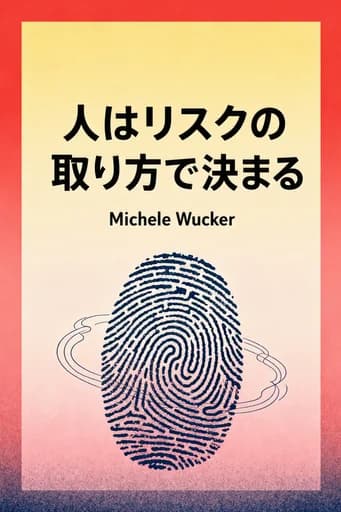
In "You Are What You Risk," Michele Wucker reveals how your personal "risk fingerprint" shapes every decision you make. Named an AudioFile Top Book of 2021, it's earned praise from Seth Godin as "an important book you'll be thinking about for a long time."
Michele Wucker, bestselling author of You Are What You Risk: The New Art and Science of Navigating an Uncertain World, is a globally recognized strategist specializing in risk anticipation and decision-making. A Chicago-based policy analyst and founder of Gray Rhino & Company, she pioneered the “gray rhino” concept—a framework for addressing high-probability, high-impact risks.
Her previous book, The Gray Rhino, sold over one million copies and became a cultural touchstone embraced by policymakers and business leaders. Her work blends behavioral science, economic policy, and strategic foresight, informed by her roles at Dow Jones, the World Policy Institute, and the Chicago Council on Global Affairs.
Wucker’s insights have been featured in The New York Times, TED Talks (her 2019 talk has 2.5 million views), and the World Economic Forum. Her earlier books, including Lockout on immigration policy and Why the Cocks Fight on Dominican-Haitian relations, underscore her interdisciplinary approach to global challenges. You Are What You Risk expands her exploration of risk psychology, offering tools for individuals and organizations to navigate uncertainty. Central banks, corporate boards, and insurers worldwide apply her methodologies, cementing her reputation as a leading voice in crisis mitigation.
You Are What You Risk explores how individuals and societies perceive and manage risk, blending psychology, culture, and economics. Michele Wucker introduces the concept of a "risk fingerprint"—a personalized combination of experiences, emotions, and cultural influences that shape decision-making. The book analyzes case studies like the 2008 financial crisis and pandemic preparedness, offering frameworks to navigate uncertainty proactively.
This book is ideal for professionals in finance, leadership, and policy-making, as well as anyone seeking to understand their relationship with risk. It’s particularly valuable for those navigating career transitions, organizational change, or global challenges like climate change and AI disruption.
Yes—the book provides actionable insights into risk management, backed by global examples and interdisciplinary research. Readers praise its accessible approach to complex topics, making it a practical guide for personal growth and strategic decision-making.
A “risk fingerprint” refers to the unique blend of psychological, cultural, and experiential factors influencing how individuals approach risk. Wucker explains how traits like upbringing, gender, and societal norms shape risk tolerance, offering tools to identify and adapt these patterns.
Wucker highlights how Eastern and Western societies prioritize risks differently, using examples like pandemic responses and financial behaviors. She emphasizes “risk empathy” to bridge gaps in workplace, policy, and international contexts.
The book advocates for:
While The Gray Rhino focused on systemic risks, this sequel examines personal and societal risk ecosystems. It expands the framework to include individual psychology, generational attitudes, and cultural narratives.
Wucker challenges stereotypes, showing how societal expectations—not biology—shape risk behaviors. She cites studies on leadership risk-taking and financial decision-making to argue for inclusive risk strategies.
Yes—the book teaches readers to align risk choices with personal values and long-term goals. It’s particularly useful for entrepreneurs, negotiators, and professionals navigating industry disruptions.
Wucker uses COVID-19 as a case study in “gray rhino” neglect, analyzing how bias and short-term thinking delayed responses. The book offers lessons for managing future global crises.
Some readers note the broad scope may overwhelm those seeking sector-specific solutions. However, most praise its interdisciplinary approach as a strength for tackling complex, interconnected risks.
As AI, climate change, and geopolitical shifts accelerate, Wucker’s frameworks help individuals and organizations build adaptive resilience. The book’s focus on cultural and emotional intelligence aligns with evolving workplace and societal needs.
著者の声を通じて本を感じる
知識を魅力的で例が豊富な洞察に変換
キーアイデアを瞬時にキャプチャして素早く学習
楽しく魅力的な方法で本を楽しむ
We are what we risk because risk reveals what we value.
Our risk decisions reveal who we are.
Risk shifts between hope and fear.
Risk is something over which we have limited control.
The idea of eliminating risks is tantalizing but fantastical.
『You Are What You Risk』の核心的なアイデアを分かりやすいポイントに分解し、革新的なチームがどのように創造、協力、成長するかを理解します。
『You Are What You Risk』を素早い記憶のヒントに凝縮し、率直さ、チームワーク、創造的な回復力の主要原則を強調します。

鮮やかなストーリーテリングを通じて『You Are What You Risk』を体験し、イノベーションのレッスンを記憶に残り、応用できる瞬間に変えます。
何でも質問し、声を選び、本当にあなたに響く洞察を一緒に作り出しましょう。

"Instead of endless scrolling, I just hit play on BeFreed. It saves me so much time."
"I never knew where to start with nonfiction—BeFreed’s book lists turned into podcasts gave me a clear path."
"Perfect balance between learning and entertainment. Finished ‘Thinking, Fast and Slow’ on my commute this week."
"Crazy how much I learned while walking the dog. BeFreed = small habits → big gains."
"Reading used to feel like a chore. Now it’s just part of my lifestyle."
"Feels effortless compared to reading. I’ve finished 6 books this month already."
"BeFreed turned my guilty doomscrolling into something that feels productive and inspiring."
"BeFreed turned my commute into learning time. 20-min podcasts are perfect for finishing books I never had time for."
"BeFreed replaced my podcast queue. Imagine Spotify for books — that’s it. 🙌"
"It is great for me to learn something from the book without reading it."
"The themed book list podcasts help me connect ideas across authors—like a guided audio journey."
"Makes me feel smarter every time before going to work"

You Are What You Riskの要約をPDFまたはEPUBで無料でダウンロード。印刷やオフラインでいつでもお読みいただけます。
Why does the same person who fearlessly parachutes from planes freeze when asking for a raise? Consider a woman who delivered messages for the Belgian Resistance during WWII, dodging Nazi patrols with nerves of steel, yet refused surgery for a life-threatening aneurysm decades later. These aren't contradictions-they're clues. Each of us carries a unique "risk fingerprint," an invisible signature written in our choices, shaped by everything from childhood experiences to the language we speak. This fingerprint doesn't just influence what we do; it reveals who we are. When COVID-19 turned the world upside down, suddenly everyone became an amateur risk analyst, weighing invisible threats against visible freedoms. Some saw danger everywhere. Others saw government overreach. The virus didn't change-our risk fingerprints determined what we saw. Think of the Bhatia family, who built real estate empires only to lose everything in 2008. Most people would play it safe after that kind of devastation. Instead, they sold their home, packed up their twin daughters, and became global nomads-a choice that seemed reckless to friends but felt emotionally secure to them. When the pandemic hit, their "risky" lifestyle landed them in New Zealand, one of the safest places on Earth. What others perceived as danger, they experienced as freedom. Your risk fingerprint combines personality traits, life experiences, and social context into a pattern as unique as your thumbprint. It includes risk sensitivity (how threatening something feels) and risk tolerance (how much uncertainty you can bear). These aren't fixed traits-they shift with circumstances, relationships, and what you have to lose. A refugee fleeing violence takes enormous risks, but compared to certain death, flight becomes the safest option. Risk is never absolute; it's always relative to your situation. Understanding this personal relationship with uncertainty isn't just intellectually interesting; it's the key to unlocking better decisions, stronger relationships, and a life aligned with your deepest values rather than your deepest fears.