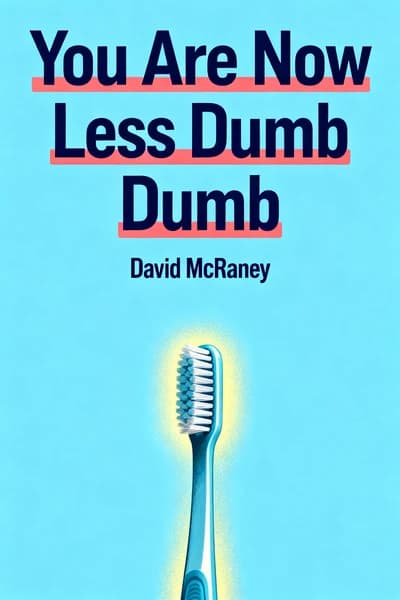
Uncover why your brain sabotages you in David McRaney's mind-bending guide to outsmarting yourself. Featuring the viral Benjamin Franklin Effect and Charlie Veitch's dramatic belief reversal, this book reveals the surprising psychology behind why doing favors for enemies actually makes you like them more.
David McRaney, bestselling author of You Are Now Less Dumb and acclaimed science journalist, explores the psychology of self-delusion, cognitive biases, and human reasoning.
A former newspaper reporter who covered pivotal events like Hurricane Katrina, McRaney leverages his background in journalism and psychology to dissect why people cling to irrational beliefs. His career spans blogging, podcasting, and authorship—his first book, You Are Not So Smart (2009), became an international phenomenon translated into 17 languages and evolved into a podcast interviewing leading scientists.
McRaney’s third book, How Minds Change, delves into persuasion and belief shifts, further cementing his reputation for translating complex research into engaging narratives. A sought-after global lecturer, he has also produced documentaries and hosted TV programs bridging science and culture.
His work is celebrated for combining wit with rigorous analysis, making psychological concepts accessible to broad audiences. You Are Not So Smart remains a cornerstone in popular psychology, frequently cited in both academic and mainstream discussions about human behavior.
You Are Now Less Dumb explores 17 cognitive biases and self-delusions that shape human behavior, such as the sunk cost fallacy, misattribution of arousal, and enclothed cognition. Through engaging anecdotes and scientific research, McRaney reveals how our brains trick us into irrational decisions—and how to outsmart these mental traps for better judgment.
This book is ideal for psychology enthusiasts, self-improvement seekers, and anyone curious about human behavior. Readers interested in behavioral economics, decision-making flaws, or overcoming cognitive biases will find actionable insights into recognizing and countering mental blind spots.
Yes—the book combines relatable examples with rigorous science to make complex psychology accessible. Critics praise its witty tone and practical takeaways, though some note a desire for deeper theoretical frameworks. It’s a compelling primer for understanding irrational thinking.
Key ideas include:
McRaney describes the Halo Effect as our tendency to assume attractive or charismatic people are more competent or moral. This bias leads to skewed judgments in hiring, relationships, and leadership evaluations—and often blinds us to contradictory evidence.
Enclothed cognition refers to how clothing influences behavior and mental performance. Wearing uniforms or formal attire can boost confidence, focus, or adherence to role expectations—a concept backed by studies on lab coats and professional attire.
The book explains that people double down on beliefs when confronted with opposing facts. McRaney argues this defensive response protects our self-identity, making it harder to change minds—even with evidence.
While praised for its accessibility, some readers note the book prioritizes entertaining examples over deeper analysis. Critics suggest a desire for more cohesive frameworks to connect the 17 concepts.
Unlike You Are Not So Smart, which focuses on general self-deception, this sequel delves into specific, actionable strategies to combat cognitive biases. Both blend humor and science, but Less Dumb emphasizes practical self-improvement.
The book advises:
This bias occurs when we attribute emotional arousal (e.g., adrenaline from exercise) to unrelated triggers (e.g., attraction to someone nearby). McRaney uses bridge experiments to show how context shapes romantic or fearful feelings.
In an era of misinformation and polarized groups, understanding mob mentality, confirmation bias, and arousal misattribution remains critical. The book’s lessons help navigate social media conflicts, workplace dynamics, and personal decision-making.
著者の声を通じて本を感じる
知識を魅力的で例が豊富な洞察に変換
キーアイデアを瞬時にキャプチャして素早く学習
楽しく魅力的な方法で本を楽しむ
Why play by the rules if no one cares?
Each act of self-control makes the next more difficult.
The source of your emotional state is often difficult to detect.
We're constantly interpreting our physical states to understand our emotions.
Shared struggles bring couples closer.
『You Are Now Less Dumb』の核心的なアイデアを分かりやすいポイントに分解し、革新的なチームがどのように創造、協力、成長するかを理解します。
『You Are Now Less Dumb』を素早い記憶のヒントに凝縮し、率直さ、チームワーク、創造的な回復力の主要原則を強調します。

鮮やかなストーリーテリングを通じて『You Are Now Less Dumb』を体験し、イノベーションのレッスンを記憶に残り、応用できる瞬間に変えます。
何でも質問し、声を選び、本当にあなたに響く洞察を一緒に作り出しましょう。

"Instead of endless scrolling, I just hit play on BeFreed. It saves me so much time."
"I never knew where to start with nonfiction—BeFreed’s book lists turned into podcasts gave me a clear path."
"Perfect balance between learning and entertainment. Finished ‘Thinking, Fast and Slow’ on my commute this week."
"Crazy how much I learned while walking the dog. BeFreed = small habits → big gains."
"Reading used to feel like a chore. Now it’s just part of my lifestyle."
"Feels effortless compared to reading. I’ve finished 6 books this month already."
"BeFreed turned my guilty doomscrolling into something that feels productive and inspiring."
"BeFreed turned my commute into learning time. 20-min podcasts are perfect for finishing books I never had time for."
"BeFreed replaced my podcast queue. Imagine Spotify for books — that’s it. 🙌"
"It is great for me to learn something from the book without reading it."
"The themed book list podcasts help me connect ideas across authors—like a guided audio journey."
"Makes me feel smarter every time before going to work"

You Are Now Less Dumbの要約をPDFまたはEPUBで無料でダウンロード。印刷やオフラインでいつでもお読みいただけます。
Why do you keep checking your phone even when you know there's nothing new? Why did that argument with your uncle about politics only make him dig in harder? These aren't random quirks-they're systematic glitches in how your mind processes reality. Our brains evolved not for truth, but for survival, and the shortcuts that kept our ancestors alive now lead us astray in ways both fascinating and frustrating. Understanding these mental blind spots isn't just intellectually interesting-it's essential for navigating a world designed to exploit them.