第1章
When Silence Speaks Louder Than Words
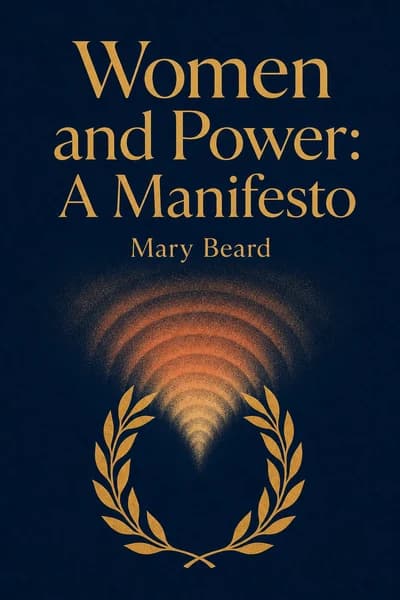
Have you ever wondered why women's voices seem to carry less weight in the public sphere? Mary Beard's slim yet powerful manifesto "Women and Power" has become a cultural touchstone since its 2017 publication, arriving at the perfect moment alongside the #MeToo movement. This New York Times bestseller, adapted from two lectures delivered at the British Museum, traces the silencing of women's voices from ancient Greece to modern Twitter. Beloved by celebrities like Emma Watson and praised by critics across the political spectrum, Beard's work connects our contemporary struggles with their classical roots. As a Cambridge professor of classics who has herself faced brutal online harassment, Beard doesn't just analyze misogyny-she's lived its modern manifestations. Her work reveals how the mechanisms silencing women today were established millennia ago, making this brief book essential reading for understanding why, despite apparent progress, women's relationship with power remains so fraught.
第2章
The First Silencing: How It All Began
The Western tradition of silencing women has a precise beginning. Nearly 3,000 years ago, in Homer's Odyssey, young Telemachus tells his mother Penelope to "go back to your quarters" when she dares request a bard change his song. "Speech will be the business of men," he declares, "all men, and of me most of all." This isn't merely a family squabble-it's a foundational cultural moment showing how male maturation inherently involves controlling public speech and silencing women.
What makes this ancient scene so disturbing is how perfectly it mirrors experiences women still face today. The Greek word Telemachus uses-muthos-specifically means authoritative public speech, not casual conversation. He's not just asking for quiet; he's declaring that meaningful public discourse belongs exclusively to men.
Throughout Greek and Roman antiquity, this exclusion wasn't merely practiced-it was deliberately paraded. Aristophanes' comedies mocked women's supposed inability to speak properly in political settings. Ovid's Metamorphoses repeatedly depicts silenced women: Io transformed into a mooing cow, Echo cursed to repeat only others' words, Philomela with her tongue cut out by her rapist to prevent her from naming him.
Classical culture permitted women's public speech in only two narrow circumstances. First, as victims or martyrs, typically just before their deaths-like early Christian women facing lions or the virtuous Lucretia denouncing her rapist before suicide. Second, women could occasionally speak to defend specifically female interests, as when Hortensia addressed the Roman Forum to protest a special tax on wealthy women. Even then, the few women who did speak publicly were characterized as unnatural-described as "androgynes" or "barking" rather than speaking.
This wasn't merely about custom-public speaking constituted the very definition of masculinity itself. The Roman elite male was explicitly defined as "a good man, skilled in speaking." Classical writers emphasized the authority of deep male voices versus high-pitched female ones, with scientific treatises linking low pitch to courage and high pitch to cowardice. Some intellectuals suggested that men speaking in female voices would be "terrible and harder to bear than any plague."
These ancient attitudes aren't merely historical curiosities. Our own traditions of debate and public speaking still lie in the shadow of the classical world, with modern rhetorical techniques drawn explicitly from ancient handbooks. The silencing continues, echoing across millennia.
第3章
Strident, Shrill, and Silenced: Modern Echoes of Ancient Prejudice
The classical prejudice against women's public speech persists with remarkable tenacity in our supposedly enlightened era. When women have claimed public voices throughout Western history, they've been treated as freakish exceptions. Consider Elizabeth I, who allegedly claimed to have "the heart and stomach of a king" despite her "weak, feeble" female body-essentially denying her womanhood to claim authority.
Our language still undermines women's public speech through subtle mechanisms. Women speaking out are labeled "strident" or accused of "whinging" and "whining"-words that trivialize their message and reposition them in the domestic sphere. These aren't neutral descriptors but weapons of delegitimization with ancient roots.
The fundamental problem isn't biological but cultural: when listeners hear a female voice, they don't hear authority because they haven't been culturally conditioned to recognize authority in it. Women face tremendous resistance when encroaching on traditionally male discursive territory, from sports commentary to political discussion shows. Their controversial views are often dismissed not as disagreeable but as stupid-"Sorry, love, you just don't understand."
Modern anthologies of great speeches by women predominantly feature those addressing "women's issues," like Sojourner Truth's "Ain't I a Woman?" speech (itself largely mythical in its popular form). Women's voices remain "niched" into speaking only about women's causes, just as in ancient Rome.
This silencing continues in literature as well. In Henry James' "The Bostonians," the female protagonist gradually loses her public speaking ability as she draws closer to her suitor, who "re-privatizes her voice." James himself wrote about women's speech as a "generalized mumble or jumble" that risked sounding like animal noises-echoing ancient Roman prejudices with disturbing precision.
Even when women do speak, their contributions often go unacknowledged. The universal "Miss Triggs experience" affects women across professions: making a point in a meeting only to have it ignored until a man repeats it and receives credit. Those who succeed often adopt "androgyne" tactics, like Margaret Thatcher lowering her voice through training, but this leaves women feeling like impersonators in their own bodies.
Rather than forcing women to change, we need to examine the foundations of what constitutes spoken authority and recognize the fault lines in dominant male discourse. The issue isn't just how women "get a word in edgeways" but how we can become aware of the processes that make us not listen to them in the first place.
第4章
Digital Daggers: Online Abuse as Modern Silencing
The internet promised democratization of speech, yet for women who dare to voice opinions online, it has often delivered new forms of the ancient silencing. Internet trolling follows classical patterns with disturbing precision. Regardless of what position a woman takes, venturing into male territory triggers abuse aimed at silencing: "Shut up you bitch" or threats to remove women's capacity to speak like "I'm going to cut off your head and rape it."
These modern threats directly echo ancient stories like Philomela's, whose rapist cut out her tongue to prevent any denunciation. The technology has changed, but the underlying cultural mechanisms remain identical-women who speak in public must be silenced, often through threats of sexual violence.
This digital silencing extends beyond anonymous trolls to formal settings. Women MPs are heckled into inaudibility in parliaments. Female academics find their expertise questioned in ways male colleagues never experience. Afghan women have their microphones disconnected mid-speech. The common advice to "block and ignore" abusers ironically achieves exactly what they want-women's silence.
What's particularly insidious about online abuse is how it exploits the very mechanisms designed to promote free speech. Social media platforms that claim to democratize discourse become weapons for enforcing ancient hierarchies. Women who speak publicly online face a terrible choice: endure horrific abuse or withdraw from the conversation entirely.
The abuse isn't random but follows predictable patterns targeting women's appearance, sexuality, and right to speak at all. A woman need not be discussing gender issues to receive gendered abuse-simply being female while expressing opinions on politics, sports, or economics is sufficient provocation. The message is clear: these domains belong to men, and women who trespass will be punished.
This digital harassment creates a chilling effect far beyond its immediate targets. Young women observing the treatment of female journalists, politicians, and academics learn the potential costs of public speech. Many choose silence over subjecting themselves to such treatment, representing a massive loss of talent and perspective in our public discourse.
What makes this particularly troubling is how normalized such abuse has become. We've grown accustomed to women facing rape threats for discussing video games or economic policy. This normalization itself represents a victory for those seeking to silence women-the abuse becomes background noise rather than a recognized crisis of democratic participation.
第5章
Medusa's Gaze: The Cultural Symbol of Female Power
If we want to understand why women in power provoke such visceral reactions, we must examine the cultural templates we've inherited. Our mental model for powerful figures remains stubbornly male-when imagining a president, professor, or CEO, most people (even women in these positions themselves) envision men. A Google search for "cartoon professor" returns almost exclusively male images with wild white hair and lab coats, while searches for "boss" or "leader" yield similar male-dominated results. This unconscious bias extends across professions, from surgeons to airline pilots.
Women in power must adopt traditionally male characteristics to "fit the part," from trouser suits to lowered voices and assertive body language. Female politicians like Margaret Thatcher famously underwent voice training to sound more authoritative, while studies show women executives often feel pressure to modify their communication styles and appearance. They're still perceived as outsiders to power-"knocking on doors," "storming citadels," or "smashing glass ceilings"-metaphors that emphasize their exteriority. Headlines about women "grabbing power" or "seizing control" reveal our deep-seated discomfort with female authority.
Greek mythology offers an extensive array of powerful female characters who function as cautionary tales rather than role models. Clytemnestra in Aeschylus's Agamemnon exemplifies this-described as androboulon ("thinking like a man") when she rules while her husband fights at Troy, she uses her illegitimate power destructively to murder him. Similar patterns appear with Medea, who uses her power for vengeance, and Circe, who transforms men into beasts. The patriarchal order is only restored when these women are subdued or destroyed, often by male heroes or their own children.
But no figure better represents our cultural anxiety about female power than Medusa-the Gorgon whose gaze turned men to stone before Perseus beheaded her. Her decapitated head adorns Athena's breastplate, symbolizing the violent reassertion of male dominance against illegitimate female power. Western art repeatedly returns to this image-from Caravaggio's bleeding Medusa head to Cellini's bronze of Perseus trampling her corpse. The image appears throughout art history, from ancient Greek pottery to Renaissance sculptures and modern digital art.
Remarkably, this beheading remains a potent cultural symbol opposing women's power today. Angela Merkel and Theresa May have had their features superimposed on Medusa images in political cartoons and social media. During the 2016 election, Trump supporters created merchandise showing Trump as Perseus holding Clinton's severed Medusa head. Similar imagery has been used against other prominent women leaders like Kamala Harris and Alexandria Ocasio-Cortez. This normalization of gendered violence demonstrates how deeply the exclusion of women from power remains culturally embedded.
Even the goddess Athena herself isn't truly female but a hybrid who bypasses womanhood-she's a virgin warrior born directly from her father Zeus's head, suggesting an ideal male world where women could be dispensed with entirely. Her rejection of traditional feminine attributes and total allegiance to patriarchal values makes her acceptable as a powerful figure. Modern parallels can be seen in how female leaders are often praised for being "more like men" or criticized for displaying traditionally feminine qualities. The message is clear: legitimate female power doesn't exist in our cultural imagination, and women who seek it must either masculinize themselves or face violent opposition.
第6章
Redefining Power: Beyond Glass Ceilings
To resituate women within power structures requires both individual tactics and broader systemic redefinition. Some successful women have strategically turned traditionally disempowering female symbols to their advantage-Margaret Thatcher famously transformed her handbag into a verb of political power ("to handbag"), while Theresa May's distinctive leopard-print kitten heels became a statement of feminine authority that refused to conform to the male template. Other leaders like Angela Merkel and Hillary Clinton developed their own power aesthetics through carefully chosen pantsuits and consistent personal presentation.
But individual strategies, however successful, aren't enough to address the deep cultural structures legitimating women's exclusion. We must fundamentally redefine power itself rather than expecting women to fit existing patriarchal models. Current discussions focus too narrowly on high-profile positions and corporate boardrooms, imagining female pioneers as exceptional superwomen heroically battling glass ceilings. This narrative doesn't speak to most women seeking a meaningful stake in power at various levels of society and organizations.
Even measuring women's success by legislative representation proves problematic-high percentages of women in parliaments may paradoxically indicate that real power has shifted elsewhere, often to male-dominated corporate or technocratic spheres. Rwanda's female-majority parliament, while significant, exists within broader patriarchal power structures. We need women in power not just for traditionally labeled "women's issues" but because their systematic exclusion is fundamentally unjust and societies cannot afford to waste their expertise, insight and capabilities.
Issues like childcare, equal pay, and workplace harassment shouldn't be perceived as solely women's concerns but as fundamental social and economic imperatives. The reasons for wanting more women in parliaments, boardrooms and leadership positions are more foundational: it's flagrantly unjust to exclude half of humanity from decision-making power, and we cannot afford to waste their expertise across all domains from economics to foreign policy. If achieving genuine equality means fewer men in legislatures and C-suites, we should be prepared to face that necessary consequence.
We must reconceptualize power differently-not as elite possession coupled to public prestige and individual charisma, but as collaborative effectiveness and the ability to create meaningful change. Women as a gender are systematically excluded from structures coded as male; we need to transform the structure itself rather than simply adding token women. Power should be understood as the ability to make difference in the world and the fundamental right to be taken seriously, rather than dominance over others.
There are reasons for optimism-like Black Lives Matter being founded by three women (Alicia Garza, Patrisse Cullors, and Opal Tometi) who effectively created transformative change without celebrity status or traditional power positions. The #MeToo movement, started by Tarana Burke, demonstrated how collective action could shift cultural conversations. Yet overall, we haven't fully subverted foundational stories and symbols of power that exclude women. Despite feminist attempts to reclaim Medusa as a symbol of female power and resistance, she's still routinely weaponized against female politicians from Hillary Clinton to Angela Merkel.
第7章
The Right to Be Wrong: Perfectionism and Double Standards
One of the most insidious aspects of women's relationship with power is the double standard applied to their mistakes. The 2017 UK election revealed telling disparities in how Diane Abbott's and Boris Johnson's equally disastrous radio interviews were received-Abbott faced brutal ridicule as fundamentally incompetent while Johnson's failings were treated as fixable lapses. Similar patterns emerged in the treatment of Hillary Clinton's email server versus various male politicians' comparable security breaches, with Clinton's mistake becoming a defining scandal while others' infractions were largely forgotten.
Women aren't just blocked from success; they're punished more harshly for mistakes. This creates a perfectionism trap where women feel they must be flawless to be taken seriously, while men are permitted human error. Studies show that female executives spend up to 20% more time preparing for presentations than their male counterparts, knowing their mistakes will be scrutinized more heavily. The pressure to be twice as good to get half as far creates psychological burdens that themselves become barriers to advancement, leading to increased stress, burnout, and imposter syndrome.
This perfectionism extends beyond politics to everyday workplace dynamics. Research shows that women's mistakes are remembered longer and weighted more heavily in performance evaluations. A study of tech industry performance reviews found that women received 2.5 times more feedback about aggressive communication styles than men, and their technical mistakes were cited 88% more frequently. A single error can confirm biases about women's unsuitability for leadership, while men's mistakes are viewed as learning opportunities or simple human fallibility.
The right to be wrong occasionally-to make mistakes, learn from them, and continue forward-is a privilege rarely extended to women in public life. Female entrepreneurs report being less likely to receive second-round funding after a failed venture compared to male counterparts. This creates risk aversion that itself limits potential, as women avoid innovative approaches that might fail. The freedom to fail and try again is essential to leadership and creativity, yet women are often denied this basic latitude, leading to more conservative decision-making and reduced innovation.
This double standard appears starkly in media coverage, where female politicians' appearance, family arrangements, and personal characteristics receive disproportionate attention compared to their male counterparts. Analysis of news coverage shows that articles about female leaders are 30% more likely to mention their personal lives and 40% more likely to discuss their appearance. Their mistakes become defining narratives rather than isolated incidents, creating a one-strike-and-you're-out environment hostile to growth and development. For example, Janet Yellen's occasional verbal stumbles as Federal Reserve Chair generated significantly more negative press than similar moments from her male predecessors.
Defending women's right to be wrong occasionally isn't about lowering standards-it's about applying the same standards we apply to men. It means recognizing that human fallibility doesn't disqualify women from leadership any more than it disqualifies men. Organizations that have actively worked to equalize their response to mistakes report increased female participation in leadership roles and higher rates of innovation. Until we grant women the right to be imperfect leaders, we perpetuate systems that demand superhuman performance from half the population while accepting mere competence from the other half, ultimately depriving society of valuable talent and perspectives.
第8章
Ancient Awareness and Modern Resistance
Some ancient writers were surprisingly self-aware about gendered assumptions regarding speech. While classical culture established the male muthos and female silence dichotomy, writers like Ovid suggested women could transcend vocal silencing-Philomela lost her tongue but denounced her rapist by weaving the story into tapestry.
The smartest ancient rhetorical theorists acknowledged uncomfortable similarities between male oratory techniques and what they considered female seduction, raising doubts about oratory's masculine safety. The disturbing story of Fulvia stabbing Cicero's severed tongue with her hairpins after his assassination represents a symbolic reversal of silencing-women's adornment turned weapon against male speech.
This critically self-aware tradition reveals the conflicts within the dominant template without directly challenging it. It raises important questions about the nature and purpose of speech that should guide our modern consciousness-raising about authority and voice.
Today's resistance takes many forms. Women reclaim silenced voices through collaborative speaking-amplifying each other's points in meetings, refusing to let interruptions stand, and creating networks that ensure women's contributions are acknowledged. Digital platforms, despite their dangers, also provide spaces where women can speak directly to audiences without traditional gatekeepers.
The popularity of terms like "mansplaining" resonates because it captures what it feels like not to have the power to be taken seriously. By naming these experiences, women create language to describe what was previously invisible, making resistance possible.
Charlotte Perkins Gilman's 1915 story "Herland" depicts a 2,000-year-old nation of women who reproduce through parthenogenesis, creating a magnificent utopia-clean, collaborative, peaceful and brilliantly organized. Yet in her sequel, when a boy is born to this female utopia, readers would know exactly who would eventually rule-that boy. This fatalistic conclusion captures how deeply embedded our assumptions about power and gender remain.
But awareness itself creates possibility. By understanding how our cultural templates were formed, we can begin the work of reforming them. The first step toward changing power structures is recognizing how they operate-making visible what has been invisible for millennia. This consciousness-raising isn't merely academic; it's the foundation for creating new models of authority that include all voices.
第9章
Breaking the Classical Mold: Toward New Templates of Power
The path forward requires both individual tactics and structural change. While we can admire women who have succeeded despite these barriers, we shouldn't mistake their exceptional achievements for systemic progress. The solution isn't simply inserting more women into existing power structures but reimagining those structures themselves.
This reimagining begins with recognizing that our current models of power aren't natural or inevitable but cultural constructions with specific historical origins. By examining those origins in classical antiquity, we can denaturalize what seems fixed and open space for alternatives.
What might these alternatives look like? Rather than power as dominance exercised over others, we might conceive power as collaborative capacity to effect change. Rather than authority derived from individual charisma or position, we might value authority emerging from collective wisdom and diverse perspectives.
Some institutions are already experimenting with these alternatives-from corporate structures that flatten hierarchies to political movements organized around distributed leadership. These experiments suggest possibilities beyond the classical mold that has excluded women for millennia.
Language itself must change. Our metaphors for power-"wielding," "seizing," "commanding"-reflect martial, masculine conceptions. New metaphors might emphasize nurturing, connecting, or building-not as "feminine" alternatives but as human capacities currently undervalued in our conception of leadership.
Education plays a crucial role in this transformation. By teaching classical texts critically rather than reverentially, we can help students recognize the gendered assumptions embedded in our cultural foundations. By including women's voices from history alongside the traditional canon, we expand our understanding of what authority can look like.
The stakes of this reimagining extend beyond gender justice to the quality of our collective decision-making. When half the population's perspectives are systematically devalued, we all lose access to crucial insights and approaches. The exclusion of women from power doesn't just harm women-it impoverishes our institutions and limits our capacity to address complex challenges.
Breaking the classical mold doesn't mean rejecting our cultural heritage but engaging with it critically and creatively. By understanding how deeply our conceptions of power and authority are rooted in gendered exclusion, we can begin the work of creating new templates that allow all voices to be heard and all contributions to be valued.