第1章
The Art of Winning Every Argument: Mastering the Battlefield of Ideas
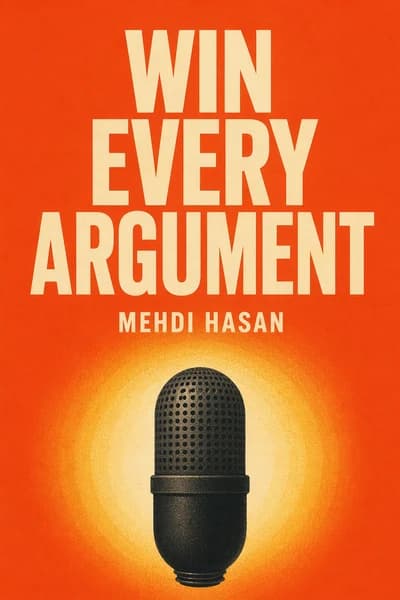
In a world where ideas clash daily, the ability to win arguments isn't just an academic exercise-it's a superpower. Mehdi Hasan's "Win Every Argument" offers this superpower to anyone willing to learn. Drawing from his experiences debating figures like Boris Johnson and Benazir Bhutto as a student to interviewing global leaders as a journalist, Hasan has created what The Guardian calls "a masterclass in the art of persuasion." The book has become required reading in law schools, corporate boardrooms, and political campaigns. Even celebrities like Rihanna and Trevor Noah have praised its practical approach to argumentation. What makes this book particularly valuable in our polarized era is that it doesn't just teach you to win-it teaches you to win with substance, integrity, and style.
第2章
Mastering Your Audience: The Foundation of Persuasion
Winning arguments begins with understanding who you're trying to convince. When I appeared on BBC Radio 4's "Any Questions?" in the conservative town of Crewkerne, I needed to argue against deporting an extremist preacher to Jordan where he might face torture. Rather than citing human rights organizations that would alienate this audience, I appealed to British tradition-invoking the Magna Carta and habeas corpus as cherished liberties now threatened. The audience erupted in applause.
This illustrates the first principle of argumentation: know your audience. Before speaking, always gather information about who you're addressing. For students, avoid references from before their time. For older audiences, skip memes they might not understand. Modify both what you say and how you say it based on who's listening.
Once you understand your audience, you need to grab their attention. In our smartphone era, humans lose concentration after just eight seconds-even less than a goldfish's nine-second attention span. Start with something unexpected or provocative in your very first sentence. Jamie Oliver began his TED Talk by stating that four Americans would die from food choices during his eighteen-minute presentation-immediately commanding attention. Alternatively, ask questions that create knowledge gaps and spark curiosity, or tell personal stories that engage listeners instantly.
But getting attention isn't enough-you must maintain connection. Make eye contact across the entire room, making everyone feel heard. Heap genuine praise on your audience that shows familiarity with them. Most importantly, get personal by sharing relevant details about yourself. People connect with you first, then your arguments. When debating Islam as a religion of peace at Oxford, I made it personal by referencing "me, my wife, my retired parents, my six-year-old child"-humanizing the abstract motion and helping win the debate.
Remember: understanding, engaging, and connecting with your audience isn't manipulation-it's the foundation of effective persuasion. Without this foundation, even the strongest arguments will fail to resonate.
第3章
The Power of Pathos: Why Emotions Trump Facts
Bernard Shaw's shocking question to Michael Dukakis in the 1988 presidential debate-asking if he would support the death penalty if his wife were raped and murdered-demonstrates how emotions drive arguments. While Dukakis responded with cold policy analysis, viewers wanted to see passion. His emotionless answer damaged his campaign irreparably.
Aristotle identified three modes of persuasion: ethos (credibility), logos (logic), and pathos (emotional appeal). Though we often rely on logos in debates, pathos typically proves more powerful. Facts remain crucial as your foundation, but they'll have minimal impact without emotional connection.
Neuroscience confirms we're feeling machines that think, not thinking machines that feel. Renowned neuroscientist Antonio Damasio's research with brain-damaged patients revealed that without emotions, even simple decision-making becomes impossible. His patient "Elliot," who lost emotional processing after brain surgery, saw his life collapse despite maintaining his intelligence. Emotions aren't "intruders in the bastion of reason" but rather "indispensable for rationality."
To harness pathos effectively, first tell stories. Our brains synchronize with storytellers through "brain-to-brain coupling"-when someone tells a story, listeners' brains mirror the emotional responses. When arguing against Saudi Arabia's human rights abuses, rather than citing statistics, I told stories of specific victims: Loujain al-Hathloul being waterboarded, seven-year-old Amal Hussein starving in Yemen, Jamal Khashoggi dismembered. Names and faces make it impossible to look away. Stories are "22 times more memorable than facts alone."
Second, choose words carefully. Compare "Ukraine was invaded by Russia" with "Defenseless Ukrainians are being bombed by Russian aggressors." Both state facts, but the second is heavy with pathos. Use words that invoke feeling-"lie" instead of "inaccuracy," "truth" instead of "valid position."
Third, show emotion yourself. Your passion signals to the audience that the topic matters. If you appear dispassionate, why should they care? The winning formula combines feelings with facts-emotions help facts reach your audience and help them retain that information. If it comes down to facts versus feelings alone, feelings often win. So make sure you have what it takes to reach listeners' hearts as well as their heads.
第4章
Evidence as Arsenal: Deploying Your Receipts
In a world of "alternative facts" and "truth decay," showing evidence-your "receipts"-remains essential to winning arguments. While emotions get you in the door, facts keep you there. Every culture throughout history has valued evidence-based reasoning, even religious texts emphasize the importance of proof.
The first step is gathering receipts before you need them. You need facts, figures, and quotes that bolster your argument while undermining your opponent's. The best receipts lie deeper than obvious challenges. When interviewing former national security adviser John Bolton, I researched his past ties to the MEK (Mujahedin-e-Khalq), an exiled Iranian opposition group once designated as a terrorist organization. When Bolton claimed I was "simply wrong on your facts," I countered with precise details about his 2010 speech to the MEK when they were still banned.
Beyond gathering receipts in advance, you can create them during the argument itself. Listen carefully for contradictions in your opponent's statements and highlight inconsistencies in real time. Use their own words against them by citing something they said earlier that undermines their current claim. This technique can create turning points in debates even when you haven't specifically prepared for that exact topic.
Timing is everything when deploying receipts. Don't throw them at your opponent willy-nilly-wait for the perfect opening when they're on the back foot. The ideal pattern is to quote your opponent, let them question the quote, then follow up with undeniable evidence including exact sources. With philosopher Slavoj Zizek, I quoted his disturbing statements about refugees, waited for him to question whether he'd said them, then cited "page 107 of your book." With Congressman Dan Crenshaw on immigration, I let him challenge my data before revealing "Those are CBP numbers." Delayed gratification makes receipts more powerful-wait for the moment of maximum impact.
Remember that receipts aren't just for winning arguments-they're for advancing truth. In an era of misinformation, bringing facts to bear is both a tactical advantage and a moral responsibility.
第5章
The Art of Ad Hominem: When Character Matters
How did Donald Trump defeat sixteen Republican rivals in the 2016 GOP presidential nomination? Not by outwitting them on policy, but by taunting them with childish nicknames: "Liddle Marco," "Lyin' Ted," "Low-Energy Jeb." While conventional wisdom says to "play the ball, not the man," attacking your opponent's ethos can be an effective strategy.
Aristotle considered a speaker's character "the most effective means of persuasion." If your opponent is establishing their credibility with the audience, you can't simply let this go unchallenged. Despite what freshman composition teaches, ad hominem arguments are often legitimate responses when someone places their character or expertise at issue in making claims.
There are three types of legitimate ad hominem arguments. First, the "abusive" ad hominem targets your opponent's reputation and ethos-if they're not honest or reliable, the audience should consider this when evaluating their arguments. Second, the "circumstantial" ad hominem exposes how opponents' claims are driven by personal circumstances, hidden biases, or conflicts of interest. The point isn't to dismiss arguments outright but to apply extra scrutiny. Third, the "tu quoque" argument targets hypocrisy by highlighting past words or actions that contradict current claims.
To effectively deploy ad hominem arguments, thoroughly research your opponent's background, biography, resume, past statements, actions, and any controversies they've been involved in. Then challenge their "three Cs"-character, credentials, and claims. When attacking character, don't shy away from exposing who they really are, especially regarding scandals or controversies. When challenging credentials, question the relevance and quality of their qualifications: What do they actually know about this issue? When did they become an expert? Finally, challenge their record of past claims-if someone has a history of failed predictions or judgments, why should audiences trust them now?
Remember that ad hominem arguments supplement, not substitute for, substantive arguments. Play both the ball and the man. While personal attacks work in real-world settings, they'll be rejected in philosophy seminars or formal debates. In real life, your opponent's personal credibility matters to their argument's success.
第6章
The Power of Listening: Winning Through Understanding
Winning an argument isn't just about speaking well-it's about listening well too. The 1992 presidential town hall debate perfectly illustrates this: while President Bush checked his watch during a voter's question, Bill Clinton approached her, made eye contact, and showed genuine empathy. Clinton won that debate 58% to 16%.
Hearing is a passive, physical process-sound waves hitting your eardrums. Listening, however, requires actively absorbing, processing, and comprehending what you've heard. In debates, many of us merely wait for our turn to speak rather than truly listening. But without listening to your opponent, you can't respond substantively-you'll end up addressing what you assume they said rather than what they actually argued.
Critical listening involves mentally engaging with what's being said-absorbing, comprehending, and evaluating information in real time. This skill helps you win arguments by catching false claims, spotting fallacious arguments, and recognizing opportunities for strategic concessions. To improve critical listening, keep an open mind rather than automatically dismissing everything your opponent says; clear your mind by putting away distractions; and take notes on important points and especially what speakers have missed that you can address later.
While critical listening is for opponents, empathetic listening is essential for audience members. This means connecting with speakers and seeing the world through their eyes, giving them your full attention with empathy and humility. Stephen Covey called it the "highest form" of listening-using "your ears, but also, and more importantly, your eyes and heart." Nelson Mandela exemplified this skill, even learning Afrikaans to better communicate with his prison guards. To practice empathetic listening: stay present by focusing completely on the speaker; maintain eye contact to build emotional connection; and ask open-ended questions that allow others to drive the conversation.
Good listening isn't just courteous-it's persuasive. As Dean Rusk noted: "One of the best ways to persuade others is with your ears."
第7章
Humor as Weapon: Making Them Laugh to Make Them Listen
When addressing BBC's Question Time after the Charlie Hebdo attack, I used humor to make a serious point about free speech limits. I compared publishing offensive cartoons to farting in a crowded elevator-you have the right to do it, but decency suggests you shouldn't, and others shouldn't feel obligated to "fart in solidarity." The audience erupted in laughter, allowing me to make a serious point in a memorable way.
Laughter is truly universal-research confirms amusement is a basic emotion shared across all cultures. The science behind laughter reveals powerful benefits: it improves memory and cognitive function, increases attention, and floods our brains with dopamine, making content more engaging and memorable. When an audience shares laughter with you, it creates "social glue"-they feel connected to you through a shared worldview.
The strategic use of humor in rhetoric dates back to ancient Greece and Rome. Gorgias of Leontini advised orators to "defeat opponents' seriousness with laughter, and their laughter with seriousness." Cicero, antiquity's greatest orator, was renowned for his wit, using jokes as "weapons of war" to make enemies seem "small, inferior, despicable."
Humor builds rapport with your audience. As John Cleese observed, "If I can get you to laugh with me, you like me better, which makes you more open to my ideas." A laughing audience is a relaxed audience-one that's paying attention rather than checking emails or nodding off.
Counter-intuitively, humor can be especially effective when addressing serious topics. A well-placed joke can open minds that are otherwise closed to contentious ideas. As Oscar Wilde suggested: "If you want to tell people the truth, make them laugh, otherwise they'll kill you."
Humor can also be a devastating weapon against opponents. During my Oxford Union debate on Islam and peace, I mocked Anne Marie Waters' attempt to become a Labour Party candidate while espousing far-right views. The audience laughed, her credibility crumbled, and she became defensive.
To use humor effectively: be self-deprecating (making fun of yourself always resonates); be spontaneous (the best humor often emerges naturally); be expressive (use facial expressions and body language); avoid offensive topics; don't overdo it (you're not a stand-up comedian); and never announce that you're about to tell a joke. The best humor feels natural and advances your argument while connecting with your audience.
第8章
The Rule of Three: Why Triads Dominate Persuasion
The Rule of Three stands as one of rhetoric's most powerful principles. Three is truly the magic number-from birth, life, and death to past, present, and future. Even Steve Jobs understood its power, introducing the iPhone as "three revolutionary products" before revealing they were one device, and structuring his Stanford commencement speech around "three stories from my life."
Our brains are wired for three. Cognitive psychologist George Miller initially suggested we can hold "seven, plus or minus two" chunks of information in short-term memory, but more recent research by Professor Nelson Cowan shows it's closer to three. His "running span" experiments consistently show people remember about three items. Even honeybees can count to three or four but not beyond. Three is also the smallest number that allows us to see a pattern-one occurrence is a one-off, twice is coincidence, but three times signals something predictable.
The Rule of Three doesn't just organize information-it creates "claptraps" that prime audiences to applaud. Speech coach Max Atkinson explains how triads build emotional momentum: boom, boom, BOOM, with feelings rising to a climactic release. Both inspirational and infamous speakers have harnessed this power, from MLK's "black men and white men, Jews and Gentiles, Protestants and Catholics" to Tony Blair's "education, education and education."
The Rule of Three isn't just rhetorical flourish-it's fundamental to organizing arguments. Aristotle recognized this when he said a complete story "has a beginning and middle and end." As writing expert Roy Peter Clark explains: "Use one for power. Use two for comparison, contrast. Use three for completeness, wholeness, roundness."
Since your audience will only remember about three things anyway, structure your entire presentation this way: Introduction, Body (with three main arguments), and Conclusion (restating those three points). Don't be afraid to explicitly tell your audience "I've got three reasons why you should listen to me"-it helps them track your argument. Whether you use Introduction-Body-Conclusion, Three Main Points, Three Stories, or Political-Economic-Moral arguments-limiting yourself to three points makes your message compelling without becoming tedious.
第9章
Strategic Maneuvers: Judo Moves and Zingers
Like judo's philosophy of "maximum efficiency, minimum effort," effective debating isn't about doubling down but about being flexible and yielding at strategic moments. The first judo move in debate is strategic concession. When your opponent attacks with passionate arguments, throw them off-balance by conceding points before pivoting to your counterarguments. Far from showing weakness, concession demonstrates strength and confidence. As Cicero demonstrated when defending his client Flaccus, you can concede irrelevant points before delivering your devastating critique.
The second judo move is preemption-addressing and debunking your opponent's arguments before they make them. You can recognize this technique when speakers use phrases like "I know what you might be thinking..." or "Critics argue..." While this must be used carefully, preemption can devastate opponents by pulling the rhetorical rug from under them.
The third judo move is reframing-guiding your audience to conclusions using frames favorable to your position. If a debate motion works in your favor, stick to it rigorously. If not, redefine or broaden its meaning, as I did when arguing "The West should cut ties with Saudi Arabia" by clarifying this didn't mean blockades or regime change but withdrawing special treatment.
Beyond judo moves, mastering the art of the zinger-sharp, witty remarks that catch listeners off guard-can establish superiority over rivals through memorable, quotable moments. Lloyd Bentsen's famous "Senator, you're no Jack Kennedy" line demonstrates how a well-delivered zinger can devastate an opponent.
The most effective zingers share one quality: brevity. From Reagan's "There you go again" to Obama's "The 1980s are now calling to ask for their foreign policy back," effective zingers deliver maximum impact in minimal time. The ancient Spartans perfected this art of laconic humor. When King Philip II of Macedon threatened to invade Laconia, writing "If once I enter into your territories, I will destroy ye all," the Spartan leaders simply replied: "If."
Even prepared zingers must be delivered with perfect timing and apparent spontaneity. You need to watch for openings in real-time debates. When right-wing historian David Starkey went on a bigoted tirade against Islam and mistakenly called me "Ahmed," I seized the opportunity: "Given you can't get my name right-my name is Mehdi, not Ahmed-I would question your selective quotation of something I said a decade ago." The audience erupted in applause, drowning out Starkey's attempts to continue.
第10章
Preparation and Performance: The Behind-the-Scenes Work
Confidence is the foundation of effective argumentation. As Mark Twain quipped, "There are two types of speakers: those that are nervous and those that are liars." During my first appearance on BBC's Question Time, despite internal panic-churning stomach, racing heart, sweating-I projected confidence to both studio and home audiences. That appearance catapulted my public profile, filling my inbox with supportive emails and leading to recognition on public transportation the next day.
Building confidence requires mental preparation beyond just developing argumentative skills. First, visualize success. Before any speech, mentally rehearse your performance in vivid detail. This seemingly simple exercise makes you more comfortable with speaking and improves your actual performance. The science is solid-visualizing an action stimulates the same brain regions as performing it.
Second, take risks. As Eleanor Roosevelt wrote, "You gain strength, courage, and confidence by every experience in which you really stop to look fear in the face." Confidence grows through both success and failure-you must try things to know you can do them. Start by volunteering to speak in front of increasingly larger groups, beginning with family dinners before tackling bigger audiences.
Third, surround yourself with positive people who boost your confidence rather than diminish it. The negative voices of others become our inner critics, as therapist Rameya Shanmugavelayutham explains. While constructive criticism is valuable, distance yourself from constant negativity.
When confidence is lacking, "fake it till you become it," as Harvard psychologist Amy Cuddy suggests. Fix your body language-keep your chin up, avoid crossing your arms, stand straight with squared shoulders, and gesture with open palms. Project your voice-speak from your diaphragm, avoid mumbling, and use strategic pauses. Make eye contact-our eyes are crucial in establishing trust and confidence.
Beyond confidence, staying calm under pressure is essential. If you lose your cool during an argument, you'll likely lose that argument. Use breathing techniques to control your emotions-taking deep breaths before speaking or during tense moments sends a signal to your brain to "chill out." Find humor in tense situations-laughter boosts endorphins while reducing cortisol (the stress hormone). Talk to yourself in the third person-research shows this creates psychological distance that helps control emotions.
Remember that while you can't control external circumstances, you can control your internal reactions. Put mistakes in perspective-messing up a one-liner isn't catastrophic, losing your notes can become a self-deprecating joke, and even being humiliated by an opponent gives you a chance for a rhetorical counterpunch.
The most important preparation is practice. Great speakers aren't born-they're made through relentless rehearsal. Like Demosthenes, who transformed from a stammering youth to ancient Greece's most revered orator through extreme dedication, anyone can learn to become an effective speaker. What audiences see as natural eloquence is actually the product of meticulous preparation. As Mark Twain quipped: "It usually takes more than three weeks to prepare a good impromptu speech."
Research is equally crucial. As Mark Twain observed, "Supposing is good, but finding out is better." Without thorough homework, "any half-decent interviewee can walk over you to peddle a message without serious challenge." Master advanced search techniques, use Wikipedia as a starting point (not an endpoint), and always check your sources. Preparation extends to role-playing-find a partner to play your opponent, allowing you to anticipate responses and counter effectively.
To avoid confirmation bias-our tendency to seek only information confirming what we already believe-you must know both sides of an argument. Practice "steelmanning"-constructing the strongest version of your opponent's argument rather than creating a strawman. Ask yourself: What is your opponent's best argument? What is their best evidence? What is their best critique of your argument?
With confidence, calm, practice, and research, you'll be prepared to win any argument that comes your way.
第11章
The Grand Finale: Ending with Impact
Churchill's May 1940 speech to his war cabinet, where he passionately rejected negotiating with Hitler, demonstrates the power of a grand finale. When Lord Halifax pushed for peace talks with Nazi Germany, Churchill delivered an emotional climax: "If this long island story of ours is to end at last, let it end only when each one of us lies choking in his own blood upon the ground." This Shakespearean peroration won over the ministers and, according to historians, "saved Britain, and Europe, and Western civilization."
Every powerful argument needs such a finale-what rhetoricians call a "peroration"-to leave audiences energized and convinced. A powerful conclusion must accomplish two goals: restate your main argument so it sticks, and grab your audience's emotions. Aristotle identified four components of an ideal peroration: drawing the audience to your side, driving home the stakes, appealing to emotion, and summarizing key points.
Your conclusion is where repetition becomes vital-as Churchill advised: "Use a pile driver. Hit the point once. Then come back and hit it again. Then hit it a third time." Studies show audiences best remember the beginning and end of speeches, making your conclusion crucial. "Topping and tailing"-finishing with the same theme you started with-creates a satisfying structure.
There are three powerful ways to end your argument. First, end with a quote. The right quote at the right moment can be incredibly powerful, providing a change of pace and introducing a "second voice" that bolsters your authority. When speaking at a Muslim charity fundraiser about solidarity with refugees, I concluded with Imam Ali ibn Abu Talib's words: "People are of two types: they are either your brothers in faith, or your equals in humanity." This perfectly reinforced my message while providing a memorable ending.
Second, end with an anecdote. Stories are our most powerful tool for connecting emotionally with audiences. Barack Obama masterfully demonstrated this technique in his 2008 election night victory speech by telling the story of 106-year-old Ann Nixon Cooper. By walking through her lifetime of witnessing American progress-from a time when women and Black Americans couldn't vote through the civil rights movement to casting her ballot for the first Black president-Obama wove together his campaign's "Yes we can" theme with the broader arc of American history.
Third, end with a call to action. If you want your audience to do something specific after absorbing your argument, conclude with a clear, concrete, and memorable call to action. When speaking in Australia about anti-Muslim extremism, I closed by challenging my audience to consider what they would tell their children about their actions during "the Great Extremism Frenzy"-whether they merely complained online or actively built alliances and invested in hope over hate.
Creating a memorable conclusion requires following key principles while avoiding common pitfalls. DO add an "exclamation point" to your most important closing lines, signal that your speech is ending to regain audience attention, and craft a memorable phrase. DON'T introduce new arguments at the end, stop abruptly, go on too long, or apologize for taking up time.
A great argument follows Churchill's "accumulation" principle-starting with skepticism and building through evidence toward an inescapable conclusion. When you master the grand finale, you'll experience that moment of pin-drop silence followed by thunderous approval-the ultimate sign that you've delivered a convincing argument and learned how to win.