第1章
The Technological Precipice: Where Humanity and Innovation Converge
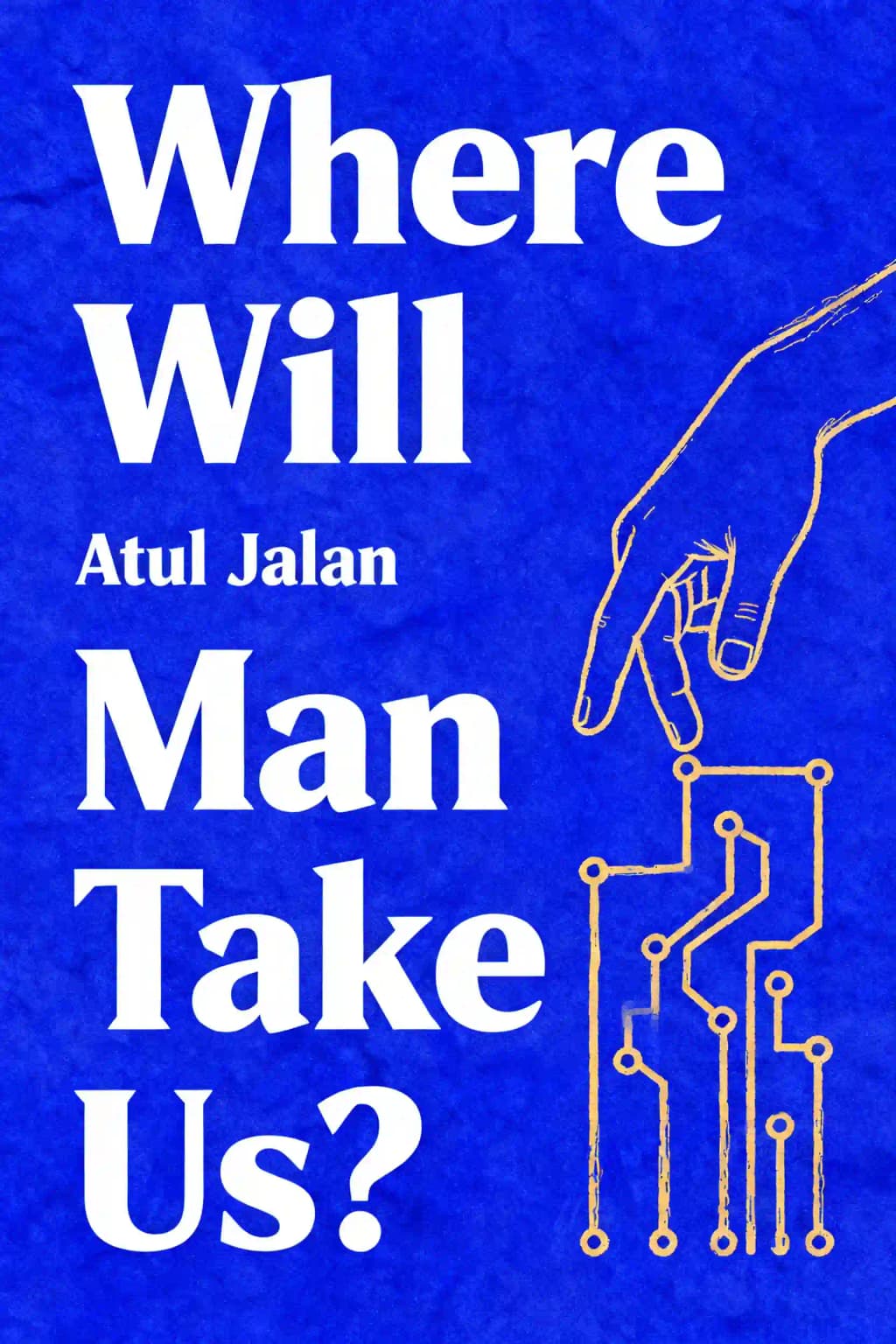
At the dawn of humanity's next great evolutionary leap, Atul Jalan's "Where Will Man Take Us?" arrives as our guidebook to the most transformative period in human history. Like a modern-day Prometheus, Jalan illuminates the technological fire that's reshaping our species. This isn't just another tech forecast-it's an examination of humanity's imminent metamorphosis through artificial intelligence, nanotechnology, genetics, and quantum computing.
The book has become required reading in Silicon Valley boardrooms and university innovation labs alike, with Elon Musk reportedly keeping a dog-eared copy on his nightstand. Its cultural impact stems from Jalan's rare ability to translate complex technological concepts into profound human questions: not just what we can build, but what we will become. As we stand at this Gutenberg moment-a transformative period comparable to the invention of the printing press-Jalan asks the essential question: where exactly will man take us?
第2章
The Architects of Intelligence: From Turing to Tomorrow
Our journey into artificial intelligence begins with Alan Turing, the tormented genius who laid the foundations for modern computing. Despite his tragic life-separated from parents in childhood, losing an unspoken love, facing persecution for his homosexuality, and enduring chemical castration-Turing's forty-two years yielded revolutionary insights spanning logic, mathematics, computing, biology, and metaphysics.
Turing's concept of a universal computing machine proved that shuffling symbols as simple as 0 and 1 could simulate any mathematical deduction. His famous question "Can machines think?" proposed that a computer deserves to be called intelligent if it can fool you into believing it's human. This conceptual leap elevated machines from performing simplistic operations to producing complex insights-the foundation of today's computational intelligence.
Beyond computing, Turing pioneered mathematical biology with his work on morphogenesis and helped end World War II by cracking the German Enigma code. Though vilified in his time, he was officially pardoned in 2009. A beautiful urban legend claims the Apple logo honors Turing's half-eaten, cyanide-laced apple-a fitting tribute to a man who bit off more than his share from the forbidden fruit of knowledge.
The philosophy of AI has since evolved along two competing paths. Computationalists like Minsky and McCarthy believed the mind operates like a computing machine with programmable rules (a top-down approach), while non-computationalists like Searle argued the mind has creative functions a purely syntactic system cannot perform, favoring neural networks that learn from data (a bottom-up approach).
After initial hype and a subsequent "AI winter," artificial intelligence experienced a renaissance in the mid-90s due to massive data availability, exponential computing power growth, IoT sensors, emerging sciences, sophisticated algorithms, and corporate investment. Today's AI exists primarily as Artificial Narrow Intelligence (ANI)-specialized systems that excel at specific tasks but lack human-like fluid intelligence across domains.
What truly excites about AI isn't the machines themselves, but how our quest to replicate intelligence forces us to ask profound questions about ourselves. In attempting to make machines capable of thought, consciousness, and emotions, we must confront how these qualities function in humans. As we advance artificial intelligence, we gain deeper insights into what it truly means to be human.
第3章
The Game-Changing Victories: How Machines Learned to Win
AI's meteoric rise in prominence has transformed from relative obscurity to a central focus of technological advancement. From not even ranking among Gartner's top hundred searches in 2016 to reaching number seven by 2017, this explosive growth reflects both genuine breakthroughs and inflated expectations. This surge has triggered a gold rush mentality, with businesses frantically incorporating AI capabilities into their products, sometimes prioritizing marketing appeal over practical utility. Modern AI creates an illusion of intelligence through its unprecedented computational abilities, most dramatically demonstrated in competitive games where human champions now consistently fall to machine opponents.
Our fascination with machines beating humans at games has deep historical roots. In 1770, Wolfgang von Kempelen's creation "The Turk" captured the imagination of European nobility, beginning with Empress Maria Theresa of Austria. This chess-playing "automaton," dressed in Ottoman robes and seated at a wooden cabinet, defeated numerous prominent figures including Napoleon Bonaparte and Benjamin Franklin. For 84 years, it toured Europe and the Americas, drawing massive crowds and sparking debates about mechanical intelligence. While The Turk was eventually exposed as an elaborate hoax-concealing various human chess masters inside its ingeniously designed cabinet-it represented humanity's enduring dream of creating thinking machines and our complex relationship with artificial intelligence.
The 1997 chess match between world champion Garry Kasparov and IBM's Deep Blue marked a genuine milestone in computing history. Dubbed "The Brain's Last Stand" by the media, the match captured global attention as Deep Blue secured a 3.5:2.5 victory, becoming the first computer to defeat a reigning world champion under standard tournament conditions. Deep Blue exemplified the traditional top-down, rules-based approach to AI, utilizing an expert system with preprogrammed chess knowledge and an inference engine processing logical rules. Its victory relied on raw computational power, analyzing up to 200 million positions per second-far beyond human capabilities.
Go presented an even greater challenge due to its vast complexity, with more possible board positions than atoms in the universe. DeepMind's AlphaGo breakthrough in 2016, defeating 9-dan professional Lee Sedol, represented a fundamental shift in AI methodology. Unlike Deep Blue's programmed approach, AlphaGo employed sophisticated machine learning, initially training on 30 million expert moves before engaging in self-play to develop novel strategies. This combination of deep learning neural networks with reinforcement learning created a system capable of intuitive play and strategic innovation, demonstrating moves that centuries of human Go wisdom had never conceived.
These game environments serve as crucial testing grounds for AI systems, preparing them for real-world challenges where rules are less clearly defined. We're witnessing a paradigm shift from explicitly programming computers to training them through experience, similar to how we might teach intelligent animals. Modern AI systems increasingly demonstrate cognitive capabilities spanning sensation, learning, reasoning, and interaction. AlphaGo's famous "Move 37" in its match against Lee Sedol-a play so creative that human experts initially thought it was a mistake-showed that machines could develop forms of intuition and creativity previously thought exclusive to human intelligence. While human intuition remains inconsistent and subject to bias, machines can potentially perfect these capabilities through massive-scale learning and iteration.
第4章
The Invisible Revolution: Nanotechnology's Vast Potential
Nanotechnology-working at the scale of billionths of a meter-promises to drive some of our greatest future advancements. A nanometer is unimaginably small: 1/100,000th the width of human hair, or if Earth were a meter, a nanometer would be a marble.
Richard Feynman laid nanotechnology's conceptual foundations in his 1959 Caltech talk "There's Plenty of Room at the Bottom," where he questioned why humans don't work at the atomic level as nature does. He envisioned miniaturization of computing machines but never used the term "nanotechnology"-that was coined in the mid-1970s by Professor Norio Taniguchi to describe semiconductor processes at the nanoscale.
Though nanotechnology is a recent scientific field, nanoscale materials have been used throughout history. Damascus steel-the legendary metal that could "cut through a rifle barrel and shear a human hair in half"-likely contained carbon nanotubes from Indian "wootz" steel, though the manufacturing process is lost to history. Medieval stained glass windows achieved their rich ruby reds and deep yellows by trapping gold and silver nanoparticles in glass matrices-nanotechnology before it had a name.
Everything around us is composed of atoms, and nanotechnology gives us the ability to see and control individual atoms and molecules. Scientists now create materials at nanoscale to exploit enhanced properties like greater strength, lighter weight, and increased chemical reactivity. Nature has already mastered nanoscale engineering: house lizards use nanofibres in foot hair to cling to surfaces, butterfly wings use multilayer nanoscale patterns to filter light, and moth eyes have nanoscale hexagonal bumps to absorb more light.
Nanotechnology will profoundly impact medical science as the lines between computers and biology blur. Soon, nanomachines could patrol your bloodstream, detecting toxins, monitoring health, and attacking pathogens-even downloading new software to combat emerging threats. Several cancer treatments using nanotechnology are already in clinical trials: one delivers tumor necrosis factor alpha hidden behind gold nanoparticles, while another uses "AuroShells" that convert infrared laser light into cancer-killing heat.
While we've gained the ability to manipulate materials at nanoscale, we're still developing true nanobots and molecular assemblers that can replicate and repair themselves atom by atom. Yet nanotechnology already enhances many everyday products-sunscreens, clothing, paints, cars-while enabling the digital revolution through nanoscale chip features.
第5章
Quantum Leaps: Computing at Nature's Fundamental Level
While humans have mastered the mechanics of large-scale phenomena-planetary motion, colliding galaxies, the expanding universe-we face significant challenges understanding the microscopic realm. Classical physics, so reliable in our everyday world, breaks down completely at the subatomic level where particles behave according to bizarre quantum rules. This limitation has reached critical practical consequences: we've hit the physical limit of transistor miniaturization at approximately 1 nanometer, where electrons begin behaving unpredictably through phenomena like quantum tunneling. This effectively marks the end of Moore's Law of exponential computing growth, which has driven technological advancement for decades.
Classical mechanics operates on well-defined laws where objects have specific properties-position, momentum, energy-at any given moment. Quantum mechanics, however, replaces this comforting certainty with probability distributions. Events happen in quantum leaps between energy states, with multiple possibilities existing simultaneously. Particles exhibit wave-particle duality, existing as both waves and particles until measured. Through superposition, they can occupy multiple positions simultaneously, maintaining this state until observed, when they "collapse" into a single definite state. Perhaps most remarkably, particles can become "entangled," where changes to one particle instantaneously affect its partner regardless of the distance between them-a phenomenon Einstein famously dubbed "spooky action at a distance," which challenges our fundamental understanding of causality and information transfer.
Quantum computers represent a radical departure from conventional computing architecture. While traditional computers encode data in binary bits (0 or 1), quantum computers employ quantum bits (qubits) that can exist as 0, 1, any quantum superposition between, or remarkably, both states simultaneously. This property allows quantum computers to perform billions of parallel computations. The power scales exponentially: a 72-qubit prototype could theoretically match the processing power of millions of conventional computers working in parallel, while a 333-qubit system would offer computational capabilities beyond our ability to express numerically-the number of states would exceed the atoms in the observable universe.
The implications of quantum mechanics extend far beyond computing into all life sciences. Since everything around us-from DNA to cellular structures-is ultimately composed of subatomic particles, quantum rules should theoretically influence biological systems. Photosynthesis provides a compelling example, demonstrating an inexplicable 95% efficiency in converting sunlight to chemical energy that may rely on quantum superposition, allowing electrons to explore multiple energy transfer routes simultaneously. In neuroscience, Sir Roger Penrose controversially proposes that consciousness itself might be explained through quantum mechanics, with Stuart Hameroff suggesting that microtubules in brain cells could serve as biological quantum computers, enabling quantum computing-like processes in neural activity.
As Nobel laureate Richard Feynman insightfully noted, "Nature isn't classical, dammit, and if you want to make a simulation of nature, you'd better make it quantum mechanical." This observation increasingly appears prophetic-to truly understand and harness life's complexities, we may need to embrace quantum computing as the fundamental computational paradigm of nature itself.
第6章
Rewriting Our Code: The Genetic Revolution
The power to manipulate genes has sparked debate about whether scientists should "play God." While humans have intuitively practiced selective breeding for millennia, the scientific understanding of genetics began with Gregor Mendel, who discovered "discrete inherited units" rather than blended inheritance through mathematical analysis of pea plant experiments.
Disillusioned by physics becoming the "science of death" after Hiroshima and Nagasaki, Erwin Schrodinger turned to applying atomic science principles to biology. His work "What Is Life?" proposed that genetic information was contained in an "aperiodic crystal" with a "code-script" that determined an organism's development. This crucial insight provided a conceptual foundation for Watson and Crick's later work on DNA structure.
While DNA was discovered in the 1860s by Friedrich Miescher, Watson and Crick's revelation of its double-helix structure in 1953 transformed biology by explaining genetic inheritance. They showed that DNA consists of two chains of alternating phosphate and sugar groups held together by four organic bases (A, T, G, C)-the "binary codes" of life. This understanding laid the groundwork for genetic modification, the Human Genome Project, and synthetic biology.
Modern genetic science has benefited from the convergence of multiple disciplines and technologies, with sequencing now so advanced that labs can read millions of DNA letters from a single sample of saliva. The Human Genome Project aims to identify and map all human genes both physically and functionally. Companies like 23andMe now offer direct-to-consumer genetic testing that can reveal ancestry, predispositions to diseases, and various traits for just a few hundred dollars.
CRISPR technology, which originated from studies of bacteria defending against viruses, now functions as molecular scissors that can precisely edit genetic code. This bacterial defense system has been reprogrammed to target and eliminate genetic causes of disease at the DNA level. The ability to engineer and "rewrite" life code for specific purposes may be humanity's greatest achievement.
As genomics evolves from science fiction to reality, profound ethical questions emerge. Should we use genetic technology not just for treatment but for enhancement-altering appearance, intelligence, or behavior? We stand at a historic turning point where evolution will no longer be driven by random natural selection but by deliberate human choices. Evolution will become planned and deterministic rather than natural and probabilistic, fundamentally changing us as a species.
第7章
Echo Chambers: How Technology Isolates Our Worldviews
The Internet, once envisioned as an "anarchic autobahn" of infinite information creating a knowledge meritocracy, has ironically evolved into a system that reinforces our personal biases. Personalization algorithms have transformed what was meant to be a unifying force into what Eli Pariser calls "the filter bubble"-a state of intellectual isolation where we increasingly see only information that confirms our existing worldviews.
Despite Tim Berners-Lee's declaration that "This is for all!", the Internet has become a messenger that confirms personal biases rather than a mainframe of knowledge. This is especially concerning for post-millennials who were born into these bubbles and may never know anything different. The great irony is that what was meant to unify humanity is now dividing us into personalized "webs of one" where each person essentially sees their own customized version of the Internet.
When Trump won the 2016 US election, the liberal world was shocked-a reaction mirrored in my own surprise at both Trump's victory and the BJP's 2014 win in India. I had been isolated in my filter bubble, seeing only what algorithms determined was relevant to me. Even Hillary Clinton's campaign algorithm "Ada" failed by reinforcing the biases of its creators rather than seeking contradictory data.
Try this experiment: search "Is Trump popular?" and "Is Trump unpopular?" on Google. The results will reinforce your preconceived biases based on your search terms and personal history. We're becoming isolated on smaller and smaller islands of opinion. As Zuckerberg noted, "a squirrel dying in your front yard may be more relevant to your interests right now than people dying in Africa," while Bill Gates warned that social media "lets you go off with like-minded people, so you're not mixing and sharing and understanding other points of view."
The filter bubble breeds overconfidence and confirmation bias-we seek information that confirms our existing beliefs and interpret ambiguous evidence to support our positions. The more emotionally invested we are, the stronger the bias becomes. Within our bubbles, "groupthink" flourishes-groups exhibit temporary loss of rational thinking, take ridiculous risks, become intolerant of different views, and develop extreme optimism about their positions.
Fake news spreads through two main channels: deliberate propaganda and clickbait designed to generate advertising revenue. Anonymous websites create sensational headlines to drive clicks and shares, making prosecution for libel difficult due to jurisdictional complexities. The lines between fake and accurate are blurring into "alternative truths"-we laughed at Kellyanne Conway's "alternative facts," but objective truth is increasingly giving way to subjective interpretations.
Technology may have worsened our filter bubbles, but it might also save us. Simple solutions include deliberately following people with opposing views and using tools like EscapeYourBubble and HiFromTheOtherSide to connect with different perspectives. AI shows particular promise in fighting fake news-West Virginia University has created a system that analyzes text and assigns probability scores for falsehood.
第8章
The Algorithmic Future: From Love to Politics
Every fairy tale ends with "...and they lived happily ever after," but perfect compatibility is theoretically improbable since both love and compatibility depend on context. Perfect compatibility requires two individuals to dance in harmony through life's changes long after "the orchestra has packed up and gone home." While traditional matchmaking focused on family alliances and bloodlines rather than individual compatibility, data science may offer our best hope for finding love in the modern world.
Traditional matchmaking wasn't primarily about the couple but about uniting families, preserving bloodlines, and keeping wealth in "the right hands." In India, Brahmin priests or barbers arranged marriages using horoscopes with numerical values that needed to score at least eighteen out of thirty-six points for compatibility. This systematic approach to matching was essentially a data science problem waiting to be solved-mapping attractiveness, character, preferences and compatibility using statistics and probability.
Modern digital communication-from texting to Facebook to WhatsApp-has created a new "digital idiom" that's more spontaneous, instinctive, urgent and passionate than traditional communication. As Aziz Ansari notes in "Modern Romance," computer-modulated communication allows people who've just met to exchange hundreds of texts overnight and feel like they've known each other for ages.
Though relying on algorithms for finding love sounds less romantic than serendipitous meetings, the reality is most people never meet their "significant someone" naturally. Technology provides greater access and soon will help us understand how potential partners might behave in relationships. Data science is becoming the holy grail of matchmaking, making the rare "Black Swan" of perfect compatibility increasingly common.
Similarly, political campaigns have been transformed by data science. In 2012, Obama's campaign relied on "Narwhal," a data platform that served as the backbone for operations-customizing fundraising emails, identifying likely-voter clusters, and creating personalized campaigns. Republicans countered with "Orca," which crashed on Election Day. This shift marked when politicians' gut instincts gave way to data platforms for electoral decision-making.
The 2016 US election revealed how Cambridge Analytica exploited Facebook data from 320,000 users to access information on over 50 million people-about a quarter of the American voting population. With this data, they built algorithms identifying swing voters and crafted targeted messages. Our democracies are now driven by data influencing our motivations without our awareness.
Political parties now operate like toothpaste brands-carefully considering branding, market research, voter segmentation, imagery, personalization tactics, and emotional appeals. This convergence happens naturally as citizens spend most of their time thinking as consumers, with those thought processes spilling into political decision-making.
第9章
Reimagining Humanity: Our Technological Evolution
The concept of cryptocurrency entered public consciousness through unfortunate circumstances-the 2013 bust of Silk Route, a Dark Web marketplace for illegal goods where bitcoin was the currency of choice. Despite this inauspicious introduction, bitcoin represents one of the most decentralized, universal and pure forms of currency ever created.
The blockchain-bitcoin's underlying distributed public ledger-tracks every transaction with verification and timestamps. Miners worldwide solve mathematical puzzles to validate transactions, adding them to the ledger cryptographically in "blocks." Every transaction is transparent and immutable, with miners receiving bitcoin rewards for their work. This system elegantly solved the double-spend problem through cryptographic verification, eliminating the need for trusted intermediaries like banks.
Beyond cryptocurrency, blockchain technology offers revolutionary potential for secure data management across industries. As the most significant innovation since double-entry bookkeeping, it enables secure exchange of digital property between strangers over the internet. Applications range from credential management to distributed energy compensation, property records, and securities trading-where Goldman Sachs estimates $11-12 billion in potential savings.
As we integrate technology more deeply into our lives, questions of data ownership become increasingly important. I've made a Faustian bargain with tech giants-trading my personal data for services from Google, Amazon, Netflix and others. The problem is that my data exists in fragmented silos across corporations, creating incomplete and often inaccurate profiles of me. What we need is a "Me Model"-a unified, holistic digital profile I control, containing all my data from every source. This model would be bidirectional, allowing me to monetize my data directly.
We're surrounded by surveillance cameras in homes, offices, elevators, cabs, malls, and bars-everyone watching everyone else. Much of our data we surrender voluntarily through online transactions, revealing our locations, companions, and activities. This surveillance state emerged partly from post-9/11 fear, when we traded privacy for security. As Sun Microsystems' CEO Scott McNealy bluntly stated in 1999: "You have zero privacy anyway. Get over it."
As we look to the future, Ray Kurzweil, now seventy, takes approximately 200 supplement pills daily and dedicates one day weekly to longevity treatments, believing humans will achieve immortality by mid-century. Many futurists predict AI will reach a point of recursive self-improvement, with unknown consequences-machines might eliminate humans as resource drains, or technology might grant us immortality. Scientists call this pivotal moment "singularity."
Our technology is already merging with our biology-from smartphones connecting us to cloud intelligence, to genome editing for disease prevention, to intelligent prosthetics enhancing rather than merely compensating for abilities. We're developing neural interfaces and adaptive systems that integrate technology with our uniquely human capacity for insight and intuition.
Wang Zhi Huan's poem captures humanity's journey-always climbing higher to see farther. Though we rank just 2.21 on the food chain (alongside pigs and anchovies), we rule this planet. Our physical abilities haven't changed much since prehistoric times, yet we're exploring Mars because we developed tools and technology to overcome our limitations. What's coming is the augmentation of the human body and mind itself, as advancements in digital technology, AI, genetics and nanotechnology enhance our biological and mental capabilities.