第1章
Where Faith and Doubt Collide: A Journey Through Istanbul and Oxford
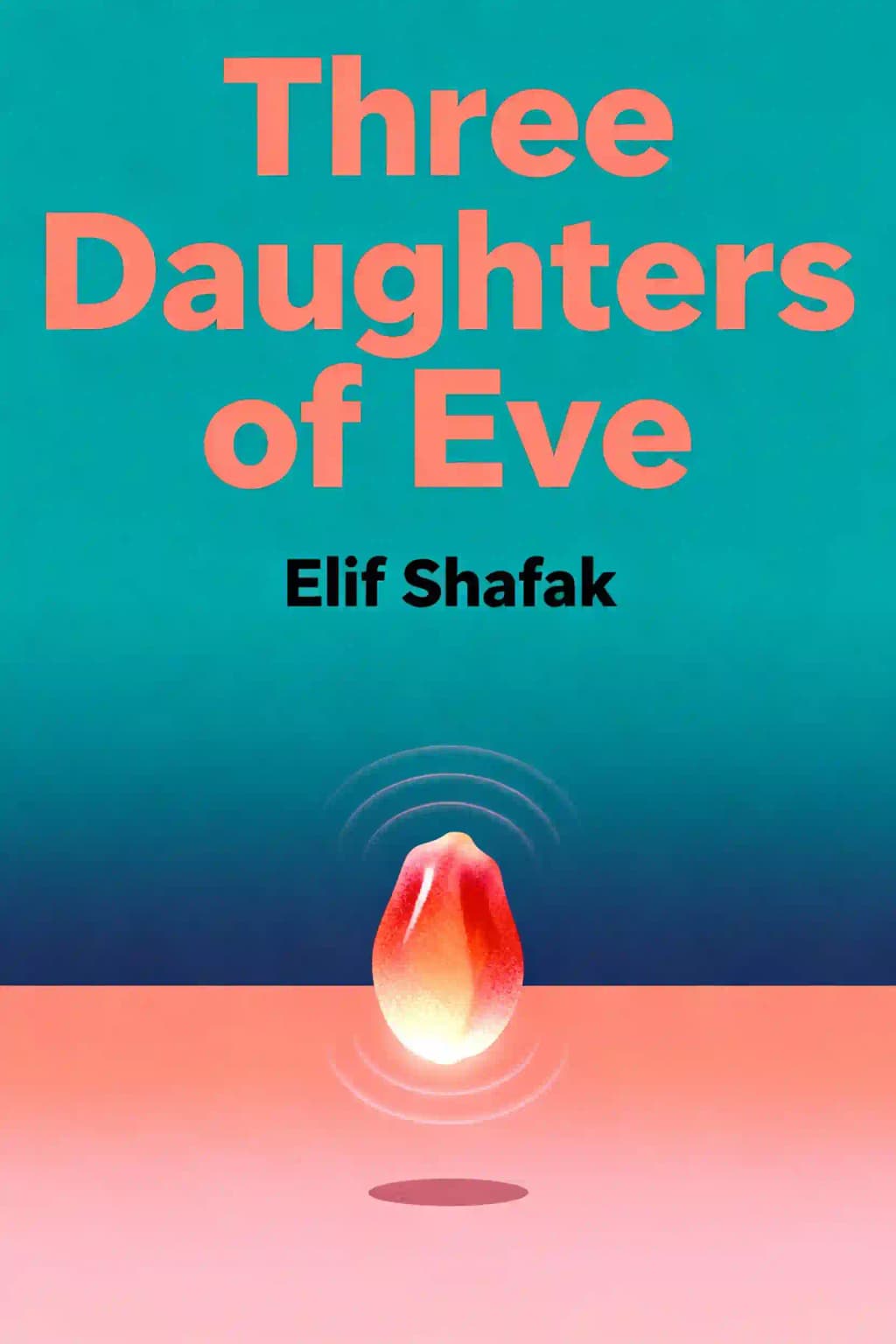
Ever found yourself caught between two opposing forces, unable to choose sides? Elif Shafak's "Three Daughters of Eve" explores this liminal space through the story of Peri Nalbantoglu, a woman perpetually trapped between faith and doubt, East and West, tradition and modernity. This international bestseller captivated readers worldwide upon its 2016 release, with celebrities like Emma Watson praising its nuanced exploration of identity. The novel's timing was particularly significant, arriving amid rising global tensions around religion and nationalism, offering a deeply human perspective on these divisive issues. Shafak herself, having faced trial in Turkey for "insulting Turkishness" in previous works, brings her own experience of straddling cultural divides to this rich narrative that unfolds across two continents and spans decades of a woman's life.
第2章
A Moment of Violence Unearths the Past
On an ordinary spring day in Istanbul, thirty-five-year-old Nazperi "Peri" Nalbantoglu discovers her capacity for violence. Stuck in Istanbul's notorious traffic with her teenage daughter Deniz, Peri's handbag is suddenly snatched from her car. In a moment of impulsive courage-or perhaps recklessness-she abandons her vehicle to chase the thieves barefoot through the streets in her expensive purple dress.
The chase leads her to a confrontation with a tramp in a cobbled alleyway. As he empties her bag, he discovers a hidden Polaroid showing Peri with two other women and a professor at Oxford University. When he threatens her with a knife, something primal awakens in Peri. She fights back with unexpected ferocity, experiencing a strange vision of "the baby in the mist"-a recurring apparition from her childhood. After defeating her attacker, she's overcome with remorse for her violence, reflecting that Professor Azur would have asked if she was "still apologizing to everyone."
This violent encounter serves as the catalyst for Peri's journey into her past. The stolen Polaroid-a memento she's carried for years despite trying to forget that chapter of her life-forces her to confront memories she's long suppressed. As she and her sullen daughter return to their car, Peri is already being pulled back through time to the formative experiences that shaped her divided self.
What makes this opening so compelling is how it immediately establishes the central tension in Peri's character. She appears to be a perfect upper-middle-class Turkish wife and mother, yet harbors a capacity for violence and a mysterious past. The contrast between her expensive dress and her barefoot chase through Istanbul's streets symbolizes her divided nature-part conformist, part rebel. Haven't we all felt that disconnect between our public personas and our hidden selves? Peri's story reminds us that beneath our carefully constructed identities often lie complicated histories waiting to resurface.
第3章
A Childhood Divided Between Reason and Faith
Peri's childhood on Istanbul's Mute Poet Street was defined by the ideological battle between her parents. Her father Mensur, a secular rationalist who worshipped Ataturk, constantly clashed with her mother Selma, a devout Muslim who found meaning through religious practice. Their home became a battleground of competing worldviews, with young Peri caught in the crossfire.
The family's fragile balance shattered when police raided their home and arrested Peri's beloved older brother Umut, a university student involved in leftist politics. They discovered a gun hidden in seven-year-old Peri's toy trunk, leading to Umut's imprisonment and torture. The trauma tore the family apart-Mensur blamed Selma for not watching their son, while Selma blamed Mensur for filling Umut's head with godless ideas.
Caught between her parents' opposing views, Peri became obsessed with finding God, believing if she could reconcile their perspectives on religion, she might restore harmony to her family. Her father encouraged this philosophical quest, giving eight-year-old Peri a turquoise notebook with a mirrored mosaic cover for recording her thoughts about the divine. He shared his unusual perspective: despite having no sympathy for religion, he felt fond of God because "He is lonely" with billions praying selfishly but "hardly anyone goes to the trouble to get to know Him."
In this notebook, Peri wrote her first entry: "I think God comes in many pieces and colours. I can build a peaceful God, all-loving. Or I can build an angry God, punishing. Or maybe I'll build nothing. God is a Lego set." This moment solidified her permanent position: while some were passionate believers and others passionate non-believers, she would always remain stuck in between.
This childhood division created in Peri a perpetual state of uncertainty. When she experienced mysterious visions of "the baby in the mist"-an apparition with golden hair and a plum-colored birthmark-her parents' responses exemplified their divide. Her father dismissed the vision entirely, asking if she wanted to "turn into her mother" by filling her head with "foolishness." Her mother, deeply concerned, took her to an exorcist hodja who claimed Peri was possessed by a jinni and warned she was "prone to darkness."
Consider how formative these early experiences are in shaping our worldviews. Many of us carry the imprint of childhood conflicts into adulthood, particularly around fundamental questions of faith and meaning. Peri's story shows how children often internalize their parents' ideological battles, creating internal divisions that can last a lifetime. Her turquoise notebook becomes both a symbol of this division and her attempt to reconcile it-a physical manifestation of her lifelong struggle to find a middle path between extremes.
第4章
Oxford: The Promise of a Third Path
When Peri gains admission to Oxford University, her secular father Mensur sees it as the fulfillment of his dreams-his daughter will study at a prestigious Western institution and return to help modernize Turkey. He sells their car and a cherished plot of land to fund her education, planning to delay telling her devout mother about Peri's departure until the last possible moment.
At Oxford, Peri encounters two women who will profoundly shape her experience: Shirin, a striking Iranian exile who "didn't feel like she belonged anywhere," and Mona, an Egyptian-American in a magenta headscarf who proudly identifies as a Muslim feminist. These three women-whom Azur later dubs "the Sinner, the Believer, and the Confused"-form an unlikely friendship despite their differences.
Peri struggles with impostor syndrome at Oxford, feeling her English and education are inadequate compared to her peers. She isolates herself, focusing on her studies rather than socializing. Running becomes her ritual escape-the only time she can quiet her anxieties and dispel her fears. Moving through Oxford's misty landscapes, she experiences a lightness of being she's never known before, temporarily freed from her collected worries.
Everything changes when Peri discovers a seminar simply titled "GOD" taught by Professor Anthony Zacharias Azur. After witnessing him at "The God Debate" at the Oxford Museum of Natural History, she becomes fascinated by his "Third Path" philosophy-embracing both faith and doubt, celebrating uncertainty rather than crushing it. When she visits his chaotic office filled with books and colorful strings crisscrossing the room with notes and maps pegged to them, he tells her his seminar requires "confusion, curiosity, and complicatedness"-qualities he sees in her.
Azur's seminar transforms Peri's intellectual life. He challenges students to remove their "mantles of certainty" before entering the classroom, warning against the "Malady of Certainty" that breeds arrogance and blindness. He assigns readings that contradict students' personal beliefs-atheists study religious texts, believers examine atheist works-to promote empathy and understanding across all perspectives.
Oxford represents for Peri the possibility of finding a third path beyond her parents' binary worldviews. The university's centuries of theological debates and philosophical inquiries offer her a framework for exploring the questions that have haunted her since childhood. Yet even in this intellectual paradise, Peri finds herself divided-cinematographically inspired by Oxford's beauty and purpose, yet simultaneously claustrophobic and intimidated by its formality.
Many of us have experienced that moment when we discover a new intellectual framework that seems to resolve our longstanding questions. Peri's excitement about Azur's "Third Path" reflects our human desire to find synthesis amid contradiction. Yet as her story reveals, even the most promising philosophical approaches can't fully resolve the emotional complexities of our lived experiences.
第5章
The Dangerous Dance of Student and Teacher
As Peri becomes increasingly involved in Professor Azur's seminar, she develops a powerful infatuation with him. She sees in him a path beyond the rigid dichotomies of her parents' household-a way of embracing both faith and doubt without being consumed by either. When he invites her to his New Year's Eve dinner party, Peri recognizes she's falling in love, though she tries to deny these feelings.
The relationship between student and teacher becomes complicated by jealousy when Peri discovers evidence suggesting Shirin and Azur are having an affair. Troy, a disgruntled former student who was expelled from Azur's seminar, claims he's been timing their meetings in Azur's college rooms, noting they lock the door for "twenty to thirty minutes." When Peri confronts Shirin, her roommate responds with hostility: "Stay out of my business, Mouse, or I'll eat you alive."
This jealousy intensifies when Peri searches Shirin's room and discovers books signed by Professor Azur with intimate inscriptions. She also realizes Azur has orchestrated their living situation as a social experiment, forcing Shirin to confront her "Other" in Mona. The three women-"the Sinner, the Believer, and the Confused"-become unwitting participants in Azur's philosophical project.
The tension between the roommates escalates through a series of arguments about religion, politics, and identity. Mona and Shirin represent opposite extremes-Mona defending faith while Shirin criticizes religious extremism. Peri, caught between them, offers balanced perspectives that satisfy neither woman. She secretly envies their certainty-Mona has faith, Shirin has fury, while Peri feels she has nothing to hold onto.
This volatile situation culminates in tragedy when Peri attempts suicide by paracetamol overdose. Though the novel doesn't explicitly state her reasons, it's implied that her unrequited feelings for Azur, her jealousy of Shirin, and her lifelong struggle with uncertainty all contribute to this desperate act. Following her suicide attempt, Azur faces an ethics investigation based on Troy's accusation that he had an inappropriate relationship with Peri and then abandoned her.
On the morning of her testimony before the committee investigating Professor Azur, Peri is torn between defending and condemning him-grateful for how he challenged her intellectually yet resentful of his arrogance and his affair with Shirin. Unable to take sides, she walks away without testifying, abandoning Azur to his fate. Only years later would she realize that her passivity actively contributed to his ruination-that in betraying him, she betrayed the truth itself.
The relationship between Peri and Azur illustrates how intellectual admiration can easily transform into emotional attachment, particularly in the intense environment of academia. Many students have experienced this dangerous dance of ideas and emotions with charismatic teachers. What makes Peri's story particularly poignant is how her lifelong pattern of indecision-her inability to choose between opposing sides-ultimately leads her to betray the very person who offered her a way beyond this binary thinking.
第6章
Istanbul 2016: The Woman Peri Has Become
Sixteen years after Oxford, Peri has become exactly the kind of woman she once dreaded-"a modern version of my mother," as she later confesses to Shirin. She's married to a successful businessman named Adnan, has three children, and moves in Istanbul's elite social circles despite her private discomfort with their values. The narrative alternates between her present at a lavish dinner party at a seaside mansion and flashbacks to her formative years.
At the dinner party, Peri observes how Turkish society has changed, from a culture where conservative Muslims and liberal drinkers easily mingled to one increasingly divided into "invisible ghettoes" of either "staunchly religious" or "staunchly secularist" communities. Looking around the table at thirteen guests from opposing camps, Peri mentally titles the scene "The Last Supper of the Turkish Bourgeoisie."
The conversation turns political when an architect declares he doesn't believe in democracy, calling it "a loss of time and money" while praising Singapore and China's authoritarian efficiency. Other guests agree that democracy is unsuitable for the Muslim world, with the businessman's wife comparing giving equal votes to uneducated people to "handing matches to a toddler." Breaking her silence, Peri challenges these views, stating firmly that "there's no such thing as benevolent dictatorship" because "there's no such thing as a small god."
Throughout the evening, Peri is haunted by the Polaroid photograph from her Oxford days that was briefly stolen and then recovered during her violent encounter earlier that day. When her daughter questions her about dropping out of Oxford, Peri claims the academic demands were too difficult, though this is clearly a lie. The photograph serves as a tangible reminder of her unresolved past-the choices she made and the paths not taken.
The dinner party is interrupted by the arrival of a psychic who insists on reading Peri's future despite her refusal. He claims she misses someone whose name begins with "A" and writes something on a napkin as a "gift." Later, Peri unfolds the napkin to find three female figures drawn like the three wise monkeys, labeled: "She Saw Evil," "She Heard Evil," and "She Did Evil"-a clear reference to Peri, Mona, and Shirin.
This encounter prompts Peri to call Shirin after many years of silence. Their conversation is tense but civil, with Shirin still angry about what Peri "did to herself...and to him." Peri learns Shirin is pregnant and plans to name her son after Azur. Shirin gives Peri Azur's phone number, encouraging her to call him. Their moment of reconciliation is interrupted when armed men burst into the dinner party.
Hidden in a wardrobe while the intruders control the mansion, Peri finally calls Azur. She offers to be "the professor this time," delivering an impromptu lecture on Ibn Arabi and Ibn Rushd's differing approaches to knowledge. She explains she was drawn to this philosophical tension because she herself has always lived "in that limbo between yes and no. No stranger to faith, no stranger to doubt." She confesses her infatuation wasn't with Azur himself but with the idealized version she'd created in her mind. "When we fall in love we turn the other person into our god - how dangerous is that?"
This final conversation brings Peri full circle, allowing her to articulate the insights she's gained through years of reflection. She's come to understand that her lifelong position between faith and doubt isn't necessarily a weakness-it's a valid philosophical stance that acknowledges the limits of human understanding. As police sirens approach the mansion, Peri reflects that life is circular, with roles constantly shifting. With her phone battery dying, she finally opens the wardrobe door and steps out to face whatever awaits her.
第7章
The Ghosts That Haunt Us
Throughout the novel, Peri is haunted by mysterious visions of "the baby in the mist"-an apparition with golden hair and a plum-colored birthmark that appears during moments of danger or distress. These visions are connected to two traumatic childhood events: a near-abduction when she was eight years old and the death of her twin brother Poyraz when they were four.
The twin brother revelation comes late in the novel, when Peri recalls accidentally causing Poyraz's death by giving him a plum that choked him. This explains why the apparition has a plum-colored birthmark and why Peri feels such profound guilt. It also illuminates her pattern of emotional paralysis in crucial moments-the same girl who watched her twin brother choke without calling for help grows into a woman who walks away from testifying at Azur's hearing.
These personal ghosts are mirrored in the larger societal ghosts that haunt Turkey. The novel explores how Turkey remains caught between East and West, tradition and modernity, authoritarianism and democracy. Peri's divided self reflects her nation's divided identity-a theme that becomes particularly poignant when news of a terrorist bombing interrupts the dinner party.
The guests process this tragedy through dark humor and detached analysis, exchanging gruesome details like dinner plates. Adnan, Peri's husband, solemnly observes how quickly such tragedies are forgotten: "Tomorrow this time few people will be talking about the teacher. In a week, he'll be forgotten." This casual acceptance of violence reveals how societies can become desensitized to trauma when it occurs frequently enough.
Shafak's portrayal of these personal and collective ghosts suggests that unresolved trauma-whether individual or societal-continues to shape our present until we find ways to acknowledge and integrate it. Peri's final conversation with Azur represents her first real attempt to confront her past rather than simply burying it beneath a veneer of respectability.
第8章
The Courage to Choose a Path
The novel's title-"Three Daughters of Eve"-refers to Peri, Shirin, and Mona, who represent three different responses to faith and modernity. Shirin, "the Sinner," rejects religious tradition entirely, embracing a Western secular lifestyle. Mona, "the Believer," finds empowerment through her faith, reconciling her feminism with her Muslim identity. Peri, "the Confused," remains perpetually caught between these positions, unable to commit fully to either path.
Professor Azur sees value in Peri's confusion, telling her his seminar requires "confusion, curiosity, and complicatedness"-qualities he recognizes in her. Yet this confusion becomes paralyzing when Peri must make crucial decisions, leading her to betray Azur by walking away from his hearing rather than taking a stand.
The novel suggests that while uncertainty can be intellectually valuable, it becomes problematic when it prevents moral action. Peri's lifelong pattern of indecision-her inability to choose between opposing sides-ultimately leads her to betray not only Azur but also her own potential for growth and authenticity.
By the novel's end, Peri finally takes a small but significant step toward resolving this pattern. When armed intruders take over the mansion, she makes two decisive choices: calling the police despite bureaucratic obstacles and then calling Azur to finally confront their shared past. As she opens the wardrobe door to face whatever awaits her, there's a sense that Peri is finally embracing agency rather than passivity.
This evolution suggests that the courage to choose a path-even an imperfect one-may be preferable to remaining perpetually suspended between options. While the novel values intellectual openness and the ability to see multiple perspectives, it also recognizes that at certain crucial moments, we must act according to our deepest values rather than retreating into indecision.
第9章
Bridges Between Worlds
At its heart, "Three Daughters of Eve" explores the possibility of building bridges between seemingly incompatible worlds: East and West, faith and doubt, tradition and modernity. Each character represents a different approach to this challenge.
Professor Azur advocates for his "Third Path"-embracing both faith and doubt, celebrating uncertainty rather than crushing it. He seeks to "inject the faithless with faith and believers with skepticism," advocating for intellectual hybridity over purity. His seminar creates a space where students from diverse religious and philosophical backgrounds can engage in meaningful dialogue.
Mona demonstrates how religious faith can coexist with progressive values. As a Muslim feminist, she challenges both Western stereotypes about Islam and patriarchal interpretations within her own tradition. She shows how tradition can be reinterpreted rather than rejected outright.
Shirin represents a more radical break with tradition. Having fled Iran's Islamic Revolution, she embraces Western secularism while maintaining a complex relationship with her Persian cultural heritage. Her approach involves rejection of religious authority but preservation of cultural identity.
Peri, caught between these positions, embodies the struggle many face in our increasingly globalized world. Her story suggests that building bridges between worlds requires not just intellectual understanding but emotional courage-the willingness to make choices that may disappoint others but remain true to one's own complex identity.
The novel ultimately suggests that true bridge-building doesn't mean erasing differences or finding perfect synthesis. Rather, it involves creating spaces where different perspectives can coexist in productive tension. As Peri tells Azur in their final conversation, she was drawn to the philosophical tension between Ibn Rushd and Ibn Arabi precisely because she herself has always lived "in that limbo between yes and no."
Perhaps this is Shafak's most profound insight: that the space between opposing worldviews-the liminal territory where certainties dissolve-can itself become a kind of home. For those who, like Peri, find themselves caught between cultures, traditions, or beliefs, the challenge isn't necessarily to choose one side but to find meaning in the journey between them.
第10章
The Power of Narrative in Shaping Identity
Throughout the novel, Shafak explores how the stories we tell-about ourselves, our nations, and our beliefs-shape our identities and actions. Peri's understanding of herself is profoundly influenced by the competing narratives of her parents: her father's secular nationalist vision of Turkey's future and her mother's religious framework that finds meaning in suffering through faith.
Professor Azur challenges his students to find "new narratives" about God rather than reducing understanding to a single formula. He recognizes that our conceptual frameworks-the stories we use to make sense of existence-profoundly shape how we perceive and interact with the world.
The novel itself moves between past and present, between Istanbul and Oxford, creating a narrative that refuses linear progression. This structure mirrors Peri's divided consciousness and suggests that identity isn't fixed but constantly renegotiated through the stories we tell about our experiences.
In the novel's final scene, as Peri opens the wardrobe door to face whatever awaits her, she's taking control of her narrative for perhaps the first time. Rather than remaining hidden-both literally in the wardrobe and figuratively behind the facade of respectability she's constructed-she steps forward to confront reality directly.
This emphasis on narrative reflects Shafak's own understanding of literature's power. In her acknowledgments, she describes Turkey as "a river country, neither solid nor settled," noting how rapidly it changed while she wrote this novel. She concludes with a reflection on motherlands-beloved yet sometimes "exasperating and maddening"-observing that for writers who question borders and barriers, the true motherland is portable: "Storyland."
By placing Peri's personal journey against the backdrop of Turkey's complex political and religious landscape, Shafak suggests that individual and collective identities are inextricably linked. The stories we tell about ourselves cannot be separated from the larger cultural narratives in which we're embedded. Yet through conscious engagement with these narratives-questioning them, reinterpreting them, sometimes rejecting them-we can achieve a degree of agency in shaping our own identities.
In this sense, "Three Daughters of Eve" isn't just about finding a path between faith and doubt, East and West. It's about recognizing that these categories themselves are narratives-powerful but not inevitable ways of organizing our understanding of the world. By acknowledging the constructed nature of these categories, we gain the freedom to imagine new possibilities for bridging the divides that separate us from each other and from ourselves.