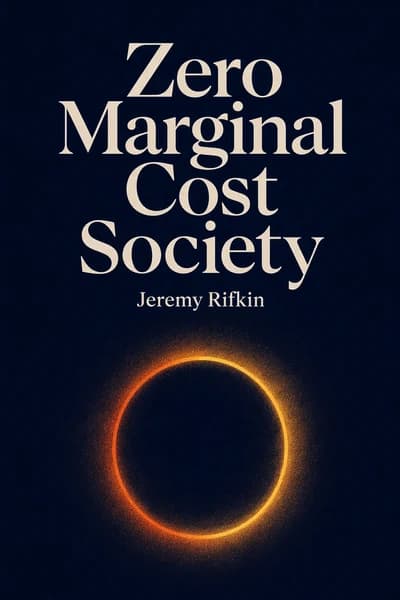
What if capitalism is engineering its own demise? Jeremy Rifkin's provocative thesis shows how near-zero marginal costs could create a post-capitalist era where goods become virtually free. Discussed at Google Talks, this economic paradox is reshaping how we view scarcity itself.
Jeremy Rifkin, bestselling author of The Zero Marginal Cost Society, is a renowned American economic theorist and sustainability advocate whose work explores the intersection of technology, economy, and environmental stewardship.
A Wharton School graduate and president of the TIR Consulting Group, Rifkin has shaped global policy as an advisor to the European Union, spearheading initiatives like the Third Industrial Revolution framework for sustainable infrastructure.
His 23 books, including The Empathic Civilization and The Third Industrial Revolution, dissect societal shifts driven by digital and renewable energy advancements, cementing his reputation as a visionary in post-carbon economics. Rifkin’s ideas have influenced corporate leaders through his Wharton executive lectures and governments worldwide, with his works translated into 35+ languages.
The Zero Marginal Cost Society (2014), a cornerstone of his legacy, forecasts the rise of collaborative economies—a concept now integrated into urban planning and green policy frameworks. His foundational 1995 bestseller, The End of Work, remains pivotal in debates on automation’s societal impact.
The Zero Marginal Cost Society explores how advancing technologies like 3D printing, renewable energy, and the Internet of Things (IoT) drive production costs to near zero, undermining traditional capitalism. Rifkin argues this will spur a "Collaborative Commons" economy where access and shared resources surpass private ownership, prioritizing sustainability and democratized innovation over profit-driven markets.
Economists, policymakers, and technology enthusiasts interested in socioeconomic shifts will benefit. It appeals to those analyzing post-capitalist models, sustainable energy transitions, or IoT’s societal impact. Critics of Rifkin’s earlier work and advocates for sharing economies will also find provocative insights.
Yes, for its bold analysis of capitalism’s decline and the rise of collaborative systems. While some critics dismiss Rifkin’s timelines as overly optimistic, the book offers a comprehensive framework for understanding how near-zero marginal costs could reshape industries like energy, manufacturing, and digital services.
The Collaborative Commons refers to a decentralized economic model where individuals and communities share goods/services via IoT-connected platforms. Rifkin contrasts this with capitalism, predicting it will dominate as profits dwindle from near-free production of renewable energy, 3D-printed goods, and digital content.
Rifkin argues capitalism’s pursuit of lower marginal costs (to maximize profits) ultimately leads to technologies that reduce costs to near zero, eroding profitability. Examples include digital music (replaced by streaming) and renewable energy outpricing fossil fuels—trends he claims will expand to physical goods via 3D printing.
IoT enables the Collaborative Commons by connecting renewable energy grids, automated factories, and global supply chains into a seamless network. Rifkin claims this "smart infrastructure" will let "prosumers" (producer-consumers) share energy, goods, and data laterally, bypassing corporate intermediaries.
Critics argue Rifkin underestimates capitalism’s adaptability and overstates human willingness to abandon ownership. Others question his dismissal of freeloading risks in sharing economies and note his timelines for systemic change are implausibly short.
He posits that solar/wind energy’s near-zero marginal costs (after initial infrastructure) will disrupt fossil fuels, enabling decentralized "energy democracies." Households and businesses could generate and share surplus energy via IoT-connected grids, reducing reliance on utilities.
Prosumers are individuals who both produce and consume goods/services. In Rifkin’s model, IoT and 3D printing empower prosumers to create and share energy, manufactured products, and digital content peer-to-peer, eroding traditional corporate supply chains.
It expands on themes from The Third Industrial Revolution (decentralized energy) and The Age of Access (shift from ownership to access). Rifkin ties these ideas to a broader critique of capitalism’s longevity, contrasting with his policy-focused Green New Deal.
With AI accelerating automation and renewable energy adoption surpassing forecasts, Rifkin’s warnings about capitalism’s instability feel prescient. The rise of decentralized platforms (e.g., blockchain, peer-to-peer markets) further mirrors his Collaborative Commons predictions.
"The inherent entrepreneurial dynamism of competitive markets is driving costs to near zero, making goods/services abundant but profits scarce”
This paradox, Rifkin argues, will catalyze capitalism’s eclipse by collaborative, sustainable systems.
著者の声を通じて本を感じる
知識を魅力的で例が豊富な洞察に変換
キーアイデアを瞬時にキャプチャして素早く学習
楽しく魅力的な方法で本を楽しむ
We are entering a new economic system—the Collaborative Commons—that is disrupting markets and re-imagining our way of life.
The Internet of Things is giving rise to a Third Industrial Revolution.
The capitalist era is passing—not quickly, but inevitably.
In the coming era, social capital is going to matter far more than financial capital.
The democratization of innovation is paving the way for a sustainable, post-scarcity world.
『Zero Marginal Cost Society』の核心的なアイデアを分かりやすいポイントに分解し、革新的なチームがどのように創造、協力、成長するかを理解します。
『Zero Marginal Cost Society』を素早い記憶のヒントに凝縮し、率直さ、チームワーク、創造的な回復力の主要原則を強調します。

鮮やかなストーリーテリングを通じて『Zero Marginal Cost Society』を体験し、イノベーションのレッスンを記憶に残り、応用できる瞬間に変えます。
何でも質問し、声を選び、本当にあなたに響く洞察を一緒に作り出しましょう。

"Instead of endless scrolling, I just hit play on BeFreed. It saves me so much time."
"I never knew where to start with nonfiction—BeFreed’s book lists turned into podcasts gave me a clear path."
"Perfect balance between learning and entertainment. Finished ‘Thinking, Fast and Slow’ on my commute this week."
"Crazy how much I learned while walking the dog. BeFreed = small habits → big gains."
"Reading used to feel like a chore. Now it’s just part of my lifestyle."
"Feels effortless compared to reading. I’ve finished 6 books this month already."
"BeFreed turned my guilty doomscrolling into something that feels productive and inspiring."
"BeFreed turned my commute into learning time. 20-min podcasts are perfect for finishing books I never had time for."
"BeFreed replaced my podcast queue. Imagine Spotify for books — that’s it. 🙌"
"It is great for me to learn something from the book without reading it."
"The themed book list podcasts help me connect ideas across authors—like a guided audio journey."
"Makes me feel smarter every time before going to work"

Zero Marginal Cost Societyの要約をPDFまたはEPUBで無料でダウンロード。印刷やオフラインでいつでもお読みいただけます。
Picture the moment when music became virtually free. Not through piracy alone, but through a fundamental shift in how we create, share, and consume. One day you're buying CDs for $15 each; the next, Spotify offers 70 million songs for the cost of a single album per month-or nothing at all. This wasn't just disruption. It was a preview of something far more profound: an economic transformation that's now spreading from pixels to power plants, from software to solar panels, from digital files to physical manufacturing. We're witnessing the early tremors of capitalism's most fundamental contradiction-the relentless drive for efficiency that's pushing the cost of production toward zero, threatening the very profit mechanism that sustains the system. When it costs nearly nothing to produce one more unit of almost anything, what happens to an economy built on scarcity and exchange? Here's the uncomfortable truth: capitalism is extraordinarily good at making itself obsolete. Every business seeks competitive advantage through efficiency and productivity gains, driving down the marginal cost-what it costs to produce one additional unit after covering fixed expenses. This race to the bottom has always existed, but something unprecedented is happening. Technology is pushing marginal costs so close to zero that entire industries can no longer sustain traditional profit models. The pattern emerged clearly in information goods. Once you've written software, recorded music, or created a digital course, reproducing it costs virtually nothing. A single server can deliver the same content to one person or one million with negligible difference in cost.