第1章
The Overwhelming Force of Negativity in Our Lives
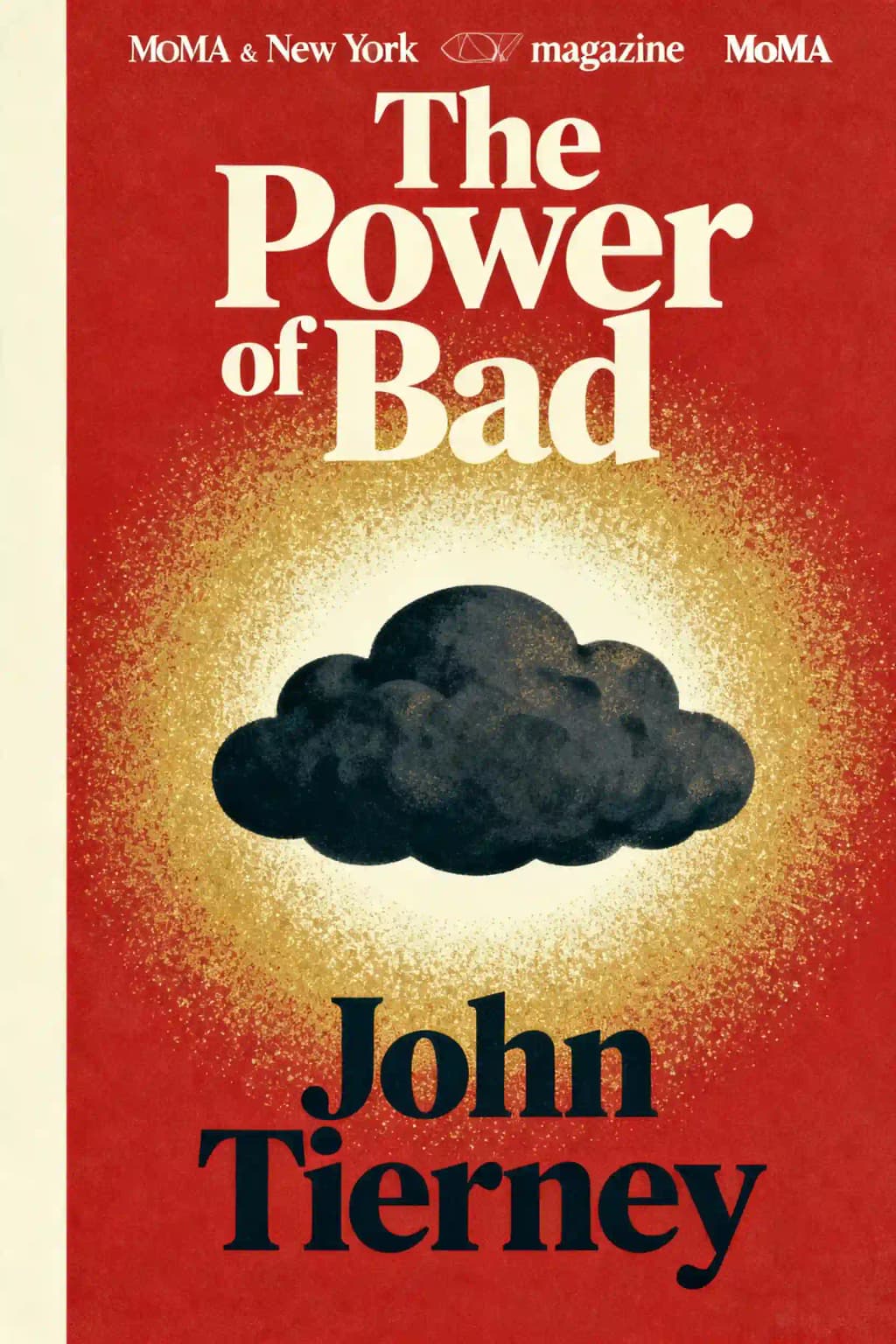
Have you ever wondered why a single criticism can ruin your day despite receiving multiple compliments? Or why we obsess over one mistake while overlooking numerous successes? This phenomenon isn't just your imagination-it's a fundamental aspect of human psychology called the negativity effect. In "The Power of Bad," renowned psychologists John Tierney and Roy Baumeister reveal how this universal bias shapes everything from our personal relationships to global politics. The book has become required reading in psychology departments worldwide and influenced business practices at companies from Google to Goldman Sachs. Even celebrities like Oprah Winfrey have cited its insights on handling criticism. At its core lies a simple yet profound truth: bad is stronger than good-but understanding this power gives us the tools to overcome it.
第2章
The Negativity Effect: Our Brain's Built-in Bias
The negativity effect was discovered almost accidentally when Roy Baumeister began searching for situations where bad events didn't have stronger impacts than good ones. Despite extensive research across psychology, sociology, economics, and anthropology, he and his colleagues couldn't find compelling counterexamples. Studies consistently showed that bad health, parenting experiences, and life events have greater and longer-lasting impacts than positive ones.
Working independently, University of Pennsylvania psychologist Paul Rozin had discovered similar patterns, particularly in how contamination works-a single cockroach can spoil a bowl of cherries, but a cherry cannot purify a bowl of cockroaches. Even our language reflects this imbalance: words like "trauma" have no positive equivalent, and terms like "murderer" have no opposite that carries equal weight.
This bias isn't arbitrary-it's an evolutionary adaptation. Our ancestors who paid more attention to threats were more likely to survive than those who focused on pleasant experiences. The brain evolved three major threat-warning systems: the basal ganglia (present even in reptiles), the limbic system with its influential amygdala, and finally the prefrontal cortex. While this advanced system can process both positive and negative information, negative stimuli trigger stronger, quicker reactions throughout the brain and nervous system.
This built-in negativity bias explains why we're devastated by criticism but barely moved by praise, why we spot angry faces in a crowd while missing friendly smiles, and why we remember insults far longer than compliments. It's not just a quirk of perception-it fundamentally shapes our lives, relationships, and societies.
第3章
Measuring the Imbalance: The Rule of Four
How much stronger is bad than good? Researchers have developed various methods to measure this imbalance, with the "positivity ratio" emerging as a particularly valuable tool. This ratio represents the number of good events needed to offset each bad event.
Pioneering researcher Robert Schwartz measured this ratio in psychotherapy patients, finding that severely depressed people experienced twice as many negative feelings as positive ones. Those with "normal functioning" averaged about 2.5 positive feelings for every negative one, while "optimal functioning" required slightly over four positive feelings per negative one.
In marriages, researchers like John Gottman discovered that troubled relationships have equal numbers of good and bad interactions, while successful relationships maintain a 5:1 ratio of positive to negative interactions-sometimes informally called the "five fucks for every fight" rule.
From these findings emerges what Tierney and Baumeister call the Rule of Four: It typically takes four good things to overcome one bad thing. This applies across contexts:
• In relationships, having sex four times as often as arguing indicates health
• When evaluating a job, four good days can compensate for one bad Friday
• Companies typically need at least three satisfied customers for every dissatisfied one
• Behavioral economists have found people won't risk losing $20 on a coin toss unless offered a potential $40 gain
The Rule of Four provides a practical framework for understanding how much positive experience we need to balance negativity. It helps counter our negativity bias when judging situations and reminds us not to overreact to isolated bad events. Most importantly, it gives us a concrete target for maintaining emotional equilibrium in our relationships and daily lives.
第4章
Safety Addiction: When Fear Overwhelms Reason
Our negativity bias creates a particularly destructive pattern that Tierney and Baumeister call "safety addiction"-an irrational focus on avoiding bad things that can paradoxically make us less safe. This addiction may be the most costly and least recognized addiction in modern society.
The American response to 9/11 perfectly demonstrates this phenomenon. While the hijacking strategy became obsolete the moment passengers on the fourth plane realized what was happening, fear overwhelmed rational judgment. The government banned flights for days, created the inefficient TSA bureaucracy that has spent over $50 billion while repeatedly failing security tests, and implemented "security theater" like banning nail clippers.
Meanwhile, millions of Americans avoided flying and drove instead, resulting in an estimated 1,600 additional deaths from auto accidents-more than half the number killed in the attacks themselves. We became so focused on preventing another 9/11 that we created new dangers.
This safety addiction affects even experts with strong incentives to make smart decisions. Professional golfers become overly cautious after making a birdie, and football coaches routinely punt on fourth down despite statistical evidence showing they'd win more games by going for it.
One remarkable exception is Kevin Kelley, a high school football coach at Pulaski Academy who recognized his own negativity bias and made a simple rule before emotions could take over: no punting. By making decisions before games and focusing on long-term statistics rather than short-term fears, he eliminated safety addiction. His strategy produced phenomenal results-scoring on 75% of possessions versus the typical 33% and winning seven state championships in sixteen seasons after the school had never won before.
The key was making rules beforehand rather than trusting gut feelings in the moment. This approach works off-field too: taking decisions out of your hands with pre-made rules or seeking advice from someone with no personal stake in the outcome helps overcome loss aversion. Despite Kelley's success, most coaches remain too afraid of criticism to adopt his methods, showing how deeply ingrained safety addiction remains in our decision-making.
第5章
Love in the Balance: Relationships and Negativity
Traditional wedding vows promise "for better or for worse," but these elements aren't equal in relationships. The "worse" matters far more than the "better," as the power of bad can overwhelm judgment during conflicts, leading to actions that further damage relationships.
Research shows that marriages typically decline in satisfaction over time, with successful ones defined not by improvement but by avoiding decline. When tracking dating couples, psychologists discovered that constructive strategies barely impact relationships, while destructive behaviors like silent withdrawal or angry threats trigger disastrous spirals of retaliation. As one researcher noted, "Negativity is a tough disease to shake-and it's highly contagious."
Insecurity can destroy otherwise healthy relationships. In laboratory studies, partners with low self-esteem catastrophically misinterpreted neutral situations as rejection, mentally pushing away their partners despite no real danger. They became resentful of routine sacrifices, and their relationships fell apart rapidly.
Gender differences emerge in these patterns: insecure men typically fear sexual infidelity and become controlling, while insecure women worry about other forms of rejection and respond with hostility. Same-sex couples tend to handle conflict more positively than heterosexual pairs, avoiding the destructive "female-demand-male-withdrawal" pattern common in heterosexual relationships.
The negativity effect offers a liberating lesson for all relationships: you don't need to work so hard. Research shows that avoiding negative parenting matters far more than providing enrichment-children with adequate (not perfect) environments generally fulfill their genetic potential. The same applies to marriages and friendships-being "good enough" works better than striving for perfection.
Instead of pursuing relationship perfection, focus on avoiding elementary mistakes:
• Don't overpromise
• Don't expect credit for extra effort
• Remember others' perceptions of bad matter more than yours
• Use conflicts as learning opportunities
• Avoid the fundamental attribution error by not assuming character flaws when situational factors explain behavior
• Bring in an imaginary referee during arguments to gain perspective
Perhaps most importantly, learn to overlook your partner's faults. Brain scans of successful couples revealed a surprising pattern: those in lasting relationships showed reduced activity in the prefrontal cortex region associated with negative judgments when viewing their partner's photo. The most satisfied spouses automatically followed William Blake's principle that "Love to faults is always blind."
第6章
Conquering Fear: The Case of "Fearless Felix"
In 2012, Felix Baumgartner planned to make history by jumping from a helium balloon in the stratosphere and breaking the sound barrier during freefall. Despite his history of daredevil stunts, Felix suddenly developed severe claustrophobia in the pressurized suit required for the jump. Five months before the planned event, during a simulation, he panicked and tore off the helmet, declaring, "I'm done with this project."
Red Bull, having invested millions in the mission, brought in performance psychologist Dr. Michael Gervais. Rather than dismissing Felix's fear, Gervais helped him understand how the mind creates anxiety through storytelling-like early humans around campfires creating physical responses to imagined threats. He offered Felix a new mental image: anxiety as a runaway train that accelerated with each negative thought.
Using a sketch of the route from Los Angeles to the test facility in Lancaster, Felix learned to monitor his heart rate and anxiety level (1-10), stopping to calm himself whenever anxiety rose. Gervais taught him two techniques: "thinking well" (reframing the suit as a special, custom-built friend rather than a prison) and "breathing well" to activate the parasympathetic nervous system's relaxation response.
Through repeated practice with first just the helmet, then the full suit, Felix learned to use positive mantras and deep breathing. Within weeks, he could spend hours in the suit comfortably, eventually completing a five-hour mission simulation to team applause.
When the day of the stratospheric jump arrived, Felix faced a serious crisis during the ascent. At 60,000 feet, his visor began fogging up-if it froze outside the capsule, he couldn't return to safety nor see during his jump. Despite engineers planning to abort the mission, Felix remained calm, developing a contingency plan for timing a blind jump if necessary.
Fortunately, the heating system worked when he reached 127,852 feet. Standing on the step with Earth far below, Felix saluted, said "I'm coming home now," and jumped. He became the first human to break the sound barrier under his own power, reaching Mach 1.25 before pulling his parachute after a record 119,431-foot free fall.
Upon landing, he celebrated his greatest accomplishment: overcoming his anxiety about the suit. "Once you extinguish the fear," Gervais said, "you're looking at a whole world of possibility and freedom."
第7章
Harnessing Criticism: When Bad Serves Good
Despite its painful nature, criticism can sharpen our wits and spur improvement when properly harnessed. British humorist Stephen Potter recognized the negativity effect's power long before psychologists named it, using it in his concept of "gamesmanship"-winning without cheating-and "one-upmanship"-strategies for the unskilled to prevail against superiors.
Researchers later confirmed Potter's insights: Teresa Amabile's experiments showed negative reviewers were perceived as more intelligent than positive ones, even when the same critic wrote both reviews. Critics often face a choice between seeming "plodding but kind" or "brilliant but cruel," with insecure people more likely to choose negativity to raise their status.
When delivering criticism yourself, the popular "criticism sandwich" approach fails because negative feedback overwhelms positive comments. In Baumeister and Cairns' study, college students recalled fewer than half of positive words but remembered most negative ones, especially when negative words appeared within mostly positive feedback.
The best approach to delivering criticism begins with knowing your audience. Effective doctors don't follow rigid scripts but take cues from patients, delivering news in person while observing reactions. They use a "perspective display sequence": first seeking the patient's perspective, then confirming it, then delivering details. This makes the doctor a partner rather than just a bearer of bad news.
After delivering criticism, pause to allow processing time rather than rushing to solutions. When critiquing, consider your objective-emotional support or behavioral change-as the sequence matters. People who hear bad traits last are more motivated for self-improvement. Once criticism is delivered, use the brain's heightened alertness to deliver positive information that will now be encoded alongside the negative feedback.
第8章
The Carrot or the Stick: What Really Motivates
Whether trying to improve yourself or others, criticism has limits. When it fails to produce results, direct incentives become necessary, raising the age-old question: the carrot or the stick?
The "carrot or stick" expression emerged in mid-nineteenth century cartoons and stories, presented as folk wisdom that supposedly favored rewards over punishment. But in reality, penalties often prove more effective than rewards across various contexts.
America's religious revival began when fiery preachers like George Whitefield and Jonathan Edwards rejected the establishment churches' genteel theology for hellfire sermons. While mainline clergymen preached about a distant, benevolent deity, revivalists vividly described eternal torment awaiting sinners. This strategy proved remarkably effective-since the 18th century, American church membership has tripled while European pews emptied.
Research by psychologist Azim Shariff confirms this pattern: people who conceive of God as vengeful and punishing are less likely to cheat than those who describe God as loving and forgiving. Cross-country analysis shows lower homicide rates correlate with belief in hell, not heaven.
Despite evidence supporting penalties' effectiveness, educators have moved away from punishments toward praise, with disastrous results for disadvantaged students, particularly boys. This shift stems partly from the 1970s self-esteem movement, which mistakenly assumed high self-esteem causes success rather than resulting from it.
Some educators have bucked this trend with remarkable results. Success Academy, a network of 47 charter schools in New York City's poorest neighborhoods, employs strict discipline, uniforms, clear standards, immediate consequences, and competitive incentives. The results are remarkable: 95% of Success Academy students pass state proficiency exams compared to fewer than a third of minority students in regular public schools.
Interestingly, framing incentives as penalties rather than rewards proves dramatically more effective. In Chicago Heights, teachers given $4,000 upfront who had to return unearned portions produced significantly better student math scores than those promised traditional year-end bonuses of the same amount. Similarly, at a Chinese factory, workers told their regular salary included an extra 80 yuan that would be deducted if they missed production targets outperformed those offered the same amount as a bonus.
第9章
The Toxic Workplace: How Bad Apples Spoil the Barrel
Before entering academia, researcher Eliza Byington discovered how negativity can spread rapidly through workplaces without anyone noticing. At her video production company, she observed a dramatic transformation when a caustic sales rep began working from home three days a week. Though good at his job, this employee would mock clients, tease colleagues for mistakes, and complain loudly. On days he wasn't present, the office became friendly and collaborative; when he returned, it went quiet again.
This "bad apple" effect has been extensively documented. Studies of widows, elderly people, and the unemployed consistently show negative social interactions affect well-being more powerfully than positive ones. Police officers subjected to undermining by supervisors or colleagues retaliated against their organizations through active or passive sabotage. In Australian fast-food restaurants, deviant employee behaviors had more impact on service speed and profitability than positive behaviors did.
When researchers studied team performance using the Big Five personality traits (Conscientiousness, Agreeableness, Neuroticism, Openness, and Extraversion), they found the worst-performing member predicted team functioning better than the average personality score or even the best member's qualities. In one experiment with business students, researchers identified three types of "bad apples"-jerks (who mock and insult), slackers (who shirk responsibilities), and downers (who spread negative emotions). Teams with jerks or slackers performed 35% worse than unspoiled teams.
Most disturbingly, these behaviors proved contagious, with team members beginning to mirror the bad apple's negative behaviors toward each other. This happens because social rejection triggers one of our most fundamental human motivations: the need to belong. When rejected, people typically respond with "fight or flight"-either withdrawing socially or becoming angry and seeking revenge.
Robert Sutton developed his famous "No Asshole Rule" after a Stanford faculty meeting where colleagues refused to hire a brilliant but toxic candidate. He suggests identifying toxic people by asking two questions: Do you feel worse about yourself after interacting with them? And do they aim their venom at those with less power?
To handle bad apples, experts recommend: protect yourself from emotional contagion; rearrange teams when possible; distinguish between useful criticism and toxicity; don't expect bad apples to change on their own; isolate them physically or group them together; intervene early with warnings and penalties; consider the total organizational cost of keeping them; and fire kindly when necessary. Even high performers should be fired if they damage team performance-as proven when a Men's Wearhouse store's sales rose 30% after firing their top salesperson.
第10章
Online Negativity: Managing the Digital Reputation Crisis
The internet has amplified the negativity effect, giving cranks and trolls unprecedented reach. Online reviews reveal a powerful negativity bias-in experiments, people judge negative reviews as equally credible regardless of their source, while positive reviews are scrutinized more carefully for credibility. Vacation planners spend more time studying negative reviews and are more influenced by them than positive ones.
This effect extends to book sales on Amazon and Barnes & Noble, where a 1-star review hurts sales more than a 5-star review helps. Business researchers even categorize extremely negative customers as "terrorists" because of their outsized damage potential. Studies at Xerox and Harvard Business School found that only customers giving 5-star ratings are truly loyal, with the biggest ROI coming from preventing unhappy customers from becoming "terrorists."
Some businesses have learned to thrive despite this challenge. New York's Casablanca Hotel has maintained a top-five TripAdvisor ranking for over a decade by applying psychological principles to guest experiences. They've discovered that first impressions matter tremendously-while positive first impressions can be easily reversed, negative ones are extremely difficult to overcome.
The peak-end rule significantly impacts how we judge experiences. In studies where people immersed hands in ice water, they preferred a longer session that ended less painfully over a shorter but consistently painful one. The Casablanca Hotel applies this knowledge by creating excellent first impressions, eliminating irritants that could become negative peaks, monitoring customer reactions, responding quickly to complaints, and ensuring positive endings.
Even with difficult guests like "the Moon Lady" who complained irrationally about windowless rooms, they respond with kindness rather than confrontation, ensuring the interaction ends positively. This approach has maintained their 5-star TripAdvisor rating for over a decade by overwhelming any negative experiences with what their VP of Sales calls "sparkling sunshine."
第11章
The Pollyanna Principle: Our Natural Defense Against Negativity
Despite the power of bad, humans have developed natural defenses against negativity. The "Pollyanna principle" represents one such defense-our tendency toward positivity in language and memory. Though named after a saccharine literary character whose "Glad Game" found something positive in every negative situation, the principle has solid scientific backing.
Our language reveals this principle-when asked to list emotion words, people consistently generate more terms for negative feelings than positive ones. Yet paradoxically, studies across multiple languages show we actually use positive words far more frequently. Research since the 1930s has found "good" appears five times as often as "bad," and "love" seven times as often as "hate."
This positivity bias likely exists because it's socially beneficial-positive language makes us more likable and attractive to others. On social media, positive tweets get retweeted twice as often as negative ones and "favorited" five times more frequently. While negative content may grab immediate attention, positivity spreads more widely over time.
Our brains have additional defenses against negativity. The "fading affect bias" means negative emotions typically fade more quickly than positive ones. We create "positive illusions" about our past-parents of grown children forget the difficulties of raising infants, sports fans vividly remember championships while forgetting losing seasons.
As people age, they naturally develop a "positivity effect"-focusing more on positive information and less on negative. Older adults are more likely to look at smiling faces than frowning ones, interpret surprised expressions as joyful rather than startled, and recall happy photographs rather than disturbing ones. Brain scans show their emotional regions respond less to negative images and more to positive ones.
This positivity isn't merely denial-it's adaptive. In a German experiment involving a risk-taking game, healthy older adults avoided dwelling on missed opportunities, unlike both young adults and depressed older people. By focusing on gains rather than regrets, they not only remained happier but played more strategically and won more.
The "U-curve of happiness" shows well-being typically bottoms out around age fifty then rises for decades, with people in their sixties happier than in their twenties. This pattern appears across cultures and even in chimpanzees and orangutans.
Everyone can improve at positivity through specific strategies from positive psychology research:
• Change the narrative by rewriting your life story, seeing bad events as new beginnings
• Share your good news with others to make triumphs seem more significant
• Celebrate others' good news enthusiastically
• List five things you're grateful for weekly
• Make time for nostalgia by creating memorable moments
• Treasure the past without comparison to the present
第12章
Beyond the Crisis Crisis: Finding Perspective in a Fearful World
When absorbing today's news or contemplating humanity's future, we should remember three key assumptions: the world will always seem to be in crisis; the crisis is never as bad as it sounds; and the solution could easily make things worse. While real problems exist, the greatest obstacle to freedom and prosperity is the exploitation of people's negativity bias by "crisismongers" who distort our view of reality.
This "Crisis Crisis" isn't new-H.L. Mencken observed in 1918 that "the whole aim of practical politics is to keep the populace alarmed by menacing it with an endless series of hobgoblins, most of them imaginary." Politicians across the spectrum exploit the same cognitive biases, spreading alarms about various threats while yearning to restore a supposedly better past.
The modern world will always be in crisis because wealth and freedom have created a crisis industry. Today's crisis industry includes journalists, politicians, academics, think tanks, and nonprofits who proclaim every problem an unprecedented threat requiring expert guidance. They exploit ancient emotions like xenophobia, transforming minor threats into existential dangers.
This "demosclerosis" explains why post-WWII Germany and Japan recovered miraculously while Britain became Europe's "sick man." Without major disruption, special interests continue enriching themselves at public expense through "death by a thousand cuts." Crisismongering accelerates this process, as politicians follow Rahm Emanuel's dictum: "You never want a serious crisis to go to waste."
We need to alter incentives by rewarding politicians who speak rationally about risks, supporting analysts who put problems in perspective, and implementing penalties to cut profits of doom. Specific suggestions include creating a neutral repository for evaluating doom prophecies, enacting "Patty's Law" to forbid naming laws after victims to prevent emotional blackmail, and establishing Red-and-Blue-Ribbon Panels with rival teams debating solutions before implementation.
We can adopt a "low-bad diet" for information consumption just as people have learned to resist junk food. Minimize negative content, switch channels when politicians attack each other, and follow the Rule of Four by seeking four uplifting stories for every bad one. Social media can actually be more positive than mass media-people share natural wonders rather than massacres, form groups around shared passions rather than political hatred, and learn from professors on YouTube.
Every new technology brings problems, but the Digital Revolution's benefits will exceed its costs by liberating people from centralized authority. Bad is stronger, but good will prevail through persistence, intelligence, and numbers-even in our digital world where merchants of bad prosper by spreading fear and hatred.