第1章
The Extraordinary Power of Reality: Where Science Outshines Myth
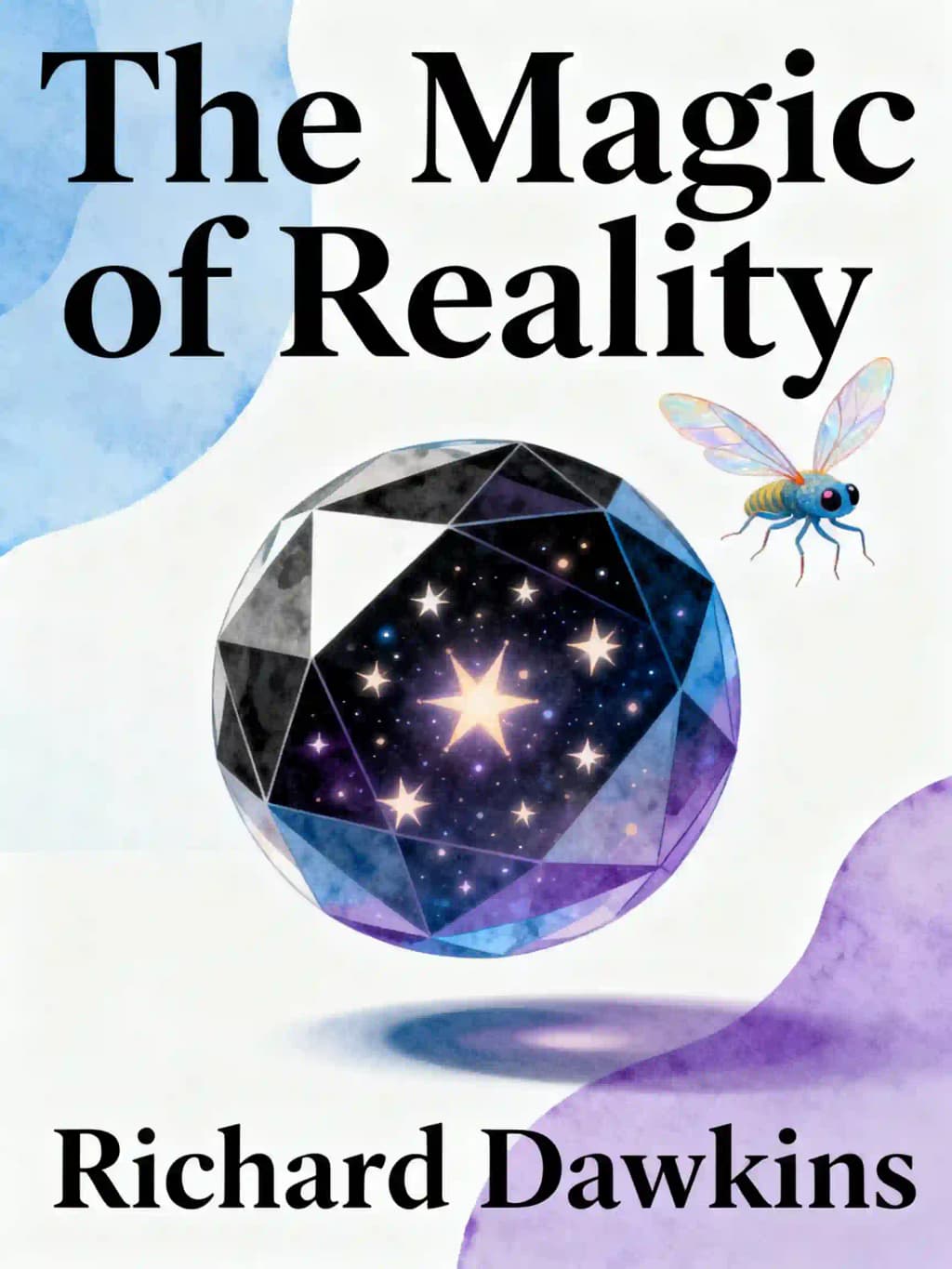
Have you ever gazed at a starry night sky and wondered about your place in the cosmos? Or questioned how rainbows form their perfect arcs across the heavens? Richard Dawkins invites us on an intellectual adventure that rivals any fantasy tale in its capacity to inspire wonder. "The Magic of Reality" has become a cultural touchstone for those seeking to understand our world without supernatural explanations. Since its publication, it has found fans among celebrities like Bill Gates and Neil deGrasse Tyson, who praised its ability to make complex scientific concepts accessible. The book represents a pivotal moment in popular science literature-a work that doesn't merely explain scientific concepts but celebrates the profound beauty of reality itself. In a world increasingly divided between scientific literacy and supernatural belief, Dawkins offers a compelling case that the universe as revealed by science contains more wonder than any myth could conjure.
第2章
Unveiling Reality: The True Magic of Existence
Reality encompasses everything that exists-but determining what exists presents a profound philosophical and scientific challenge. Our five senses detect much of reality directly, from the warmth of sunlight to the texture of sand, but human perception alone captures only a tiny fraction of what's real. We extend our sensory reach through sophisticated instruments: telescopes reveal distant galaxies billions of light-years away, electron microscopes expose the intricate dance of atoms, and seismographs detect subtle movements within Earth's crust. Reality also includes things we can't directly perceive but can detect through careful analysis of evidence-like dinosaurs known through fossils, ancient civilizations revealed through archaeology, or stars whose light reaches us from millions of years in the past.
Scientists discover hidden aspects of reality through increasingly sophisticated models when direct sensory detection isn't possible. They begin by imagining what might exist, create detailed models (physical, mathematical, or computational), then calculate what observations should result if the model accurately reflects reality. When predictions match observations across multiple experiments, confidence in the model grows. Gregor Mendel discovered genes this way by meticulously counting pea plant varieties over many generations, finding mathematical patterns that matched his heredity model. Similarly, Watson and Crick determined DNA's double helix structure by building physical models and checking if they matched Rosalind Franklin's X-ray crystallography measurements. The Large Hadron Collider's discovery of the Higgs boson followed this same pattern-theoretical models predicted its existence decades before technology could confirm it.
Reality includes not just physical objects but also emergent phenomena like consciousness, emotions, and abstract concepts. Love, joy, fear, and creativity are intensely real to those experiencing them but didn't exist before brains evolved to generate these experiences. These subjective experiences, while deeply personal, have measurable effects on brain chemistry and physical behavior. Mathematics itself represents another layer of reality-abstract patterns and relationships that exist independent of human minds yet are discovered rather than invented.
Science thrives on its current limitations, using unanswered questions as motivation to keep questioning and refining models to approach truth. Each discovery typically reveals new mysteries to explore. The identification of DNA's structure, for instance, opened up vast new questions about gene regulation, epigenetics, and the complexity of cellular machinery.
The supernatural, by contrast, offers no genuine explanatory power. To claim something is supernatural means declaring it permanently beyond human understanding or investigation. Throughout history, phenomena once attributed to supernatural causes-from lightning to mental illness to planetary motions-have consistently yielded to natural explanations when investigated scientifically. The real world, understood through scientific inquiry, has its own profound "poetic magic"-an inspiring beauty that's all the more remarkable because it's real, comprehensible, and connects us to the vast cosmic web of cause and effect that makes up our universe.
第3章
The Gradual Transformation: Evolution's Elegant Mechanism
Was there ever a "first person"? Surprisingly, no-because every person had parents who were also people. This applies to all creatures-there was never a first rabbit, first crocodile, or first dragonfly. Every creature belongs to the same species as its parents and grandparents. This continuous chain of ancestry, without sudden jumps between species, is one of evolution's most elegant yet counterintuitive principles.
To understand this concept, imagine a thought experiment: create a stack of photographs starting with yourself, then your father, grandfather, and so on back through time. If you continued for about 185 million generations, you'd find that your 185-million-greats-grandfather was actually a fish. Between you and that fish ancestor, each individual in the chain looked very similar to its neighbors-each child belonging to the same species as its parents. The changes were so gradual that you wouldn't notice any trend walking back 10,000 years, though at 100,000 years you might see slight differences. At one million years, the differences become more pronounced, yet still recognizably human-like. By ten million years, our ancestors would appear more ape-like, and by sixty million years, they would resemble small, tree-dwelling mammals.
We know what our distant ancestors looked like primarily through fossils-stones that have preserved the shapes of dead animals or plants. Fossils form when an animal is buried in sediment that eventually hardens into rock, creating detailed impressions of bones, teeth, and sometimes even soft tissues like skin or feathers. The process requires specific conditions: rapid burial, minimal decay, and the right chemical environment. Scientists can date fossils using radioactive isotopes in nearby igneous rocks. When molten rock hardens, radioactive "clocks" like uranium-238 begin counting time. By measuring the ratio of uranium-238 to lead-206, scientists can calculate how long ago the rock formed. Other dating methods include potassium-argon dating for older fossils and carbon-14 for more recent organic materials.
DNA provides irrefutable evidence of our kinship with all life. This genetic information reveals our evolutionary relationships with remarkable precision. Comparing genes shows chimpanzees differ from humans by only 9 letters out of 2,076 in the FoxP2 gene, while mice differ by 139 letters. This pattern of genetic similarity mirrors evolutionary relationships: species that shared a recent common ancestor have more similar DNA sequences. All mammals share a more recent common ancestor with each other than with frogs, and this is reflected in their genetic makeup. The genetic code itself is identical across all living creatures, from bacteria to blue whales, proving beyond doubt that we are all cousins. This universal genetic code, using the same four DNA letters (A, T, C, G) and the same amino acid translation system, represents one of the strongest pieces of evidence for the common origin of all life on Earth.
第4章
The Branching Tree: How Species Diversify
Scientists have named about 2 million species, yet this represents only a fraction of Earth's biodiversity. Species are defined primarily by their ability to interbreed and produce fertile offspring-horses and donkeys belong to different species because their offspring (mules) are infertile, while spaniels and poodles belong to the same species despite looking quite different.
Scientific classification organizes life in a hierarchical system: species belong to genera (like Homo sapiens or Panthera leo), genera to families (like Felidae for cats), families to orders (like Carnivora or Primates), and orders to classes (like Mammalia). This classification system forms a branching tree structure that mirrors the evolutionary family tree of all life on Earth.
Just as species branch into diverse forms, languages split and diversify over time. Romance languages like Spanish, Italian, and French all evolved from Latin, while Bantu languages in Africa form another distinct family. Languages drift apart when speakers are separated geographically, with small differences accumulating over generations until they become mutually unintelligible. Similarly, species change when their DNA drifts apart over time.
Marine iguanas evolved from land iguanas on the Galapagos, completely changing their lifestyle to feed on underwater seaweed. This pattern repeats across the Galapagos with tortoises, lava lizards, flightless cormorants, mockingbirds, and finches. Islands-including lakes, oases, and mountains-manufacture new species by isolating populations. Rivers and mountain ranges create similar separations, as can simple distance.
The concept of a "gene pool" helps explain evolution. When populations of the same species become geographically isolated, their gene pools can drift apart until they become different species that can no longer interbreed. Unlike language drift, natural selection gives direction to these changes, favoring genes that help bodies survive and reproduce. Every living thing is essentially an elaborate machine for passing on the genes that made it.
第5章
The Building Blocks: Matter's Hidden Architecture
Crystals like diamond are gigantic molecules composed of millions of atoms arranged in regular patterns-like soldiers parading in three dimensions. Despite appearing solid, most "solid" matter actually consists mostly of empty space. Carbon atoms can form different crystal structures: the incredibly hard diamond or the soft graphite used as lubricant.
Most solid objects are made of crystals, including metals like iron, gold, and copper, as well as rocks like granite and sandstone. Sand grains are typically small bits of rock ground down by water and wind, which can later be packed together to form sedimentary rocks. Some crystals contain just one element (like diamond or gold), while others contain multiple elements arranged in precise patterns, like salt with its alternating sodium and chlorine ions.
In solids, molecules maintain fixed positions relative to their neighbors. Liquids allow molecules to flow while staying close together, filling containers from the bottom up. Gases consist of freely moving molecules that rush about until hitting something, filling entire containers. Temperature affects molecular movement-higher temperatures make molecules move faster.
Though atoms are the smallest units of elements, they can be split-though this transforms them into different elements and releases enormous energy. The Rutherford-Bohr model depicts atoms as miniature solar systems with nuclei at the center and electrons orbiting around them. Surprisingly, atoms are mostly empty space-if a nucleus were scaled to football size, neighboring nuclei would be 15 kilometers apart with electrons like gnats flying between them.
Carbon's extraordinary ability to link with other carbon atoms in chains makes it uniquely special in chemistry, earning its own field called "organic chemistry." Carbon forms chains of varying lengths-from octane's eight atoms to structures hundreds of atoms long-sometimes forming loops. This versatility enables the formation of complex structures like myoglobin in our muscles, making life itself possible through carbon's remarkable chemical flexibility.
第6章
Cosmic Rhythms: The Dance of Earth and Sun
Our lives follow two great rhythms: the daily 24-hour alternation between light and dark, and the yearly 365-day cycle between winter and summer. These fundamental cycles, which scientists now understand through precise astronomical measurements, shape nearly every aspect of life on Earth through their influence on temperature, light availability, and environmental conditions.
The daily rhythm of night and day occurs as our planet rotates on its axis, taking exactly 23 hours, 56 minutes, and 4 seconds to complete one full rotation. This dramatic difference shapes animal behavior through complex adaptations developed over millions of years. Diurnal creatures like humans, most birds, and squirrels have evolved keen color vision and are active during daylight hours. In contrast, nocturnal animals such as owls, hedgehogs, and jaguars have developed specialized night-vision capabilities, with larger eyes and more rod cells in their retinas. Some species, called crepuscular, like rabbits and deer, are most active during twilight hours, taking advantage of both day and night adaptations.
Similarly, animals have developed remarkable strategies to cope with seasonal changes. Mammals in northern climates grow thick winter coats - the Arctic fox's fur becomes not just thicker but whiter for camouflage. Birds undertake extraordinary migrations, with the Arctic tern holding the record for the longest migration, traveling 44,000 miles annually between poles. Some creatures enter hibernation, like bears and groundhogs, while others undergo brumation, a similar process in reptiles. Desert animals often estivate during hot seasons, becoming dormant to survive extreme heat.
Isaac Newton's groundbreaking work on gravity revolutionized our understanding of planetary motion. His famous cannon thought experiment illustrated orbital mechanics: imagine a cannon on a mountain firing horizontally at increasing velocities. At about 17,000 miles per hour, the cannonball would achieve orbital velocity, perpetually falling around Earth in a perfect balance between gravitational pull and forward momentum. This same principle explains how satellites maintain their orbits and how Earth maintains its annual journey around the sun.
The Earth's orbit is elliptical but nearly circular, with a mere 3% difference between its closest approach to the sun (perihelion) at 91.4 million miles in January and its furthest point (aphelion) at 94.5 million miles in July. This orbital variation actually contradicts common assumptions about seasons - Earth is closest to the sun during Northern Hemisphere winter. The real cause of seasons is Earth's axial tilt of 23.5 degrees relative to its orbital plane. This tilt means that during summer, your hemisphere is oriented toward the sun, receiving more direct sunlight and experiencing longer days. During winter, the opposite occurs - sunlight arrives at a more oblique angle, spreading the same energy over a larger area and resulting in less solar heating per square foot of surface. This effect is amplified at higher latitudes, explaining why polar regions experience such extreme seasonal variations.
第7章
The Stellar Engine: Our Life-Giving Star
The sun is simply a star-no different from others except for its proximity to Earth, which makes it appear larger and brighter. To grasp these cosmic distances, imagine a football representing the sun, with Earth as a peppercorn 25 meters away, and the moon as a pinhead 5 centimeters from the peppercorn. Yet the nearest star, Proxima Centauri, would be another football 6,500 kilometers away!
Stars differ from planets fundamentally-stars shine by their own light while planets merely reflect light from nearby stars. A star's enormous mass creates tremendous pressure at its core, generating extreme heat. When temperatures become inconceivably high, the star functions like a slow-acting hydrogen bomb, radiating heat and light. This intense heat causes the star to expand, while gravity pulls inward, creating a self-regulating thermostat effect.
Our sun, currently middle-aged at 4.5 billion years, consists primarily of hydrogen which its core converts to helium through nuclear fusion, releasing enormous energy. In about 5 billion years, it will become a red giant. Long before then-in just 2 billion years-Earth will become uninhabitably hot like Venus.
Massive stars burn through hydrogen much faster than our sun and forge progressively heavier elements-carbon, oxygen, nitrogen, iron-in their intense furnaces. After relatively brief lives, they self-destruct in colossal supernova explosions, creating elements heavier than iron. Though catastrophic, these rare events are vital-they scatter element-rich dust through space that eventually forms new stars and planets. The poetic phrase "We are stardust" is literally true; without supernovas, life's essential elements wouldn't exist.
The sun is essential for life throughout the universe. Plants capture sunlight through their flat, thin leaves that function as solar panels, converting it to energy stored in sugars. This energy flows through the food chain-from plants to herbivores to carnivores to parasites and finally to decomposers-with some energy lost as heat at each transfer. All life's processes are ultimately powered by the sun.
第8章
The Spectrum's Secret: Unlocking Nature's Code
The rainbow appears to be a physical object at a specific location, but rainbows aren't objects you can approach-they always recede and eventually disappear. They're illusions without fixed locations, though understanding this illusion leads to fascinating scientific insights.
Isaac Newton discovered about 350 years ago that white light is actually a mixture of all colors. He proved this through experiments with prisms, demonstrating that white light separates into the spectrum-all colors of the rainbow in perfect order. This happens because different colored light bends at different angles when passing through glass or water, with red light bending less than blue light.
Rainbows form when sunlight interacts with millions of raindrops, with the sun behind the observer. Each raindrop acts somewhat like a tiny prism, but with a crucial difference-the far side of each drop acts as a mirror. Sunlight enters a raindrop, bends as it passes through (with colors separating), reflects off the back surface, and exits toward the observer. Any single raindrop shows only one pure color to your eye, while other raindrops positioned differently provide the other colors.
Light consists of electromagnetic vibrations with different wavelengths. Like sound has bass and treble notes, light has "low notes" (red, long wavelength) through "high notes" (violet, short wavelength). The visible spectrum is just a tiny band in a vast electromagnetic spectrum. Beyond violet lies ultraviolet light, X-rays, and gamma rays. Beyond red lies infrared, microwaves, and radio waves.
The spectroscope reveals that light from distant galaxies shows the same characteristic element patterns but shifted toward the red end of the spectrum. This "red shift" increases with the galaxy's distance from us. This phenomenon is a Doppler effect-similar to how a trumpet's pitch drops as it passes you. The red shift proves distant galaxies are rushing away from us, with more distant galaxies moving faster. By calculating backwards from this universal expansion, astronomers determined everything-the universe, time, and space itself-began in the "big bang" between 13-14 billion years ago.
第9章
Beyond Our World: The Search for Alien Life
Scientists honestly admit they don't know whether extraterrestrial life exists, though the odds seem favorable. Recent discoveries show that planets are common-we've found hundreds of extra-solar planets orbiting other stars using methods like detecting a star's slight movements from planetary gravitational pull or the dimming of starlight when planets transit across their stars. With approximately 10,000 billion billion stars in the universe, and about 10% being "sun-like," we're potentially dealing with billions of billions of planets that could host life.
Life as we know it requires liquid water-not ice or steam-making planets in the "Goldilocks Zone" crucial: not too close to their star where water would boil, not too far where it would freeze. Europa, Jupiter's moon, with its ice-covered liquid ocean, has replaced Mars as our solar system's most promising candidate for extraterrestrial life. Beyond our system, Gliese 581d, a rocky planet orbiting a red dwarf star 20 light years away, sits in its star's habitable zone.
While science fiction often lazily depicts aliens as modified humans or familiar creatures, there might be good reason why extraterrestrial life could have recognizable features like eyes. Eyes are tremendously useful wherever light is available, and since life-supporting planets likely orbit stars, light would be abundant. Eyes have evolved independently dozens of times on Earth, using only a few possible designs: camera eyes (like ours and octopuses'), scanning eyes (like jumping spiders), compound eyes (like insects), and mirror eyes (like scallops).
Aliens might see beyond our visual spectrum, perhaps with X-ray vision, though radio waves would provide poor resolution. On foggy planets, sonar might evolve instead, as it has in bats and dolphins. Other sensory systems might include radar or electrical sensitivity like that of platypuses. Though we haven't discovered alien life yet, science guides our search methodically, helping us ask meaningful questions about the universe without resorting to implausible stories.
第10章
The Magic of Understanding: Science's Greatest Gift
The question "Why do bad things happen?" is less sensible than "Why does anything happen?" There's no reason to single out bad events unless they occur more frequently than chance would predict or unless we believe natural justice should ensure bad things only happen to bad people. While everything happens for a reason in the sense of having causes, people often mistakenly interpret "reason" as "purpose."
Bad things don't happen more often than they should by chance. The universe has no mind or personality, so doesn't act to hurt or please us. Things simply happen, regardless of whether they're good or bad from our perspective. However, evolution creates a different dynamic. Unlike neutral forces like earthquakes, living predators and parasites are effectively "out to get" their prey through natural selection.
Miracle stories typically spread as rumors, passing through multiple people until the original source becomes untraceable. Strange coincidences, like dreaming of someone who died that night, seem miraculous until we consider statistics. With millions dreaming nightly and thousands dying daily, such coincidences are mathematically inevitable. We only notice and report the coincidences, never the non-events.
David Hume defined miracles as transgressions of natural laws-like walking on water or turning water into wine. His clever insight was that we should believe miracle stories only if the testimony's falsehood would be more miraculous than the claimed miracle itself. There are things even today's best scientists cannot explain, but that doesn't justify invoking supernatural explanations which don't actually explain anything at all.
Arthur C. Clarke captured this idea in his Third Law: "Any sufficiently advanced technology is indistinguishable from magic." While time machines might seem impossible today, future technology may make currently unimaginable things possible-though not everything we can imagine will become reality. Rather than lazily declaring something "supernatural," we should work to improve our science until it can provide an explanation. It's perfectly acceptable to admit "This is something we don't yet understand, but we're working on it"-indeed, it's the only honest approach.
The real world, understood scientifically, has its own magic-the magic of reality. This magic doesn't disappear when we understand it; rather, it deepens and becomes more wondrous as we uncover its elegant mechanisms. In the end, the greatest miracle may be our human capacity to comprehend the universe at all.