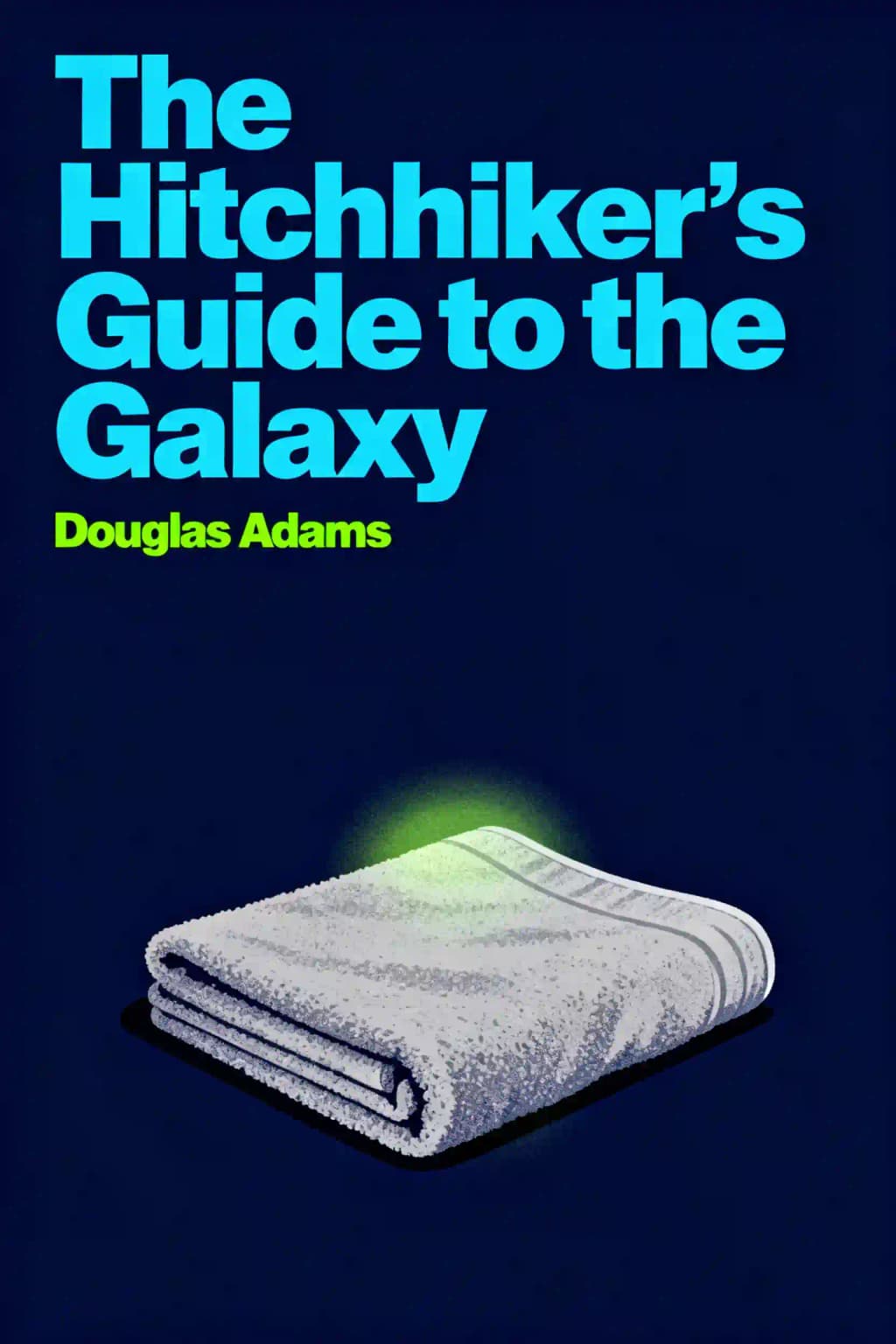
In Douglas Adams's cosmic comedy masterpiece, Earth is demolished for a hyperspace bypass. With 15 million copies sold and Elon Musk sending a towel to space, discover why "42" became the answer to life's ultimate question. Don't panic - just grab your towel.
Douglas Noel Adams (1952–2001) was the British bestselling author behind The Hitchhiker’s Guide to the Galaxy, celebrated for his groundbreaking fusion of science fiction and absurdist humor.
A Cambridge English literature graduate and former BBC Radio writer, Adams honed his satirical voice through work on Doctor Who and comedy troupes before creating his iconic intergalactic saga. The novel, born from a 1978 radio series, blends existential themes with razor-sharp wit, reflecting Adams’ knack for transforming cosmic absurdity into relatable human comedy.
Its success spawned four sequels—The Restaurant at the End of the Universe, Life, the Universe and Everything, So Long, and Thanks for All the Fish, and Mostly Harmless—alongside the Dirk Gently detective series and collaborative works like Last Chance to See. A pioneer in digital media, Adams co-founded h2g2, an early internet community, and advocated for environmental causes.
Translated into over 30 languages and adapted for TV, stage, and film, The Hitchhiker’s Guide has sold more than 15 million copies worldwide, cementing its status as a cornerstone of cult literature.
The Hitchhiker's Guide to the Galaxy follows Arthur Dent, an Englishman thrust into a galactic adventure after Earth’s destruction to make way for a hyperspace highway. With his alien friend Ford Prefect, they navigate absurd civilizations, bureaucratic Vogons, and existential mysteries using a satirical electronic guidebook. The story blends science fiction with dark humor, questioning humanity’s significance in an indifferent universe.
Fans of satirical science fiction and absurdist humor will enjoy this cult classic. Its witty critique of bureaucracy, philosophy, and human folly appeals to readers seeking laugh-out-loud storytelling with intellectual depth. Douglas Adams’ eclectic style—compared to Monty Python—also resonates with those who appreciate genre-bending narratives.
Yes—it’s a landmark in comedic sci-fi, selling over 15 million copies globally. Its enduring popularity, cultural references (e.g., “42” and Towel Day), and sharp social commentary make it both entertaining and thought-provoking. Critics praise its originality, though some note uneven pacing in later sequels.
The Babel fish is a small, telepathic creature that translates any language when placed in the ear. A hallmark of Adams’ absurdity, it embodies the guide’s practicality while satirizing bureaucratic solutions to cosmic problems. Its inclusion underscores themes of communication and the futility of overcomplication.
The Vogons—a race of hyper-bureaucratic aliens—destroy Earth for a highway, showcasing Adams’ disdain for rigid systems. Their love of terrible poetry and indifference to suffering mock institutional incompetence, reflecting real-world critiques of red tape and authority.
“42” is the supercomputer’s answer to the “ultimate question of life, the universe, and everything.” This nonsensical result satirizes humanity’s quest for meaning, emphasizing absurdity over logic. The joke has become a cultural shorthand for unresolved existential dilemmas.
A towel symbolizes preparedness and practicality for interstellar hitchhikers. Adams humorously elevates it to an essential survival tool, later inspiring “Towel Day” to honor his legacy. The detail reflects the guide’s blend of satire and faux-survivalist advice.
Earth’s entry in the guide—described as “harmless”—contrasts humanity’s self-importance. By demolishing Earth for a highway, Adams underscores humanity’s cosmic insignificance, mocking anthropocentrism and societal delusions.
Some critics argue later sequels lack the original’s tight pacing, veering into convoluted plots. Others find its nihilistic humor polarizing, though most agree the first book remains a masterclass in sci-fi satire.
Adams’ Monty Python-esque humor blends whimsy with sharp wit, using footnotes, asides, andGuide entries to break the fourth wall. This meta-narrative style immerses readers in the story’s chaotic universe while critiquing modern life.
Its themes—AI, bureaucratic absurdity, and existential uncertainty—resonate in an era of rapid technological change. The rise of digital media and AI parallels theGuide’s fictional tech, making its satire feel eerily prescient.
While less philosophical than Dirk Gently’s Holistic Detective Agency, Hitchhiker’s Guide remains his most iconic. Both share absurdist humor, but the latter’s galactic scope and quotable wit cement its status as a genre-defining classic.
著者の声を通じて本を感じる
知識を魅力的で例が豊富な洞察に変換
キーアイデアを瞬時にキャプチャして素早く学習
楽しく魅力的な方法で本を楽しむ
A towel, [The Hitchhiker's Guide to the Galaxy] says, is about the most massively useful thing an interstellar hitchhiker can have.
Space is big. You just won't believe how vastly, hugely, mind-bogglingly big it is. I mean, you may think it's a long way down the road to the chemist's, but that's just peanuts to space.
There is an art, it says, or rather, a knack to flying. The knack lies in learning how to throw yourself at the ground and miss.
The Answer to the Great Question... Of Life, the Universe and Everything... is... Forty-two,' said Deep Thought, with infinite majesty and calm.
『The hitchhiker's guide to the galaxy』の核心的なアイデアを分かりやすいポイントに分解し、革新的なチームがどのように創造、協力、成長するかを理解します。
『The hitchhiker's guide to the galaxy』を素早い記憶のヒントに凝縮し、率直さ、チームワーク、創造的な回復力の主要原則を強調します。

鮮やかなストーリーテリングを通じて『The hitchhiker's guide to the galaxy』を体験し、イノベーションのレッスンを記憶に残り、応用できる瞬間に変えます。
何でも質問し、声を選び、本当にあなたに響く洞察を一緒に作り出しましょう。

"Instead of endless scrolling, I just hit play on BeFreed. It saves me so much time."
"I never knew where to start with nonfiction—BeFreed’s book lists turned into podcasts gave me a clear path."
"Perfect balance between learning and entertainment. Finished ‘Thinking, Fast and Slow’ on my commute this week."
"Crazy how much I learned while walking the dog. BeFreed = small habits → big gains."
"Reading used to feel like a chore. Now it’s just part of my lifestyle."
"Feels effortless compared to reading. I’ve finished 6 books this month already."
"BeFreed turned my guilty doomscrolling into something that feels productive and inspiring."
"BeFreed turned my commute into learning time. 20-min podcasts are perfect for finishing books I never had time for."
"BeFreed replaced my podcast queue. Imagine Spotify for books — that’s it. 🙌"
"It is great for me to learn something from the book without reading it."
"The themed book list podcasts help me connect ideas across authors—like a guided audio journey."
"Makes me feel smarter every time before going to work"

The hitchhiker's guide to the galaxyの要約をPDFまたはEPUBで無料でダウンロード。印刷やオフラインでいつでもお読みいただけます。
Imagine waking up to find bulldozers about to demolish your house for a new bypass. Now imagine that same day, your entire planet gets vaporized for an intergalactic highway project. This is the cosmically unfair situation Arthur Dent finds himself in at the beginning of "The Hitchhiker's Guide to the Galaxy." Fortunately for Arthur, his friend Ford Prefect isn't actually human but an alien researcher who helps him escape Earth's destruction by hitching a ride on a passing Vogon constructor ship. The absurdity of parallel demolitions-Arthur's house and Earth itself-sets the tone for a universe where the extraordinary and mundane collide with hilarious results. What makes this cosmic joke so effective is how it plays with scale. The bureaucratic indifference that threatens Arthur's home is the same force that casually obliterates an entire planet. The universe, it seems, runs on paperwork and apathy rather than grand design. And how does Arthur respond to witnessing his planet reduced to cosmic dust? By fixating on the impossibility of getting a decent cup of tea-a perfectly human reaction to the incomprehensible. Ford's revised entry for Earth in the Guide after years of research? "Mostly harmless"-an upgrade from the previous single-word entry: "harmless." In two words, Adams captures our species' cosmic insignificance while hinting at our potential for both good and mischief.
