第1章
The Invisible Puppeteer: How Our Hidden Brain Shapes Every Decision
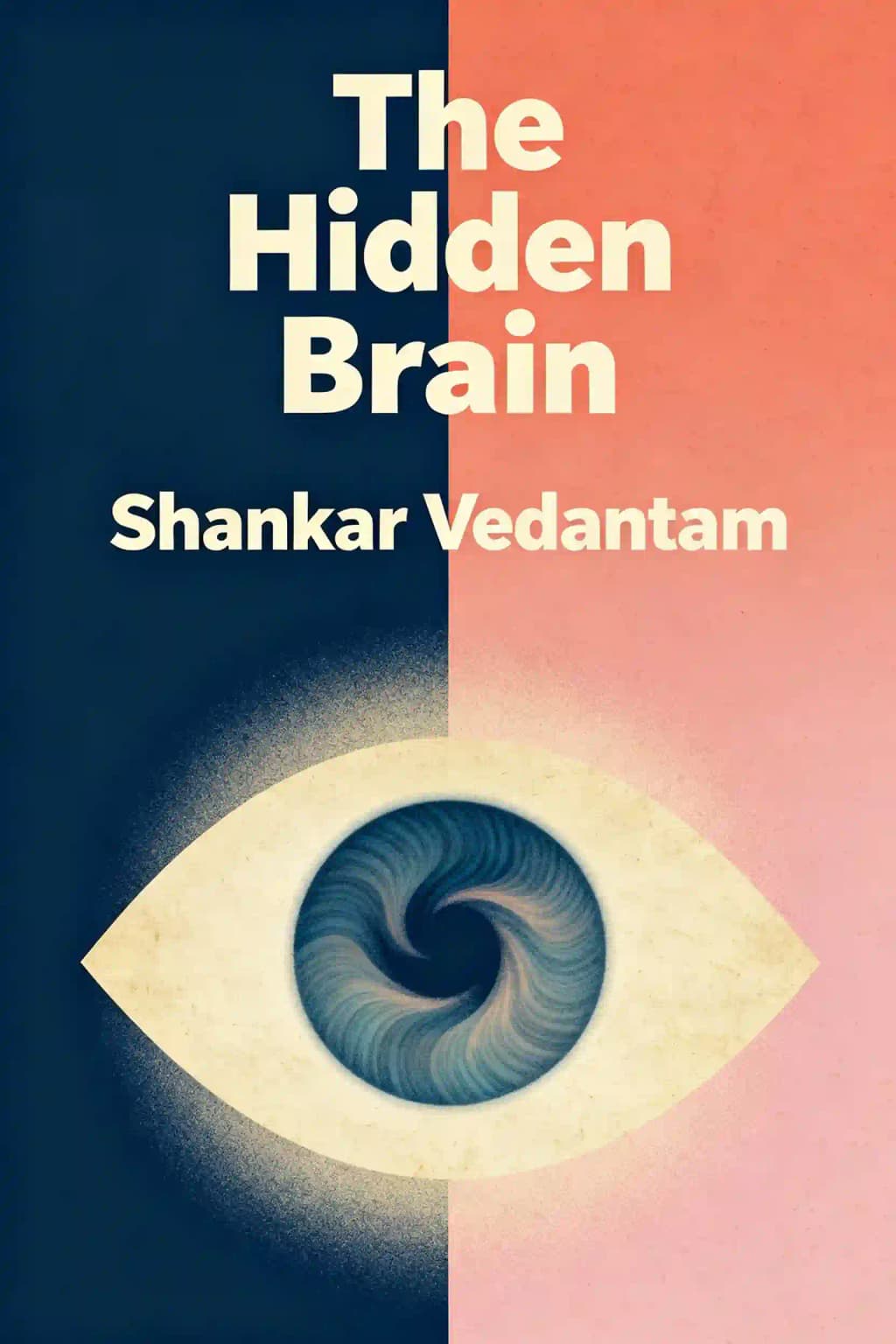
Have you ever caught yourself doing something completely out of character? Perhaps you laughed at an inappropriate joke, froze during a critical moment, or made a snap judgment about someone based on their appearance. In these moments, we often feel bewildered, as if some invisible force momentarily took control. According to Shankar Vedantam, that's precisely what happens. In his groundbreaking work "The Hidden Brain," Vedantam reveals how unconscious forces constantly shape our decisions, beliefs, and behaviors without our awareness or consent. The book has become a cornerstone text in psychology courses worldwide, praised by figures ranging from Malcolm Gladwell to Daniel Kahneman. Its impact extends beyond academia, influencing corporate diversity training programs, legal reforms, and even inspiring Vedantam's popular NPR podcast of the same name. What makes this exploration so compelling is not just its scientific rigor, but how it challenges our most fundamental belief: that we understand why we do what we do.
第2章
The Illusion of Conscious Control
Five days before her thirtieth birthday, Toni Gustus was gardening when a seemingly intoxicated man asked for directions. Despite growing discomfort, her ingrained politeness prevented her from dismissing him. When she finally tried ending the conversation, he forced her into her apartment and raped her.
During the horrific assault, Gustus methodically memorized her attacker's features - white, early twenties, dark blond hair, blue narrow eyes, tapered jaw, and a small black cross tattoo on one arm. After escaping by calmly asking to get water from the kitchen, she fled through a nearby door and provided police with detailed descriptions for a composite sketch.
Though initially cautious in her identification of suspect Eric Sarsfield, after spending Christmas with family in her childhood church, her doubts vanished and she became absolutely certain. Her compelling testimony helped convict him. Fourteen years later, DNA evidence proved Sarsfield couldn't have been the rapist.
When they finally met, Gustus noticed something striking - Sarsfield had crooked teeth, unlike her attacker who had even teeth. She'd never mentioned this detail because it wasn't "distinctive" enough. This tragic case reveals how our hidden brain can manipulate memory and judgment without our awareness. Our emotional states, tendency to focus on distinctive rather than ordinary details, and unconscious mental processes can lead to devastating errors even when we're desperately trying to be accurate.
We believe ourselves rational beings who understand our motivations, but research reveals much of our mental activity happens outside conscious awareness. While we acknowledge basic bodily functions occur automatically, we assume important mental processes are deliberate and conscious.
The conscious brain excels at novel, analytical tasks, while the hidden brain masters familiar patterns through mental shortcuts. Learning skills involves transferring processes from conscious effort to automatic execution. When the hidden brain applies shortcuts inappropriately, we make errors without realizing it. Studies show that when shown faces of political candidates, people instantly judge competence based solely on appearance, with Democrats seeing competent faces as Democratic and Republicans seeing them as Republican.
Despite knowing about unconscious influences, we never actually feel our hidden brain manipulating us. We remain convinced our actions are intentional and rational - a fundamental misunderstanding with profound implications for our institutions, relationships, and global challenges.
第3章
The Spotlight Effect: How Unconscious Cues Guide Behavior
In a Newcastle office, researcher Melissa Bateson conducted a fascinating experiment at the company beverage station. For ten weeks, she alternated the small decorative image on the payment notice between pairs of watching eyes and flowers. The results were remarkable - during weeks with eye images, honesty tripled compared to weeks with flower images. Most strikingly, when questioned afterward, no employee consciously noticed the changing images.
This experiment reveals how our attention works like a spotlight that can only illuminate certain aspects of our environment while leaving others in darkness. Though we can shift this spotlight, we can never focus on everything simultaneously. Meanwhile, our hidden brain remains vigilant to peripheral cues, responding without conscious awareness - interpreting even photographs of eyes as actual observation and adjusting our behavior accordingly.
Our hidden brain applies shortcuts or heuristics that powerfully influence decisions without our awareness. Economists Adam Alter and Daniel Oppenheimer discovered that investors unconsciously favor companies with easy-to-pronounce names over difficult ones. Companies with simple names outperformed those with complex names by 11.2% on their first trading day, growing to over 33% after a year - a $330,000 difference on a million-dollar investment. Similarly, companies with easily pronounced ticker symbols outperformed those with difficult symbols by 8.5% initially. These effects disappeared over time as investors gained substantive information, but the initial bias occurred because our hidden brain associates pronounceability with comfort and safety, while linking difficulty with risk and unfamiliarity.
Our hidden brains also communicate with each other at an unconscious level, creating powerful social effects. In a Dutch restaurant experiment, a waitress who mimicked customers' exact language received tips 140% larger than when she acknowledged orders using synonyms. This mimicry works because it subtly signals understanding and agreement. We unconsciously mirror others in conversation through matching phrases, speech rhythms, and even physical movements - psychologists Chartrand and Bargh found people unconsciously copied a lab assistant's face-rubbing or foot-shaking without noticing.
第4章
The Complementary Minds: How Hidden Brains Create Partnerships
Alzheimer's researchers John Trojanowski and Virginia Lee demonstrate how seemingly incompatible personalities can form powerful partnerships. John speaks in elaborate, detailed sentences with icy restraint when angry, while Virginia uses staccato speech, stripping language to essentials and flashing fire when upset. Despite arguing over trivial matters like wake-up times and breakfast cereal preparation, they've maintained a loving marriage for over thirty years while building a world-renowned scientific partnership.
Their colleagues are often shocked by their public disagreements, with Virginia interrupting John and both bringing each other "to the brink of tears" during professional disputes. Yet their secret to success is complementarity - unconsciously dividing responsibilities based on strengths, with Virginia handling biochemistry and bench science while John manages clinical issues and external communications.
They've deliberately structured their collaboration to reduce competitiveness, insisting on sharing all recognition equally - John once threatened to reject a million-dollar grant unless both names were included. Their interdependence creates a powerful bond where each believes their success depends entirely on the other.
This complementary relationship illustrates how our hidden brains often seek partners with qualities we lack ourselves. The unconscious mind recognizes these complementary traits long before our conscious mind acknowledges them. While we might consciously focus on similarities when choosing partners, our hidden brain often draws us toward people whose strengths offset our weaknesses, creating partnerships greater than the sum of their parts.
第5章
When the Hidden Brain Fails: Frontotemporal Dementia
Brian and Wendy McNamara's thirty-year marriage began unraveling mysteriously after Brian's retirement and Wendy's hysterectomy. Once sociable and affectionate, Wendy grew emotionally distant and indifferent. She developed strange behaviors - examining tree bark obsessively, counting wheels on trucks, approaching strangers to touch their hair, and walking around at night studying patterns. Their relationship deteriorated without traditional conflict, moving directly from warmth to indifference. After a disastrous family trip to France where Wendy's behavior alarmed her psychologist sister, medical tests revealed frontotemporal dementia, a disorder affecting the brain regions that regulate social behavior while leaving analytical abilities intact.
Unlike Alzheimer's that primarily attacks memory, frontotemporal dementia erodes social judgment and behavior. Patients like Wendy maintain acute observational skills - counting truck wheels or identifying subtle patterns - while losing grasp of social norms. The frontal and temporal lobes, evolutionary developments that enabled civilization itself, unconsciously shape our social judgments and moral conscience. When damaged, patients reveal how our hidden brain, not conscious reasoning, governs social interactions.
While much of this book examines errors caused by unconscious bias, the hidden brain also serves essential positive functions. It enables social navigation, forms the foundation for meaningful relationships, and allows us to work collegially with others. Without it, we wouldn't become superior thinking machines - we'd be isolated creatures unable to form friendships or fall in love. Like water's wetness to fish, we rarely notice but cannot survive without our hidden brain.
Patients with frontotemporal dementia reveal that morality springs not from conscious knowledge but from unconscious brain functions. These patients know right from wrong intellectually but lack the emotional component that makes most people care about social rules. Studies show they commit offenses ranging from shoplifting to assault without remorse, despite understanding these actions violate laws. This demonstrates that our ethical behavior stems not from textbooks or religious teachings but from evolutionary algorithms in the hidden brain.
第6章
The Face in the Mirror: How Racial Bias Develops
The author's experiment with his infant daughter reveals how extraordinary our innate facial recognition abilities truly are. While computers struggle with this task, babies effortlessly track faces, particularly those of their parents - a crucial survival adaptation. Scientists have identified the fusiform face area in the brain that specializes in recognizing human faces in various forms. This explains why we see faces in random patterns (like Saddam Hussein's face in the moon) and prefer anthropomorphized features in animals and objects. Our brains are literally designed to be biased toward faces, particularly familiar ones.
Our hidden brain's preference for familiar faces creates an unintended consequence - we become better at recognizing faces from our own ethnic group than those from less familiar groups. Through repeated exposure, we develop automatic processing for familiar ethnic faces while requiring conscious effort for unfamiliar ones. This explains incidents like when Congresswoman Cynthia McKinney was not recognized by a Capitol Hill police officer, leading to a confrontation interpreted through racial lenses.
Frances Aboud's research shows that children develop racial biases without anyone intending it - parents, teachers, or the children themselves can all want the opposite outcome, yet children still associate positive traits with white faces and negative with black faces. This bias emerges through environmental patterns rather than explicit teaching.
Around middle school, interracial friendships experience an "extinction event" - by seventh grade, children have significantly fewer interracial friendships than in fourth grade. While children constantly add and drop friends, Aboud's research revealed a subtle pattern: different-race friends were slightly more likely to be dropped and less likely to be added. This gradual shift results in older children having 1.5 times more same-race friends than different-race friends.
This shift coincides with children's developmental stage where they seek group membership to cement identity. Around ages 7-8, children naturally gravitate toward in-groups based on various dimensions including race, sports teams, cultures and nations. The decline in cross-cultural friendships isn't driven by hostility but by children's natural tendency to define themselves through group identity.
第7章
The Vulnerable Mind: Age and Prejudice
The hidden brain provides a parsimonious explanation for prejudice across the lifespan. When we see someone slip with racist remarks, our reaction shouldn't be "We finally caught that racist bastard!" but "There, but for the grace of God, go I." Studies consistently show that biased attitudes aren't the exception but the norm, deeply embedded in our neural circuitry through years of cultural exposure and implicit learning.
If we assume Allen and Richards had no hidden brain, their controversial comments would seem like intentional political suicide. Both men expressed genuine confusion and distress about their words, repeatedly insisting they contradicted their true beliefs and lifelong values. But when the hidden brain operates without conscious restraint - whether through experimental distraction, acute stress, emotional arousal, or diminished cognitive capacity - automatic biases emerge with striking clarity. These moments of unguarded expression reveal the constant tension between our conscious values and unconscious associations.
William von Hippel's groundbreaking research demonstrated that elderly people were significantly more likely to express prejudice when they had diminished ability to control their minds - paralleling the loss of social restraint seen in patients with frontotemporal dementia. In his studies, elderly volunteers who struggled with basic distraction tasks were markedly more likely to express prejudiced views about race, gender, and other social categories. The correlation between cognitive control and expressed prejudice was remarkably consistent. In a fascinating related experiment, researchers even managed to reduce prejudiced responses among adults by giving them glucose (in the form of sugar) rather than Splenda - effectively providing additional mental fuel to help restrain hidden stereotypes and maintain conscious control.
The pattern of vulnerability to unconscious bias manifests consistently across the human lifespan: young children without fully developed executive function, adults under cognitive load or emotional stress, and elderly people experiencing normal age-related decline in brain matter all show increased susceptibility to their unconscious associations. This suggests that our capacity to override implicit biases requires active cognitive resources and intact neural systems. Most people are genuinely truthful when saying they don't consciously harbor bigotry or wish to discriminate - their explicit attitudes often reflect sincere egalitarian values. However, their hidden brain, shaped by years of cultural exposure and implicit learning, doesn't necessarily share these enlightened views. This disconnect between conscious intentions and unconscious associations helps explain why prejudice persists even as explicit attitudes have become more progressive.
第8章
The Undercurrent: Gender Bias in Professional Life
During Hillary Clinton's 2008 Democratic primary race against Barack Obama, gender bias emerged as a contentious issue. This echoed patterns I'd observed in how female leaders worldwide are described - from Margaret Thatcher ("Attila the Hen") to Angela Merkel ("Iron Frau"). Before gaining power, these same women were diminished as "the girl" or "dumb doll," revealing our hidden brain's conflict between unconscious stereotypes about leadership (associated with strength and masculinity) and stereotypes about women.
Madeline Heilman's research confirms this bias. In her experiment, volunteers read identical descriptions of a manager named either "Andrea" or "James." Three-quarters found James more likeable, and four-fifths preferred him as a boss - simply because Andrea was a woman in leadership.
While Clinton faced blatant sexism from media figures like Rush Limbaugh and Tucker Carlson, determining whether sexism caused her primary loss remains complex. Obama supporters often dismissed this claim, noting Clinton's political missteps and her historic eighteen million votes. This highlights a crucial challenge: while laboratory experiments can prove unconscious sexism exists, demonstrating its impact in specific real-world cases is far more difficult.
Transgender individuals offer a unique scientific window into gender bias. When someone transitions while maintaining the same education, expertise, and experience, any differential treatment can be attributed to gender alone. The evidence is compelling: when men transition to women, they typically experience income decreases and professional disadvantages they never faced as men. Conversely, women who transition to men often find their professional lives becoming easier and their incomes rising.
Ben Barres, a Stanford biologist who transitioned at age fifty, experienced stark differences in how he was treated before and after transition. As Barbara, he faced numerous instances of sexism, including a professor accusing him of having "his boyfriend" solve a difficult math problem he'd actually solved himself. After transitioning, Ben noticed immediate changes in how seriously he was taken. After one presentation, someone who didn't know Barbara and Ben were the same person commented that "Ben Barres gave a great seminar today, but his work is much better than his sister's."
第9章
The Social Current: Group Behavior in Crisis
Six years after Deletha Word's tragic death on Belle Isle bridge, a similar pattern of group behavior emerged during the September 11 attacks. At Keefe, Bruyette & Woods, an investment firm occupying the 88th and 89th floors of the South Tower, a puzzling outcome occurred: nearly everyone on the 88th floor survived while almost everyone on the 89th floor perished. The striking pattern wasn't that individuals made different choices - it was that each floor collectively reached opposite decisions.
The odds of this happening by chance are astronomically small. Studying individual decisions misses the larger pattern: people on the 88th floor ran for the stairs because everyone else was running; those on the 89th floor stayed because others were staying. Though everyone felt they were making autonomous decisions, the evidence shows these life-or-death choices were made by groups, not individuals.
Research by sociologist Beningo Aguirre following the 1993 World Trade Center bombing revealed that during disasters, escape time depended not on floor height but on group size. Larger groups took longer to evacuate because people unconsciously seek consensus with those around them. In crises, we're hardwired to turn to groups for guidance, which explains why people perish or survive in clusters.
Disasters consistently reveal our unconscious reliance on group decision-making. When fire alarms sound, people look to one another rather than immediately evacuating. During the 2003 Rhode Island nightclub fire that killed ninety-six people, security footage showed patrons turning to each other as flames erupted, wasting precious seconds seeking consensus.
We wrongly assume people will flow evenly through all available exits during emergencies, but humans behave more like molasses than water. They follow others even in wrong directions, help each other even when counterproductive, and typically try to exit the same way they entered rather than using the nearest exit. During the 2004 Asian tsunami, fisherfolk gathered to discuss the receding sea rather than fleeing, seeking group consensus about the phenomenon.
To understand how the hidden brain functions in disasters, we must suspend our model of people as autonomous individuals. Will DeRiso, who survived the World Trade Center attacks, made few conscious decisions; rather, he was guided by the social forces around him - "You see people running down the stairs, you see people running right at you. You go down the stairs."
第10章
The Tunnel: How Ordinary People Become Extremists
Ariel Merari's research challenges our fundamental assumptions about suicide bombers. Rather than being mentally disturbed or religious zealots, these individuals are often well-educated professionals who appear more idealistic than their peers. Merari likens the process to a tunnel: ordinary people enter one end, and focused terrorists emerge from the other. This transformation occurs not through brainwashing but through subtle manipulation that preserves the illusion of autonomy.
Larry Layton, who attempted a suicide mission at Jonestown, exemplifies how ordinary people transform into extremists. Raised as a Quaker committed to nonviolence, Layton was a shy, principled young man who championed civil rights and opposed the Vietnam War. Disillusioned with mainstream politics after Kennedy's assassination, he and his wife Carolyn moved to Ukiah "in search of utopia." There, Jim Jones targeted the idealistic couple, using psychic "revelations" and lavish attention to draw Layton in. Jones appealed to Layton's ego and idealism, convincing him he would be doing something special for humanity by joining Peoples Temple.
The conventional narrative about suicide terrorism - that shadowy recruiters aggressively seek out desperate, poor, or dim-witted young men with promises of virgins in the afterlife - is fundamentally wrong. Marc Sageman's database of hundreds of al-Qaeda terrorists reveals that three-fourths are married and two-thirds have children. Religious fanaticism isn't the primary driver either; the Tamil Tigers who pioneered modern suicide bombing were motivated by language and cultural pride, not religion.
Scott Atran's field research shows that terrorists don't get recruited - they actively seek out terrorist groups. The 2004 Madrid bombers weren't found by al-Qaeda; they sought out al-Qaeda. These "bunches of guys" create parallel universes where they reinforce each other's worldview. In Moroccan neighborhoods that produce suicide bombers, Atran found the best predictor wasn't religiosity but belonging to a small group where others had become terrorists.
The tunnel metaphor explains how ordinary people transform into extremists. In Jonestown's final moments, Jones manipulated his followers with apocalyptic rhetoric, telling them they must kill their children because "they'll parachute in here on us" and "shoot some of our innocent babies." This wasn't suicide, he insisted, but "a revolutionary act."
第11章
The Telescope Effect: Why One Life Outweighs Thousands
The telescope effect reveals how our hidden brain distorts moral reasoning. When faced with suffering, we respond more strongly to individual stories than to mass tragedies. Experiments show this paradox clearly: people donate more to help one child than eight children with cancer, and volunteers give less money when presented with two children in need versus just one.
Our unconscious mind simply cannot process mass suffering effectively. As psychologist Paul Slovic discovered, "compassion fatigue" begins when victim numbers rise from one to two - not after thousands. "You can't lock on to two people in need of help as closely as you can lock on to one person," Slovic explained. "If empathy is putting yourself in someone's shoes, think of putting yourself in two people's shoes. It does not work."
This evolutionary bias made sense for our ancestors who needed to prioritize their own kin's survival. The fierce loyalty toward our children that seems morally questionable in global context was essential for human survival. What makes evolutionary sense, however, rarely makes moral sense.
The solution isn't to bemoan our hidden brain but to recognize its limitations and create systems that compensate for them. By establishing institutions that respond to humanitarian crises based on reason rather than instinct, we can overcome our natural biases. Making the unconscious conscious is difficult, but putting reason ahead of instinct is what sets humans apart from other species.
Understanding the hidden brain and building safeguards against its vagaries can help us become better people. For all the ways our rational mind is unequal to the hidden brain's machinations, reason remains our only bulwark against bias - our lighthouse and life jacket against unconscious prejudice.