第1章
Transforming the Business World, One Consultation at a Time
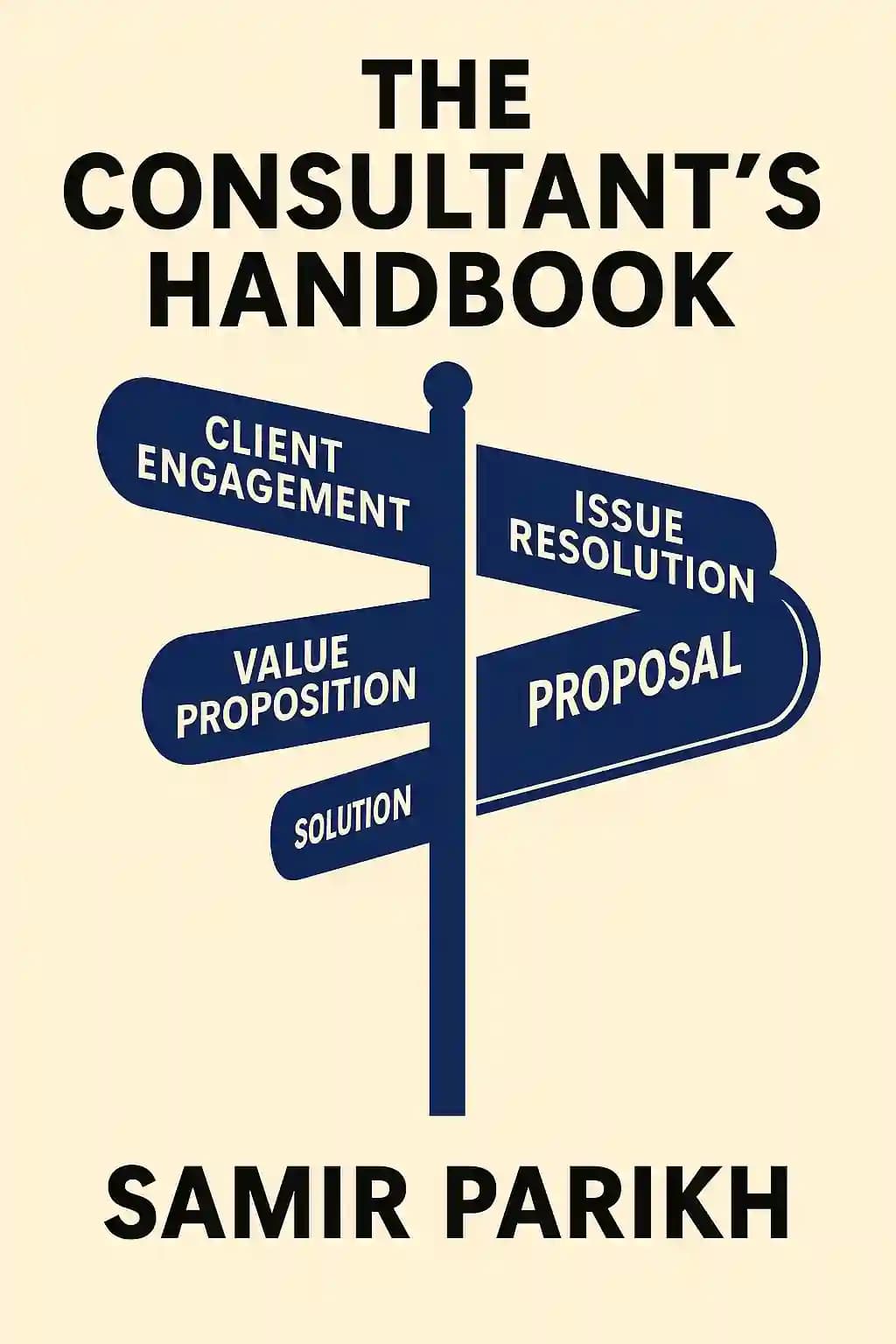
The Consultant's Handbook isn't just another business manual-it's a comprehensive guide that has revolutionized how professionals approach the consulting process. Written by Samir Parikh, a British-born consultant with over two decades of experience spanning aerospace, technology, financial services, and pharmaceuticals, this book distills the essence of effective consulting into practical, immediately applicable strategies. Since founding SPConsulting in 2000, Parikh has worked with multinational corporations across 50+ countries, transforming them into consulting-based organizations. His handbook has become required reading at top business schools worldwide and is frequently cited by industry leaders as the definitive resource for both aspiring and seasoned consultants. What makes this work particularly valuable is how it bridges theory and practice-offering frameworks that work in real-world scenarios rather than just academic concepts.
第2章
The Essence of Consulting: Beyond the Business Card
Consulting has evolved into a catch-all term applied to roles ranging from management advisors to travel agents and gardeners. Yet beneath this dilution lies a precise definition: consulting is fundamentally a helping relationship provided based on expertise and experience. The value proposition combines formal education and skills with practical knowledge gained from previous situations-a balance that shifts throughout a consultant's career. New graduates rely heavily on expertise, while senior consultants leverage accumulated experience.
Unlike regulated professions such as accounting or medicine, consulting lacks formal qualifications and regulatory oversight. Anyone can claim the title, resulting in varying service quality and creating risk for clients engaging consultants for the first time. This makes reputation and demonstrated track record essential for success. Many clients approach consultants with skepticism due to previous negative experiences where consultants disrupted operations, implemented questionable methodologies, and left organizations in disarray.
What distinguishes true consulting from mere selling is its ethical foundation. Consultants must prioritize the client's best interests, even when this conflicts with generating more business. The most respected consultants position themselves as trusted advisers, sometimes recommending minimal intervention or even walking away from potential business when it's in the client's best interest. This client-first approach often strengthens long-term relationships and creates future opportunities.
Consider the case of a senior consultant who declined a lucrative project because the client already had the internal capabilities needed. While this meant immediate revenue loss, the client was so impressed by this integrity that they later awarded the firm a much larger contract, noting: "We knew you would tell us the truth, even when it wasn't in your financial interest."
第3章
Preparation: The Competitive Edge in Client Engagement
Just as doctors must understand patients before prescribing treatment, consultants need thorough client knowledge to provide effective solutions. This preparation distinguishes mature consultants from those who simply promote standardized solutions. Clients can immediately detect who is well-prepared versus working from a blank sheet, making preparation a competitive differentiator.
The handbook introduces a scalable preparation framework with three levels of increasing depth based on available time:
Basic preparation covers essential "must know" elements achievable in 1-2 hours. This includes understanding the client's industries, geography, headquarters location, basic financials, key executives, business units, market position, competitors, recent news, product offerings, customer segments, and internal intelligence from previous projects.
When more time is available (half to full day), detailed preparation extends beyond basics to include the client's vision and strategic objectives, company history, industry trends, new products/services, sales channels, marketing positioning, customer testimonials, and in-depth financial analysis. This deeper analysis examines business unit performance, revenue and profit trends, and cash flow-revealing whether a client needs help with growth or cost reduction.
Engagement-specific preparation focuses on the particular topic to be discussed. Key elements include clarifying the discussion topic and agenda, researching participating stakeholders and their expectations, reviewing previous meeting outcomes, anticipating client questions, preparing questions to ask, and identifying relevant consulting experience to reference.
A fascinating real-world example involved two consulting teams competing for the same project. The first team arrived with generic industry knowledge, while the second had researched the client's specific financial challenges, recent leadership changes, and competitive pressures. The client later admitted the second team won the contract before the presentation even began, simply because their preparation demonstrated genuine interest in the client's unique situation.
第4章
Credibility: The Foundation of Client Trust
Establishing credibility is fundamental to consulting success. Clients decide whether to accept advice based on both the quality of the advice itself and the credibility of those presenting it. Credibility influences client relationships, cooperation levels, and perception relative to competitors. Research shows that up to 85% of client decisions are influenced by the consultant's perceived credibility before any substantive work begins.
A credible personal introduction should embody four key elements: objectivity, tangibility, relevance, and conciseness. Objectivity means presenting evidence rather than "selling" oneself - for example, sharing specific project outcomes rather than making broad claims about capabilities. Tangibility involves quantifying expertise with precise metrics, such as "delivered 15 successful ERP implementations across five industries with an average ROI of 127%" rather than vague statements about "extensive implementation experience." Relevance requires deliberately connecting past experiences to the client's current challenges, while conciseness demands communicating these points efficiently within the appropriate timeframe - typically 2-3 minutes for initial meetings.
When introducing an organization, consultants must navigate a delicate balance between showcasing corporate credentials and maintaining a consultative rather than sales-oriented approach. One effective technique is the "reference hook" - briefly mentioning relevant organizational experience followed by asking permission to share specific examples. For instance: "We've helped several pharmaceutical companies optimize their R&D processes. Would you like to hear about how we helped one client reduce their development cycle by 40%?"
Documentation plays a crucial role in establishing credibility. This includes well-organized credentials presentations, case studies with verifiable metrics, and reference lists featuring named contacts from similar engagements. The most effective credentials documents follow a "pyramid" structure - leading with headline achievements, followed by supporting details, and backing documentation available on request.
The competitive impact of credibility was dramatically illustrated in a recent healthcare consulting engagement where two firms competed for a $2M transformation project. Both had comparable domain expertise, but the winning firm distinguished itself through three specific approaches: they presented detailed case studies of three similar projects with quantified outcomes, provided direct client references from the same industry, and demonstrated deep understanding of the client's specific challenges by relating them to previous experiences. The losing firm relied more heavily on general capabilities and brand reputation. As the client's CFO later explained: "Both teams were clearly capable, but one team showed us exactly how they'd solved similar problems before. The other team told us they could solve our problems. That difference was decisive."
Maintaining credibility requires consistent reinforcement throughout the engagement through regular progress updates, transparent communication about challenges, and delivery on commitments. Studies show that credibility can be lost up to four times faster than it is built, making it essential to protect through careful relationship management and consistent performance.
第5章
The Art of Client Meetings: Structure with Flexibility
Client meetings require a structured approach to navigate complex issues while maintaining flexibility. Two contrasting consulting styles emerge: some firms require multiple iterations to deliver satisfactory results, while others come exceptionally well-prepared and can meet client needs after just one meeting.
Effective client meetings follow a three-phase structure: set-up, body, and closure. The set-up phase includes participant introductions and establishing meeting context. The chairperson opens with courtesies and introduces team members following credibility guidelines. Next comes agreeing on the meeting's purpose, typically conveyed with a simple phrase like "What we would like to do today is..." followed by a critical check point ("Would that be OK?") to ensure expectations align.
The body is where the work happens-information exchange, discussions, agreements, and action item allocation. Its structure varies based on meeting purpose, whether collecting requirements, defining problem scope, or presenting analyses and recommendations.
Meeting closure consists of a clear summary and next steps agreement. The summary should highlight key points and agreements from your notes, demonstrating your understanding and attention to detail. A specific, detailed summary builds client confidence that you've understood their needs.
Imagine you're in a meeting with a manufacturing client discussing inventory management challenges. Rather than concluding with "Thanks for the meeting, we'll be in touch," an effective consultant might say: "Let me summarize what we've discussed. You're experiencing a 20% excess inventory problem costing approximately $2.3 million annually. Your current system requires manual stock logging, which is both time-consuming and error-prone. You need a solution that automates inventory tracking, improves ordering accuracy, and can manage component build lists for over 100 product configurations. Have I captured that correctly?"
This level of specific detail demonstrates attentiveness and builds confidence that you truly understand the client's needs-a critical foundation for any consulting relationship.
第6章
From Exploration to Solution: Navigating Client Engagements
Consulting engagements typically progress through distinct phases, beginning with exploring opportunities and culminating in solution delivery. When exploring new opportunities, consultants must systematically identify business objectives, scope, requirements, and stakeholders. This initial discovery phase requires both analytical rigor and interpersonal finesse to uncover both stated and unstated client needs.
The "ask-then-comment" technique proves particularly valuable during this phase-understanding client thinking before making recommendations. This approach involves asking probing questions about current challenges, desired outcomes, and constraints before offering potential solutions. In one case study, consultants helped a consumer electronics manufacturer articulate specific business objectives: supporting new product introduction within one year, enabling 50% sales growth over three years, and identifying operational cost savings. By asking questions before proposing solutions, they uncovered the client's true priorities, including concerns about market timing and competitive pressures that weren't initially apparent.
When presenting solution approaches, successful consultants balance thorough preparation with flexibility. Rather than rigidly following prepared materials regardless of relevance, they introduce approaches briefly and take navigation checkpoints to eliminate irrelevant topics and focus on priorities. These checkpoints typically occur after presenting high-level concepts but before diving into detailed recommendations. This navigation skill optimizes meeting time and demonstrates responsiveness to client needs while building trust through active listening.
Consider how this played out when consultants presented solution options to a major insurance company. After introducing five candidate solution areas (new product development, streamlining sales organization, automating administrative processes, recruitment and training, and new sales channels), they paused to gauge the client's interest. Learning that product development was already underway and partnership options weren't desired, they immediately pivoted to focus on the areas of greatest interest-demonstrating the flexibility that distinguishes exceptional consultants. This agile approach allowed them to spend their remaining time developing detailed implementation plans for sales force optimization and process automation, the areas most likely to deliver immediate value.
The most effective consultants also recognize that solution development is iterative. They establish regular feedback loops with clients, incorporating new insights and adjusting recommendations as circumstances evolve. For example, when implementing a sales transformation program, successful consultants typically schedule weekly progress reviews to assess implementation challenges and make necessary course corrections. This ongoing dialogue ensures solutions remain aligned with client needs and capabilities throughout the engagement.
第7章
Analytical Frameworks: Structuring Complex Problems
Analysis is a crucial component of consulting work, enabling thorough understanding of issues before prescribing solutions. While this upfront analytical investment significantly impacts solution accuracy and value, clients may be skeptical about commissioning consultants for analysis, preferring immediate solutions. This tension between thorough analysis and quick fixes often requires consultants to demonstrate the value of their methodical approach through early wins and clear communication of the process.
Logic trees have emerged as an effective framework for breaking down complex problems into manageable components. They work by creating hierarchical relationships between issues, allowing teams to systematically explore cause-and-effect relationships. In one notable case study, consultants faced with improving an airline's profitability developed a structured approach by identifying "high costs" and "low revenues" as the main branches. Under "high costs," they further broke down into fuel efficiency, maintenance procedures, staff utilization, and fleet management. The "low revenues" branch expanded into route optimization, pricing strategy, load factors, and ancillary revenue opportunities. This systematic decomposition revealed previously hidden connections and opportunities for improvement.
The development of effective logic trees requires careful preparation and methodology. Consultants should begin with internal brainstorming sessions involving team members with diverse expertise and perspectives. The main branches must be mutually exclusive and collectively exhaustive (MECE) to ensure comprehensive coverage while avoiding overlap. For instance, when analyzing a manufacturing efficiency problem, branches might include process design, equipment reliability, workforce capabilities, and supply chain management - each distinct but together covering all potential issues.
During client discussions, the presentation and navigation of logic trees require specific techniques for maximum effectiveness:
• Begin with a clear explanation of the methodology and its benefits
• Use visual aids and real-time documentation to capture insights
• Guide discussions systematically through each branch
• Incorporate client feedback and expertise into the framework
• Establish clear priorities for investigation and action
• Provide detailed summaries that document decisions and next steps
This structured approach to problem-solving has applications far beyond consulting. When facing any complex challenge-whether in business, education, or personal life-breaking it down into logical components makes the seemingly insurmountable become manageable. For example, a retail chain used this approach to address declining sales by breaking down customer experience into store layout, product mix, staff training, and pricing strategy. A university employed similar techniques to improve student retention by analyzing academic support, campus life, financial aid, and curriculum design.
As one executive noted after experiencing this approach: "For the first time, I could see our entire problem landscape on one page. It transformed how we approached the solution." This sentiment reflects the power of analytical frameworks in creating clarity from complexity and enabling more effective decision-making and problem-solving across various domains.
第8章
Crafting Compelling Proposals: The Bridge to Project Success
Having established objectives, scope and requirements, a written proposal must outline the intended project with commercial terms. With multiple consulting firms often under consideration, a clear approach emphasizing the firm's credentials and differentiators is essential. The proposal serves as both a technical document and a persuasive marketing tool, requiring careful balance between detail and strategic positioning.
The executive summary, typically 2-3 pages, must capture attention by addressing the client's key pain points and articulating a compelling value proposition. This section should present main messages, anticipated benefits, and unique differentiators in crisp, business-focused language. For example, rather than stating "we will implement a new CRM system," frame it as "we will increase sales productivity by 25% through intelligent automation and streamlined customer engagement processes."
The introductory chapter establishes context by demonstrating deep understanding of the client's industry, specific challenges, and strategic objectives. This section should reference relevant market trends, competitive pressures, and regulatory considerations that impact the project's urgency and importance. Including specific data points and industry benchmarks strengthens credibility.
The solution approach requires careful crafting to provide sufficient detail while protecting intellectual property. Best practice is to outline the methodology's key phases, major workstreams, and critical success factors without revealing proprietary frameworks or tools. Time plans should include clear milestones, dependencies, and resource requirements. RACI matrices (Responsible, Accountable, Consulted, Informed) help clarify roles and decision rights across stakeholder groups.
Pricing models must align with project characteristics and risk allocation preferences:
• Fixed price works well for clearly defined scope with reusable components, typically offering 15-20% savings versus T&M
• Time and materials suits dynamic environments requiring flexibility
• Shared risk/reward structures, such as charging 70% fixed fee plus 30% performance bonus, align incentives for transformational projects
Credential sections should be highly customized, featuring:
• Relevant case studies with quantified results
• Team member profiles highlighting pertinent experience
• Firm's intellectual property and accelerators specific to the engagement
• Previous work with the client that demonstrates understanding of their environment
Common pitfalls to avoid include:
• Scope creep beyond core requirements
• Overly aggressive timelines that create delivery risk
• Ambiguous language around deliverables and success metrics
• Insufficient attention to change management and capability building
Breaking complex projects into phases helps manage risk and build confidence. For example, a major transformation might start with a 12-week diagnostic phase before committing to full implementation. Each phase should deliver tangible value while building toward the larger vision. This approach also allows for adjustment based on learning and changing circumstances.
Successful proposals demonstrate thorough preparation, client-centricity, and realistic planning. As one managing partner noted: "The best proposals feel less like a sales pitch and more like the first deliverable of the project itself."
第9章
Delivering Excellence: The 50:50 Rule of Client Satisfaction
Client satisfaction in consulting is driven equally by two components: delivering the agreed result and creating a positive client experience. This "50:50 rule" recognizes that in competitive industries where multiple vendors can deliver similar results at similar prices, the client experience becomes the key differentiator.
Consider the airline industry-while safe transportation is the baseline expectation, passengers choose carriers based on the experience: how they're treated, the comfort of the journey, and the overall service quality. Similarly, consulting clients expect technical competence as a given but differentiate providers based on the experience of working together.
Consulting methodologies provide structure for assignments, typically consisting of a roadmap showing progression steps and tools/templates for execution. These methodologies divide projects into phases with defined activities and quality checkpoints, while providing tools that support consistent information gathering, analysis, and documentation. Good judgment remains fundamental in applying methodologies optimally, knowing when to follow guidance and when to depart from it.
The project organization consists of a team led by a project manager responsible for delivering according to timeline and budget. The execution approach varies between working from consulting offices with periodic client meetings versus working on-site at client premises. Client perception of value often correlates with consultant visibility, requiring those at the client interface to emphasize behind-the-scenes work when using remote delivery methods.
Optimizing the client experience requires active management of relationships at all project levels. Partner-oriented relationships extend beyond transactional qualities, requiring additional effort but yielding greater longevity and value. Consultants establish these relationships through thorough preparation, friendly attitudes, clear explanation of roles, and genuine interest in understanding clients' perspectives. As one senior manager noted, even when projects face challenges, a strong relationship with the client "has always saved us" because mutual understanding and commitment drive successful collaboration.
第10章
Navigating Client Complexity: Adaptability and Obstacle Management
A consulting career involves working with diverse client personnel across organizational levels and functions, requiring significant adaptability. Clients vary considerably in style, structure, and willingness to collaborate, with differing expectations that must be carefully managed.
Small adjustments to one's approach in response to client behaviors or organizational culture can significantly improve interactions. Experienced consultants don't impose their methods but instead ask how to adapt for success in each unique situation. When working with verbose clients who enjoy social conversation, patience is required along with diplomatic steering toward agenda topics. With unstructured clients, consultants must establish clear agendas and politely redirect tangential discussions.
Consultants frequently encounter obstacles including poor client cooperation, resistance to change, and stakeholder conflicts. Resistance often stems from personal pride, budget concerns, and fear of losing influence. In one manufacturing company example, an IT department head resisted replacing an accounting system he had developed because it would diminish his authority, reduce department budgets, and decrease his leverage within the organization. The consultants successfully addressed this by acknowledging the merits of the existing system, reinforcing business needs with hard-to-contradict facts, and positioning the IT department as the project owners.
When client stakeholders have conflicting interests, consultants can employ two approaches: facilitation or escalation. As facilitators, consultants can help navigate around obstacles by finding middle ground between opposing departments. In one Latin American example, consultants successfully mediated between operations (wanting an elaborate solution) and marketing (needing quick implementation) by structuring the project in phases to satisfy both parties. When facilitation fails, escalation procedures become necessary, requiring access to stakeholders with sufficient authority to resolve conflicts.
第11章
The Logic of Persuasion: Building Compelling Arguments
Quality advice depends on expertise, experience, information analysis, and the ability to formulate defensible recommendations. Consultants use both deductive and inductive reasoning methods to build persuasive arguments.
Deductive reasoning builds arguments analytically by systematically eliminating options until reaching a unique conclusion. Starting from a solid basis (either a fact or point of firm agreement), the argument uses funnel-type logic to narrow down choices. In one example, a consultant started with ten available SUVs, then eliminated options based on diesel requirement (reducing to five), rear door mechanism (reducing to three), and delivery timeframe (leaving one recommendation).
Inductive reasoning aggregates multiple supportive reasons to demonstrate a conclusion's likelihood. This method can accommodate subjective information and relies on selecting reasons aligned with the client's priorities. Unlike deductive reasoning where disputing one premise breaks the entire argument, inductive arguments can withstand challenges to individual premises as long as enough supporting reasons remain.
Complex consulting situations often require multiple arguments to support different aspects of a recommendation. These can be combined in layers, with each strengthening the overall recommendation. The deductive main argument provides the logical flow, while inductive arguments at the detailed level offer supporting evidence that can withstand challenges to individual points without collapsing the entire recommendation.
Before presenting an argument, thorough preparation is essential: ensure complete understanding of your arguments, decide on your narrative approach, anticipate audience questions, and plan for damage control. When delivering, develop the audience's understanding incrementally, checking regularly that everyone follows your logic. Remember to adjust your presentation for different audiences within an organization, tailoring content to address specific needs and interests of each group.
As Warren Buffett once observed: "You can't communicate complex ideas with complex language." The most successful consultants translate sophisticated analytical frameworks into clear, compelling narratives that resonate with clients at every organizational level-a skill that distinguishes true advisory excellence.