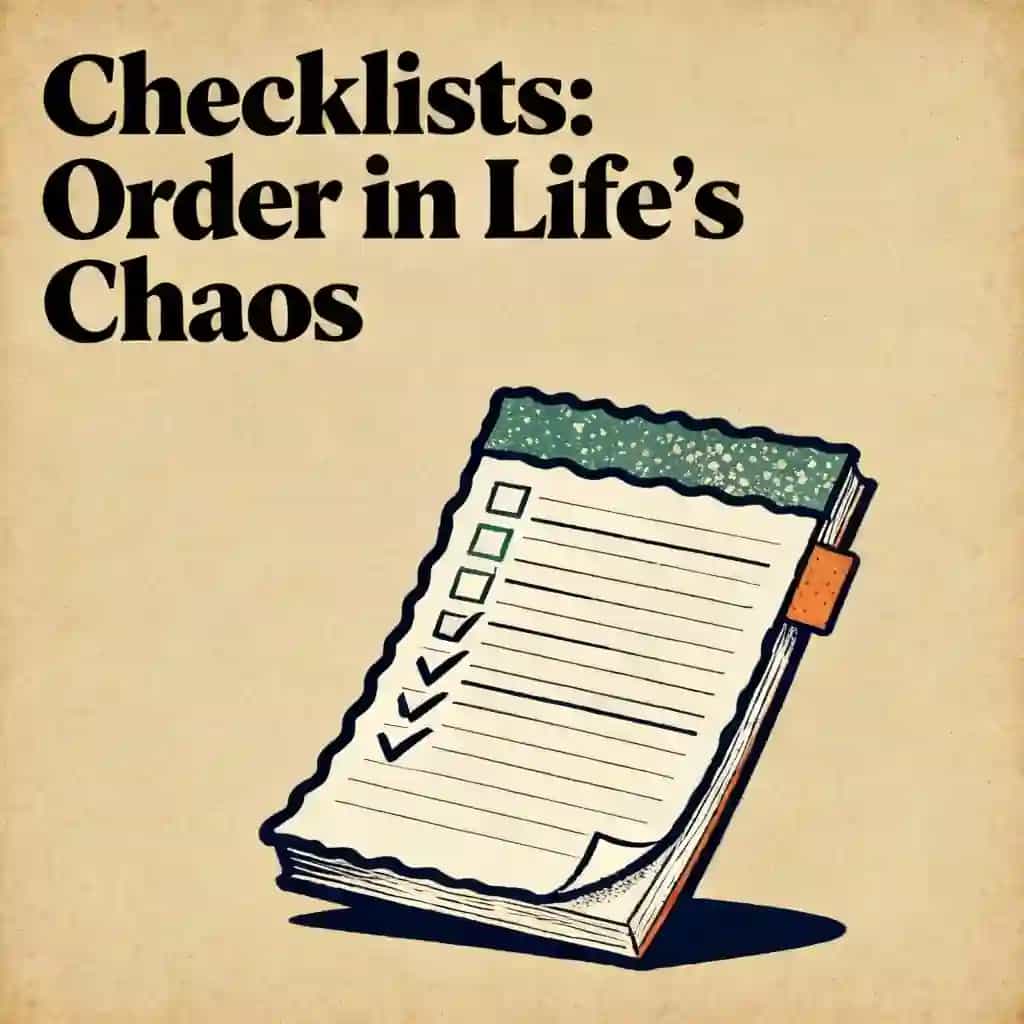
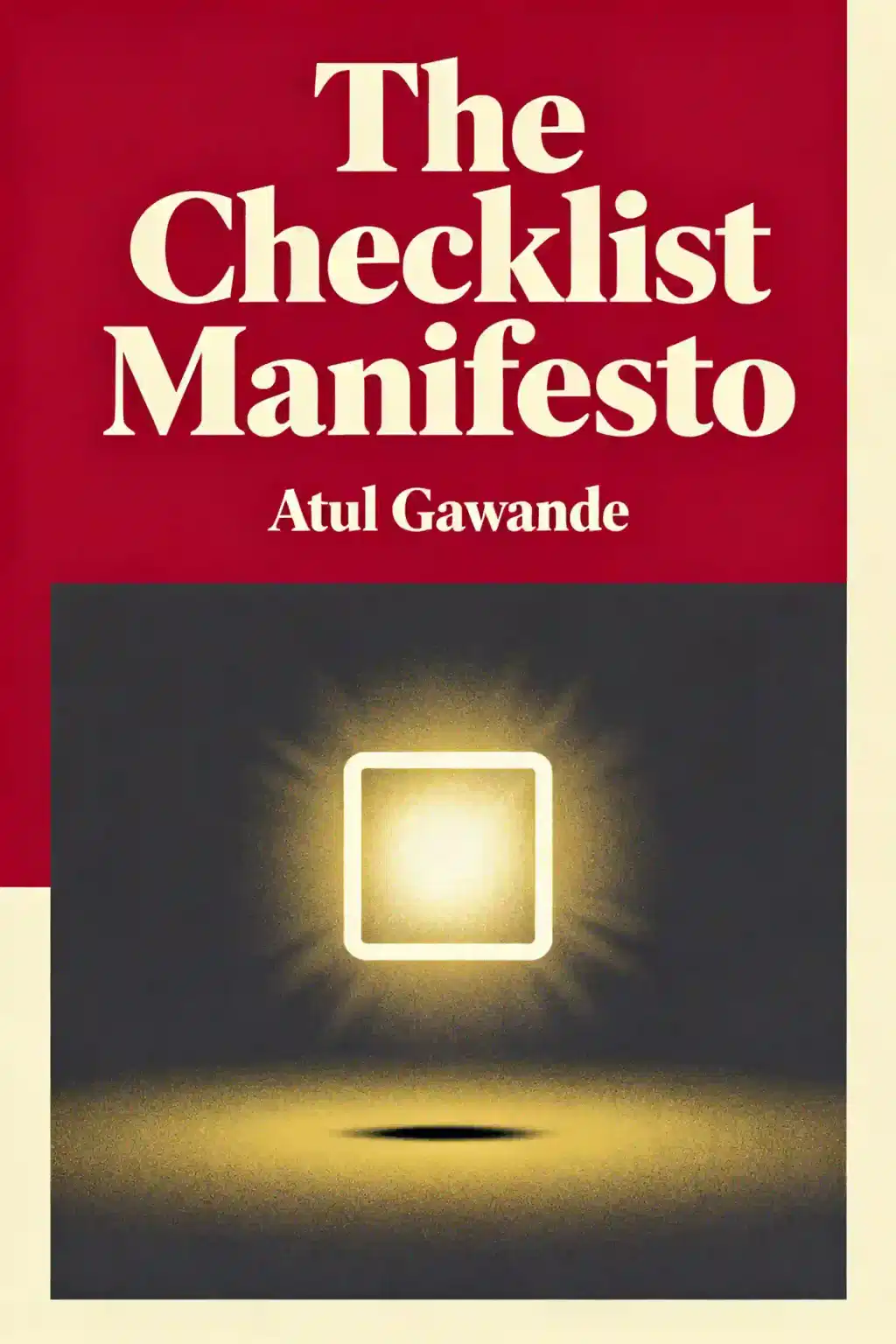
『The checklist manifesto』の概要
In "The Checklist Manifesto," surgeon Atul Gawande reveals how simple checklists dramatically reduce fatal errors. A 90-second surgical checklist cut fatalities by over 30%. Endorsed by entrepreneurs like Derek Sivers, this New York Times bestseller transforms complex tasks into manageable triumphs across industries.
- Checklists prevent critical oversights in high-stakes environments like surgery or aviation.
- DO-CONFIRM checklists verify completed steps while READ-DO lists guide complex task execution.
- Empower frontline teams to adapt using expertise while ensuring essential steps aren’t skipped.
- Atul Gawande’s checklist method halves ICU stays by standardizing care communication and processes.
- Simple 5-9 item checklists outperform detailed manuals in complicated professional workflows.
- Transform failure rates by prioritizing disciplined process adherence over individual heroics.
- Checklists democratize authority: nurses gain power to correct surgeons’ missed safety steps.
- Combat human memory limits with precise, single-page checklists using sans-serif formatting.
- Complex problems require checklists that mandate team communication and responsibility distribution.
- Aviation-style two-checklist systems separate routine tasks from unexpected scenario protocols.
- Reduce infections 11% to 0% with handwashing verification checklists in hospital settings.
- Checklists instill cultural discipline without stifling creativity in dynamic work environments.
『The checklist manifesto』の著者について
Atul Gawande, MD, MPH, is the New York Times bestselling author of The Checklist Manifesto and a globally recognized surgeon, public health leader, and advocate for systems innovation in healthcare.
A professor at Harvard Medical School and the Harvard T.H. Chan School of Public Health, Gawande’s expertise in managing complexity through structured processes stems from his dual career as a practicing general surgeon at Brigham and Women’s Hospital and his role as founder of Ariadne Labs, a center dedicated to improving healthcare delivery.
His earlier works—Complications (a National Book Award finalist), Better, and Being Mortal—established his reputation for blending medical insight with actionable solutions, a theme central to The Checklist Manifesto’s exploration of error reduction in high-stakes fields.
A longtime staff writer for The New Yorker and recipient of the MacArthur “Genius Grant,” Gawande’s ideas have influenced industries from aviation to finance. The Checklist Manifesto has been widely adopted in healthcare, tech, and business, with its principles featured in an Oscar-nominated documentary adaptation of Being Mortal.
『The checklist manifesto』に関するよくある質問
What is The Checklist Manifesto by Atul Gawande about?
The Checklist Manifesto explores how simple checklists prevent critical errors in complex fields like surgery, aviation, and construction. Atul Gawande argues that even experts benefit from structured lists to manage memory lapses, streamline teamwork, and ensure consistency. The book highlights real-world examples, including a WHO surgical checklist that reduced complications by 35%.
Who should read The Checklist Manifesto?
Professionals in healthcare, project management, aviation, and finance—or anyone handling complex tasks—will find this book valuable. It’s also ideal for leaders aiming to reduce errors, improve team coordination, or implement scalable processes. Gawande’s insights apply to both high-stakes environments and everyday productivity challenges.
Is The Checklist Manifesto worth reading?
Yes—it combines compelling storytelling with practical frameworks, offering actionable strategies to enhance reliability in any field. The book’s impact is proven: hospitals using its principles saw shorter ICU stays and fewer infections, while businesses reported fewer oversights.
What are the main concepts in The Checklist Manifesto?
Key ideas include human fallibility in complex tasks, the DO-CONFIRM vs. READ-DO checklist types, and decentralizing decision-making to empower frontline teams. Gawande emphasizes balancing discipline with adaptability, ensuring critical steps aren’t skipped while allowing expertise-driven flexibility.
How do checklists improve team communication?
Checklists create shared accountability by clarifying roles (e.g., nurses initiating surgical checklists) and fostering dialogue. Teams using checklists report fewer miscommunications, as seen in aviation pre-flight routines and hospital safety protocols.
Can checklists enhance creativity?
Paradoxically, yes. By automating routine steps, checklists free mental bandwidth for creative problem-solving. Surgeons, pilots, and investors using checklists focus more on nuanced decisions rather than procedural details.
What industries benefit from Gawande’s checklist approach?
Healthcare (surgery, ICU care), aviation (pre-flight checks), construction (project timelines), and finance (investment vetting). The WHO’s surgical checklist, inspired by the book, is now standard in 20+ countries.
What critiques exist about The Checklist Manifesto?
Some argue checklists can oversimplify nuanced tasks or face resistance in expertise-driven cultures. However, Gawande counters that checklists complement—rather than replace—professional judgment.
How to create an effective checklist?
Gawande recommends:
- 5-9 precise, action-oriented items
- Simple language familiar to users
- Real-world testing to refine steps
- Clear ownership (e.g., nurses leading surgical checklists)
What are key quotes from The Checklist Manifesto?
- “Checklists…provide a kind of cognitive net.” Highlights their role in catching overlooked steps.
- “Push decision-making to the periphery.” Emphasizes empowering frontline teams with autonomy
How does The Checklist Manifesto compare to other productivity books?
Unlike abstract theory, Gawande provides a field-tested framework rooted in high-stakes environments. It’s more tactical than Atomic Habits but less technical than Deep Work, making it accessible for practical implementation.
What real-world successes stem from the book?
- A Michigan ICU reduced infections by 66% using checklists.
- The WHO surgical checklist lowered complications by 35% globally.
- Construction firms cut delays by 30% through task verification.
著者の声を通じて本を感じる
知識を魅力的で例が豊富な洞察に変換
キーアイデアを瞬時にキャプチャして素早く学習
楽しく魅力的な方法で本を楽しむ
『The checklist manifesto』の登場人物
- Atul GawandeAuthor, surgeon, and public health researcher
- Anthony DeFilippoPatient whose surgical complications are profiled
『The checklist manifesto』の主要テーマ
- error reduction
- cognitive load management
- systemic failure prevention
- operational complexity
- standardized procedures
『The checklist manifesto』の名言
Checklists seem able to defend anyone, even the experienced, against failure in many more tasks than we realized.
We don't like checklists. They can be painstaking. They're not much fun.
The volume and complexity of what we know has exceeded our individual ability to deliver its benefits correctly, safely, or reliably.
Good checklists, on the other hand are precise. They are efficient, to the point, and easy to use even in the most difficult situations.
Under conditions of complexity, not only are checklists a help, they are required for success.
あなたに合った学び方を探す
 クイックサマリーモード
『The checklist manifesto』の要約を9分で読む・聴く
『The checklist manifesto』の核心的なアイデアを分かりやすいポイントに分解し、革新的なチームがどのように創造、協力、成長するかを理解します。

 エンタメモード
『The checklist manifesto』のレッスンを21分のストーリーで
鮮やかなストーリーテリングを通じて『The checklist manifesto』を体験し、イノベーションのレッスンを記憶に残り、応用できる瞬間に変えます。
 パーソナライズモード
The checklist manifestoを自分の学習スタイルで体験
何でも質問し、学習スタイルを選び、自分に本当に響くインサイトを一緒に作れます。

"Instead of endless scrolling, I just hit play on BeFreed. It saves me so much time."


"I never knew where to start with nonfiction—BeFreed’s book lists turned into podcasts gave me a clear path."


"Perfect balance between learning and entertainment. Finished ‘Thinking, Fast and Slow’ on my commute this week."
"Crazy how much I learned while walking the dog. BeFreed = small habits → big gains."
"Reading used to feel like a chore. Now it’s just part of my lifestyle."

"Feels effortless compared to reading. I’ve finished 6 books this month already."
"BeFreed turned my guilty doomscrolling into something that feels productive and inspiring."

"BeFreed turned my commute into learning time. 20-min podcasts are perfect for finishing books I never had time for."
"BeFreed replaced my podcast queue. Imagine Spotify for books — that’s it. 🙌"

"It is great for me to learn something from the book without reading it."
"The themed book list podcasts help me connect ideas across authors—like a guided audio journey."
"Makes me feel smarter every time before going to work"
"Instead of endless scrolling, I just hit play on BeFreed. It saves me so much time."
"I never knew where to start with nonfiction—BeFreed’s book lists turned into podcasts gave me a clear path."
"Perfect balance between learning and entertainment. Finished ‘Thinking, Fast and Slow’ on my commute this week."
"Crazy how much I learned while walking the dog. BeFreed = small habits → big gains."
"Reading used to feel like a chore. Now it’s just part of my lifestyle."
"Feels effortless compared to reading. I’ve finished 6 books this month already."
"BeFreed turned my guilty doomscrolling into something that feels productive and inspiring."
"BeFreed turned my commute into learning time. 20-min podcasts are perfect for finishing books I never had time for."
"BeFreed replaced my podcast queue. Imagine Spotify for books — that’s it. 🙌"
"It is great for me to learn something from the book without reading it."
"The themed book list podcasts help me connect ideas across authors—like a guided audio journey."
"Makes me feel smarter every time before going to work"
"Instead of endless scrolling, I just hit play on BeFreed. It saves me so much time."
"I never knew where to start with nonfiction—BeFreed’s book lists turned into podcasts gave me a clear path."
"Perfect balance between learning and entertainment. Finished ‘Thinking, Fast and Slow’ on my commute this week."
"Crazy how much I learned while walking the dog. BeFreed = small habits → big gains."
"Reading used to feel like a chore. Now it’s just part of my lifestyle."
"Feels effortless compared to reading. I’ve finished 6 books this month already."
"BeFreed turned my guilty doomscrolling into something that feels productive and inspiring."
"BeFreed turned my commute into learning time. 20-min podcasts are perfect for finishing books I never had time for."
"BeFreed replaced my podcast queue. Imagine Spotify for books — that’s it. 🙌"
"It is great for me to learn something from the book without reading it."
"The themed book list podcasts help me connect ideas across authors—like a guided audio journey."
"Makes me feel smarter every time before going to work"
"Instead of endless scrolling, I just hit play on BeFreed. It saves me so much time."
"I never knew where to start with nonfiction—BeFreed’s book lists turned into podcasts gave me a clear path."
"Perfect balance between learning and entertainment. Finished ‘Thinking, Fast and Slow’ on my commute this week."
"Crazy how much I learned while walking the dog. BeFreed = small habits → big gains."
"Reading used to feel like a chore. Now it’s just part of my lifestyle."
"Feels effortless compared to reading. I’ve finished 6 books this month already."
"BeFreed turned my guilty doomscrolling into something that feels productive and inspiring."
"BeFreed turned my commute into learning time. 20-min podcasts are perfect for finishing books I never had time for."
"BeFreed replaced my podcast queue. Imagine Spotify for books — that’s it. 🙌"
"It is great for me to learn something from the book without reading it."
"The themed book list podcasts help me connect ideas across authors—like a guided audio journey."
"Makes me feel smarter every time before going to work"

The checklist manifestoの要約をダウンロード
The checklist manifestoの要約をPDFまたはEPUBで無料でダウンロード。印刷やオフラインでいつでもお読みいただけます。