第1章
Less is More: The Radical Power of No
In a world that celebrates busy, Greg McKeown dares to ask: What if we've been measuring success all wrong? While most of us drown in commitments, McKeown's "Essentialism" - which spent 12 weeks on the New York Times bestseller list - offers liberation through subtraction.
The Silicon Valley advisor who's coached executives at Apple, Google, and Facebook reveals the counterintuitive truth: your greatest contribution comes not from doing more things reasonably well, but from doing fewer things with extraordinary focus. McKeown doesn't just theorize - he lives this philosophy, once famously declining a meeting with a powerful CEO because it conflicted with his daughter's birth.
What separates this manifesto from standard productivity fare is its radical permission structure. You'll learn to distinguish the vital few from the trivial many, create unbreachable boundaries, and embrace the powerful clarity that comes from elimination. The result? Not just a cleaner calendar, but a life where what's most meaningful finally gets most of your attention.
This isn't about efficiency - it's about reclaiming ownership of your one wild and precious life.
第2章
The Essentialist Mindset: Choosing What Truly Matters
At the heart of Essentialism lies a fundamental shift in how we approach our choices. The Nonessentialist believes "I have to do everything," while the Essentialist understands "I choose to do only what matters most." This distinction is not merely semantic - it represents a profound difference in mindset that affects every aspect of our lives.
Consider Sam Elliot, a Silicon Valley executive whose story opens the book. After his company was acquired, Sam found himself drowning in commitments, trying to please everyone and saying yes to every request. The result? Mediocre performance across the board, increased stress, and a deteriorating family life. Only when he began ruthlessly prioritizing - focusing solely on what was truly essential and eliminating everything else - did he regain control of his life and work.
The way of the Essentialist isn't about getting more done in less time. It's about getting only the right things done. It's about challenging the core assumption that we can have it all and do it all. Instead, Essentialism embraces the reality of trade-offs. As McKeown puts it, "Essentialism is not about how to get more things done; it's about how to get the right things done."
This approach draws inspiration from Dieter Rams' design philosophy of "less but better" - eliminating the nonessential to emphasize what truly matters. When we apply this principle to our lives, we stop trying to be all things to all people. We make deliberate choices about where to invest our time and energy, rather than letting others or circumstances decide for us.
Have you ever found yourself busy all day yet feeling like you accomplished nothing of significance? That's the Nonessentialist trap - being active without being productive, making a millimeter of progress in a million directions rather than significant progress in what matters most.
第3章
Why We Struggle with Saying No: The Rise of Nonessentialism
Why is Nonessentialism so prevalent in our society? Three powerful forces work against our ability to discern what's truly important.
First, we face an unprecedented abundance of choices. From the supermarket aisle with 175 salad dressing options to the countless career paths available to us, we're constantly bombarded with possibilities. This overwhelming array of options taxes our decision-making capacity, leading to what psychologists call "decision fatigue" - the deteriorating quality of decisions after making too many of them.
Think about the last time you spent an evening scrolling through Netflix, unable to decide what to watch. Now multiply that decision paralysis across every aspect of your life, and you begin to understand the mental toll of excessive choice.
Second, social pressure pushes us toward saying yes to everything. From an early age, we're conditioned to please others and avoid disappointing them. This creates what McKeown calls "the social awkwardness of saying no" - that uncomfortable feeling when we need to decline a request or invitation.
Finally, we've embraced the myth that we can have it all. This seductive idea has been promoted by everything from advertising to workplace culture, leading us to believe that with enough effort and the right time management techniques, we can do everything and please everyone.
But here's the reality: the very word "priority" was singular for 500 years. Only in the 20th century did we pluralize it to "priorities." The concept was never meant to accommodate multiple "first things." When everything is important, nothing is.
What happens when we live by the Nonessentialist creed? We make a millimeter of progress in a million directions. We become busy but not productive. We feel perpetually overwhelmed. And perhaps most dangerously, we surrender control of our own choices to others, allowing their agendas to dictate our lives.
第4章
Explore: The First Step to Essentialist Living
The journey toward Essentialism begins with exploration - creating space to discern the vital few from the trivial many. This requires time to think, observe, listen, and understand.
In our hyper-connected world, this kind of space is increasingly rare. We're constantly bombarded with information, notifications, and demands on our attention. The Essentialist pushes back against this trend by deliberately creating pockets of solitude and reflection.
Frank O'Brien, founder of a marketing firm called Conversations, instituted what he called "Do-Not-Call-Monday." Once a month, his entire team would disconnect from phones, emails, and meetings to focus on thinking and planning. The results were transformative - better ideas, clearer priorities, and ultimately, more effective work.
This practice of deliberate withdrawal isn't new. Bill Gates is famous for his "Think Weeks" - periods of solitude where he reads and reflects on the future of technology. Newton developed his theory of gravity during a period of isolation when Cambridge University closed due to the plague. Einstein's breakthrough insights often came during his violin breaks.
The Essentialist understands that space to think is not a luxury - it's a necessity. This space allows us to step back from the noise and ask the crucial questions: "What is essential?" and "What can I let go of?"
But exploration isn't just about creating physical space. It's also about developing the mental habits that allow us to see what really matters. Like a skilled journalist, we need to learn to filter for what's truly fascinating and significant amidst the daily deluge of information.
Nora Ephron's father taught her an invaluable lesson when he said, "Everything is copy" - meaning that a good writer finds meaning and stories in everyday experiences. Similarly, an Essentialist develops the ability to extract what's meaningful from the mundane, to see patterns where others see only noise.
This exploratory mindset is supported by practices that might seem counterintuitive in our productivity-obsessed culture: play, sleep, and journaling. Play sparks creativity and opens our minds to new possibilities. Adequate sleep enhances our decision-making abilities and problem-solving skills. Journaling helps us process experiences and identify patterns in our lives that might otherwise go unnoticed.
When was the last time you allowed yourself unstructured time to think? When did you last get a full night's sleep without feeling guilty about it? These seemingly "unproductive" activities are actually essential to clarity and wise decision-making.
第5章
Select: Choosing the Vital Few
Once we've created space to explore options, we must develop rigorous criteria for selecting what deserves our attention and energy. The Essentialist doesn't just ask, "Is this a good opportunity?" but rather, "Is this the very best use of my time and resources?"
Derek Sivers, founder of CD Baby, offers a simple but powerful decision-making heuristic: "If it's not a hell yes, it's a no." This extreme criteria helps cut through the ambiguity that often surrounds our choices. When faced with an opportunity, if your response isn't an enthusiastic "Hell Yeah!" then the answer should be a clear no.
McKeown suggests applying what he calls the "90 Percent Rule" to decisions. Rate options on a scale of 0 to 100, and automatically eliminate anything that scores below 90. This might seem harsh, but it ensures that you invest your limited time and energy only in truly excellent opportunities.
Consider Nancy Duarte, who transformed her struggling graphics business by focusing exclusively on presentations. By saying no to other types of design work - even when it meant turning down immediate revenue - she positioned her company to become the world's leading presentation design firm, eventually creating presentations for Al Gore's "An Inconvenient Truth" and numerous Fortune 500 companies.
The courage to be selective often means saying no to good opportunities so you can say yes to great ones. It means understanding that saying yes to one thing means saying no to something else. Every choice has an opportunity cost, and the Essentialist acknowledges this reality rather than trying to defy it.
What if you applied this selective approach to your own life? What activities, commitments, or relationships would score below 90 on your scale? What would happen if you eliminated them to make room for what truly matters?
第6章
Clarify: Defining Your Essential Intent
Without clarity about what's essential, even the most disciplined person will struggle to make wise choices. The Essentialist develops what McKeown calls an "essential intent" - a clear, meaningful, and inspiring goal that guides all decisions.
An essential intent is both inspirational and concrete. It's not a vague mission statement like "Be the best company in our industry." Nor is it merely a specific target like "Increase sales by 15% this quarter." Instead, it combines the inspirational with the specific: "To become the leading presentation design firm by focusing exclusively on creating world-class presentation experiences."
Nelson Mandela exemplified this clarity of purpose with his singular focus on ending apartheid in South Africa. This clear essential intent guided his decisions over decades, helping him distinguish between important opportunities and distractions.
Martha Lane Fox, co-founder of Lastminute.com, led a UK government initiative with the essential intent to "get everyone in the UK online by the end of 2012." This clear goal guided the allocation of resources and helped team members make consistent decisions without constant oversight.
In your own life, what is your essential intent? What is the one thing that, if accomplished, would make everything else easier or unnecessary? Clarifying this intent is perhaps the most important step in becoming an Essentialist, as it provides the foundation for all other decisions.
第7章
Dare: The Courage to Say No
Even with clarity about what's essential, saying no remains challenging. It requires courage to decline requests, especially from people we respect or care about. Yet the ability to say no gracefully is perhaps the Essentialist's most powerful tool.
Rosa Parks demonstrated this courage when she refused to give up her seat on a Montgomery bus in 1955. Her simple but firm "no" helped spark the civil rights movement and changed the course of history. While most of our daily choices won't have such far-reaching consequences, they still shape the direction of our lives.
Stephen R. Covey once faced a dilemma when his daughter invited him to a father-daughter activity on the same day he was scheduled to give an important speech. Despite the professional opportunity, he chose his daughter. Years later, she couldn't remember what they did together that day, but she never forgot that he chose her over work.
The challenge isn't just saying no, but saying it gracefully. McKeown offers several practical strategies:
1. The awkward pause: Simply remain silent for a moment after a request, giving yourself time to consider it rather than automatically saying yes.
2. The soft "no": Decline while expressing appreciation - "I'm honored by your request, but my schedule won't allow it."
3. "Let me check my calendar and get back to you": This gives you time to evaluate the request against your essential intent.
4. The "yes, what should I deprioritize?": When a boss or colleague makes a request, ask them what existing commitment should be pushed aside to accommodate it.
Remember that saying no isn't just about declining specific requests. It's about protecting your ability to say yes to what matters most. Every time you say yes to something nonessential, you're implicitly saying no to something essential.
第8章
Uncommit: Escaping the Commitment Trap
Even the most disciplined Essentialist occasionally finds themselves overcommitted. The path to reclaiming focus often requires the courage to uncommit from existing obligations.
The "sunk cost bias" makes this particularly difficult. We tend to continue investing in projects or relationships simply because we've already put so much into them, even when they no longer serve our essential intent. The Concorde supersonic jet project exemplifies this fallacy - Britain and France continued pouring money into it long after it became clear it would never be profitable, simply because they had already invested so much.
To overcome this bias, we must learn to evaluate our commitments based on their future value, not past investments. This requires acknowledging the reality of sunk costs and having the courage to cut our losses when necessary.
Several strategies can help us escape commitment traps:
1. Zero-based budgeting: Instead of assuming existing commitments should continue, start from scratch and justify each one anew.
2. Getting a neutral second opinion: Someone without emotional attachment to our past decisions can often see more clearly when it's time to let go.
3. Running a "reverse pilot": Test what happens when you temporarily remove an activity from your life or organization. If no one notices or complains, perhaps it wasn't essential after all.
4. Avoiding casual commitments: Be mindful of how quickly a small "yes" can turn into a major obligation.
5. Overcoming FOMO (Fear Of Missing Out): Recognize that saying no to one opportunity means saying yes to something more important.
What commitments are you maintaining simply because you've already invested in them? What would happen if you evaluated them solely on their future value to your essential intent?
第9章
Execute: Making the Essential Effortless
The final challenge of Essentialism is execution - actually doing what matters most with minimum friction and maximum impact. This requires designing systems that make essential activities almost automatic.
Buffer by building in margins. Just as Joseph in the biblical story stored grain during seven years of plenty to prepare for seven years of famine, the Essentialist creates buffers to absorb the inevitable surprises and setbacks that life brings. This might mean scheduling meetings for 45 minutes instead of an hour, or planning to arrive at the airport earlier than seems necessary.
Subtract by removing obstacles. In Eliyahu Goldratt's business novel "The Goal," the protagonist discovers that addressing the single biggest constraint in a system can improve overall performance dramatically. Similarly, the Essentialist identifies and eliminates the primary obstacles to what's essential, rather than trying to fix everything at once.
Progress through small wins. Teresa Amabile's research shows that the single most motivating factor in work is making progress on meaningful projects. By breaking essential goals into small, achievable steps, we create momentum that carries us forward. This approach is far more effective than attempting massive changes that quickly fizzle out.
Create routines that make the right behaviors automatic. Michael Phelps, the most decorated Olympian of all time, followed the same routine before every race - from what he ate to the exact sequence of stretches he performed. This routine allowed him to perform at his peak even under intense pressure. Similarly, the Essentialist creates routines that make essential activities almost effortless.
Focus on what's important now. Highland High School's rugby team adopted the mantra "WIN" - What's Important Now? - to keep players focused on the present moment rather than dwelling on past mistakes or worrying about future plays. This same focus helps the Essentialist stay present and engaged with what matters most right now.
第10章
Living the Essentialist Life
Essentialism isn't just a productivity strategy - it's a way of life. It's about making the essential the default position in everything we do.
This means regularly asking ourselves: "Is this the very most important thing I should be doing with my time and resources right now?" It means having the courage to say no to good opportunities so we can say yes to great ones. It means designing our lives around what truly matters rather than trying to fit what matters into our lives.
The rewards of this approach extend far beyond efficiency. They include greater clarity, control, and joy in both our professional and personal lives. By focusing on the vital few, we make our highest contribution to the things that really matter.
Imagine what your life would look like if you eliminated all the nonessential activities, commitments, and distractions. What would you do with that reclaimed time and energy? What contribution could you make? What relationships could you deepen?
The Essentialist life isn't about doing more with less. It's about doing less, but better. It's about making the wisest possible investment of your time and energy in order to operate at your highest point of contribution.
In a world that increasingly celebrates busyness over effectiveness, breadth over depth, and quantity over quality, the way of the Essentialist offers a revolutionary alternative - one that promises not just greater productivity, but a life of meaning, purpose, and impact.
第11章
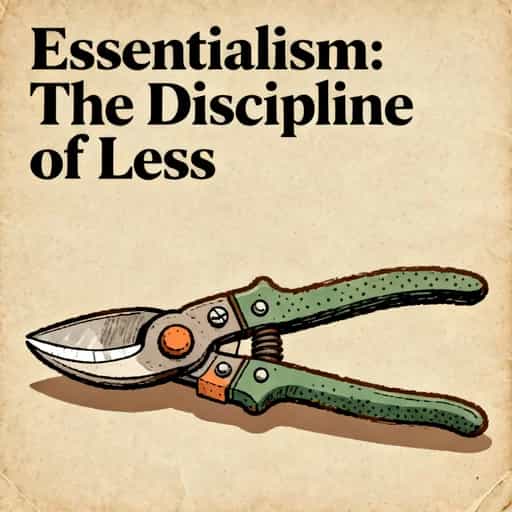
The Disciplined Pursuit of Less
The path to Essentialism isn't easy - it's a continuous journey that demands both mindful awareness and deliberate action. It requires constant vigilance against the creep of nonessential demands, which can manifest in many forms: the endless stream of emails, the "quick" meetings that multiply on your calendar, or the well-meaning requests from colleagues and friends that slowly accumulate until they overwhelm your capacity to deliver meaningful work.
This philosophy demands three core commitments. First, it requires the courage to disappoint people in small ways so you don't disappoint yourself and others in big ways. This might mean declining to join another committee at work, saying no to a social event that doesn't align with your priorities, or stepping back from projects that don't leverage your unique strengths. Second, it requires the discipline to say no to good opportunities so you can say yes to great ones - understanding that every "yes" to one thing is implicitly a "no" to something else. Third, it demands the wisdom to distinguish between what is merely good and what is truly essential.
The rewards of this approach are immense and far-reaching. When you focus on what truly matters - when you invest your time and energy in the vital few rather than the trivial many - you unlock your highest potential in several ways:
• You produce work of higher quality because your energy isn't dispersed across too many projects
• You develop deeper relationships because you're fully present in your important interactions
• You achieve breakthrough results in areas that matter most because you've allocated sufficient resources to them
• You experience less stress and greater satisfaction because your actions align with your values
Perhaps most significantly, you create a life that matters - not just to others, but to yourself. This isn't about minimalism or sacrifice; it's about maximizing your impact through strategic focus and intentional choice.
As Greg McKeown reminds us: "If you don't prioritize your life, someone else will." This stark truth highlights the fundamental choice we all face. Every day we don't actively choose our priorities, we passively allow others to choose for us. The momentum of external demands, social expectations, and others' urgencies will fill every available space unless we consciously prevent it.
The choice is yours, but it's not a one-time decision. It's a series of daily choices that compound over time. Will you continue to be pulled in a thousand directions by other people's agendas? Or will you take the path of the Essentialist - the disciplined pursuit of less, but better? Will you allow your time and energy to be diluted across countless good-but-not-great opportunities, or will you concentrate them on the few things that could be truly exceptional?
The answer to that question will determine not just how you work, but how you live. It will shape not only what you achieve, but who you become. The path of the Essentialist is challenging, but it leads to a life of purpose, impact, and lasting satisfaction - a life where less truly becomes more.