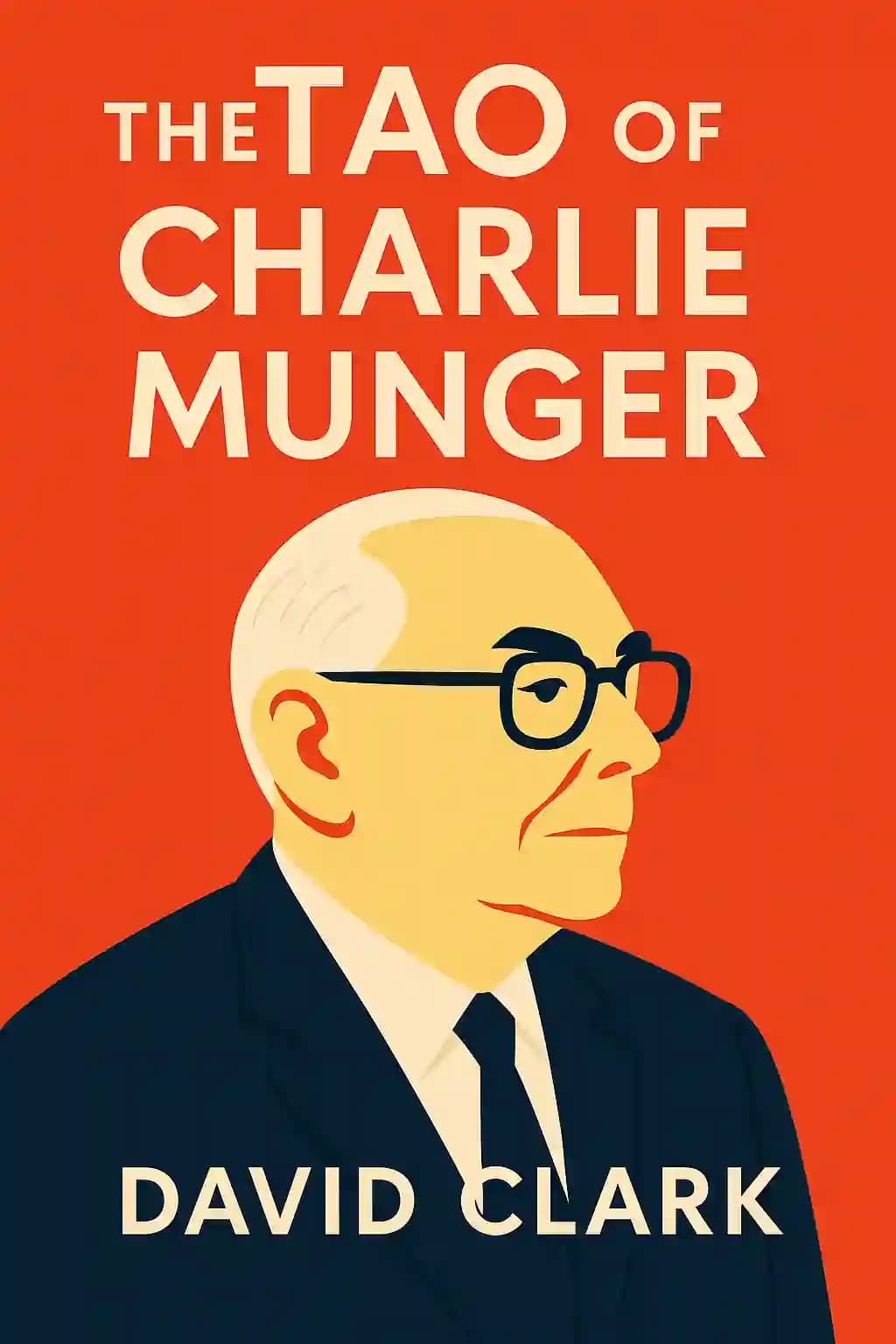
Dive into Warren Buffett's right-hand genius with "The Tao of Charlie Munger" - the investment bible Andrew Wilkinson read "20 times" and calls "better than any MBA." Discover why multidisciplinary thinking and concentrated investments outperform conventional wisdom in just 3 hours.
David Clark, author of Tao of Charlie Munger, is a world-renowned expert on Warren Buffett’s investment philosophies (Buffettology) and co-author of the international bestseller The Tao of Warren Buffett. A finance and law graduate from Omaha, Nebraska—Warren Buffett’s hometown—Clark grew up alongside Buffett’s family, fostering a lifelong passion for value investing. His seven collaborative works with Mary Buffett, including The New Buffettology and Warren Buffett and the Interpretation of Financial Statements, distill complex financial strategies into accessible frameworks.
Clark’s writing focuses on practical investment wisdom, behavioral economics, and long-term wealth building, themes rooted in his decades of studying Buffett and Charlie Munger. As a lecturer and managing director of an Omaha-based investment partnership, he bridges academic theory and real-world application. His insights have been quoted in the New York Times and leveraged by investors globally.
The Tao of Charlie Munger extends Clark’s legacy of decoding investment giants’ mental models. His works have become essential reading for investors worldwide and have been translated into multiple languages, solidifying his authority in value investing.
The Tao of Charlie Munger distills the investment philosophy and life principles of Warren Buffett’s longtime business partner. It compiles Munger’s wisdom on rational decision-making, long-term value investing, and avoiding cognitive biases, using quotes and anecdotes to illustrate concepts like durable competitive advantages and "sitting on your ass" investing. The book emphasizes patience, continuous learning, and psychological discipline as keys to financial and personal success.
Aspiring investors, business professionals, and anyone seeking to improve decision-making will benefit. Clark’s concise format appeals to readers wanting actionable insights without dense financial theory. Fans of Warren Buffett or behavioral psychology will find it especially relevant, as will those interested in mental models and avoiding common cognitive pitfalls.
Yes—it’s praised for condensing decades of Munger’s wisdom into digestible lessons, making complex ideas accessible. Critics note some repetitive commentary, but the core principles on investing, rationality, and life philosophy remain highly valued. For those new to Munger, it’s an ideal primer; seasoned readers may prefer deeper dives into his methodologies.
Munger identifies 18 common mental traps (e.g., confirmation bias, social proof) that sabotage decisions. The book advocates using checklists and multidisciplinary thinking to counteract them. Clark underscores Munger’s belief that avoiding stupidity trumps seeking brilliance, illustrated by examples like overpaying for “hot” stocks.
Both books (co-authored by David Clark) explore Berkshire Hathaway’s philosophies, but Munger’s focuses more on psychology and multidisciplinary thinking, while Buffett’s emphasizes value investing metrics. Clark’s deep expertise on both figures ensures complementary insights for readers.
Some reviewers argue Clark’s commentary repeats Munger’s points without adding new analysis. Others note the book’s brevity (150 pages) may oversimplify complex topics. However, most praise it as a highly quotable introduction to Munger’s ideology.
Munger advocates for decades-long holding periods, using Berkshire’s stakes in Coca-Cola and See’s Candy as examples. The book stresses that time allows compounding to work and reduces transaction costs/taxes. Clark contrasts this with Graham’s fear-driven, short-term value approach.
Munger views crashes as opportunities to buy quality assets at discounts. The book advises preparing cash reserves in advance and avoiding debt to capitalize on volatility. Clark highlights how this strategy helped Berkshire thrive in 2008.
Clark connects investing principles to life: patience in relationships, compounding knowledge through reading, and avoiding toxic influences mirror portfolio management. Munger’s mantra of “inversion” (solving problems backward) is framed as a tool for career and personal decisions.
Its lessons on adapting to economic uncertainty and navigating AI-driven markets resonate today. The focus on psychological discipline counters algorithmic trading’s short-termism, while Munger’s skepticism of hype (e.g., crypto) aligns with current risk-averse trends.
著者の声を通じて本を感じる
知識を魅力的で例が豊富な洞察に変換
キーアイデアを瞬時にキャプチャして素早く学習
楽しく魅力的な方法で本を楽しむ
Using leverage is like driving a car with a dagger on the steering wheel pointed at your heart.
People are trying to be smart-all I am trying to do is not to be idiotic.
The big money is not in the buying and selling, but in the waiting.
The big money is made when you can act when others are paralyzed by fear.
『The tao of Charlie Munger』の核心的なアイデアを分かりやすいポイントに分解し、革新的なチームがどのように創造、協力、成長するかを理解します。
『The tao of Charlie Munger』を素早い記憶のヒントに凝縮し、率直さ、チームワーク、創造的な回復力の主要原則を強調します。

鮮やかなストーリーテリングを通じて『The tao of Charlie Munger』を体験し、イノベーションのレッスンを記憶に残り、応用できる瞬間に変えます。
何でも質問し、声を選び、本当にあなたに響く洞察を一緒に作り出しましょう。

"Instead of endless scrolling, I just hit play on BeFreed. It saves me so much time."
"I never knew where to start with nonfiction—BeFreed’s book lists turned into podcasts gave me a clear path."
"Perfect balance between learning and entertainment. Finished ‘Thinking, Fast and Slow’ on my commute this week."
"Crazy how much I learned while walking the dog. BeFreed = small habits → big gains."
"Reading used to feel like a chore. Now it’s just part of my lifestyle."
"Feels effortless compared to reading. I’ve finished 6 books this month already."
"BeFreed turned my guilty doomscrolling into something that feels productive and inspiring."
"BeFreed turned my commute into learning time. 20-min podcasts are perfect for finishing books I never had time for."
"BeFreed replaced my podcast queue. Imagine Spotify for books — that’s it. 🙌"
"It is great for me to learn something from the book without reading it."
"The themed book list podcasts help me connect ideas across authors—like a guided audio journey."
"Makes me feel smarter every time before going to work"

The tao of Charlie Mungerの要約をPDFまたはEPUBで無料でダウンロード。印刷やオフラインでいつでもお読みいただけます。
A man sits reading six hundred pages a day while his peers frantically trade stocks on multiple screens. He holds cash earning nearly nothing while others leverage themselves to the hilt chasing returns. He admits ignorance freely while Wall Street experts project certainty about everything. This man-Charlie Munger-and his partner Warren Buffett turned $100 invested in 1965 into over $2 million by 2015, a 20.8% annual return spanning five decades. The secret wasn't complexity or speed. It was something far more difficult: disciplined simplicity in a world addicted to action. While most investors treat the stock market like a casino, Munger approached it like a scholar studying civilizations-patiently, broadly, and with brutal honesty about what he didn't know. His wisdom extends far beyond finance, offering a blueprint for clear thinking in an age of noise.