第1章
The Timeless Wisdom of Charlie Munger: A Modern Franklin
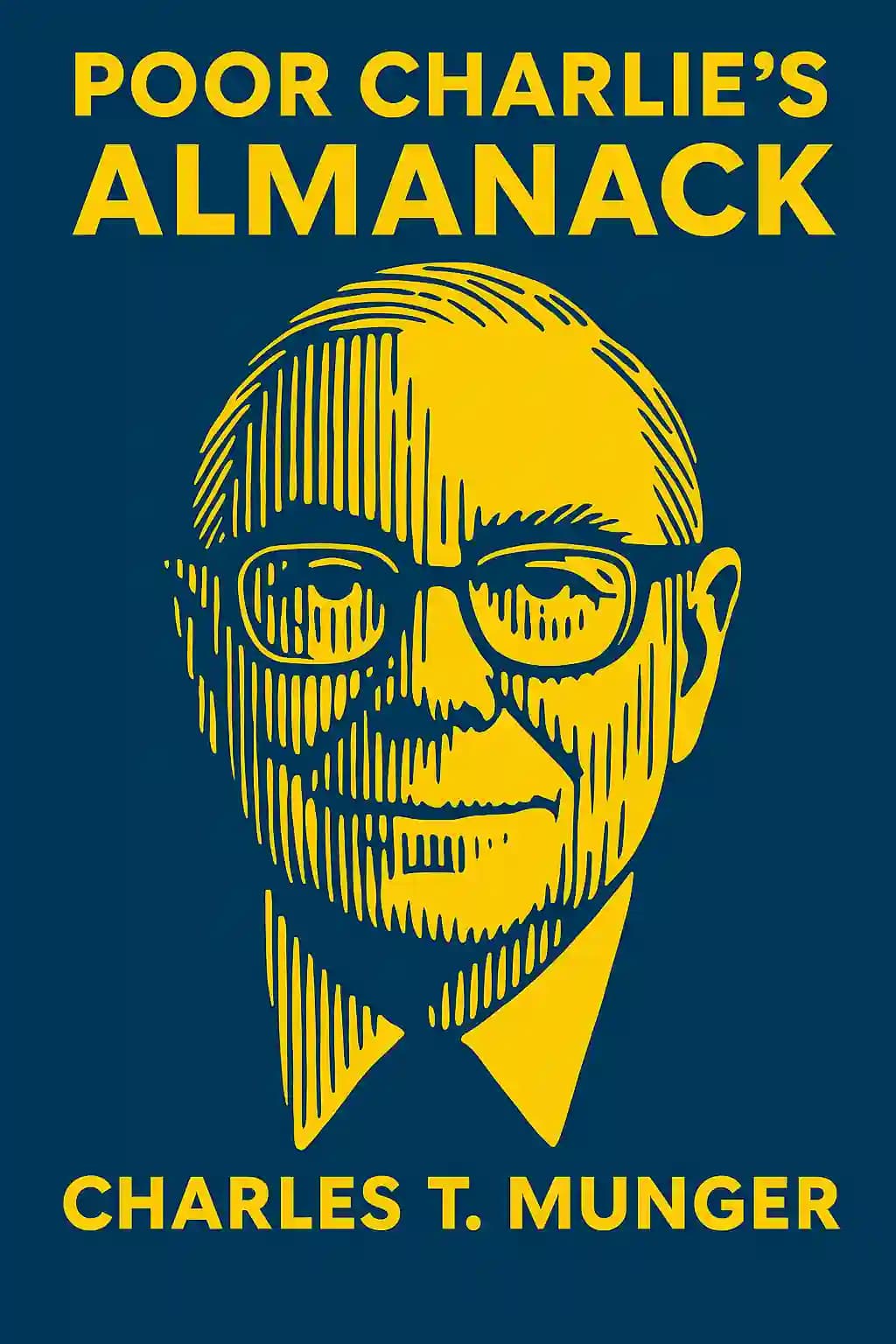
Poor Charlie's Almanack has become something of a bible in investment circles and beyond. Warren Buffett's right-hand man at Berkshire Hathaway, Charlie Munger has cultivated a devoted following that includes everyone from Wall Street titans to Silicon Valley entrepreneurs. Bill Gates calls it "one of the most important books" he's ever read, while Elon Musk credits Munger's mental models as foundational to his thinking. What makes this collection of speeches and wisdom so compelling is that it doesn't just teach you how to invest-it teaches you how to think. In a world increasingly dominated by specialized knowledge, Munger stands as a Renaissance man, drawing insights from fields as diverse as psychology, physics, and history to build what he calls a "latticework of mental models." Let's explore the multidisciplinary mind of this modern-day Benjamin Franklin.
第2章
The Multidisciplinary Approach: Building a Latticework of Knowledge
What separates ordinary thinkers from extraordinary ones? According to Charlie Munger, it's the ability to draw from multiple disciplines rather than remaining trapped in a single field of expertise.
Munger calls this approach building a "latticework of mental models"-a framework where knowledge from various fields connects and reinforces itself. Rather than seeing disciplines as separate silos, he views them as interconnected pieces of a greater whole. This perspective allows him to analyze problems from multiple angles, identifying patterns and solutions that specialists might miss.
"You've got to have models in your head," Munger explains. "And you've got to array your experience-both vicarious and direct-on this latticework of models." He emphasizes that these models should come from diverse fields: mathematics, psychology, physics, biology, and more. Each discipline offers unique tools for understanding reality.
This approach stands in stark contrast to academic specialization, which Munger criticizes for producing "man-with-a-hammer syndrome"-where specialists see every problem as a nail because they only have one tool. Instead, he advocates for broad learning across disciplines, creating a mental toolkit that can address any challenge.
The practical benefits of this approach are evident in Munger's investment success. While others rely solely on financial metrics, he incorporates psychological biases, historical patterns, and systems thinking into his analysis. This comprehensive view has helped him avoid common pitfalls and identify opportunities others miss.
How might we apply this in our own lives? Start by reading widely across disciplines. Connect concepts from different fields. When facing a problem, ask yourself: "What mental models from other domains might apply here?" The goal isn't to become an expert in everything but to develop enough familiarity with key concepts to apply them effectively when needed.
Remember that building this latticework takes time. Munger himself spent decades accumulating knowledge across fields. But the compound interest on intellectual capital works just like financial capital-small, consistent investments yield remarkable returns over time.
第3章
The Psychology of Human Misjudgment: Understanding Our Cognitive Biases
Why do smart people make foolish decisions? This question fascinated Munger throughout his career, leading him to develop a comprehensive framework for understanding human misjudgment.
Munger identified 25 psychological tendencies that lead us astray, from incentive-caused bias to social proof tendency. These aren't just academic curiosities-they're practical tools for understanding behavior in business, politics, and everyday life.
Consider incentive-caused bias. "Never, ever, think about something else when you should be thinking about the power of incentives," Munger warns. He shares the story of Federal Express solving their package-transfer problem by switching from hourly wages to piece-rate compensation. Overnight, the same employees who couldn't complete the task during regular hours finished by 10 AM.
Or take social proof tendency-our inclination to think and act like those around us. This explains why fashion trends spread, why cults gain followers, and why investment bubbles form. "If you're going to be in this game for the long pull, you better be able to handle a 50% decline without fussing too much about it," Munger advises, knowing that market panics often result from social proof gone wild.
What makes Munger's approach unique is his focus on how these biases interact. He coined the term "Lollapalooza effect" to describe situations where multiple psychological tendencies reinforce each other, creating extreme outcomes. The 2008 financial crisis exemplifies this-overconfidence, incentive-caused bias, and social proof combined to create a perfect storm.
How can we guard against these biases? Munger suggests several strategies:
First, awareness is crucial. Simply knowing these tendencies exist helps us recognize them in ourselves and others.
Second, use checklists to ensure thorough thinking. "Part of what you must learn is how to handle mistakes and new facts that change the odds," he says. Checklists prevent us from overlooking important factors.
Third, invert problems. Instead of asking "How can I succeed?" ask "What would guarantee failure?" This helps identify pitfalls to avoid.
Finally, seek disconfirming evidence. Challenge your beliefs by actively looking for information that contradicts them.
By understanding these psychological tendencies, we gain insight not just into others' behavior but our own thinking processes. This self-awareness is perhaps the most valuable tool in Munger's mental toolkit.
第4章
The Circle of Competence: Knowing What You Know
One of Munger's most powerful concepts is the "circle of competence"-the idea that we should operate within areas where we have genuine knowledge and understanding.
"Knowing what you don't know is more useful than being brilliant," Munger emphasizes. This principle has guided his investment approach for decades. Rather than chasing every opportunity, he and Buffett focus on businesses they truly understand, making fewer but higher-conviction investments.
The circle of competence has two components: First, accurately assessing what you know. Second, having the discipline to stay within those boundaries. Both are surprisingly difficult.
We tend to overestimate our knowledge due to what Munger calls "excessive self-regard tendency." Studies show that most people rate themselves above average in intelligence, driving ability, and other skills-a statistical impossibility. This overconfidence leads to poor decisions when we venture beyond our actual expertise.
How do you define your circle of competence? Munger suggests a simple test: "Can you explain it to someone else clearly?" If not, you probably don't understand it well enough to invest in it. This explains why Berkshire Hathaway avoided technology investments for many years-until they felt they truly understood specific companies in the sector.
The circle of competence isn't static. It can expand through dedicated learning and experience. But expansion should be gradual and deliberate. "Expand your circle of competence only when you can do it reliably," Munger advises.
This principle applies beyond investing. In careers, relationships, and personal decisions, knowing your limitations is as important as knowing your strengths. It's better to excel within a narrower domain than to perform poorly across a broader one.
Perhaps most importantly, the circle of competence teaches intellectual honesty. In a world that rewards confident assertions over careful qualification, admitting "I don't know" requires courage. Yet this humility is the foundation of wisdom.
As Munger puts it: "Knowing the edge of your competency is not a weakness. It's a strength." By focusing our efforts where we have genuine insight and avoiding areas where we don't, we dramatically improve our decision-making.
第5章
The Power of Inversion: Thinking Backwards
"Invert, always invert," Munger frequently quotes the German mathematician Carl Jacobi. This seemingly simple advice contains profound wisdom about problem-solving and decision-making.
Inversion means approaching problems backward. Instead of asking, "How do I achieve success?" ask, "What would guarantee failure, and how do I avoid that?" Rather than focusing solely on what to do, consider what not to do.
This approach offers several advantages. First, it's often easier to identify what would cause disaster than to pinpoint the exact path to success. Second, avoiding catastrophic mistakes is sometimes more important than making brilliant moves.
Munger applies inversion to investing by focusing first on risk before return. "All I want to know is where I'm going to die so I'll never go there," he quips. By eliminating investments with high probabilities of permanent capital loss, he narrows the field to safer opportunities.
The power of inversion extends beyond investing. In his famous "How to Guarantee a Life of Misery" speech at Harvard, Munger outlined behaviors that would ensure unhappiness: resentment, unreliability, self-pity, and self-indulgence. By avoiding these pitfalls, one naturally moves toward a more fulfilling life.
Inversion also helps overcome confirmation bias-our tendency to seek evidence supporting our existing beliefs. By actively considering why we might be wrong, we open ourselves to disconfirming evidence that might otherwise be ignored.
How can we practice inversion in daily life? Before making important decisions, ask:
• What would cause this to fail?
• What am I trying to avoid?
• If I were trying to sabotage this situation, what would I do?
These questions often reveal blind spots in our thinking and highlight potential pitfalls we hadn't considered.
Inversion isn't pessimism-it's pragmatism. By understanding what leads to failure, we clear the path to success. As Munger notes, "It is remarkable how much long-term advantage people like us have gotten by trying to be consistently not stupid, instead of trying to be very intelligent."
第6章
The Virtues of Patience and Discipline: Waiting for the Fat Pitch
In baseball, the best hitters don't swing at every pitch-they wait for the perfect one. Munger applies this same principle to investing and decision-making, advocating for extreme patience punctuated by decisive action when the right opportunity appears.
"The big money is not in the buying and selling," Munger explains, "but in the waiting." This patience manifests in Berkshire Hathaway's investment approach, where they might make no major investments for years, then deploy billions when conditions are right.
This approach contradicts our natural impulses. Humans are wired for action-we feel more productive doing something rather than nothing, even when inaction is the wiser choice. Munger calls this "do-something syndrome" and considers it responsible for many poor decisions.
The discipline to wait requires overcoming several psychological tendencies. First, there's what Munger calls "deprival-superreaction tendency"-our fear of missing out on opportunities. Second, there's social pressure when others are actively investing while we remain on the sidelines. Finally, there's the challenge of maintaining focus during long periods of inactivity.
How does Munger cultivate this patience? He creates an environment that supports it. By avoiding leverage and maintaining cash reserves, Berkshire never faces pressure to act prematurely. By focusing on long-term results rather than short-term activity, they align their incentives with their strategy.
Munger also emphasizes the importance of preparation during waiting periods. "The best thing a human being can do is to help another human being know more," he says. By continuously expanding his knowledge base, he's ready when opportunities arise.
This patience extends beyond investing to personal development. Munger advocates for "continuous learning" rather than frantic activity. "In my whole life, I have known no wise people who didn't read all the time," he observes. This steady accumulation of knowledge compounds over time, just like investment returns.
The lesson? Don't confuse activity with progress. Sometimes the most productive thing you can do is wait, observe, and prepare. As Munger puts it: "The big money is made in the waiting and the thinking."
第7章
Incentives: The Superpower of Understanding Human Behavior
"Show me the incentive and I will show you the outcome." This Munger maxim captures his belief in the overwhelming power of incentives to shape human behavior.
Despite their importance, Munger observes that incentives are frequently misunderstood or underestimated. "I think I've been in the top 5% of my age cohort all my life in understanding the power of incentives, and all my life I've underestimated it," he admits.
The impact of incentives extends far beyond obvious financial rewards. Munger identifies several types: financial, social approval, psychological comfort, and more. These often work in combination, creating powerful motivational forces that can lead to either remarkable achievements or catastrophic failures.
Consider his example of Federal Express's overnight delivery system. The company struggled with packages remaining unsorted by morning until they changed from an hourly wage to a piece-rate system. Suddenly, the same workers who couldn't complete the task during regular hours finished by 10 AM. The incentive structure, not the workers' capabilities, had been the problem.
Incentives can also lead to perverse outcomes when poorly designed. Munger shares the story of a surgeon who received a flat fee per operation, regardless of complexity. Unsurprisingly, the doctor began recommending multiple simple procedures instead of single complex ones, increasing his income at patients' expense.
Understanding incentives helps explain seemingly irrational behavior. Why do smart professionals sometimes give bad advice? Often because their incentives don't align with their clients' best interests. "Never ask the barber if you need a haircut," Munger cautions.
How can we apply this insight? First, examine the incentives in any situation to predict likely outcomes. Second, design systems with aligned incentives to achieve desired results. Third, be wary of situations where incentives work against good judgment.
Munger also warns about the dangers of incentive-caused bias-our tendency to see what serves our interests. This explains why "it is difficult to get a man to understand something when his salary depends upon his not understanding it," as Upton Sinclair observed.
By recognizing the power of incentives, we gain a clearer understanding of human behavior and can design better systems, make more accurate predictions, and avoid situations where incentives work against our goals.
第8章
The Lollapalooza Effect: When Multiple Forces Converge
While understanding individual psychological tendencies is valuable, Munger's most profound insight may be what he calls the "Lollapalooza effect"-when multiple tendencies combine to create outcomes of extreme magnitude.
"The Lollapalooza effect occurs when two or more forces are all operating in the same direction," Munger explains. "And, frequently, you don't get simple addition. You get a nuclear explosion or something."
This concept helps explain why traditional academic psychology, which typically studies isolated factors under controlled conditions, often fails to predict real-world behavior. In practice, psychological tendencies don't operate in isolation-they interact and reinforce each other.
Consider cults, one of Munger's favorite examples. Successful cults don't rely on a single manipulation technique but combine several: social proof (others are joining), authority (a charismatic leader), commitment and consistency (small initial requests leading to larger ones), and scarcity (exclusive access to truth or salvation). Together, these create a powerful influence system that can override critical thinking.
The Lollapalooza effect appears in business too. Coca-Cola's success stems from multiple reinforcing advantages: the reward of sugar, caffeine's mild addiction, powerful branding, ubiquitous availability, and social proof. No single factor explains its dominance-it's the combination that creates an unassailable market position.
Understanding this effect has practical applications. When analyzing a business, Munger looks for multiple advantages reinforcing each other. When designing systems, he tries to align multiple motivational forces toward desired outcomes. When evaluating risks, he watches for situations where several negative tendencies might converge.
How can we apply this concept? First, recognize that complex outcomes rarely have simple causes. Look for multiple factors working together. Second, when trying to create change, combine several approaches rather than relying on a single strategy. Third, be especially cautious in situations where multiple psychological tendencies might reinforce undesirable behavior.
The Lollapalooza effect reminds us that reality is complex and interconnected. By understanding how various forces combine and interact, we gain deeper insight into both opportunities and risks.
第9章
Learning from Mistakes: The Importance of Intellectual Humility
For all his wisdom, Munger places extraordinary emphasis on learning from mistakes-both his own and others'. "There's no way that you can live an adequate life without making many mistakes," he observes. The key is to learn from them.
Munger's approach to mistakes reflects his intellectual humility. Despite his remarkable success, he readily admits errors and continuously seeks to improve his thinking. This humility isn't false modesty but a strategic advantage-it allows him to learn and adapt where others might become defensive or entrenched.
"I'm not entitled to have an opinion unless I can state the arguments against my position better than the people who are in opposition," Munger says. This standard forces him to thoroughly understand opposing viewpoints rather than dismissing them.
His focus on mistakes extends beyond personal experience to vicarious learning. "You don't have to pee on an electric fence to learn not to do it," he quips. By studying others' failures, we can avoid repeating them.
Munger particularly values learning from catastrophic failures. In his view, these provide clearer lessons than successes, which might result partly from luck. He cites aviation's safety improvements through systematic analysis of crashes as a model for other fields.
This approach contrasts sharply with common human tendencies. We naturally prefer focusing on successes rather than failures and tend to attribute our successes to skill while blaming failures on bad luck. Overcoming these biases requires deliberate effort.
How does Munger cultivate this learning mindset? First, he creates an environment where acknowledging mistakes is acceptable. At Berkshire annual meetings, he and Buffett openly discuss their errors. Second, he practices what he calls "inversion"-thinking about how things could go wrong. Third, he maintains a decision journal to track his thinking and review outcomes objectively.
The lesson? Embrace mistakes as learning opportunities rather than threats to your self-image. As Munger puts it: "I'm not interested in the fact that the ancient Egyptians created the greatest civilization in history. I'm interested in why it collapsed."
第10章
The Ethics of Success: Deserving What You Want
Beyond investment strategies and mental models, Munger emphasizes a fundamental principle: "To get what you want, you have to deserve what you want."
This ethical dimension distinguishes Munger's philosophy from mere tactics for success. He believes that sustainable achievement requires integrity, fairness, and contribution-not just clever maneuvering.
"The safest way to try to get what you want is to try to deserve what you want," Munger explains. "It's such a simple idea. It's the golden rule. You want to deliver to the world what you would buy if you were on the other end."
This approach has practical benefits. Trust and reputation are valuable assets in business and life. By consistently acting with integrity, Munger and Buffett have built a reputation that gives Berkshire Hathaway advantages in acquisitions and deals. When they make promises, people believe them, reducing friction in transactions.
Munger extends this principle to broader social questions. He argues that societies function best when people generally get what they deserve-when effort, skill, and contribution are rewarded. This doesn't mean ignoring luck's role or abandoning compassion, but it does mean designing systems that align rewards with value creation.
How does this ethical framework manifest in daily decisions? Munger suggests several practices:
First, focus on earning trust through consistent honesty. "The best way to get a good spouse is to deserve one," he notes, applying the principle to personal relationships.
Second, think long-term about reputation. Short-term gains from questionable behavior rarely outweigh long-term reputational damage.
Third, practice reciprocity. Treat others as you would want to be treated, creating positive cycles of cooperation.
Finally, contribute value before seeking rewards. "The best way to get what you want in life is to deserve what you want," Munger repeats. "How can it be otherwise?"
This ethical dimension reminds us that success isn't just about techniques and strategies but about becoming the kind of person who deserves success. As Munger puts it: "Live so that you can say to every rattlesnake: 'I am more poisonous than you are.'"
第11章
Applying Munger's Wisdom: Practical Steps for Better Thinking
Charlie Munger's insights aren't just theoretical-they're meant to be applied. How can we incorporate his wisdom into our daily thinking and decision-making?
First, build your own latticework of mental models. Start by identifying fundamental concepts from key disciplines: mathematics (compound interest, probability), psychology (cognitive biases), biology (evolution, systems thinking), physics (critical mass, equilibrium), and economics (opportunity cost, competitive advantage). Study these concepts deeply enough to apply them in various contexts.
Second, develop a decision-making checklist. Munger uses checklists to ensure thorough analysis and avoid common errors. Your checklist might include questions like: What are the incentives at play? Am I falling prey to confirmation bias? What would cause this to fail? Have I considered opportunity costs? Such systematic questioning helps overcome cognitive limitations.
Third, practice inversion regularly. Before making important decisions, explicitly consider what would cause failure. This simple habit helps identify risks that might otherwise be overlooked and often suggests preventive measures.
Fourth, maintain a decision journal. Record your thought process when making significant decisions, including your reasoning and expectations. Review this journal periodically to assess outcomes against predictions. This practice builds self-awareness about your decision-making patterns.
Fifth, create your own "too hard" pile. Munger acknowledges that many problems are simply too difficult to solve reliably. Having the discipline to set these aside-rather than forcing a conclusion-prevents costly mistakes. As he puts it: "We have three baskets: in, out, and too tough."
Sixth, deliberately seek disconfirming evidence. When you form a hypothesis or belief, actively look for information that might prove it wrong. This counteracts confirmation bias and leads to more robust conclusions.
Finally, cultivate intellectual humility. Recognize the limits of your knowledge and be willing to change your mind when evidence warrants. As Munger advises: "I never allow myself to have an opinion on anything that I don't know the other side's argument better than they do."
These practices won't make you Charlie Munger overnight, but they will gradually improve your thinking. The compound interest of better decisions, like financial compound interest, produces remarkable results over time.
第12章
The Legacy of Charlie Munger: Wisdom That Transcends Investing
While Charlie Munger is best known as Warren Buffett's partner and a legendary investor, his greatest contribution may be his approach to thinking itself. His multidisciplinary framework, psychological insights, and ethical principles offer wisdom that extends far beyond finance.
Munger's emphasis on continuous learning models a path for intellectual growth at any age. Well into his nineties, he continued reading voraciously across disciplines, demonstrating that curiosity and mental development need never cease. "In my whole life, I have known no wise people who didn't read all the time," he observes. "None, zero."
His focus on psychological tendencies provides a practical framework for understanding human behavior-our own and others'. By recognizing these patterns, we gain insight into everything from personal relationships to political movements to market dynamics.
The ethical dimension of Munger's philosophy offers a refreshing counterpoint to cynical views of success. His insistence that we should "deserve what we want" reminds us that character and contribution matter-not just clever tactics or positioning.
Perhaps most valuable is Munger's intellectual honesty. In an era of polarization and certainty, his willingness to acknowledge complexity, consider opposing viewpoints, and change his mind when warranted provides a model of rational discourse increasingly rare in public life.
What makes Munger's wisdom so enduring is its foundation in fundamental principles rather than specific techniques or trends. The psychological tendencies he identifies have operated throughout human history. The multidisciplinary approach he advocates has produced breakthrough insights for centuries. The ethical framework he espouses has roots in ancient wisdom traditions.
As we navigate an increasingly complex world, Munger's mental tools become more valuable, not less. His latticework of mental models offers a way to make sense of information overload. His psychological insights help us navigate a media environment designed to exploit cognitive biases. His long-term perspective provides balance against short-term thinking.
In the end, Poor Charlie's Almanack isn't just about becoming a better investor-it's about becoming a better thinker. And in a world where thinking clearly is increasingly precious, that may be Munger's most valuable legacy.