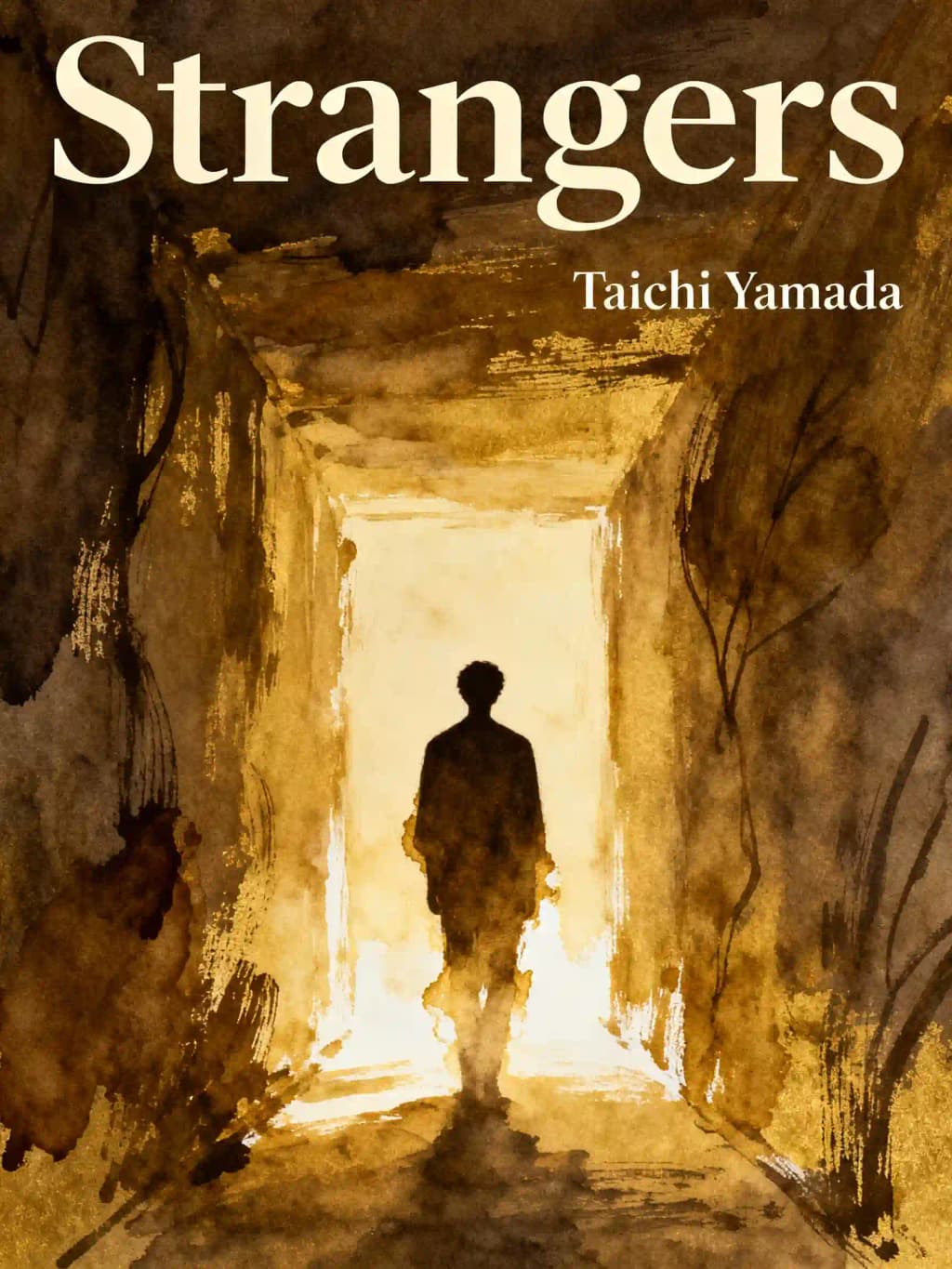
A haunting ghost story where a lonely scriptwriter meets his deceased parents, "Strangers" blurs reality and afterlife. Yamada's award-winning novel inspired two films, including 2023's "All of Us Strangers." What happens when the dead return - and why can't we let go?
Taichi Yamada (1934–2023) was an acclaimed Japanese screenwriter and novelist, best known for his seminal work of supernatural fiction, Strangers (1987). The novel explores themes of loneliness, familial longing, and the porous boundary between life and death.
Born in Tokyo’s Asakusa district, Yamada was educated at Waseda University. He began his career as a film studio assistant director before becoming a prolific television dramatist, penning hit series like Kishibe no arubamu. His transition to novels earned him the Yamamoto Shūgorō Prize for Strangers, which masterfully blends psychological depth with ghostly suspense, reflecting his lifelong fascination with memory and human connection.
The book’s enduring legacy includes two film adaptations: 1989’s The Discarnates and 2023’s BAFTA-nominated All of Us Strangers. Yamada’s other translated works, such as In Search of a Distant Voice and I Haven’t Dreamed of Flying for a While, further cement his reputation for haunting, introspective storytelling.
Originally published in Japanese as Ijintachi to no natsu, Strangers has been translated into over 15 languages, captivating global audiences with its ethereal meditation on grief and belonging.
Strangers explores loneliness and existential disconnection through Hideo Harada, a divorced TV writer who encounters mysterious figures resembling his deceased parents and an enigmatic neighbor. Blending psychological drama with supernatural elements, the novel delves into themes of grief, identity, and the blurred lines between reality and memory.
Fans of Japanese literary fiction and atmospheric, introspective narratives will appreciate this haunting story. Ideal for readers interested in existential themes, ghostly allegories, or post-war Japanese societal shifts. Its brevity (under 200 pages) also suits those seeking a concise yet layered work.
Yes—the novel won the 1988 Yamamoto Shūgorō Prize and inspired multiple film adaptations (The Discarnates, All of Us Strangers). Critics praise its elegant prose and ability to evoke unease through quiet, surreal moments.
Key themes include isolation (Hideo’s empty apartment building), unresolved grief (his parents’ ghostly return), and the fragility of identity. Yamada contrasts urban alienation with fleeting human connections, using the supernatural to mirror emotional repression.
Hideo’s solitary existence amplifies his vulnerability to eerie encounters—like Kei, a neighbor projecting desperation, and his “parents,” who reflect his unmet emotional needs. The sparse dialogue and vacant setting underscore his internal void.
The nearly vacant building symbolizes Hideo’s emotional isolation. Its silence (“utterly alone in a vast dark void”) mirrors his dissociation from society, while Kei’s presence hints at unrealized intimacy.
Yes—Hideo interacts with doppelgängers of his long-dead parents and questions their reality. These encounters blur psychological trauma with ghostly visitation, challenging readers to interpret their symbolism.
The train to Asakusa represents Hideo’s unresolved past, while his impulsive silk tie purchase reflects a futile attempt to construct identity. The champagne bottle Kei carries symbolizes transient escapism.
Beyond its Yamamoto Prize win, the 2003 English translation was longlisted for The Independent’s Foreign Fiction Prize. Film adaptations have won awards at Moscow International and Telluride festivals.
Unlike Yamada’s screenplay-driven TV dramas, Strangers adopts a minimalist, introspective style. However, it shares his focus on urban loneliness, seen in novels like In Search of a Distant Voice.
Yes: Nobuhiko Obayashi’s The Discarnates (1988) and Andrew Haigh’s All of Us Strangers (2023). Both reinterpret the novel’s themes through distinct cultural lenses.
Drawing from his Asakusa upbringing and screenwriting career, Yamada fused post-war Tokyo’s social fragmentation with universal questions about belonging. The story reflects Japan’s 1980s bubble economy alienation.
著者の声を通じて本を感じる
知識を魅力的で例が豊富な洞察に変換
キーアイデアを瞬時にキャプチャして素早く学習
楽しく魅力的な方法で本を楽しむ
The building becomes a physical manifestation of his emotional state-a hollow shell housing a single occupant, surrounded by emptiness.
Harada acknowledges his increasingly antisocial tendencies since the divorce.
This moment marks the crossing of a threshold.
His longing for connection...creates an opening through which the dead will soon return.
『Strangers』の核心的なアイデアを分かりやすいポイントに分解し、革新的なチームがどのように創造、協力、成長するかを理解します。
鮮やかなストーリーテリングを通じて『Strangers』を体験し、イノベーションのレッスンを記憶に残り、応用できる瞬間に変えます。
何でも質問し、学習スタイルを選び、自分に本当に響くインサイトを一緒に作れます。

"Instead of endless scrolling, I just hit play on BeFreed. It saves me so much time."
"I never knew where to start with nonfiction—BeFreed’s book lists turned into podcasts gave me a clear path."
"Perfect balance between learning and entertainment. Finished ‘Thinking, Fast and Slow’ on my commute this week."
"Crazy how much I learned while walking the dog. BeFreed = small habits → big gains."
"Reading used to feel like a chore. Now it’s just part of my lifestyle."
"Feels effortless compared to reading. I’ve finished 6 books this month already."
"BeFreed turned my guilty doomscrolling into something that feels productive and inspiring."
"BeFreed turned my commute into learning time. 20-min podcasts are perfect for finishing books I never had time for."
"BeFreed replaced my podcast queue. Imagine Spotify for books — that’s it. 🙌"
"It is great for me to learn something from the book without reading it."
"The themed book list podcasts help me connect ideas across authors—like a guided audio journey."
"Makes me feel smarter every time before going to work"

Strangersの要約をPDFまたはEPUBで無料でダウンロード。印刷やオフラインでいつでもお読みいただけます。
In the heart of Tokyo, alongside the ceaseless hum of Route 8, stands a seven-story building where reality begins to unravel. Forty-seven-year-old scriptwriter Harada has moved into this building following his divorce, occupying an apartment he once used as an office. After three weeks of solitary existence, he notices something unsettling-an unnatural silence pervading the building at night. Looking out his window, he sees only a single pink van in the otherwise deserted parking lot, and realizes his might be the only illuminated window in the entire structure. This concrete ghost ship becomes a physical manifestation of his emotional state-a hollow shell housing a single occupant surrounded by emptiness. The building's liminal nature-neither fully residential nor commercial, neither fully occupied nor abandoned-mirrors Harada's own in-between state. Recently divorced, professionally adrift, and emotionally untethered, he exists in a borderland where the boundaries between past and present, living and dead, begin to dissolve. His isolation deepens when his colleague Mamiya delivers a shocking announcement: he intends to pursue Harada's ex-wife with marriage in mind. This betrayal by someone he's worked with for nearly a decade cuts deep, especially when Mamiya frames his declaration as a courtesy. The encounter leaves Harada reeling, adding another layer of abandonment to his already fragile emotional state.
On his birthday, Harada impulsively visits his birthplace in Asakusa after a decade's absence. This spontaneous journey becomes the moment when the veil between worlds begins to thin. Born in 1939 to a sushi chef father and kitchen-helper mother, Harada's childhood was marked by wartime hardship. At twelve, his parents died in a hit-and-run accident. As he wanders through present-day Asakusa, he's drawn into the Asakusa Variety Hall, where an extraordinary encounter awaits. During a performance, Harada hears his father's voice from the audience. Looking over, he sees a man who's the spitting image of his father at the time of his death. When their eyes meet, the man smiles and nods, sending a chill through Harada's body. Despite his rational mind's protests, when the man says "Whadda ya say we get outta here?" Harada follows without hesitation. The power of this moment lies in Harada's visceral recognition. Despite the decades passed and faded childhood memories, something in him instantly identifies this stranger as his father - a recognition that transcends rational thought.
Following the man through quiet streets, Harada encounters a couple who are mirror images of his long-dead parents - the woman a perfect match for his mother who died at thirty-five. Their modern apartment's appliances confirm they couldn't be his actual parents, yet their mannerisms, speech, and interactions perfectly match his childhood memories. As the man playfully teases his wife about her radio-controlled cars, Harada struggles not to call them "Mom" and "Dad." The encounter's power lies in how it fulfills his deepest longing - the unconditional security he lost with his parents' deaths, something even marriage couldn't replace. Through them, he experiences again what it means to be truly loved and accepted as someone's child. Have you ever longed for someone so deeply that you could almost will them back into existence? This is the emotional territory "Strangers" explores - how grief can open doors between worlds when our need becomes overwhelming.
While Harada processes his supernatural encounter, Kei Fujino from the third floor begins visiting his apartment. She lives alone, having fled her previous residence due to a burn scar on her chest. Their relationship turns intimate with one condition - Kei insists he must not see her burn scars, likening it to ancient myths where a man's gaze causes irreversible damage. Despite his reassurances, they make love with her back to him. This relationship contrasts with Harada's supernatural encounters. His "parents" tie him to his past while Kei represents potential future after his divorce. Both relationships carry limitations - his parents exist between life and death, while his connection with Kei is restricted by her hidden scars. Harada finds himself caught between the comfort of his parents and the promise of new love, forcing him to choose between dwelling in past or embracing an uncertain future.
People around Harada begin noticing alarming changes in his appearance. A producer, Kei, and his colleague Mamiya all express shock at his increasingly gaunt and pale appearance. Though he initially dismisses their concerns, Kei forces him to face reality by showing him his reflection. The mirror reveals a horrifying transformation - sunken eyes, hollow cheeks, and ghostly pallor. The sight leaves him collapsed and drained. This physical deterioration embodies the novel's central truth: communion with the dead exacts a terrible price from the living. Harada's desperate yearning for his parents and childhood security is literally consuming him. Each visit drains more of his vitality, showing how an inability to release the past can destroy one's present. This physical manifestation of emotional attachment carries a clear warning - if Harada continues, it will kill him. His story illustrates how desperately clinging to memories can consume us from within, preventing us from fully living in the present.
Despite Kei's warnings, Harada meets his parents at a sukiyaki restaurant for closure. When they announce their departure, his protests dissolve into gratitude as they express pride in him. He manages a final "Thank you Mom and Dad!" as they vanish. This farewell represents both loss and liberation - his parents choose to depart before their presence could fully consume him, providing the closure he's needed since their deaths. In the hallway, Harada learns Kei's truth: she's a vengeful suicide victim who planned to "drag him down" for rejecting her. Blood seeps through her white dress as she fades away. After twenty-two days in the hospital, Harada emerges with gray hair, damaged vision, and a weakened body. With Mamiya, he discovers the apartment building where he "met" his parents had been demolished months before - revealing it was all an illusion.
What makes "Strangers" so haunting isn't just its supernatural elements but its understanding of how grief and loneliness reshape reality. The novel suggests that the boundaries between living and dead aren't fixed - our deepest emotional needs can breach these boundaries. Harada's encounters, whether supernatural or psychological, served their purpose - enabling him to bid farewell to his parents, receive their blessing, and move forward. His meeting with Kei forced him to face his fear of new connections after divorce. The supernatural versus psychological debate matters less than the emotional truth these experiences revealed. Harada's journey through grief, loneliness, and acceptance speaks to the universal experience of loss and the search for meaning. We all carry ghosts - memories, regrets, lost loves, and missed opportunities. The question isn't whether these ghosts exist, but how we choose to live with them. Do we let them consume us, or find the courage to acknowledge them and move forward? In life's empty spaces, sometimes the most important conversations are with those no longer here.