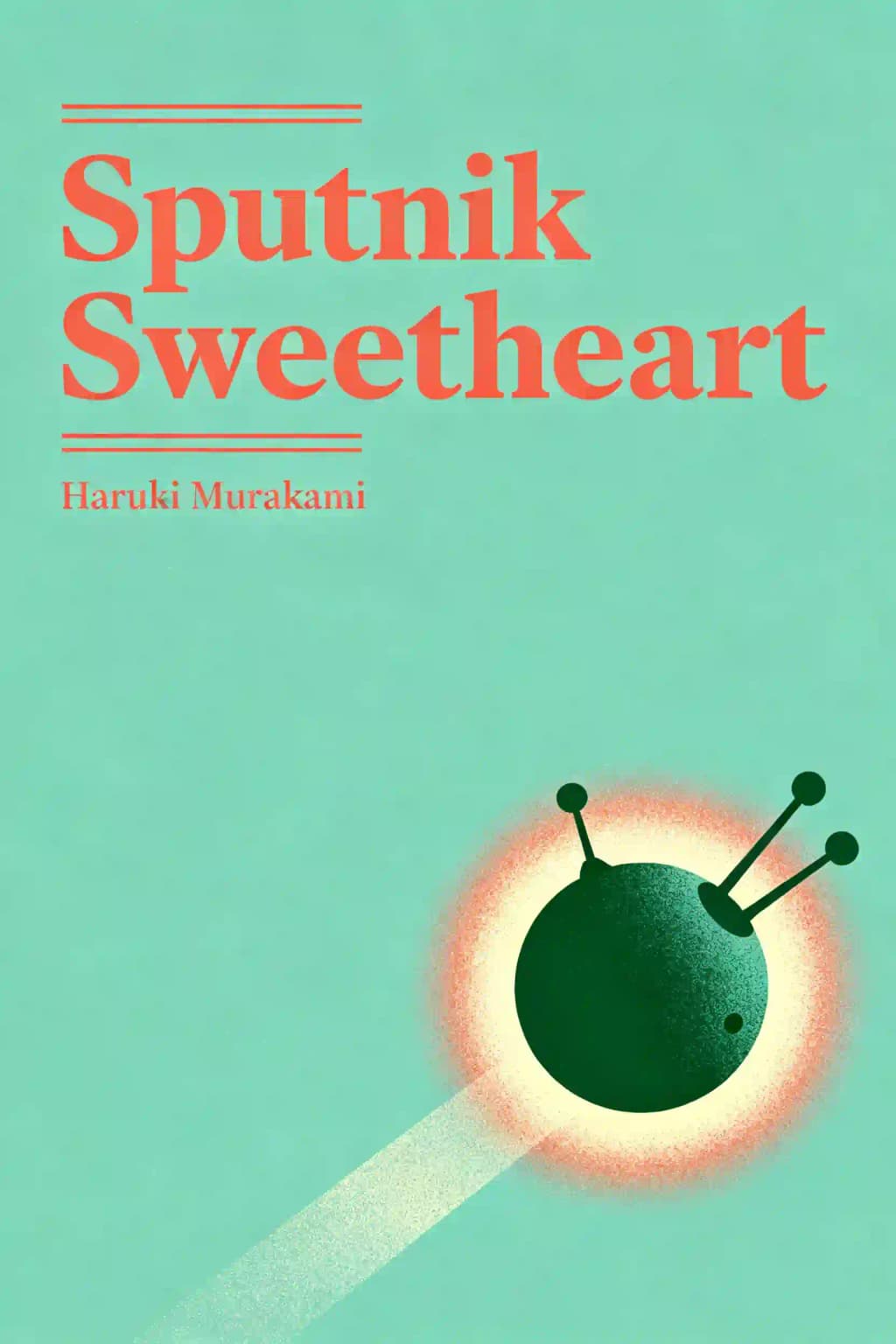
In Murakami's "Sputnik Sweetheart," loneliness and surrealism collide when a woman vanishes from a ferris wheel. This $1,600-collectible explores human disconnection with such hypnotic prose that readers report being utterly transformed by its haunting ferris wheel scene.
Haruki Murakami is the bestselling author of Sputnik Sweetheart and one of the most internationally renowned contemporary Japanese writers, celebrated for his distinctive blend of magical realism, surrealism, and modern existential themes. Born in Kyoto in 1949, Murakami studied drama at Waseda University and later ran a jazz bar with his wife for seven years—an experience that profoundly shaped his literary sensibility and frequent incorporation of Western music and culture.
Sputnik Sweetheart, published in 1999, explores themes of unrequited love, loneliness, and identity through Murakami's signature dreamlike narrative style.
His other acclaimed novels include Norwegian Wood, a melancholic bestseller; Kafka on the Shore; The Wind-Up Bird Chronicle; and the epic 1Q84. Murakami's debut, Hear the Wind Sing, won the Gunzo Award in 1979, launching a prolific career. His work has been translated into more than fifty languages and has earned prestigious honors including the Jerusalem Prize and Franz Kafka Prize.
Sputnik Sweetheart by Haruki Murakami is a love story centered on an unconventional triangle of unrequited affections. The narrator K loves his best friend Sumire, an aspiring writer who falls hopelessly in love with Miu, an older businesswoman with mysterious white hair. When Sumire mysteriously disappears during a trip to Greece with Miu, K travels to find her, uncovering supernatural occurrences and exploring the boundaries between reality and dreams.
Sputnik Sweetheart is ideal for readers who appreciate literary fiction exploring loneliness, identity, and unconventional relationships. Fans of Haruki Murakami's signature surrealism and magical realism will enjoy this shorter work, though newcomers should expect his characteristic ambiguity and dreamlike narratives. The book appeals to those interested in LGBTQ+ themes, psychological complexity, and philosophical questions about human connection and isolation in modern life.
Sputnik Sweetheart is worth reading for its profound meditation on human longing and beautiful, simple prose, though it may not be Murakami's most accessible work. At nearly novella length, it presents his core themes of loneliness and transformation in a more concise form than his epic novels. However, readers should expect Murakami's characteristic "weirdness" and an open-ended conclusion that leaves many questions unanswered.
The primary themes in Sputnik Sweetheart include unrequited love, loneliness, transformation, and the split between mind and body. Murakami explores how desire can fracture identity, symbolized through Miu's literal splitting into two selves after a traumatic experience. Other significant themes include societal conformity, sexual identity, the mystical connection between dreams and reality, and the metaphor of people as satellites—traveling companions who remain fundamentally alone in separate orbits.
The title Sputnik Sweetheart originates from a conversation where Miu accidentally calls Sumire a "Sputnik" instead of "Beatnik" when discussing poets. In Russian, "Sputnik" means "traveling companion," which becomes a central metaphor for the relationships in Haruki Murakami's novel. The metaphor captures the tragic irony of characters who orbit close to each other yet remain isolated—"wonderful traveling companions but in the end no more than lonely lumps of metal in their own separate orbits".
Sputnik Sweetheart features Haruki Murakami's characteristically ambiguous ending that refuses clear resolution. After months of Sumire's disappearance, K receives an unexpected phone call from her, claiming she's back at the phone booth near her apartment where she always called him from. She asks him to come get her, but Murakami leaves readers uncertain whether this reunion is real, a dream, or represents K moving into an alternate reality where his love might be reciprocated.
The love triangle in Sputnik Sweetheart by Haruki Murakami consists entirely of unrequited relationships: K loves Sumire, Sumire loves Miu, and Miu cannot fully reciprocate due to her fractured self. K, a schoolteacher, harbors deep feelings for his best friend Sumire, who develops intense romantic and sexual feelings for Miu, an older businesswoman. The novel also features a parallel relationship where Carrot's mother loves K, extending the chain of one-way affections that explores how desire moves in only one direction.
The main characters in Sputnik Sweetheart include K, the narrator and schoolteacher who loves Sumire; Sumire, an aspiring writer and free-spirited nonconformist; and Miu, a successful businesswoman with prematurely white hair. Supporting characters include Carrot, K's student who struggles with shoplifting, and Carrot's mother, a married woman having an affair with K. Each character embodies themes of isolation and societal misfit, with K feeling disconnected from his family and Sumire resisting conventional life.
Sumire mysteriously disappears after attempting to physically connect with Miu during their trip to a Greek island. After Miu rejects Sumire's romantic advance—explaining she cannot respond because she's missing half of herself—Sumire vanishes overnight without explanation. K travels to Greece to investigate but finds only ambiguous clues suggesting Sumire may have crossed into another reality or dimension, consistent with Haruki Murakami's exploration of parallel worlds where lost parts of ourselves exist.
Sputnik Sweetheart is significantly shorter than Haruki Murakami's popular novels like Norwegian Wood or Dance, Dance, Dance, reading almost like a novella. While it contains Murakami's signature themes—loneliness, surrealism, unrequited love, mysterious disappearances, and dreamlike narratives—it presents them in a more concentrated, concise form. The book explores similar mystical territory as his other works but with a tighter focus on a specific love triangle rather than the sprawling, epic storylines found in 1Q84 or The Wind-Up Bird Chronicle.
Critics note that Sputnik Sweetheart exemplifies Haruki Murakami's "weirdness" and surrealism, which can make the book difficult to recommend to general readers. The lack of a clear, concise ending frustrates readers seeking closure, as Murakami leaves Sumire's fate and K's final phone call deliberately ambiguous. Some reviewers suggest the novel's brevity prevents the deep character development found in Murakami's longer works, and the heavy reliance on metaphysical events may feel inaccessible to those unfamiliar with his magical realist style.
Miu's white hair in Sputnik Sweetheart symbolizes her psychological and spiritual fracturing after a traumatic experience. She explains to Sumire that her naturally dark hair turned completely white after an otherworldly encounter where she witnessed her doppelgänger engaging in sexual acts through binoculars—an event that literally split her in two. This supernatural hair transformation represents the mystic theme in Haruki Murakami's work: how conscience and trauma can physically alter reality, leaving Miu as an "empty shell" unable to reciprocate Sumire's love.
著者の声を通じて本を感じる
知識を魅力的で例が豊富な洞察に変換
キーアイデアを瞬時にキャプチャして素早く学習
楽しく魅力的な方法で本を楽しむ
I don't have confidence anymore in the act of writing itself.
Love might appear suddenly like a tornado.
College was a waste of time.
She worries she's experiencing a delayed adolescence.
I want to be with Miu more than I want to write.
『Sputnik, mi amor』の核心的なアイデアを分かりやすいポイントに分解し、革新的なチームがどのように創造、協力、成長するかを理解します。
『Sputnik, mi amor』を素早い記憶のヒントに凝縮し、率直さ、チームワーク、創造的な回復力の主要原則を強調します。

鮮やかなストーリーテリングを通じて『Sputnik, mi amor』を体験し、イノベーションのレッスンを記憶に残り、応用できる瞬間に変えます。
何でも質問し、声を選び、本当にあなたに響く洞察を一緒に作り出しましょう。

"Instead of endless scrolling, I just hit play on BeFreed. It saves me so much time."
"I never knew where to start with nonfiction—BeFreed’s book lists turned into podcasts gave me a clear path."
"Perfect balance between learning and entertainment. Finished ‘Thinking, Fast and Slow’ on my commute this week."
"Crazy how much I learned while walking the dog. BeFreed = small habits → big gains."
"Reading used to feel like a chore. Now it’s just part of my lifestyle."
"Feels effortless compared to reading. I’ve finished 6 books this month already."
"BeFreed turned my guilty doomscrolling into something that feels productive and inspiring."
"BeFreed turned my commute into learning time. 20-min podcasts are perfect for finishing books I never had time for."
"BeFreed replaced my podcast queue. Imagine Spotify for books — that’s it. 🙌"
"It is great for me to learn something from the book without reading it."
"The themed book list podcasts help me connect ideas across authors—like a guided audio journey."
"Makes me feel smarter every time before going to work"

Sputnik, mi amorの要約をPDFまたはEPUBで無料でダウンロード。印刷やオフラインでいつでもお読みいただけます。
Imagine being trapped on a Ferris wheel at night, peering through binoculars at your own apartment window, only to see yourself inside with someone else. This haunting scene from "Sputnik Sweetheart" captures the novel's essence - we are all separated from each other and even from ourselves by invisible boundaries we cannot cross. Like the Soviet satellite that carried the dog Laika into endless orbit, Murakami's characters circle each other in their own emotional trajectories, close enough to see but too distant to touch. They become cosmic travelers, forever longing for connections they can never fully achieve. The story unfolds through three characters caught in a triangle of unrequited desire: Sumire, a bohemian aspiring writer; Miu, a sophisticated businesswoman seventeen years her senior; and an unnamed narrator, a pragmatic schoolteacher. Their orbital dance - the narrator loves Sumire who loves Miu who cannot love anyone physically - creates a meditation on loneliness that has resonated with readers worldwide, from teenagers navigating their first heartbreaks to celebrities like Phoebe Bridgers and David Bowie.
