第1章
Digital Dystopia's Prophetic Warning
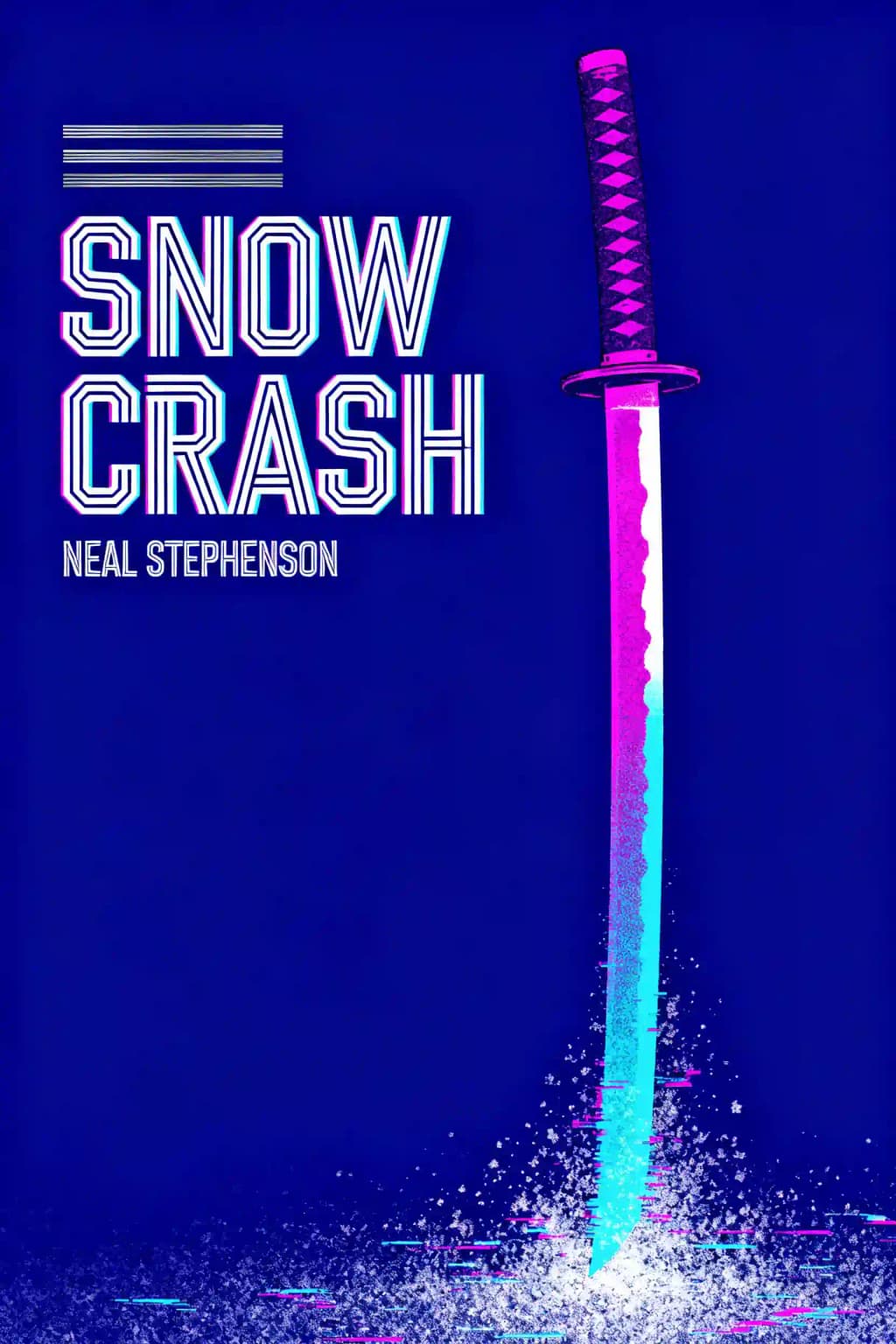
Snow Crash exploded onto the literary scene in 1992, becoming an instant cultural phenomenon that forever changed how we think about the internet, virtual reality, and digital identity. Neal Stephenson's cyberpunk masterpiece predicted concepts like the metaverse decades before Mark Zuckerberg made it his corporate mission. The book has achieved near-religious status among Silicon Valley tech leaders-Sergey Brin and Larry Page cite it as inspiration for Google Earth, while John Carmack (Oculus VR) calls it required reading for understanding virtual worlds. Beyond tech circles, it's beloved by readers worldwide for its perfect blend of high-concept ideas and adrenaline-pumping action. Thirty years after publication, Snow Crash remains startlingly prescient-a warning about corporate power, viral information, and the blurred lines between our physical and digital selves that feels more urgent today than when it was written.
第2章
The Deliverator's Digital Duality
In the novel's opening scene, we meet Hiro Protagonist-yes, that's his actual name-as "The Deliverator," a pizza delivery driver for the Mafia-owned CosaNostra Pizza. This isn't just any delivery job; it's life-or-death. In this fragmented future America, pizza delivery is serious business with military-grade vehicles and strict time guarantees. When Hiro crashes his high-tech delivery car into an empty swimming pool while trying to make an impossible deadline, he meets Y.T. (Yours Truly), a teenage "Kourier" who offers to complete his delivery.
This opening sequence brilliantly establishes the novel's dual-reality premise. In the physical world, Hiro is a down-on-his-luck pizza delivery guy living in a storage unit. But in the Metaverse-Stephenson's virtual reality universe-he's royalty: "Last of the freelance hackers, Greatest swordfighter in the world." This duality runs throughout the narrative, showing how digital identity can transcend physical limitations.
The contrast between Hiro's cramped U-Stor-It living quarters and his magnificent Metaverse mansion underscores a key theme: in a world where physical space has been commodified and privatized, the virtual realm offers freedom and status otherwise unattainable. As Hiro explains, "When Hiro first saw this place ten years ago, the monorail hadn't been built yet; he and his buddies had to write car and motorcycle software to get around. They would take their software out and race it in the black desert of the electronic night."
This digital escapism isn't mere entertainment-it's economic necessity in a hypercapitalist America where everything, including security and citizenship, has been privatized. The government has collapsed into irrelevance, replaced by corporate "Burbclaves" and "Franchise-Organized Quasi-National Entities" (FOQNEs) like Mr. Lee's Greater Hong Kong and New South Africa. Even the Central Intelligence Agency has been privatized into the Central Intelligence Corporation, where Hiro works as a freelance "stringer" collecting information.
第3章
The Metaverse: Digital Refuge from Dystopia
The Metaverse represents Stephenson's most enduring contribution to our technological imagination-a fully immersive virtual reality where people interact through customizable avatars. Unlike the physical world's decay and franchise-dominated landscape, the Metaverse offers infinite possibilities: "The Street is a grand boulevard going all the way around the equator of a black sphere with a radius of a bit more than ten thousand kilometers. That makes it 65,536 kilometers around, which is a number that happens to be exactly 2 to the sixteenth power."
This mathematically precise digital universe reflects its creation by hackers who appreciate powers of two, embedding their cultural values directly into the architecture of virtual space. Within this vast digital expanse, users can build impossible architecture, defy physics, and create neighborhoods limited only by imagination and programming skill. Floating palaces hover alongside twisted geometric forms that could never exist in reality, while virtual parks stretch endlessly in impossible directions. The Street itself-the Metaverse's main thoroughfare-hosts 120 million daily users, representing "the hundred million richest, most connected people on earth" plus those accessing through public terminals scattered throughout the physical world's urban landscapes.
The Metaverse's social stratification mirrors reality's inequalities with stark precision. Elite users have high-resolution, custom-designed avatars with fluid movements and photorealistic details, while those accessing from public terminals appear as crude black-and-white figures-the digital equivalent of wearing secondhand clothes. These "Clints" and "Brandys" (default male and female avatars) mark their users as members of the digital underclass, unable to afford the hardware or bandwidth for more sophisticated representations. Status is displayed not just through avatar quality but through virtual real estate ownership, custom programming abilities, and access to exclusive venues. At the pinnacle of this virtual society sits The Black Sun, an exclusive nightclub created by Hiro and his friend Da5id, where only a few thousand people worldwide can enter, making it the ultimate symbol of digital elitism.
Stephenson's description of The Black Sun reveals his deep understanding of both technical constraints and social dynamics: "Everything is matte black, which makes it easier for the computer to draw things in on top of it-no worries about filling in a complicated background. And it's easy on the eyes." This pragmatic approach to virtual design shows how technical limitations shape social spaces, just as architecture does in the physical world. The club's design demonstrates how even in virtual space, form follows function, but with function defined by computational efficiency rather than physical constraints. The Black Sun's popularity stems not just from its exclusivity but from its superior performance - it runs faster and smoother than other virtual venues, making it the preferred gathering place for the digital elite who can appreciate both its technical and social sophistication.
The Metaverse thus emerges as both utopia and dystopia - a space of unlimited possibility that nonetheless recreates and perhaps amplifies the social hierarchies of the physical world. Its structure reflects the values and limitations of its creators, while its social dynamics reveal how humanity's tendencies toward stratification persist even in virtual space.
第4章
Snow Crash: When Code Becomes Contagion
The novel's central threat emerges when Hiro witnesses his friend Da5id collapse after viewing something called "Snow Crash"-both a computer virus in the Metaverse and a drug in Reality. This dual-nature threat operates across the digital-physical divide, suggesting a deeper connection between computer code and human consciousness.
The term itself combines computer terminology-"snow" refers to television static from poor reception, and "crash" means system failure-with biological concepts of viral infection. When a stranger offers Da5id a hypercard containing Snow Crash, he confidently accepts it, believing his superior programming skills make him immune. His hubris proves fatal when the program causes his avatar to disintegrate into "a jittering cloud of bad digital karma" before affecting his physical brain.
Juanita, Hiro's ex-girlfriend and Da5id's ex-wife, explains the mechanism: "This Snow Crash thing-is it a virus, a drug, or a religion?" Hiro asks. Juanita responds, "What's the difference?" This provocative equivalence suggests that all three operate by reprogramming human thought patterns. Snow Crash exploits a fundamental vulnerability in the human operating system-our susceptibility to certain types of information.
The virus works by displaying a pattern that travels directly through the optic nerve into the brain, bypassing conscious thought. As Juanita explains, "Your brain is a computer... And it can be hacked." This concept brilliantly extends computer security metaphors to human cognition, suggesting that minds, like machines, contain exploitable vulnerabilities.
Stephenson grounds this seemingly fantastical concept in neurolinguistic theory and ancient mythology. The Snow Crash virus is revealed to be a modern version of an ancient Sumerian "nam-shub" or linguistic virus created by the god-like figure Enki. This connection between ancient language and modern code becomes the novel's central mystery, linking contemporary hacker culture to prehistoric information technology.
第5章
L. Bob Rife: Information Monopolist
Behind Snow Crash stands L. Bob Rife, a telecommunications magnate who combines elements of real-world figures like Rupert Murdoch, Bill Gates, and televangelists. Rife owns the global fiber-optic network-the physical infrastructure of the information age-and has expanded his empire to include religious franchises (Reverend Wayne's Pearly Gates) and even an aircraft carrier converted into his personal yacht.
Rife represents the dangers of information monopoly in its most extreme form. He doesn't just control the pipes through which information flows; he seeks to control human minds directly. As he explains in a chilling interview: "I got this whole system that's incredibly fucking complex and beautiful. I'm the only one who understands it. Even the guys who're supposed to be running it for me don't understand it. Which is just fine by me, Fido, because there's a lot of power in that... I'm developing a biological agent that will make it possible for me to control the information no matter where it is-on a hard disk, in a book, or inside someone's fucking brain."
This megalomaniacal vision connects contemporary concerns about media consolidation with ancient myths of mind control. Rife has discovered that the Sumerian language contained a "neurolinguistic virus" that made its speakers susceptible to programming through linguistic "me"-fundamental rules governing all aspects of civilization. By resurrecting this ancient technology, Rife aims to create a population of programmable humans.
Rife's most visible project is "the Raft"-a massive floating structure built around his aircraft carrier Enterprise, carrying refugees from Asia toward America. These refugees serve as test subjects for his mind-control experiments, many speaking in glossolalia (speaking in tongues) after being infected. The Raft physically manifests Rife's information network-a tangled mass of vessels connected by makeshift bridges, cables, and social hierarchies, all ultimately controlled from the center.
第6章
Ancient Viruses in Modern Minds
Stephenson's narrative takes a fascinating detour into Sumerian mythology and linguistics, suggesting that ancient civilizations understood concepts we now associate with computer science. Through the Librarian-an artificial intelligence research assistant-Hiro discovers that Sumerian civilization may have been controlled by "me," which functioned like linguistic programming. These "me" were not merely cultural practices but precise instructions encoded in language itself, comparable to modern computer code:
"The me were like algorithms for carrying out certain activities essential to the society... They were like little programs for humans. A human being who knew the me for a particular task could carry it out automatically, just as a computer can execute a program without understanding it."
The novel explores how these ancient "programs" controlled everything from bread-baking to temple rituals, religious ceremonies, and even social hierarchies. Each me contained specific instructions that, when properly transmitted, could program human behavior with remarkable precision. This system allowed Sumerian civilization to maintain complex social structures and technological achievements that would have been impossible without this linguistic operating system.
This concept bridges ancient and modern information technology, suggesting that human brains have always been programmable systems. The Sumerian language itself is portrayed as uniquely powerful-an "operating system" for human thought that allowed direct programming of behavior. Its structure, with its precise grammatical rules and embedded metaphysical concepts, made it particularly effective at transmitting complex instructions directly to the human brain's deep processing centers.
According to Lagos (a researcher whose work Hiro inherits), the god Enki created a "nam-shub" or linguistic virus that reprogrammed human brains to be unable to understand Sumerian, creating the multiplicity of languages described in the Biblical Tower of Babel story. This nam-shub worked like a computer virus, spreading from person to person through ordinary conversation, gradually erasing their ability to process Sumerian language patterns.
This linguistic fragmentation served as a defense mechanism against the more dangerous "metavirus" that had previously controlled humanity through a shared language. By forcing linguistic diversification, Enki essentially patched a security vulnerability in the human operating system, making people resistant to large-scale linguistic programming-until Rife rediscovered the technique. The novel suggests that this ancient "hack" created the modern human mind, with its capacity for individual thought and resistance to mass programming.
Stephenson's integration of ancient mythology, linguistics, and computer science creates a compelling alternative history of human consciousness. The novel suggests that rational, independent thought isn't humanity's natural state but rather the result of an ancient "hack" that liberated us from viral programming. This perspective casts modern computer viruses as descendants of ancient mind-control techniques, and religion as a form of benign viral infection that structures human thought. The parallel between ancient Sumerian me and modern computer code suggests that human vulnerability to programming, whether through language, religion, or computer viruses, is a fundamental aspect of our neural architecture.
The novel further explores how this ancient system of linguistic programming might manifest in the modern world, particularly through the power of memes, viral marketing, and digital communication. It suggests that while we may have escaped the direct programming of Sumerian me, our brains remain susceptible to various forms of information viruses, from advertising jingles to political slogans, operating on the same fundamental principles as their ancient predecessors.
第7章
Y.T.: Teenage Courier in a Corporate World
While Hiro investigates the intellectual puzzle of Snow Crash, Y.T. provides the novel's street-level perspective. As a fifteen-year-old "Kourier" who delivers packages on her high-tech skateboard, Y.T. navigates the physical landscape of fragmented America with remarkable adaptability. Her equipment-from her "RadiKS Mark IV Smartwheels" that adjust to terrain, to her "poon" (magnetic harpoon) that lets her hitch rides on vehicles-represents practical solutions to urban mobility in a world where public infrastructure has collapsed.
Y.T.'s character embodies teenage rebellion adapted to corporate reality. She works for RadiKS (Radical Knights of the Skateboard), a courier company with corporate structure but countercultural aesthetics. When arrested by MetaCops Unlimited security forces, she displays both teenage bravado and strategic thinking, using her specialized equipment-including a "dentata" (a female anti-rape device)-to escape.
Her relationship with the Mafia, particularly Uncle Enzo (the Godfather-like leader of Nova Sicilia), provides some of the novel's most touching moments. After completing a pizza delivery for CosaNostra Pizza, Y.T. earns Uncle Enzo's personal gratitude. Their subsequent meeting reveals unexpected depth in both characters. Uncle Enzo shares that he volunteered for Vietnam specifically to anger his father, showing how rebellion crosses generations. Before they part, he gives Y.T. his dog tags, still warm from his neck, telling her they might help if she ever finds herself in trouble.
This human connection in a dehumanized world shows how personal relationships persist despite corporate structures. The Mafia, ironically, represents old-fashioned values in a world of franchise anonymity. As one character explains: "The Mafia way is that we pursue larger goals under the guise of personal relationships." This blend of business and family-however dysfunctional-contrasts with the purely transactional relationships of other corporate entities.
第8章
Raven: The Ultimate Badass
Every great thriller needs a memorable villain, and Stephenson delivers with Raven-an Aleut harpooner whose forehead tattoo reading "POOR IMPULSE CONTROL" understates his volatile nature. Standing nearly seven feet tall with obsidian-black hair and penetrating eyes, Raven embodies physical menace in its purest form, serving as a stark contrast to Rife's intellectual manipulation. His signature weapons are molecular-sharp glass knives, crafted from volcanic glass and undetectable by metal sensors, allowing him to bypass even the most sophisticated security systems. He moves with a preternatural speed that seems impossible for his massive frame, demonstrating a deadly grace that makes him nearly impossible to track or counter. Most terrifying of all, he carries a hydrogen bomb in his motorcycle's sidecar, wired to his vital signs and set to detonate if his heart stops beating - making him effectively untouchable.
Raven's backstory weaves personal tragedy with historical atrocity in a way that transforms him from simple antagonist to complex avenger. His father, blinded during the atomic bombing of Nagasaki while serving as a prisoner of war, later returned home only to witness American nuclear tests in the Aleutian Islands that irreversibly contaminated their ancestral homeland. This double nuclear victimization - first as collateral damage in war, then as unwitting test subjects - created a multi-generational trauma that fuels Raven's implacable vendetta against America. His partnership with Rife isn't merely mercenary but ideological, seeing corporate power as a tool to strike back at the system that destroyed his people's way of life.
Despite his fearsome reputation and body count, Raven reveals unexpected layers through his interactions with Y.T. His Russian Orthodox faith manifests in quiet moments of reflection and ritual, while his knowledge of Aleut folklore and tradition shows a deep connection to his cultural heritage. His growing protective instinct toward Y.T. transcends his role as Rife's enforcer, suggesting a capacity for genuine human connection that makes his character all the more tragic. These glimpses of humanity make him more than a simple antagonist - he becomes a living embodiment of historical wounds weaponized by corporate greed.
The climactic confrontation between Hiro and Raven unfolds simultaneously across Reality and the Metaverse, creating a masterpiece of parallel action. As their avatars clash in the digital realm with ancient swords and modern code, their physical bodies engage in a brutal chase through LAX airport, each reality informing and affecting the other. This dual-layer showdown serves as the perfect culmination of the novel's themes, demonstrating how the digital and physical worlds have become inextricably intertwined, and how ancient grievances find new expression in modern conflicts. The fight sequence showcases Raven's mastery of both traditional combat and modern technology, making him the ideal final obstacle in Hiro's quest.
第9章
The Rat Things: When Dogs Become Cybernetic Weapons
Among Stephenson's most memorable creations are the Rat Things-cybernetically enhanced dogs serving as security systems for Mr. Lee's Greater Hong Kong franchulates. These creatures combine biological brains with mechanical bodies capable of running at 700 mph, creating security systems that are both terrifyingly effective and strangely sympathetic. Their titanium-reinforced frames house sophisticated weapons systems and cooling mechanisms, while their canine brains remain intact, preserved in a bath of cryogenic fluid to prevent overheating during high-speed runs.
The Rat Things retain their canine consciousness and emotional connections despite their weaponized bodies. When Y.T. helps an injured Rat Thing return to its "hutch" (cooling station), she creates an unexpected ally. The hutches themselves are technological marvels, featuring liquid nitrogen cooling systems and advanced diagnostic equipment. These facilities serve as both maintenance stations and homes where the Rat Things can experience their virtual reality "doggy paradise" - complete with endless fields to run in and infinite tennis balls to chase.
Later, we discover this particular Rat Thing might be her childhood pet Fido, who recognizes her as "the nice girl who loves him." This revelation adds layers of complexity to the nature of consciousness and memory in cybernetic beings. The Rat Things' programming includes strict behavioral constraints, yet their emotional cores remain fundamentally canine - loyal, protective, and capable of deep emotional bonds.
This relationship culminates when Fido breaks his programming constraints to save Y.T., racing across the country at supersonic speed. Stephenson writes: "The Rat Thing, which thinks of itself as a dog named Fido, has begun a long, loping run down the center of the runway. Its paws, which can accelerate it to sixty miles per hour in a couple of seconds, are digging divots in the concrete." The description of Fido's rescue mission includes vivid details of his mechanical body pushing beyond design limits, coolant systems struggling to keep pace, and his unwavering determination to reach Y.T.
The Rat Things represent Stephenson's nuanced view of human-technology integration. Rather than presenting cybernetic enhancement as dehumanizing, he suggests it might amplify existing qualities-including emotional connections and loyalty. As their creator Ng explains to Y.T., "We're not computers, Y.T., we're physical objects, our brains are made of meat... We have to use our brains as best we can." This philosophy extends beyond the Rat Things to challenge broader assumptions about artificial intelligence and consciousness, suggesting that true intelligence - whether natural or enhanced - cannot be separated from emotional capacity and physical embodiment.
The Rat Things also serve as a commentary on the militarization of technology, showing how even the most advanced weapons systems remain tethered to fundamental biological and emotional realities. Their dual nature - both cutting-edge weapon and loving pet - highlights the complex relationships between technology, consciousness, and human connection in Stephenson's metaverse.
第10章
Digital Prophecy: Snow Crash's Enduring Legacy
Snow Crash concludes with Hiro thwarting Rife's plan to infect the world's hackers with the Snow Crash virus. By infiltrating the center of Rife's virtual "egg" and activating his "SnowScan" defensive program, Hiro transforms the virus into an advertisement for his security consulting business. This clever resolution maintains the novel's satirical edge while providing narrative satisfaction.
What makes Snow Crash remarkable thirty years later isn't just its thrilling plot but its prescient vision of our digital future. Stephenson coined terms like "avatar" for online representations and "Metaverse" for virtual reality spaces that have become standard terminology. His vision of a privatized America dominated by corporate franchises feels increasingly plausible in an era of weakening government and strengthening corporate power.
Most importantly, Snow Crash anticipated how information technology would reshape human consciousness and society. The novel's central metaphor-that minds can be hacked like computers-has moved from science fiction to mainstream concern as social media algorithms, targeted advertising, and information warfare demonstrate the vulnerability of human cognition to digital manipulation.
The novel's exploration of viral information predated internet memes, fake news, and information cascades that now dominate our digital landscape. Stephenson understood that in an information economy, controlling minds is the ultimate form of power-whether through corporate advertising, religious programming, or algorithmic manipulation.
Snow Crash ultimately delivers a warning about surrendering our mental autonomy to technological systems we don't understand. As Juanita tells Hiro, "We are all susceptible to the pull of viral ideas... Memes propagate like viruses... Who knows what evil lurks in the hearts of men? The Deliverator knows, because he gets his tip percentage."
In our world of increasing digital immersion and information manipulation, Snow Crash remains not just entertaining but essential-a prophetic warning about protecting our minds in the age of viral information.