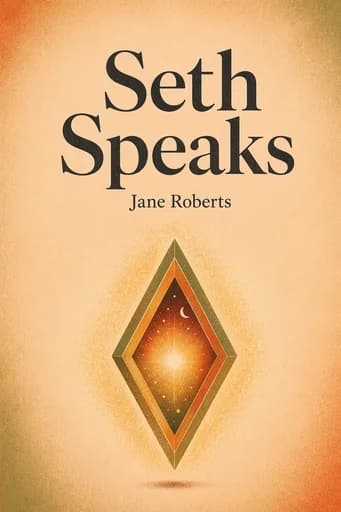
『セスは語る』の概要
ジェーン・ロバーツがトランス状態でチャネリングした『セスは語る』は、死後の意識を形而上学的な洞察とともに探求し、1972年以来、精神世界の考え方に変革をもたらしてきました。8,500件を超える熱狂的なレビューが寄せられ、イェール大学にも保管されているこの現実を覆す古典的名著には、どのような永遠の真理が待ち受けているのでしょうか?
セスは語るの要約をダウンロード
セスは語るの要約をPDFまたはEPUBで無料でダウンロード。印刷やオフラインでいつでもお読みいただけます。
ジェーン・ロバーツがトランス状態でチャネリングした『セスは語る』は、死後の意識を形而上学的な洞察とともに探求し、1972年以来、精神世界の考え方に変革をもたらしてきました。8,500件を超える熱狂的なレビューが寄せられ、イェール大学にも保管されているこの現実を覆す古典的名著には、どのような永遠の真理が待ち受けているのでしょうか?
セスは語るの要約をPDFまたはEPUBで無料でダウンロード。印刷やオフラインでいつでもお読みいただけます。
コロンビア大学卒業生が開発 サンフランシスコ発
"Instead of endless scrolling, I just hit play on BeFreed. It saves me so much time."


"I never knew where to start with nonfiction—BeFreed’s book lists turned into podcasts gave me a clear path."


"Perfect balance between learning and entertainment. Finished ‘Thinking, Fast and Slow’ on my commute this week."
"Crazy how much I learned while walking the dog. BeFreed = small habits → big gains."
"Reading used to feel like a chore. Now it’s just part of my lifestyle."

"Feels effortless compared to reading. I’ve finished 6 books this month already."
"BeFreed turned my guilty doomscrolling into something that feels productive and inspiring."

"BeFreed turned my commute into learning time. 20-min podcasts are perfect for finishing books I never had time for."
"BeFreed replaced my podcast queue. Imagine Spotify for books — that’s it. 🙌"

"It is great for me to learn something from the book without reading it."
"The themed book list podcasts help me connect ideas across authors—like a guided audio journey."
"Makes me feel smarter every time before going to work"
コロンビア大学卒業生が開発 サンフランシスコ発
"Instead of endless scrolling, I just hit play on BeFreed. It saves me so much time."
"I never knew where to start with nonfiction—BeFreed’s book lists turned into podcasts gave me a clear path."
"Perfect balance between learning and entertainment. Finished ‘Thinking, Fast and Slow’ on my commute this week."
"Crazy how much I learned while walking the dog. BeFreed = small habits → big gains."
"Reading used to feel like a chore. Now it’s just part of my lifestyle."
"Feels effortless compared to reading. I’ve finished 6 books this month already."
"BeFreed turned my guilty doomscrolling into something that feels productive and inspiring."
"BeFreed turned my commute into learning time. 20-min podcasts are perfect for finishing books I never had time for."
"BeFreed replaced my podcast queue. Imagine Spotify for books — that’s it. 🙌"
"It is great for me to learn something from the book without reading it."
"The themed book list podcasts help me connect ideas across authors—like a guided audio journey."
"Makes me feel smarter every time before going to work"
"Instead of endless scrolling, I just hit play on BeFreed. It saves me so much time."
"I never knew where to start with nonfiction—BeFreed’s book lists turned into podcasts gave me a clear path."
"Perfect balance between learning and entertainment. Finished ‘Thinking, Fast and Slow’ on my commute this week."
"Crazy how much I learned while walking the dog. BeFreed = small habits → big gains."
"Reading used to feel like a chore. Now it’s just part of my lifestyle."
"Feels effortless compared to reading. I’ve finished 6 books this month already."
"BeFreed turned my guilty doomscrolling into something that feels productive and inspiring."
"BeFreed turned my commute into learning time. 20-min podcasts are perfect for finishing books I never had time for."
"BeFreed replaced my podcast queue. Imagine Spotify for books — that’s it. 🙌"
"It is great for me to learn something from the book without reading it."
"The themed book list podcasts help me connect ideas across authors—like a guided audio journey."
"Makes me feel smarter every time before going to work"
"Instead of endless scrolling, I just hit play on BeFreed. It saves me so much time."
"I never knew where to start with nonfiction—BeFreed’s book lists turned into podcasts gave me a clear path."
"Perfect balance between learning and entertainment. Finished ‘Thinking, Fast and Slow’ on my commute this week."
"Crazy how much I learned while walking the dog. BeFreed = small habits → big gains."
"Reading used to feel like a chore. Now it’s just part of my lifestyle."
"Feels effortless compared to reading. I’ve finished 6 books this month already."
"BeFreed turned my guilty doomscrolling into something that feels productive and inspiring."
"BeFreed turned my commute into learning time. 20-min podcasts are perfect for finishing books I never had time for."
"BeFreed replaced my podcast queue. Imagine Spotify for books — that’s it. 🙌"
"It is great for me to learn something from the book without reading it."
"The themed book list podcasts help me connect ideas across authors—like a guided audio journey."
"Makes me feel smarter every time before going to work"




セスは語るの同じアイデアを、あなたに合う声・深さ・ペースで学べます。いつでも切り替えられます。
In 1963, a young poet named Jane Roberts experienced a profound psychic awakening that would forever alter her life and influence spiritual thought for generations. During a routine evening, her consciousness suddenly left her body, returning with automatic writing titled "The Physical Universe as Idea Construction." This experience initiated what would become one of the most significant channeling phenomena of the 20th century-the emergence of Seth, a self-described "energy personality essence no longer focused in physical form." Seth Speaks became an underground sensation that influenced luminaries from Deepak Chopra to Marianne Williamson, and continues to resonate with seekers of spiritual truth today. Through Roberts' remarkable trance sessions, meticulously documented by her husband Robert Butts, Seth delivered a revolutionary framework for understanding consciousness, reality, and the nature of the soul that challenged conventional Western thinking about existence itself.
Seth's core message begins with a fundamental assertion: you are not merely a physical being bound by flesh. Your physical body and the material world you perceive are simply the most apparent manifestations of your multidimensional identity. "Consciousness creates form, not the other way around," Seth insists. Your physical senses, while allowing you to navigate three-dimensional reality, also limit your perception of other equally valid dimensions of existence. This limitation, however, serves a purpose - it allows for focused experience and growth within the physical realm while other aspects of consciousness operate simultaneously on different levels. Within this framework, Seth describes a structure of self that extends far beyond our everyday awareness. The "outer ego" manages physical experience, acting as a specialized focus point for material reality, making decisions, and interpreting sensory data. Meanwhile, the "inner ego" directs inner activities, perceiving reality beyond three-dimensional limitations, carrying memories of past existences, and maintaining physical functions through countless unconscious processes. This inner self is naturally clairvoyant and telepathic, continuously communicating with other aspects of consciousness in ways the outer ego rarely notices. The inner ego orchestrates everything from cellular repair to intuitive insights, operating beneath our conscious awareness. Beyond both inner and outer egos lies what Seth calls the "entity" or "soul" - the multidimensional personality from which all incarnations spring. This entity exists outside conventional time and space, simultaneously experiencing multiple lives while maintaining distinct individual focuses. It's comparable to a brilliant light source casting multiple shadows, with each shadow representing a different incarnation or probable self. This perspective fundamentally challenges our understanding of identity. The "you" that you identify with is merely one facet of a much larger consciousness. Your soul isn't something you have - it's what you are. Unlike religious conceptions of the soul as a static, finished thing, Seth describes it as alive, responsive, curious, and forever changing. It exists in a constant state of becoming, learning through subjective experience rather than time or space. Each moment of existence adds to its growth and understanding, contributing to an ever-expanding awareness. Most profoundly, Seth asserts that nothing exists - rock, mineral, plant, animal, or air - that isn't filled with its own kind of consciousness. There is no dead matter; everything rejoices in sensation and creativity. A stone possesses its own awareness, though vastly different from human consciousness. Plants demonstrate intelligence and responsiveness that transcends mere biological programming. Even subatomic particles exhibit a form of consciousness, making choices and responding to observation. This understanding transforms our relationship with the world around us, revealing a universe pulsating with awareness at every level, where consciousness itself is the fundamental building block of all reality. This expanded view suggests that consciousness isn't produced by the brain but rather flows through it, much like music through a radio. The physical world becomes not a limiting container but a rich medium through which consciousness expresses itself in endless variations and possibilities.
『セスは語る』の一語一語が音声に合わせてリアルタイムでハイライトされ、自然に読み進められます。
Perhaps Seth's most revolutionary teaching is that you create your own physical reality through your thoughts, beliefs, and emotions. This isn't simply positive thinking or wishful manifestation; Seth describes a concrete mechanism through which consciousness materializes into physical form, operating through precise metaphysical laws that govern the transformation of thought into matter. The process begins with electromagnetic energy units that exist beneath the range of physical matter - fundamental particles of consciousness that are smaller than atoms or quarks. These units are natural emanations from all consciousness, including human thought, animal awareness, and even the basic consciousness present in plants and minerals. They unite under certain laws of attraction and repulsion, following patterns that mirror the original thought or emotion that generated them. Under specific conditions, these units coagulate into matter, with high-intensity units materializing more quickly into physical form. "The intensity of a feeling or thought or mental image is the important element in determining its subsequent physical materialization," Seth explains. The more intense the core thought or emotion, the sooner its physical manifestation occurs - whether the mental image is fearful or joyful. This creates an important challenge: if you think in vivid mental-emotional images with high intensity, these will swiftly form into physical events. Therefore, pessimistic people with vivid imaginations will faithfully reproduce their negative thoughts in experience, while optimistic individuals with strong visualization abilities can manifest positive outcomes more readily. Seth describes coordinate points as sources of fantastic energy that act as channels between realities - cosmic transformers where consciousness converts into physical matter. These points impinge upon both time and space, creating locations where ideas and matter become more highly charged. Though smaller than any known particle, these pure energy accumulations cause minute alterations in gravity and physical laws in their vicinity. They serve as transformers, providing generating energy that makes creation continuous. These coordinate points exist throughout all space, forming a cosmic grid through which consciousness flows into physical manifestation. This understanding has profound implications for daily life and personal development. Your environment is not thrust upon you by some outside agency but is the physical materialization of your thoughts, beliefs, and emotions. Every object, circumstance, and relationship in your life reflects some aspect of your inner world. By changing your mental patterns - particularly your core beliefs and emotional responses - you can literally change your physical reality. The physical world you perceive is your own unique creation - a psychological projection made tangible through these metaphysical processes. Seth emphasizes that this creative process operates constantly, whether we're conscious of it or not. Our habitual thoughts and beliefs create persistent patterns in reality, while sudden intense emotions can manifest rapid changes. Understanding this mechanism allows for conscious reality creation, though it requires discipline, awareness, and careful attention to our mental and emotional states.
Seth challenges our linear conception of time and reincarnation, offering instead a multidimensional understanding where all lives exist simultaneously. "Progress doesn't exist in the terms you consider it to," Seth explains, "any more than time does." What we call reincarnational lives all exist simultaneously-they're not occurring one after another in a linear fashion. In this framework, you're not simply living one life at a time. You're an actor in multiple "period pieces" or "reincarnational dramas" occurring simultaneously across what we perceive as time. These various lives represent different aspects of your multidimensional personality, each exploring different challenges, abilities, and experiences. Your entire identity or soul participates in all these existences at once, though your conscious awareness in each life is typically limited to that particular focus. Seth uses a theatrical metaphor to explain this concept. Consider yourself an actor in a play set in the twentieth century. You create the props, settings, and themes-writing, producing, and acting in the entire production along with every other individual. You're so focused in your role, so entranced by the problems and hopes of your character that you've forgotten this reality is your own creation. Yet there are other plays occurring simultaneously in which you also participate-in the twelfth century, the eighteenth century, 500 B.C., or A.D. 3000. These settings also represent your environment, surrounding your entire personality. The portion of you participating in this period piece is so focused that you're unaware of these other existences. This simultaneous nature of time explains why progress cannot be measured in linear terms. In each reincarnational drama, different problems are set up. Progress can only be measured by how these problems were solved or not solved. The multidimensional self creates these various plays for its own purposes, not as punishments or rewards for previous existences. Through these plays, the multidimensional personality learns and grows through its own actions, trying out endless varieties of poses, behaviors, and attitudes. Consciousness is in a state of becoming, learning the art of actualization by creating varied conditions and challenges for itself-all done with spontaneity and unbounded joy.
Dreams serve as crucial bridges between physical reality and other dimensions of existence. Seth explains that the sleep and dream states involve the same dimension we'll experience after death, though we typically don't remember the most important parts of these nightly adventures. While the physical body sleeps, we exist consciously in a coherent, purposeful creative state, carrying on many activities that will be encountered after death. Just as waking life has memory and continuity, the dreaming self maintains an equally large body of memory with its own continuity. A portion of us remains aware of every dream encounter and experience. Dreams are no more hallucinatory than physical life-in fact, from the dreaming self's perspective, our physical self is the dreamer it sends on its way, and our daily experiences are the dreams it dreams. In dreams, you learn how to construct physical reality day by day, just as after death you learn to construct your next physical lifetime. You solve problems while sleeping and become consciously aware of these solutions during waking hours. In dreams you set goals, just as after death you establish goals for another incarnation. When you dream of flying, you're often actually doing so, operating under conditions similar to those after death. In dreams, you may speak with dead friends, revisit the past, travel through space instantly, meet guides, teach others, and perform meaningful work. Unlike physical life, there's no lag between conceiving an idea and its construction in dream reality. Seth suggests that our current sleep patterns-one extended block-are inefficient and create an artificial division between aspects of the self. Two three-hour periods would suffice for most people with proper suggestions for the body's recuperation. Brief naps rather than extended sleep would allow the conscious self to recall more dream adventures, create higher peaks of conscious focus, and eliminate the sharp division between areas of the self. Exploring your dreaming self is the best preparation for after-death reality, though few take the time to do so. Those who understand their dream nature won't find themselves alienated when their full attention turns in that direction after death.
Seth provides a comprehensive view of what happens at death, emphasizing that there's no single answer as each person is an individual with unique experiences. Death represents merely a longer pause in the pulsation of consciousness, directing awareness away from physical reality temporarily. After death, consciousness withdraws from the body either slowly or quickly depending on various factors. Beliefs strongly color experiences-fear of death can cause psychological panic leading to coma states; beliefs in heaven or hell create corresponding temporary hallucinations. An "honorary guard" of helpers, both living and dead, assists in orientation. The newly dead find themselves in another form that seems physical until they attempt to manipulate physical reality. Those with faith in afterlife adapt more easily. The after-death environment is generally more intense and joyful than physical reality, requiring understanding of new freedoms. Death is not an eternal resting place but another state of becoming, where abilities must be used and undeveloped talents faced. After examining the fabric of the life just left, consciousness becomes ready for knowledge of other existences. The newly dead often experience vivid hallucinations formed by their thoughts and emotions-these aren't invalid experiences but symbolic frameworks. Historical symbols like crossing the River Styx or Christian concepts of heaven and hell provide familiar reference points through which guides can communicate truth. For those still strongly focused in physical reality or needing recuperation, there are hospitals and rest homes in the initial stage after death. Some patients don't realize nothing is wrong with them, projecting illness onto their new body as they did their old one. They receive psychic treatment and learn their condition stems from their beliefs. Many individuals don't need this period. After death, three main paths open before you: reincarnation, exploring variations of your past life, or entering another probability system entirely. Your choices depend on your development and preferences. Some personalities prefer logical structures organized by past, present and future, and these typically choose reincarnation. Others with more intuitive natures prefer associative processes and choose probability systems.
『セスは語る』の一語一語が音声に合わせてリアルタイムでハイライトされ、自然に読み進められます。
Seth introduces the concept of probable realities-parallel existences that branch off from every decision point in our lives. At any moment, we face multitudinous choices of actions, both trivial and important. While we perceive reality as composed only of the actions we choose to take, Seth reveals that every possibility is actually explored in some reality. All actions begin as mental acts, and these mental acts are valid regardless of whether we physically actualize them. If you wanted to be a doctor but chose another profession, in some probable reality you are a doctor. These probable selves are portions of your identity or soul, which Seth describes as "a multidimensional, infinite act" creating dimensions for its fulfillment. Every decision point creates branches of probable realities. When faced with choices-like whether to accept a friend's invitation-each potential action has its own reality. Though we physically actualize only one choice, the others are carried out in parallel probable existences. These probable selves consider themselves the "real you," just as you consider yourself real. Because of the sympathetic relationship between your various selves, your experience isn't limited by physical perceptive mechanisms. You can draw upon knowledge from independent selves in other realities by learning to focus attention away from physical reality. Through imagination, and particularly in dreams, we can sometimes glimpse these other probable realities and even benefit from their experiences and abilities. There exists a natural attraction between yourself and other probable selves, with electromagnetic connections and psychic links that become especially active during dreams. In the dream state, with ego functions diminished, considerable communication occurs between various portions of your entire identity, giving glimpses of probable roads not taken. Your thoughts and feelings set patterns that determine which probable futures materialize as your physical experience. Through dreams and intuitions, probable selves can warn you of unfortunate events, allowing you to change course and avoid them.
Seth describes various states of consciousness that extend beyond our normal waking awareness, providing a map for inner exploration. Just one step away from normal waking consciousness lies what he calls "A-1"-a slightly separated state where remarkable abilities emerge. Here, consciousness can enter another's body to heal it, perceive one's own physical condition from within, and consciously manipulate matter from the inside. This state serves as a side platform from which to view physical events with greater clarity, temporarily released from bodily pressures. In this state, problems find solutions more readily, suggestions become more effective, and mental images gain greater mobility. With practice, you can perceive the present moment from unique internal perspectives, examining physical conditions by looking inward, entering your body as a miniature or point of light, then making adjustments by directing energy. Beyond A-1 lie deeper states that allow exploration of probable pasts and futures, communication with any personality across time, and access to a reservoir of innovations and world-changing inventions. In these states, you may encounter thought-forms, energy manifestations, and projections from personal or collective unconscious. These phenomena take symbolic form, appearing beneficial or threatening according to your attitude. Seth emphasizes that consciousness itself is the soul's tool that we're learning to use. True consciousness means perceiving physical reality by choice, knowing it as one of many realities, no longer forced to perceive it alone through ignorance. With practice, we can learn to control these consciousness shifts rather than being swept willy-nilly during sleep. Though waking consciousness seems continuous, it actually contains significant fluctuations-fifteen to fifty "blank spots" per hour when attention shifts elsewhere into mini-dreams or intuitive processes perceiving other realities. Normal consciousness pretends no break occurred, though occasionally experiences leap the gap with such intensity they can't be ignored. When you acknowledge other realities, you activate potentials that alter electromagnetic connections in your mind and perceptive mechanisms. Your future thoughts and acts are as real in these dimensions as if they had already occurred, forming part of your development. You are formed not only by your past but by your future and alternate existences.
Seth provides a unique perspective on religion, explaining that each personality contains internal realizations of multidimensional existence. This knowledge floods outward, transforming elements of the physical world with brilliance and intensity. Every person possesses this inner knowledge and seeks confirmation of it in the outer world. An internal psychic drama is carried on by each individual, eventually projected outward upon history. The birth of great religious events emerges from this interior religious drama. Certain individuals are chosen to manifest outward the interior truths that all intuitively know, emerging as eternal heroes in the external religious drama. Ideas of good and evil, gods and salvation are symbols of deeper cosmic values that cannot be translated into physical terms. These become driving themes in religious dramas where actors may return in different roles across time. In a sense, gods and men create each other-the attributes of gods being those inherent within man himself, magnified and brought into powerful activity. Seth reveals that the historical Jesus knew he was one of three personalities composing one entity and shared in the memory of the other two. The third personality, prophesied as the "Second Coming," has not yet appeared. This Christ will not come at the world's end to reward the righteous, but will begin a new religious drama with historical continuity. By 2075, this will be accomplished. This third personality will teach humanity to use inner senses that make true spirituality possible, emphasizing individual spiritual experience and soul expansiveness. In the next century, man's inner nature will free itself from many constraints. A new era will begin-not heaven on earth, but a more sane and just world where man is more aware of his relationship with his planet and his freedom within time. The "new religion" following the Second Coming won't be Christian as we understand it, though initiated by the third Christ personality. Human personality will experience unbelievable benefits. Children will learn that identity isn't dependent on the body and that time is an illusion. They'll be aware of past existences and identify with their future older selves. The wisdom of age will be available to the young, while the old will retain spiritual elasticity. New brain areas will activate to handle these changes, allowing physical mapping of past-life memories. These spiritual transformations will free religion from organizational bounds, making it a living part of individual existence.
Seth concludes his teachings with practical guidance for those seeking to explore their multidimensional nature. Self-discovery requires willingness, acquiescence, and desire to examine one's own subjective states. The key exercise he suggests is to fully experience the present moment-both physically in your immediate surroundings and by imagining experiences happening simultaneously across the globe. This practice alone will expand awareness and appreciation of your multidimensional nature. Seth emphasizes that you are not fated to dissolve into All That Is-individuality is preserved, not destroyed. Previous personalities are not absorbed but continue as living, vital entities going their own way. Since all lives occur simultaneously, separation is merely psychological. The multidimensional qualities of the psyche allow endless dimensional experiences, with the soul extending both within and without physical life. Understanding the symbolic nature of physical reality is crucial. Your body is a symbol of what you are or think you are. Any physical ailment symbolizes an inner reality. Once you understand the symbolic nature of physical reality, you're no longer entrapped by it. Your intimate physical environment is a symbolic statement of your inner situation, which is fluid and always becoming. The environment is always altered from the inside, with instant feedback between interior and exterior conditions. The interior drama is always the important one. You are the author of your life's story, with the power to change your own condition. By recognizing that you create your own reality through your thoughts, beliefs, and emotions, you can begin to consciously shape your experience. This isn't merely a philosophical concept but a practical approach to living that can transform your relationship with yourself and the world. Seth's teachings offer a comprehensive framework for understanding the nature of consciousness and reality that challenges conventional Western thinking while providing practical tools for personal growth and spiritual development. Through Jane Roberts' remarkable channeling, Seth has provided a body of work that continues to inspire and transform those who encounter it, offering a vision of human potential that extends far beyond the limitations of physical existence.
100万人以上の学習者に愛用されています
“23日間、毎日使い続けています。今では日課の一部です。”
jayallen


The Cosmic Mirror: Science Meets Spirit
This plan is essential for seekers and thinkers looking to reconcile modern physics with ancient metaphysical truths. It is designed for those who want to move beyond reductionist science toward a deeper, unified understanding of the mind and the cosmos.

Have a spiritual awakening
This plan is designed for individuals seeking profound inner transformation beyond surface-level mindfulness. It provides a structured path for those ready to move from intellectual understanding to lived spiritual realization by integrating shadow work and daily presence.

Eckhart & Jung: The Mystic Path
This plan bridges the gap between spiritual presence and psychological depth, offering a unique synthesis of modern mysticism and Jungian theory. It is ideal for seekers and practitioners looking to integrate shadow work with mindfulness for a more complete journey of self-realization.

The Evolutionary Coach: Jungian Depth and Gene Keys
This plan bridges the gap between depth psychology and modern spiritual systems, offering a unique framework for coaches seeking deeper client breakthroughs. It is ideal for practitioners who want to master shadow work and the mythic journey of self-realization.

The Science of Near-Death Experiences
This plan bridges the gap between spirituality and neuroscience, offering a data-driven look at the brain's final frontier. It is ideal for medical students, psychology enthusiasts, or anyone curious about the biological triggers of consciousness during extreme trauma.

The Somatic Path to Awakening
This plan is essential for practitioners who feel a disconnect between their spiritual insights and their lived emotional experiences. It is specifically designed for those seeking to ground their personal growth in somatic safety and authentic relational boundaries.

Study Mind, Soul, & Self-Improvement
This plan bridges the gap between scientific understanding and spiritual depth for a holistic approach to growth. It is ideal for seekers who want to combine psychological mastery with a meaningful sense of purpose.

Freud, Jung & Fyodor readings
This learning plan bridges depth psychology and existential literature, offering profound insights into human consciousness and behavior. It's ideal for therapists, philosophers, literature enthusiasts, and anyone seeking deep self-understanding through the intersection of psychoanalytic theory and existential thought. The synthesis of Freud, Jung, and Dostoevsky provides a comprehensive foundation for exploring the hidden dimensions of the psyche and confronting life's fundamental questions.