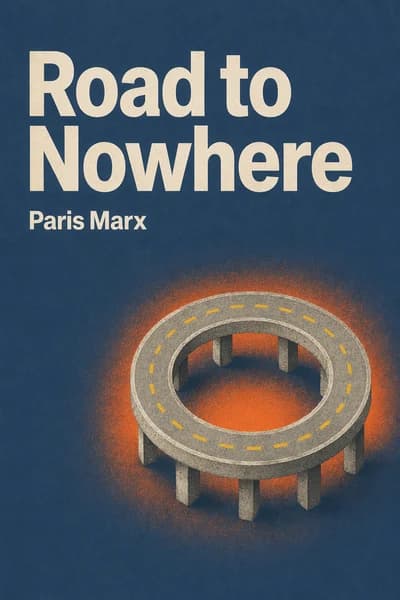
Road to Nowhere
What Silicon Valley Gets Wrong about the Future of Transportation
『Road to Nowhere』の概要
In "Road to Nowhere," Paris Marx demolishes Silicon Valley's car-centric transportation fantasies. This "brutally realistic analysis" reveals how tech's mobility solutions perpetuate inequality rather than progress. What if the future we're being sold is actually a high-tech return to our unsustainable past?

『Road to Nowhere』の主要テーマ
- automotive supremacy
- silicon valley libertarianism
- urban highway history
- publicly funded innovation
- transportation equity
『Road to Nowhere』の名言
They were manufacturing it.
The automobile's dominance wasn't inevitable but deliberately engineered.
When drivers killed pedestrians, they were viewed as murderers.
The internet exemplifies public-sector technology consumed by corporations.
The tech industry's leaders have narrow worldviews shaped by privilege.
『Road to Nowhere』の登場人物
- Paris MarxAuthor and critic of tech-led transportation
- Travis KalanickFormer Uber CEO envisioning automated taxis
- John Perry BarlowAuthor of the Declaration of Cyberspace
Road to Nowhereの要約をダウンロード
Road to Nowhereの要約をPDFまたはEPUBで無料でダウンロード。印刷やオフラインでいつでもお読みいただけます。
この本に関するよくある質問
Road to Nowhere critiques Silicon Valley’s tech-driven transportation visions, arguing that innovations like self-driving cars, delivery robots, and gig economy platforms prioritize corporate profits over public needs. Paris Marx exposes how these "solutions" exacerbate inequality, privatize public space, and fail to address systemic mobility challenges, advocating instead for democratic, equitable transit systems.
Urban planners, policymakers, tech critics, and anyone interested in transportation equity will find this book essential. It’s also accessible to general readers concerned about Silicon Valley’s growing influence on cities, labor rights, and climate-responsive infrastructure.
Yes. Marx combines sharp analysis with historical context, debunking tech industry myths while offering actionable alternatives. The book is praised for its clarity in linking transportation policies to broader capitalist dynamics, making it a vital resource for understanding 21st-century urban crises.
Marx argues that tech companies repackage flawed ideas (e.g., automated vehicles) as “progress,” masking privatization efforts and labor exploitation. These innovations often ignore proven solutions like public transit, cycling, and walkable cities, reinforcing class divides instead of solving mobility issues.
Marx advocates reclaiming public control over transit, expanding affordable options (buses, trains), and designing “15-minute cities” where daily needs are walkable. Examples include Oslo’s bike-friendly policies and Paris’s neighborhood-centric urban planning, which prioritize accessibility over corporate interests.
Marx dismisses self-driving cars as unrealistic distractions that centralize power in tech firms. These projects divert resources from equitable transit, rely on invasive data collection, and fail to address traffic or emissions meaningfully.
The title critiques Silicon Valley’s empty promises of a tech-utopian future. Marx argues these visions lead to “nowhere” beneficial for most people, instead perpetuating exploitative systems under the guise of innovation.
The book highlights how automation rhetoric (e.g., delivery robots) obscures human labor exploitation. Marx ties this to gig economy platforms like Uber, which profit from precarious work while undermining labor rights.
Marx hosts the Tech Won’t Save Us podcast and holds a master’s degree in urban geography. Their research focuses on tech’s socioeconomic impacts, particularly in transportation, blending academic rigor with accessible criticism.
Some reviewers note Marx focuses more on Silicon Valley’s speculative projects than real-world urban changes. Others argue the book’s social-democratic solutions lack concrete pathways to post-capitalist transit systems.
A central idea: “Silicon Valley’s vision of the future of mobility is a road to somewhere—but it’s not a good somewhere.” This underscores Marx’s warning against tech-driven urban futures that prioritize profit over people.
As tech firms expand into drone delivery, AI-driven transit, and gig labor, Marx’s critiques of corporate control over public space and data remain urgent. The book’s emphasis on democratic alternatives aligns with growing calls for climate-resilient cities.


