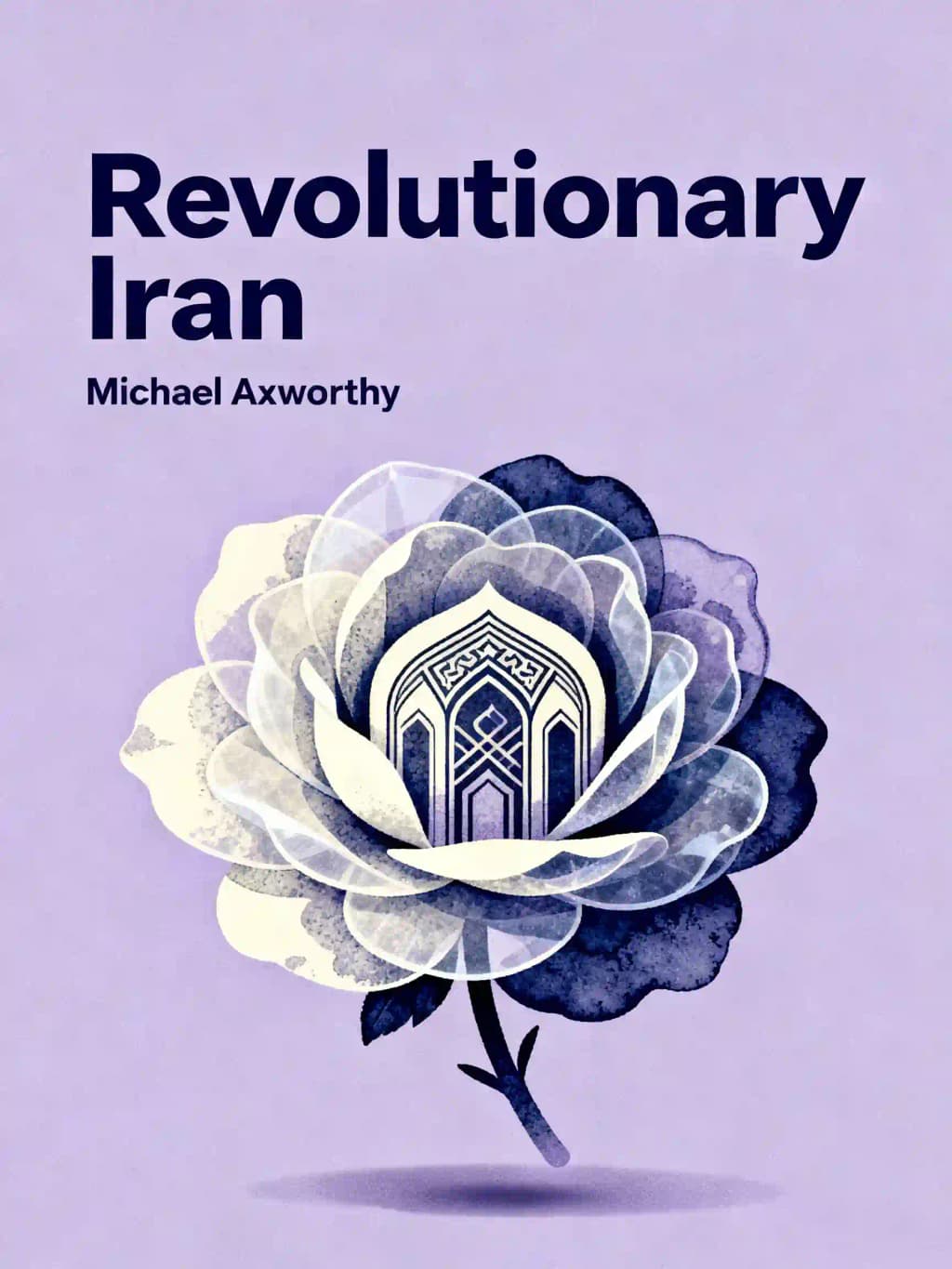
Revolutionary Iran
A History of the Islamic Republic
『Revolutionary Iran』の概要
Axworthy's definitive history unveils Iran's revolutionary transformation from monarchy to Islamic republic. Praised for its balanced approach, this nuanced exploration dispels Western misconceptions while examining the revolution's global impact. What hidden complexities of Iranian politics might change your understanding of Middle Eastern dynamics forever?

『Revolutionary Iran』の主要テーマ
- shi'a political thought
- islamic revolutionary movement
- clerical governance
- modern theocracy
- iranian cultural identity
『Revolutionary Iran』の名言
History pivoted the moment Khomeini's feet touched Iranian soil.
Iran defies simple categorization.
Each funeral became a political demonstration.
Khomeini wasn't a medieval throwback but a sophisticated religious innovator.
We seem to be moving from one dictatorship to another.
『Revolutionary Iran』の登場人物
- Michael AxworthyAuthor and historian of Iranian history
- Ayatollah Ruhollah KhomeiniCleric and leader of the Islamic Revolution
- The ShahThe monarch of Iran ousted in the 1979 revolution
- Abbas AmanatHistorian who explains the revolution's cycles
- Hamid DabashiReligious scholar who analyzed Khomeini's doctrine
著者について
『Revolutionary Iran』の著者について
Michael George Andrew Axworthy (1962–2019) was a British academic, historian, and leading authority on Iranian history, best known for his critically acclaimed work Revolutionary Iran.
As Director of the Centre for Persian and Iranian Studies at the University of Exeter and former head of the Iran section at the British Foreign & Commonwealth Office, Axworthy brought unparalleled expertise to his analysis of Iran’s political and cultural evolution. His seminal book A History of Iran: Empire of the Mind – praised by the Financial Times as “a beautifully distilled retelling of Iranian history” – cemented his reputation for blending scholarly rigor with accessible storytelling.
Axworthy’s works explore themes of geopolitical identity, religious complexity, and Iran’s enduring influence across centuries, informed by his diplomatic experience and frequent media commentary for outlets like The Daily Telegraph. His nuanced perspectives challenged Western stereotypes of Iran while critically examining its authoritarian tendencies. Revolutionary Iran has become essential reading for understanding modern Middle Eastern politics, with translations reaching global audiences and acclaim from publications like The Observer and New Statesman.
Revolutionary Iranの要約をダウンロード
Revolutionary Iranの要約をPDFまたはEPUBで無料でダウンロード。印刷やオフラインでいつでもお読みいただけます。
この本に関するよくある質問
Revolutionary Iran examines the 1979 Islamic Revolution, Ayatollah Khomeini’s rise, and the establishment of Iran’s Islamic Republic. Michael Axworthy analyzes Iran’s political evolution, its resistance to Western influence, and internal struggles, offering a comprehensive look at the revolution’s global impact and legacy. The book blends historical context with firsthand accounts to explain Iran’s complex modern identity.
This book is ideal for historians, political analysts, and readers interested in Middle Eastern geopolitics. Policymakers and students of Islamic studies will gain insights into Iran’s ideological clashes, while general audiences seeking to understand Iran’s defiance of Western norms will find it accessible. Axworthy’s nuanced perspective bridges academic rigor and narrative readability.
Yes. Axworthy’s balanced analysis challenges stereotypes, detailing Iran’s post-revolutionary resilience without excusing its autocratic regime. The book is praised for integrating soldier testimonies, memoirs, and political critique, making it a definitive resource on Iran’s modern history. Its exploration of ideological tensions and human rights issues remains widely cited.
The revolution stemmed from widespread discontent with the Shah’s authoritarian rule, U.S. interference, economic inequality, and Khomeini’s mobilization of religious nationalism. Axworthy highlights how these factors coalesced into a grassroots movement that overthrew the monarchy, replacing it with a theocratic state.
Axworthy uses soldier interviews and memoirs to illustrate the war’s devastation and Iran’s ideological fervor. He emphasizes the Basij volunteers’ sacrifices and the conflict’s role in consolidating the Islamic Republic’s identity while straining its economy. The war is framed as a catalyst for Iran’s isolationist policies.
Khomeini is central as the revolution’s architect and the Islamic Republic’s ideological figurehead. Axworthy critiques his authoritarian measures, including mass executions and suppression of dissent, while acknowledging his enduring influence on Iran’s anti-Western stance.
Some scholars argue Axworthy understates the 1988 mass executions (estimating 4,000–5,000 deaths vs. opposition claims of 30,000) and downplays systemic repression. Others note his focus on political history over social dynamics. Despite this, the book is lauded for its balanced approach.
Axworthy portrays Iran as a “defensive” power historically victimized by foreign interventions, yet defiant in asserting Islamic sovereignty. He discusses its nuclear ambitions and support for proxy groups as strategies to counter Western dominance.
The book draws on memoirs, revolutionary slogans, novels, and interviews with veterans and politicians. This diversity enriches its narrative, offering perspectives from both regime supporters and dissidents.
Themes include ideological resilience, the clash between democracy and theocracy, and Iran’s struggle for autonomy. Axworthy also explores generational shifts, women’s roles, and the tension between religious authority and secular nationalism.
A pivotal Khomeini decree states: “The decisiveness of Islam before the enemies of God is among the unquestionable tenets of the Islamic regime.” Another highlights Iran’s historical self-view: “Misunderstood and exploited by external enemies”.
Axworthy contrasts the Shah’s regime, where torture sought information, with the Islamic Republic’s use of torture for forced confessions. He details post-revolution executions, censorship, and the Green Movement’s suppression.
Unlike oversimplified narratives, Axworthy’s work contextualizes Iran’s actions within its historical grievances. It is frequently compared to Ervand Abrahamian’s A History of Modern Iran for its focus on ideological evolution.