第1章
When Failing Becomes Your Winning Strategy
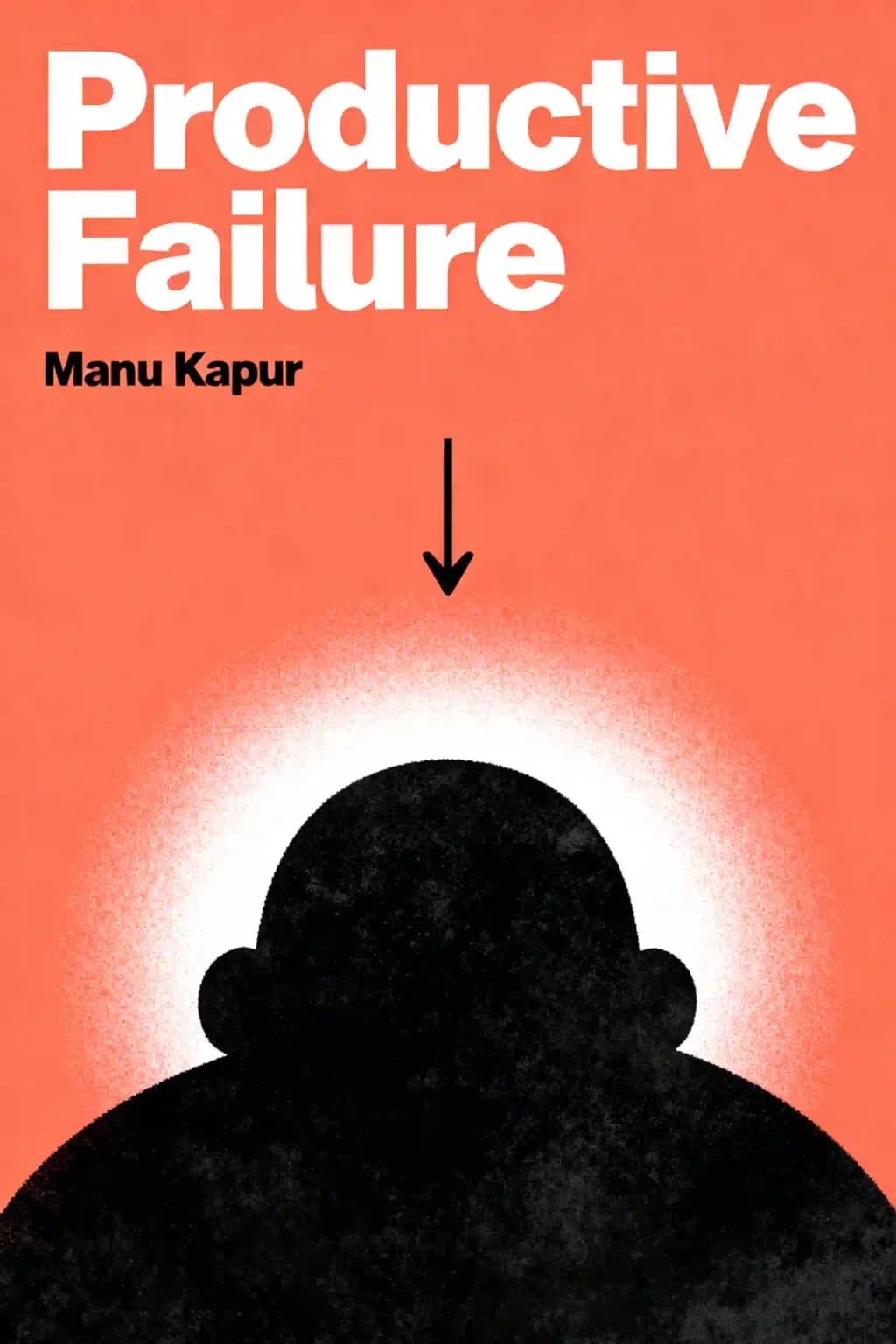
In a world obsessed with success, Manu Kapur offers a revolutionary perspective: failure, when properly designed, can be our most powerful teacher. "Productive Failure" has quickly become a favorite among education innovators and business leaders alike, with figures like Bill Gates praising its counterintuitive approach. The book has sparked a global conversation about learning methods, challenging centuries of educational orthodoxy with rigorous scientific evidence. What makes this work particularly compelling is Kapur's personal journey-from a career-ending soccer injury to reluctant teacher to pioneering researcher-all woven together to demonstrate how his greatest failures ultimately led to his most significant insights. His approach has been implemented in educational systems across four continents, with studies showing students outperforming traditional methods by up to two academic years. The question isn't whether we'll fail-we all do-but whether we can transform those failures into stepping stones for deeper understanding.
第2章
The Three Fundamental Problems of Learning
Learning faces three interconnected challenges that often prevent us from truly mastering new knowledge. First, we fail to remember what we've learned. Our memory operates on two dimensions: storage strength (how deeply information is embedded) and retrieval strength (how easily we can access it). According to Bjork and Bjork's New Theory of Disuse, the optimal pattern for strengthening memory is counterintuitive: learn, forget, retrieve, relearn, repeat. This makes forgetting productive rather than problematic, as retrieval attempts strengthen storage most when retrieval strength is low.
Second, we fail to understand concepts deeply. Chess grandmasters demonstrate that expertise isn't about superior general memory but specialized pattern recognition. While they perform no better than novices at remembering random chess pieces, they excel at recalling authentic chess positions. This pattern extends across domains-experts see deep structures where novices see only surface features. This creates a learning paradox: novices need to see critical features to develop expertise, but lack the prior knowledge to recognize these features. Even excellent teaching often fails because students lack the necessary prior knowledge to truly understand-they're essentially learning a foreign language without translation.
Third, we struggle to transfer knowledge to new contexts. When what we learn becomes inextricably linked with where and how we learn it-what researchers call Situated Cognition-transfer becomes difficult. This explains why students struggle to apply classroom knowledge in real-world situations. Our brains link learning with environmental cues, creating a "home advantage" effect where recall works best in familiar contexts. This explains why language learned through conversation transfers better than vocabulary learned through dictionaries, why pilots train in cockpit simulators, and why traditional schooling often fails. We decouple knowledge from practice-teaching math theory separately from mathematical practice-creating a fundamental disconnect between learning contexts and application contexts.
These three problems-failing to remember, understand, and transfer-form the foundation for understanding why learning often falls short of expectations. Only by addressing all three can we develop effective solutions that help us truly master new knowledge.
第3章
Flipping the Traditional Learning Model
What if we treated new concepts like toys for children to explore? Research shows children allowed to freely play with new toys (without prior instruction) are three times more inventive than those first shown how to use them-and both groups learn equally well how the toys work. This raises profound questions about traditional education approaches.
For decades, education has been dominated by two opposing philosophies. Direct Instruction is like following a detailed recipe when cooking-the teacher presents knowledge step-by-step, students absorb and practice. Its underlying logic is that if you don't know a concept, the most efficient path is explicit instruction. Discovery Learning, by contrast, resembles experimenting in the kitchen without a recipe-students engage with problems and develop solutions with minimal guidance. When tested against each other, Direct Instruction consistently outperformed Discovery Learning in formal learning contexts. By 2003, the debate seemed settled: Direct Instruction had won.
But what if the fundamental assumption underlying Direct Instruction-that making learning easy eases learning-was flawed? Despite its dominance, anomalies were accumulating-students often developed shallow understanding with retention and transfer problems. Kapur decided to test a counterintuitive idea: what if making initial learning hard improved outcomes? He created conditions where students would attempt problems beyond their knowledge base-problems so difficult they would lead to failure.
The solution to extracting value from failure lies in inverting the traditional Direct Instruction model. While Direct Instruction follows an Instruction-Problem Solving (I-PS) sequence, Productive Failure flips this to Problem Solving-Instruction (PS-I). This simple reversal-solve first, learn later-allows students to benefit from generating suboptimal solutions before receiving formal instruction. Unlike pure Discovery Learning, Productive Failure harnesses constrained problem-solving followed by explicit instruction.
The results across multiple studies were striking. While both methods produced high levels of procedural knowledge, Productive Failure students demonstrated significantly deeper conceptual understanding and far better transfer to novel problems. Meta-analysis of over 50 studies across four continents showed Productive Failure's effect was up to three times that of learning from a good teacher for one year, with students performing up to two academic years ahead of Direct Instruction students.
This challenges two common fallacies in education. The "basic knowledge fallacy" assumes we should build basic knowledge efficiently through Direct Instruction before worrying about deeper understanding. Kapur's research reveals that how we learn foundational knowledge dramatically influences our understanding and ability to transfer it. The "creativity fallacy" assumes knowledge enables creativity, but Direct Instruction students, despite having correct knowledge, produced far less diverse and creative solutions than Productive Failure students who had attempted problems before learning the concepts.
第4章
The Science of Activation: Why Struggle Prepares the Mind
When we try to solve problems before learning the concepts needed to solve them, something remarkable happens in our brains. This process-which Kapur calls "activation"-prepares our minds for deeper learning in ways that passive listening or reading simply cannot match.
Imagine being asked to remember random people performing actions: "John is swimming" or "Mary is cooking." This would be challenging. But if the task changes to remembering famous people doing what they're known for-"Shakespeare wrote a play" or "Michael Jordan dunked a basketball"-recall becomes effortless. This illustrates how connecting new information to existing knowledge facilitates learning.
The activation spectrum represents different ways to engage prior knowledge when learning. At the lower end are passive activities like lectures that elicit narrow activation and require less cognitive effort. At the higher end are complex tasks like problem-solving that generate broader activation of relevant knowledge but demand more effort. Since broader activation facilitates better processing and learning, methods higher on the spectrum typically produce better outcomes.
Failure-based activation extends this spectrum beyond success-based methods. While conventional approaches focus on activating correct ideas, Productive Failure deliberately designs for failure to achieve more powerful activation of relevant prior knowledge. This works through three mutually reinforcing mechanisms: Processing, Preparation, and Priming.
Processing leverages what psychologist Robert Bjork called "Desirable Difficulties"-deliberately making initial learning more challenging to improve long-term retention. Like a museum organized by mixed artists rather than clustered by artist, introducing difficulty forces deeper mental processing. When retrieval strength is low or zero (as in failed generation), we gain the strongest boost to both storage and retrieval strengths. This principle works across domains from language learning to motor skills to music.
Preparation builds fertile ground for future learning, much like a gardener preparing soil before planting seeds. Failed generation serves four critical functions: it activates relevant prior knowledge (both formal and intuitive), differentiates prior knowledge by highlighting which features matter and which don't, encodes variability by creating multiple memory pathways, and builds cognitive flexibility-the ability to adaptively navigate various problem-solving approaches despite initial failure.
Priming prepares the mind for learning without requiring generation or failure. Simply knowing what questions to look for before reading a passage creates mental markers, making dense material more navigable. Research shows that pretesting (attempting questions before learning) produces the best results, but even prequestioning (reviewing questions without answering) outperforms conventional reading by focusing attention and reducing mind wandering.
These three mechanisms-Processing, Preparation, and Priming-work together to make failed generation a powerful tool for deeper learning. By embracing the struggle before instruction, we activate our minds in ways that prepare us for more profound understanding.
第5章
Awareness: Recognizing What We Don't Know
"Awareness of ignorance is the beginning of wisdom," Socrates famously declared. This insight forms the foundation of the second mechanism behind Productive Failure's effectiveness. When we attempt to solve problems beyond our current abilities, we become acutely aware of our knowledge gaps-creating the perfect conditions for subsequent learning.
Research by Kurt VanLehn and colleagues analyzing 125 hours of physics tutoring sessions revealed that learning primarily occurs when students reach "impasses"-moments where they get stuck and cannot proceed. Surprisingly, when students didn't encounter these impasses, they learned very little regardless of the tutor's explanations. These findings suggest that experiencing difficulty is crucial for effective learning, as impasses create awareness of knowledge gaps that make subsequent explanations meaningful.
Multiple studies demonstrate how intentionally designed impasses improve learning. Students experiencing Productive Failure reported significantly higher awareness of knowledge gaps than those receiving Direct Instruction first. This awareness helped them benefit more from subsequent instruction, especially when teachers explicitly contrasted students' solutions with correct ones.
Sometimes our intuitions lead us astray without us even realizing we're wrong. The Cognitive Reflection Test (CRT) demonstrates this perfectly by presenting problems where the most intuitive answers are incorrect. When presented with counter-explanations after giving wrong intuitive answers, 45% of participants changed their minds. In group settings, the effect was even stronger; correct reasoning proved "contagious," with individuals who initially had the right answer successfully convincing their groups.
Counterintuitively, high-confidence errors are actually easier to correct than low-confidence ones. Butterfield and Metcalfe's experiment found that high confidence errors were not only better remembered but also more likely to be corrected. When something we believe with high confidence is proven wrong, we become more aware of our knowledge gap, more aroused by the mismatch, and pay greater attention to the correction.
Beyond failure, awe can also create awareness of knowledge gaps. Recent studies revealed that experiencing awe-that spine-tingling sensation when encountering something vast beyond our understanding-significantly increases our awareness of what we don't know. In experiments comparing participants who watched awe-inspiring nature videos versus humorous ones, those who experienced awe reported greater awareness of their knowledge gaps and showed increased interest in science.
Whether through failure, confronting misconceptions, or experiencing awe, becoming aware of what we don't know creates the perfect conditions for deeper learning. This awareness transforms subsequent instruction from passive information transfer into active gap-filling-making learning more meaningful, engaging, and effective.
第6章
The Emotional Engine: How Failure Drives Learning
Kapur introduces the power of emotional engagement through the example of Charles Dickens' "The Old Curiosity Shop," whose serialized publication created such anticipation that American readers reportedly gathered at New York Harbor awaiting ships with the next installment. This illustrates how cliffhangers create suspense and anticipation, compelling audiences to return for resolution. Similarly, when we fail to solve a problem despite multiple attempts, it creates a "cognitive and affective cliffhanger"-having invested in the problem, we become eager to discover the correct solution.
The Zeigarnik effect, named after Russian psychologist Bluma Zeigarnik, reveals that we remember incomplete tasks better than completed ones. Zeigarnik observed waiters who could recall complex orders while serving but struggled to remember them after completion. Her experiments confirmed people remembered interrupted tasks at significantly higher rates (68% vs 43% for completed tasks). This cognitive phenomenon stems from our affective "need for closure"-once we start something, we feel compelled to finish it.
Our drive to achieve closure creates four levels of affective boosts (ABLe) that can be harnessed in learning. ABLe 1 stems from loss aversion-our reluctance to waste invested effort can motivate persistence after failure. ABLe 2 comes from "endowed progress"-framing failed problem-solving as preparation for future learning creates motivation, like a partially-stamped loyalty card makes customers more likely to continue. ABLe 3 involves the "goal-gradient effect"-our motivation intensifies as we approach completion. ABLe 4 represents the final push, where completion itself becomes rewarding.
Beyond the need for closure, failure also triggers situational interest and curiosity. Children naturally use curiosity in play to construct knowledge, preferring toys that defy expectations and create uncertainty. Adults show similar patterns: uncertainty drives curiosity, which then drives learning. Neuroscience research reveals how curiosity affects the brain-high-curiosity questions activated brain regions associated with reward anticipation, and learning from failure proved more durable than learning from success.
Our orientation toward learning significantly impacts how we approach challenges. Students with mastery goals focus on understanding and growth, embracing challenges as learning opportunities. They employ deeper learning strategies, show resilience facing setbacks, and maintain intrinsic motivation. Research shows that the Productive Failure method naturally induces mastery-oriented goals, unlike traditional Tell-and-Practice instruction.
Finally, emotions act like highlighters in our memory, marking important moments for future recall. The brain processes emotional stimuli through a coordinated dance between three key regions: the amygdala (the emotional epicenter), the frontoparietal network (the attention arbiter), and the hippocampus (the memory maestro). This neurobiological collaboration ensures emotionally charged events receive preferential treatment during all three stages of memory processing-encoding, consolidation, and retrieval-resulting in more vivid, accessible memories that persist over time.
第7章
Assembly: Transforming Failed Attempts into Deep Understanding
Assembly represents the culmination of the Productive Failure process, where teachers help students build knowledge after they've experienced productive struggle. Like constructing with Lego blocks, this phase involves identifying useful elements within students' incorrect thinking and connecting these to expert knowledge structures, rather than simply correcting errors.
When teaching physics, most experts immediately correct students' misconceptions rather than leveraging them. For instance, when students incorrectly believe a force must be acting on a sliding ball (the "force-as-mover" misconception), effective teaching doesn't just dismiss this thinking but identifies the valuable intuition within it: students correctly sense something exists in the direction of motion, though it's momentum, not force.
Andrea diSessa pioneered the concept that our minds contain collections of simple knowledge units derived from everyday experiences-"p-prims" or phenomenological primitives. These self-evident "facts" from daily life (like "things fall when dropped" or "bigger causes create bigger effects") become axiomatic building blocks we constantly reconfigure to develop more complex understanding. These intuitive knowledge pieces function like Lego blocks that can be rearranged to construct increasingly sophisticated conceptual structures.
Learning isn't just about identifying knowledge blocks but reconfiguring them into expert understanding. By building upon intuitive blocks rather than dismissing them as wrong, teachers create deeper understanding through connection to prior knowledge.
We learn better from comparing cases than from single examples. Gick and Holyoak's radiation problem experiments revealed that only 10% of students could solve it unaided, while 30% succeeded after reading an analogous military strategy story. When students read two analogous stories, success jumped to 45%, and with the principle explicitly stated afterward, reached 60%. This confirms that effectiveness comes not from simply providing principles but from properly preparing students to understand them through comparative examples.
The Apollo 13 crisis demonstrates creative problem-solving at its finest-fitting a square peg into a round hole with makeshift solutions. In Productive Failure, students learn to see solutions as assemblies of components that can be rearranged for novel contexts. This flexible knowledge assembly explains why Productive Failure students outperform Direct Instruction students on transfer tasks.
Many worry that activating misconceptions could strengthen incorrect knowledge pathways, but this concern is unfounded. Through "pruning failure," our brains naturally eliminate unused connections while strengthening beneficial ones. Through "promoting failure," generating incorrect solutions actually enhances learning. Studies show students who generate more failed solutions learn more from subsequent instruction. Even "vicarious failure"-studying others' incorrect solutions-produces better results than direct instruction.
Assembly brings everything together, transforming exploration and failure into deep learning by connecting students' intuitive knowledge with formal concepts in ways that create lasting understanding.
第8章
Designing Productive Failure for Others
To effectively implement Productive Failure, we need design principles that guide creating productive learning experiences. These principles help us design experiences for others to learn deeply in a safe way, and for ourselves to accelerate growth without waiting for life's tests to happen.
A good Productive Failure task isn't just any challenging activity. Effective tasks share seven critical features: they use layperson's language rather than technical terms; contextualize problems in relatable situations; admit multiple solutions and representations; create an affective draw through novelty and uncertainty; use contrasting cases rather than single examples; vary certain features between cases while keeping others constant; and minimize computational load so students focus on designing ideas rather than calculations.
After designing the task, we must consider how learners engage with it. Studies show Productive Failure works whether learners work individually or in small groups, though collaboration during the generation phase has significant benefits. A useful approach is having learners work alone first to generate ideas, then collaborate to share and build upon them.
Effective facilitation amplifies the benefits of generating ideas and solutions. A simplified two-step approach works well: explain your idea, and hack your idea. When learners explain their ideas to others, both the preparation and delivery deepen understanding. The "hack your idea" step challenges learners to test their solutions' robustness by finding situations where they wouldn't work.
Traditional classroom settings often reward correct answers and penalize mistakes, creating fear of failure. Productive Failure requires a fundamental shift in the social environment to embrace failure, value effort, and prioritize the learning process. Creating psychological safety, where learners feel comfortable expressing ideas, making mistakes, and asking questions without fear, is essential. This requires establishing clear expectations that value open-ended exploration and intellectual risk-taking.
Learners' beliefs about intelligence significantly impact their response to challenges. Carol Dweck's research on growth mindset-the belief that abilities develop through effort and learning from mistakes-shows that students with this perspective see failure as an opportunity rather than a reflection of fixed ability. Meta-analyses confirm growth mindset interventions benefit academic outcomes, mental health, and social functioning, particularly for at-risk learners.
Designing for Productive Failure requires an iterative process of generating ideas, testing, learning, and redesigning until the approach works for your specific context. This approach has proven effective across diverse settings from schools to corporate training programs, and across domains including mathematics, science, engineering, psychology, language, business, and creative fields.
第9章
Becoming a Productive Failure Learner
Self-doubt and imposter syndrome are normal experiences that can actually signal growth. As Manu Kapur's father wisely advised, "one's ambition should always exceed their talent." This wisdom aligns with Vygotsky's Zone of Proximal Development (ZPD), the space between what someone can do independently and what they can achieve with guidance. Entering this zone requires attempting tasks beyond your current abilities-where failure becomes inevitable and valuable.
When applying Productive Failure principles to personal learning, all three design layers-task, participation, and social surround-must work together synergistically. The task layer involves creating challenges that push beyond current understanding. The participation layer means seeking feedback and collaboration at appropriate times. The social surround layer requires establishing an environment with supportive norms and a growth mindset.
When designing personal learning challenges, the key is finding tasks that are challenging yet accessible-pushing you into the Zone of Proximal Development where productive struggle occurs. One effective strategy is retrieval practice-testing yourself before accessing information, even if you initially fail.
Learning is most effective when contextualized in real-world situations that mirror how the knowledge will be applied. True understanding means being able to think about, explain, and represent concepts in multiple connected ways. Learning deepens when we engage with topics that spark curiosity and passion.
Preparing to explain concepts to others dramatically improves your own understanding. When you organize information to teach someone else-even if just pretending-you must break down concepts, create analogies, and structure your thoughts clearly. Hacking involves deliberately challenging your understanding by asking when and how your knowledge might fail.
Creating a psychologically safe environment for learning means establishing conditions where mistakes are viewed as part of the process rather than failures. This involves adopting a growth mindset that sees challenges as opportunities rather than obstacles.
The journey begins with "productive discontentment"-entering the Zone where deep learning happens through struggle and even failure. Though these feelings can be uncomfortable, embracing "productive discomfort" is essential for growth. Productive Failure provides the framework, but struggle alone doesn't guarantee learning-we must deliberately design for it, seek expert help, build supportive communities, and be intentional in our approach.
第10章
Redefining Success Through Productive Struggle
Performance and learning are not the same thing, though we often conflate them. The relationship between performance and learning creates four potential outcomes: Productive Success (high learning, high performance), Productive Failure (high learning, low initial performance), Unproductive Failure (low learning, low performance), and Unproductive Success (low learning, high performance).
The illusion of learning through high performance can be particularly deceptive, as with students who memorize information without developing deeper understanding. True learning doesn't always correlate with immediate high performance, and recognizing this allows us to value both obvious victories and the hidden growth embedded in our struggles.
Four big-picture takeaways summarize the book's message: (1) Failure as a mechanism-deliberately design for failure to optimize learning and growth; (2) Failure as a signal-if you're not experiencing any failure, you're likely not pushing yourself to your learning edge; (3) Failure as a feature-build safe spaces where tolerance for failure is valued; and (4) Failure as a mantra-internalize Productive Failure as a way of thinking and being, regularly seeking to harness the positive potential within failure until it becomes part of everything you do.
In a world obsessed with immediate success, Productive Failure offers a revolutionary perspective: our greatest failures, when properly designed and supported, can become our most powerful teachers. By embracing struggle as a necessary part of deep learning, we can transform education, professional development, and personal growth-creating not just better learners but more resilient, creative, and adaptable human beings.