第1章
The Uncomfortable Power of Not Knowing
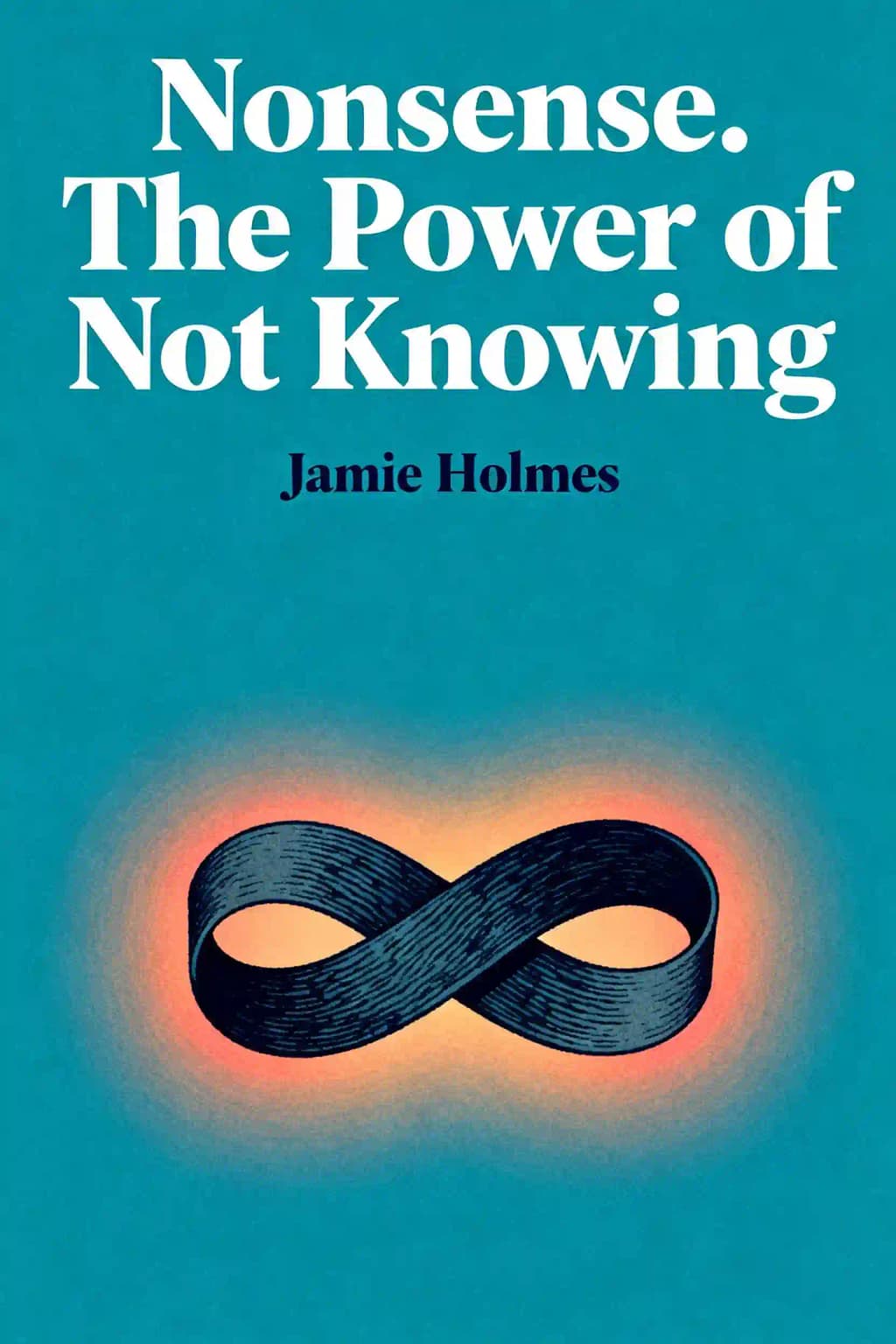
In 1996, six struggling teenagers with no prior success in language learning signed up for a five-day intensive French course at London's City and Islington College. Their instructor, Michel Thomas, transformed the classroom with armchairs and dim lighting, instructing students not to take notes or try to memorize anything. By week's end, these previously failing students could translate complex French sentences that normally take years to master. Thomas's revolutionary approach addressed the fundamental challenge of language learning-helping students overcome mental barriers to unfamiliar concepts by cultivating calm curiosity rather than anxious apprehension. This wasn't just a teaching method; it was a philosophy about how humans navigate uncertainty. Thomas, a Holocaust survivor and Allied spy who captured thousands of Nazi war criminals after WWII, had discovered something profound about the human mind: our relationship with ambiguity determines our capacity for growth, innovation, and even happiness. "Nonsense" became an international bestseller, praised by Malcolm Gladwell as "wonderfully interesting," and has transformed how thousands approach uncertainty in their professional and personal lives.
第2章
The Mind's Urgent Quest for Resolution
Our brains are wired to resolve ambiguity-a tendency that explains why humor works. When jokes present unexpected juxtapositions that we can still make sense of-like "purple flavor" for wine or amusingly mistranslated foreign signs-we experience pleasure in resolving the contradiction. This pleasure comes from our innate drive to eliminate inconsistencies in our understanding of the world.
Humor requires three elements: expectation, surprise, and discovery of a rule that resolves the puzzle. Bill Cosby's "Kids Say the Darndest Things" showcased this when five-year-old Kemett explained that healed cuts "go to another country." The humor emerges from the collision between our adult understanding and the child's creative explanation that resolves the mystery of disappearing scabs.
Jean Piaget, the pioneering developmental psychologist, found that children use "assimilation" to understand mysteries by extending familiar concepts-like trees waving their arms to create wind. This isn't just childish thinking; it's a fundamental human cognitive process. We all have mental models (schemes) that we apply to new situations. When faced with contradictions, we either deny them or "accommodate" by adjusting our worldview.
This resolution urge is evolutionarily adaptive-it helps us simplify complexity and make decisions quickly. But it also explains why we find certain things funny. Mad Libs, Absolut ads, and children's creative explanations all amuse us by playing with our brains' ambiguity-eliminating tendencies. As humor psychologist Rod Martin explains, "Our brain is like a Swiss Army knife... and what we do in humor is play with these tools, using them in ways they're not normally used."
The pleasure we experience when resolving cognitive dissonance isn't just entertaining-it's a window into how our minds fundamentally operate. We are meaning-making machines, constantly working to transform the unfamiliar into the familiar, the nonsensical into the sensible. This drive serves us well in many contexts, but as we'll see, it can also lead us astray when we rush to eliminate ambiguity too quickly.
第3章
When Confusion Makes Us See More Clearly
In the polite European town of Tilburg, Netherlands, where Van Gogh once took drawing lessons and Trappist monks produce La Trappe beer, social psychologist Travis Proulx conducts fascinating experiments on how people react to confusing and ambiguous events. His research reveals something counterintuitive: confusion can actually sharpen our perception.
In one experiment, Proulx and colleague Steven Heine had subjects read Franz Kafka's disorienting story "A Country Doctor" before performing pattern recognition tasks. The results were striking-those exposed to the surreal story identified 33% more patterns in letter strings than those who read a straightforward narrative. Similar experiments involving self-contradiction, nonsense word pairs, and surrealist art produced comparable results-confusion made people more pattern-hungry.
This heightened pattern recognition isn't always beneficial. The same mechanisms that help us detect real patterns can lead us to see connections where none exist. When our fundamental assumptions about reality are violated, we experience what psychologists call "meaning threat"-a state that triggers both anxiety and increased vigilance.
Proulx's research builds on the work of Jean Piaget and Leon Festinger, showing that disorder stimulates both pattern-seeking behavior and affirmation of existing beliefs. This helps explain why people cling to beliefs even when confronted with contradictory evidence-a phenomenon Festinger famously studied by infiltrating a doomsday cult led by Dorothy Martin.
When Martin's prophecy of alien rescue before a catastrophic flood failed to materialize on December 21, 1954, believers initially froze in shock. Hours later, Martin claimed to receive another message: the cataclysm had been called off because their own good spirits had saved Earth. Despite continued failed prophecies, many followers clung to their beliefs, becoming increasingly desperate to find confirmation patterns.
This response illustrates Festinger's theory of cognitive dissonance-the disturbing feeling experienced when holding two conflicting cognitions. To resolve this discomfort, people often double down on existing beliefs rather than revising them. Subsequent research by Zanna and Cooper revealed that when people could attribute their discomfort to an external source (like a placebo pill supposedly causing tension), they no longer felt compelled to resolve contradictions in their beliefs.
Recent neuroscience research has validated Festinger's core insight that physical anxiety drives our need to reestablish order after encountering disorder. Our brains respond to conceptual contradictions much as they do to physical threats-with an alarm system that activates even when the violation is positive, as shown in studies where subjects experienced stress responses to unexpected but favorable outcomes.
Understanding this process helps explain why we often rush to judgment when faced with ambiguity. The discomfort of uncertainty triggers a predictable sequence: an error message in the brain, followed by anxious vigilance, and finally a commitment to resolve the contradiction-either by assimilating new information into existing beliefs or accommodating by changing those beliefs. When anxieties linger, we find comfort in our social groups and emphasize our ideals through "affirmation," intensifying whatever beliefs we already hold.
This meaning-maintenance system is so fundamental that Proulx speculates it may explain as much as 60 percent of our day-to-day behavior-a constant, mostly unconscious effort to maintain a coherent understanding of the world, even when that means distorting reality to fit our expectations.
第4章
When Urgency Clouds Judgment
In the aftermath of the 1906 San Francisco earthquake, a strange phenomenon emerged amid the devastation: a marriage boom. This pattern reveals something profound about how humans respond to disaster. When approximately 15% of Americans experience disasters in their lifetimes, they face what psychologist Ronnie Janoff-Bulman calls a "double dose of anxiety"-fear for physical safety coupled with the collapse of their conceptual understanding of the world. This upheaval creates a powerful need for certainty, often leading to rushed decisions.
Group decisions under high need for closure mirror individual ones, with groups grabbing for farfetched conspiracies or falling back on core beliefs during unstable times. Studies show that under time pressure, dissenting voices are quickly marginalized, and groups adopt more dictatorial decision-making styles, favoring autocratic leaders. This explains why George W. Bush's approval jumped 30 percentage points after 9/11-Americans craved his decisiveness when faced with uncertainty.
A heightened need for closure has been linked to support for militancy, torture, secret prisons, and prioritizing national security over individual rights. When the world feels unpredictable, people entrench existing views or jump to conclusions. Yet uncertain times, while painful, represent opportunities for innovation-over 50% of Fortune 500 companies were founded during recessions.
Consider how this plays out in medicine. Patients are "practically drowning" in diagnostic tests, many of which don't justify their use. Health policy expert Shannon Brownlee argues that for every helpful scan, another may cloud diagnosis by sending doctors down wrong paths. Research reveals a phenomenon called "investigation momentum"-when ambiguous test results trigger more invasive testing. In one study of PSA screening, 40% of men who received inconclusive results opted for risky biopsies, compared to just 25% of those without any test results.
While financial incentives and defensive medicine contribute to overtesting, investigation momentum represents a deeper psychological issue. One case study described a man whose routine hernia surgery was delayed six months while doctors chased harmless nodules discovered on precautionary scans. The initial chest X-ray, which wasn't even medically indicated, spawned two additional CT scans that ultimately revealed nothing concerning.
The medical community has begun addressing this problem. Roughly $200 billion may be wasted annually on overtreatment in the US. The journal JAMA Internal Medicine launched a "Less Is More" series highlighting when reducing care improves outcomes. The ABIM Foundation's "Choosing Wisely" campaign has identified over 325 overused tests and procedures.
To counteract urgency's negative effects in any context, we need tools that increase awareness of our situational need for closure. Simple practices help: consider your stress level before making decisions, formalize reminders about how anxiety affects judgment, and create accountability systems that reward good long-term decisions. As Mayor Joseph Alioto of San Francisco demonstrated during the 1969 "anti-earthquake party," we can acknowledge reality while refusing to succumb to hysteria.
第5章
The Peril of Premature Certainty
The 1993 standoff outside Waco, Texas ended in tragedy after a 51-day siege when FBI tactics escalated from negotiation to confrontation. This disaster illustrates how our inability to tolerate ambiguity can lead to catastrophic outcomes.
The fundamental failure at Waco stemmed from FBI leaders' inability to handle ambiguity-specifically, David Koresh's ambivalence about surrendering. Rather than recognizing that Koresh both wanted to leave and stay, they simplified reality by deciding he was merely "toying with them." As negotiator Gary Noesner understood, Koresh's intentions were unstable and changeable, not fixed and hidden.
Good negotiators possess what poet John Keats called "Negative Capability"-the ability to exist "in uncertainties, Mysteries, doubts, without any irritable reaching after fact & reason." This quality, unrelated to IQ but crucial in crisis situations, allows one to resist drawing premature conclusions from contradictory information.
The FBI later demonstrated what they'd learned from Waco during the 1996 standoff with the Freemen militia in Montana. Using a completely different approach-casual clothing instead of combat gear, third-party intermediaries, trust-building, patience, and lowered pressure-they resolved the 81-day siege (the longest in US history) without firing a single bullet.
Organizations can better handle ambiguity by hiring people with lower need for closure, creating cultures that respect uncertainty, and implementing processes like "red teaming" to systematically imagine alternative explanations. Unfortunately, these lessons came too late for Waco, which ended tragically on April 19 when armored vehicles punctured the compound walls and FBI listening devices recorded ominous phrases about pouring fuel and starting fires.
This pattern of premature certainty appears across domains. In fashion, John Fairchild, the powerful editor of Women's Wear Daily, staked his reputation on predicting that 1970 would be the year of the midi skirt-falling four inches below the knee. Despite midi popularity in Europe, American women stubbornly clung to their beloved miniskirts. Department stores made varying commitments to the midi, with Bonwit Teller boldly stocking 95% midi inventory for fall.
The fashion establishment desperately wanted longer hemlines to return. But American women rebelled against what they saw as fashion dictatorship. Protest groups formed-POOFF (Preservation of Our Femininity and Finances) in Los Angeles gathered thousands of members, while men created SMACK (Society of Males Who Appreciate Cute Knees).
As the fall fashion season approached, Fairchild's bold predictions were put to a brutal market test. Despite Women's Wear Daily's unwavering support for the longer hemline, consumers overwhelmingly rejected it. Critics called the midi dowdy, saying it added "instant age" and made women look like "bags of potatoes." The financial fallout was devastating-Bonwit Teller suffered huge losses, Malcolm Starr Inc. went bankrupt, and even three years later, retailers still hadn't liquidated their midi inventory.
These examples demonstrate how our rush to eliminate ambiguity-whether in crisis negotiations or business forecasting-often leads to disaster. The healthier approach is learning to distinguish between risk (known odds but unknown outcomes) and ambiguity (unknown odds because the rules determining outcomes are unclear), and developing the capacity to tolerate the latter.
第6章
Finding Opportunity in Uncertainty
For the Italian motorcycle manufacturer Ducati, 2004 was supposed to be a breakthrough year in MotoGP racing. After a surprisingly successful 2003 debut season that included podium finishes and even a race victory, expectations were high. But 2004 proved disastrous-riders crashed frequently, the team was forced to switch engines mid-season, and performance was consistently disappointing. This failure-after-success pattern reveals something crucial about innovation: neither success nor failure alone drives improvement. The real story is about uncertainty and how we respond to it.
While failure is now celebrated in innovation circles as necessary for progress, the real story is more nuanced. Innovation inherently "drags you into the realm of ambiguity," as Gary Pisano notes. Most experiments fail-scientific experiments flop over 70% of the time, and new food products fail at similar rates. This uncertainty is unavoidable in creative pursuits, from venture capital to pharmaceutical research.
The economic landscape demands innovation more than ever. Companies remain in the S&P 500 only one-fifth as long as they did in 1937, and experts like Thomas Friedman argue that only innovators and entrepreneurs will be safe from automation and outsourcing. Yet our educational system poorly prepares students for this reality, focusing on skill repetition rather than adaptability in uncertain conditions.
Sports psychologist Bob Christina revolutionized golf instruction by noticing that typical driving range practice-mechanically hitting ball after ball with the same club-poorly prepared players for actual tournaments. He developed "transfer practice" where golfers simulate the unpredictability of real courses by constantly switching clubs, distances and scenarios.
Christina's most counterintuitive technique was withholding feedback, forcing golfers to develop their own problem-solving abilities rather than becoming dependent on instruction. By training players to adapt to uncertainty rather than merely repeating skills, he transformed how top golf instructors teach.
This approach directly parallels the innovation challenge in business and technology. Today's educational system faces a fundamental mismatch with the demands of the modern economy. University lectures-essentially unchanged for 600 years-focus on transmitting information rather than developing comfort with uncertainty. Studies reveal professors typically wait only two seconds after asking questions before answering themselves.
Some innovative educators like Jim Lang deliberately keep students "off-kilter" to prepare them for uncertainty, while others design assignments that students are likely to fail at-mirroring real-world challenges. Researcher Manu Kapur calls this "designing for productive failure," while professor Edward Burger actually grades students on their "quality of failure."
In 2014, Christopher Myers and colleagues investigated when people learn from failure and when they don't. The key factor was "ambiguity of responsibility"-how clearly people could identify the causes of outcomes. In their experiments, participants who took responsibility for their failures were significantly more likely to succeed in subsequent challenges than those who blamed external factors.
Ducati's response to its 2004 racing failures exemplifies this principle. Engineers admitted their mistakes and identified specific design flaws: they'd started too late, giving themselves insufficient testing time, and created an inflexible integrated system. For 2005, they began designing earlier and shifted to a modular approach that allowed component-by-component changes.
Conversely, Ducati's earlier successes in 2003 had actually hindered learning. As technical director Corrado Cecchinelli confessed: "You look at the data when you want to understand what's going wrong. You do not look at the data because you want to understand why you're performing well." Their "learning season" became too successful, leading them to stop analyzing data and questioning their assumptions.
Organizations should treat successes with the same scrutiny normally applied to failures, questioning the role of unforeseen factors. Pixar exemplifies this approach-despite fourteen straight box office hits, they conducted postmortems after each success. As co-founder Ed Catmull noted, employees would rather celebrate victories and move on, but he encouraged them to seek out "the Hidden"-the vast universe of unknowns that becomes harder to see when successful.
第7章
Discovering Hidden Functions
Before mobile banking existed, migrant laborers across the world discovered they could transfer money by texting prepaid airtime codes to family members in remote villages. This grassroots innovation transformed airtime cards into virtual currency, allowing anyone with a basic phone to send money without banks or Western Union. Telecom companies eventually formalized this practice, with services like PasaLoad in the Philippines and M-PESA in Kenya, which by 2013 served over two-thirds of Kenya's adult population.
This functional repurposing of SMS technology sparked a revolution. Beyond money transfers, governments began offering text-based services for reporting crime, checking passport applications, and sending flood warnings. Companies created SMS-based systems for selling clean water and delivering crop insurance.
Remarkably, Carnegie Mellon researchers found that 85 percent of innovations in mobile financial services came from emerging markets, with at least half pioneered by ordinary users rather than companies. This pattern of seeing beyond an object's intended function parallels the early days of the telegraph, when its unexpected use for catching criminals surprised everyone.
Bell and Gray's competing work on the telephone reveals how breakthrough innovation requires overcoming functional fixedness. While both men discovered how to transmit sound electrically, Gray remained fixated on improving the telegraph's existing function, dismissing the telephone as a "scientific toy" with no commercial value. Bell, despite pressure from his financier to focus on multiple telegraphy, recognized the telephone's revolutionary potential beyond its technical novelty.
The pattern is clear: true innovation happens when inventors recognize that an object's assumed function is merely one possibility among many. Just as telegraph wires could carry voices and SMS could transfer money, objects have hidden functions waiting to be discovered.
Psychologist Tony McCaffrey developed a systematic approach to overcoming functional fixedness after studying thousands of inventions. His "generic-parts technique" follows the pattern behind nearly all breakthroughs: first notice an obscure feature of an object, then build a solution based on that feature.
The method requires breaking down objects into their component parts without referencing their functions. Instead of seeing "tires" on a truck, you reconceive them as "air-filled rubber tubes." This deliberate decomposition forces you to step outside conventional classifications and see new possibilities.
McCaffrey's research extends beyond the generic-parts technique to more comprehensive invention methods. In one study, he asked people to list features of common objects and discovered they typically overlook two-thirds of an object's characteristics-far more than his predicted one-third. This blindness to features severely limits innovation potential.
Using this insight, he developed the "feature-spectrum technique," a thirty-two-category system that identifies overlooked properties. By deliberately examining neglected features like motion or weight change, McCaffrey invented ten new candle designs in just two hours, including a self-snuffing candle that uses weight loss during burning to trigger a snuffer mechanism.
For complex real-world problems, McCaffrey created an "analogy finder" that overcomes linguistic biases in problem descriptions. When a materials company needed to "adhere coating to Teflon," his thesaurus-based approach revealed hidden assumptions in the verb "adhere" and led to a magnetic sandwich solution rather than a chemical bond.
The greatest inventors possess an extraordinary capacity to be puzzled. Thomas Edison, with minimal formal education but 1,093 patents, possessed what one observer called a "remarkable kaleidoscopic brain" that generated endless design variations. His breakthroughs with the incandescent lightbulb helped people realize that telegraphy wasn't the fundamental category of electrical innovation-just one application of electricity.
第8章
The Wisdom of Embracing Contradictions
The Touitou-Elon family exemplifies the benefits of multilingualism at Jerusalem's Hand in Hand school. Their son Andrei speaks Arabic with a flawless accent that comes "from his guts," moving comfortably between Jewish and Arab communities. His mother Danae explains that while Arab parents want their children to speak accent-free Hebrew to participate in Israeli society, Jewish children speaking perfect Arabic represents a political act.
Despite its success, Hand in Hand faces significant challenges. Sixth-graders were verbally and physically attacked on a bus simply for speaking Arabic, with one attacker proudly declaring, "I'm not embarrassed to be racist." The school has endured hate graffiti, arson attacks, and discrimination from local amusement parks segregating Jewish and Arab children.
Psychologists Arne Roets and Alain Van Hiel have linked prejudice to Arie Kruglanski's concept of need for closure-the hunger for certainty that makes people "afraid to say 'I don't know'" and unable to "tolerate ambiguity." Like Gordon Allport's earlier research on stereotyping, this reveals how our minds naturally eliminate contradictions. While we all rely on stereotypes to simplify our complex world, the prejudiced person seeks to eradicate contradictions rather than embrace them.
The bilingual advantage stems partly from understanding language's arbitrary nature, but also from holding two cultural worldviews simultaneously. As John Gardner wrote, art begins in "a wound inherent in the nature of life"-often from living between cultures. This "healthy doubleness of vision" fuels both empathy and creativity, which spring from the same source: diversity. Reading fiction, traveling, and intergroup experiences all help lower our need for closure and increase empathy.
We consistently underestimate how much we'll change in the future while acknowledging significant changes in our past. Psychologist Jordi Quoidbach's research with nearly twenty thousand subjects revealed this striking pattern: people across all age groups reported dramatic personality changes over the previous decade but predicted minimal change in the coming one. "At every age, we feel like we're done with our own evolution," Quoidbach explains.
This "End of History Illusion" references Francis Fukuyama's famous 1989 essay claiming we were witnessing "the end point of mankind's ideological evolution." This tendency to view history as a plot heading inevitably toward the present robs past, present, and future of their mystery. It treats our past selves as evolving while seeing our current selves as fully developed, denying the unpredictability that makes both present and future wonderful and frightening.
Our brain does much of its necessary resolving and categorizing unconsciously, yet we remain exceptionally sensitive to anomalies. The heroes of this book are all protestors against the premature destruction of the world's mystery-from Arie Kruglanski and Gary Noesner to Trisha Torrey and Tony McCaffrey. Each showed we can push back against our mind's need to reduce and simplify.
In a world increasingly characterized by complexity, ambiguity, and rapid change, the ability to exist comfortably in uncertainty-to resist the urge for premature closure-may be our most valuable skill. As poet John Keats suggested, the capacity to remain "in uncertainties, Mysteries, doubts, without any irritable reaching after fact & reason" isn't weakness but strength. It's the foundation of creativity, empathy, and wisdom in an unpredictable world.