第1章
The Moral Compass in a Self-Centered World
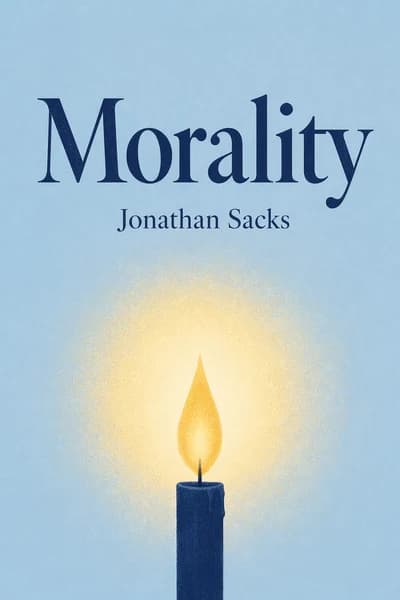
When Barack Obama was asked to name his favorite book of 2018, he didn't hesitate: "Morality" by Rabbi Jonathan Sacks. The late Chief Rabbi of the United Kingdom's exploration of our collective moral decline has resonated far beyond religious circles, becoming required reading for political leaders and cultural commentators alike. Named one of The Economist's Books of the Year, this work arrived at a pivotal moment when Western societies were experiencing unprecedented polarization. What makes this book particularly powerful is Sacks' unique perspective - combining the analytical rigor of his Oxford and Cambridge philosophical training with the practical wisdom gained from decades as a spiritual leader. His diagnosis of our "cultural climate change" offers not just critique but hope - a roadmap for rebuilding the moral foundations that sustain human flourishing.
第2章
From "We" to "I": The Great Moral Shift
The fundamental transformation of Western society over the past half-century can be summarized in one profound shift: the move from "We" to "I." This isn't merely philosophical abstraction - it's visible in our everyday language. Google Ngram searches reveal that while "we" usage remained relatively stable until 1965, "I" began a precipitous rise that continues today. Similar patterns appear in pop music lyrics between 1980-2007, where first-person singular pronouns increased dramatically while plural pronouns and words expressing positive social emotions decreased.
This linguistic shift reflects a deeper cultural transformation. Any functioning social institution - whether marriage, community, or nation - requires individuals to occasionally sacrifice self-interest for the group's sake. A brilliant soccer team fails if players act as divas; an orchestra produces noise if musicians interpret independently. Without "we-consciousness," relationships crumble, communities dissolve, and nations split apart.
The consequences have been devastating. More people live alone than ever before, with single-person households doubling in the US over fifty years, reaching 40% in large cities. Britain saw a 16% increase in solo living between 1997-2017. This isolation has created a loneliness epidemic now recognized as a major health hazard, with Britain appointing its first "Minister for Loneliness" after research showed nine million Britons feel lonely, with 200,000 elderly going over a month without conversation.
Loneliness damages both mental and physical health, increasing risks of cardiovascular disease, stroke, cancer, dementia, and Alzheimer's. Social isolation is as harmful as smoking fifteen cigarettes daily and worse than obesity, with isolated individuals facing 26% greater mortality risk. Simply playing cards weekly with friends adds as many years to life as quitting smoking.
By contrast, places with strong social bonds show remarkable benefits. In certain Sardinian villages where no one lives alone, where the elderly live with family and remain active into their 90s, men live as long as women (unusual globally) and centenarians are ten times more common than average. These communities consider their elderly "treasures" - respected, honored and never left alone.
Our individualism has liberated us to live as we choose, but at significant cost to our well-being. While we can do things our ancestors couldn't imagine, what they found simple - marriage, community, identity, continuity with past and future - we find extremely difficult. This atomization makes us vulnerable to future turbulence and unpredictability.
第3章
The Limits of Self-Help
The self-help industry promises personal transformation through individual effort, yet its fundamental premise is flawed. The self is where problems begin, not where they end. Looking back at my life, it was always someone else who set me on new trajectories - someone who believed in me more than I believed in myself or perhaps told me the honest truth when I needed to hear it.
Recent evaluations of the self-help movement reveal its limitations. Marianne Power's experiment living according to self-help classics for fifteen months left her with more debt, less productivity, weight gain, and damaged friendships. The books, promising unattainable happiness, made her increasingly dissatisfied and self-obsessed.
Viktor Frankl demonstrated the transformative power of the voice from outside the self in Auschwitz. As a psychotherapist taken to the death camp, he maintained the will to live while helping others do the same. His first decision was refusing to let the Nazis define his situation - instead of seeing himself as a victim, he chose to view himself as a scientist conducting an experiment on humanity. He then helped others by finding missions waiting for them that could only be fulfilled if they stayed alive. This led to his development of Logotherapy - psychological healing based on man's search for meaning. The essence was a call from outside the self, asking not what we want from life but what life wants from us - the difference between ambition and vocation.
Iris Murdoch described a similar concept she called "unselfing," where the relentless first-person singular falls silent as we become aware we're not the center of the universe. This gives morality its unique power - we can both feel our feelings as subjects and stand outside them as objects, capable of second-order evaluations that consider others' feelings and consequences of our actions.
Dr. Ludwig Guttmann demonstrated how someone from outside can change an entire group's self-image. As a Jewish neurosurgeon who fled Nazi Germany, he revolutionized the treatment of paraplegics at Stoke Mandeville Hospital in 1943. Where others saw "moribund cripples" confined to beds and heavily sedated with 3-6 month life expectancies, Guttmann saw "the best of men." By reducing sedatives, getting them to sit up, play catch, and eventually compete in wheelchair sports, he transformed their lives. His efforts led to the Paralympic Games, which by 2012 had grown to 4,302 participants from 164 countries.
Morality is precisely un-self-help. It strengthens our relationships with others, responding to their needs rather than insisting they listen to us.
第4章
The Digital Disconnect
Social media negatively impacts young people's physical and psychological health in profound ways. Comparing themselves to carefully curated online profiles leaves many feeling inadequate and depressed. The Duchess of Sussex warned how pursuing "likes" skews self-worth, while eighteen-year-old Shannon McLaughlin described how seeing only positive aspects of others' lives worsened her depression and anxiety, creating unrealistic body image expectations.
The public nature of social media creates new phenomena like FOMO (Fear of Missing Out), turning life into "advertisements for myself" and reducing meaningful experiences to photo opportunities. One businessman noted young people now only want selfies with celebrities rather than conversation - seeing the world through a lens rather than their eyes.
Research shows smartphones physically alter young brains. Studies reveal chemical imbalances in addicted users, while even a switched-off phone nearby reduces cognitive capacity. Global attention spans have measurably shortened - Twitter trends in 2016 lasted just 11.9 hours compared to 17.5 hours in 2013. Parents using devices to pacify young children may damage their emotional development and self-regulation abilities.
The consequences are severe: depression, eating disorders, substance abuse, and self-harm, particularly among teenage girls. A 2018 Children's Society report found nearly a quarter of fourteen-year-old British girls had self-harmed within a year. This "internet-induced depression" has become a recognized public health hazard, prompting the British government to propose fines for harmful content.
Human interaction increasingly happens electronically rather than face-to-face, with siblings texting while in the same house and teenagers preferring text over in-person communication because it's "less stressful." The result is declining empathy and social skills. Even relationship breakups and apologies happen via text, but as one graduate student noted, a texted "I'm sorry" fails to resolve conflicts because it avoids witnessing the other's emotions.
Ironically, tech pioneers strictly limited their own children's screen time. Steve Jobs forbade his children from using iPads, Tim Cook kept his nephew off social media, Bill Gates limited his daughter to 45 minutes on weekdays, Snapchat founder Evan Spiegel allows his stepson just 90 minutes weekly, and Mark Zuckerberg emphasized outdoor play for his daughter.
Something essential is lost when human interaction isn't face-to-face: the affective dimension that makes us feeling persons in relation with others. Anthropologist Bronislaw Malinowski identified "phatic communion" - seemingly trivial conversation that creates bonding and relationship. Robin Dunbar later suggested language evolved primarily for "grooming" - establishing trust and mutual responsibility through physical presence.
第5章
The Fragile Family
Marriage represents the supreme consecration of "We" within culture - two people joining in a covenant of loyalty and love to build a life together. For many immigrant communities and throughout Jewish history, strong families created resilient communities that survived persecution and displacement. Marriage represents the transformation of two "I's" into a collective "We" - the consecration of commitment to care for another. While contracts benefit, covenants transform; contracts concern interests, covenants create identity - an "Us."
The 1960s delivered the biggest blow marriage and family had ever encountered in Western civilization. Sex became disconnected from marriage and commitment. Over the next generation, fewer people married, those who did married later, and unprecedented proportions of marriages ended in divorce.
The consequences have created new forms of financial and moral poverty concentrated among single-parent families. Family breakdown correlates with increased eating disorders, substance abuse, depression, and suicide attempts among young people. This has created a societal divide comparable to what Disraeli called "two nations" 150 years ago.
Social scientific evidence overwhelmingly shows children benefit from stable marriages with two parents. Divorce harms children, and single parenthood even more so - affecting childhood aggression, delinquency, educational achievement, emotional health, and ability to form lasting relationships.
The top third of society briefly experimented with new freedoms but largely returned to traditional conventions - they married, joined religious communities, and focused intensely on their children's success. The bottom third couldn't swim against the cultural current, creating communities without adult role models where teenagers join gangs and enter drug culture or crime. America now has one of the highest child poverty rates in the developed world.
Many young men from broken families have strong instincts for good but lack positive models. When asked about future fatherhood, they express desires to provide structure and presence for their children - things they never had themselves. This represents a profound injustice inflicted by a generation that embraced sex without responsibility.
For various reasons - medical developments, moral changes, and shifts in responsibility from individuals to the state - everything marriage once united has been split apart. Sex divorced from love, love from commitment, marriage from children, and children from parental responsibility.
第6章
Markets Without Morality
Corporate failures like Carillion's 2018 collapse exemplify a disturbing pattern of "recklessness, hubris and greed" endemic in modern business. The company's implosion, leaving 7 billion in liabilities and 43,000 jobs at risk, highlighted how executives continued paying themselves generous bonuses while the company crumbled. Similarly, business leaders expressed shock at bankers' behavior during the 2008 financial crash - taking unprecedented risks with others' money while securing their own bonuses and golden parachutes regardless of outcome. This perfectly exemplifies "moral hazard," where decision-makers take excessive risks knowing others will bear the costs of failure. While thousands lost homes and savings, many bankers received bonuses and showed little remorse.
Justice as fairness appears to be deeply embedded in human instinct, as demonstrated through Frans de Waal's remarkable experiments with capuchin monkeys. When monkeys performing the same task saw others receive superior grape rewards while they got cucumbers, they actively rejected their lesser rewards - demonstrating an innate sense of fairness that predates human civilization. The market economy fundamentally needs this moral foundation - Adam Smith himself wrote "The Theory of Moral Sentiments" before "The Wealth of Nations," recognizing that human beings naturally care about others' welfare and that markets require trust and ethical behavior to function.
Behavioral economics experiments consistently reveal this moral dimension. In the Ultimatum Game, people regularly reject free money rather than accept unfair splits. The Public Goods Game shows participants willingly spending their own resources to punish free riders who don't contribute to the common good. These findings demonstrate that humans value fairness and reciprocity over pure self-interest. Markets need these moral underpinnings to function - the very words "credit" (from credere, to believe), "confidence" (with faith), and "fiduciary" (relating to trust) have deep moral roots. While markets excel at generating wealth and fostering creativity, they don't inherently guarantee equity or integrity. They were designed to serve human needs, not to become our masters.
When individual self-interest ("I") dominates community welfare ("We"), market thinking inappropriately invades areas where it doesn't belong, particularly in the pursuit of happiness. Despite average incomes more than doubling in Britain and America over the past century, surveys show people aren't notably happier, suggesting we're seeking fulfillment in the wrong places.
Aristotle provided Western civilization's most influential analysis of happiness (eudaemonia), viewing it as inseparable from moral virtue - defining it as "an activity of the soul in accordance with virtue." This links personal fulfillment to ethical behavior and contribution to community welfare. The Hebrew Bible offers a parallel perspective, consistently connecting genuine happiness with righteousness and moral conduct.
Our modern consumer society produces widespread dissatisfaction by constantly highlighting what we lack rather than appreciating what we have. Social media and technology companies deliberately design addictive platforms to capture and monetize our attention, while market values steadily undermine crucial human qualities like loyalty, community, and personal growth. Even sports, once celebrated for building character and teamwork, increasingly reduce players to statistical assets and games to algorithmic calculations. This transformation reflects how market thinking can hollow out activities that once provided deeper meaning and satisfaction.
第7章
Democracy in Danger
Intellectuals warn that Western liberal democracy is in crisis, as evidenced by pessimistic book titles like "How Democracy Ends" and "The Suicide of the West." The 2016 US presidential election and Brexit vote created bitter divisions that have only deepened. Throughout the West, trust in politicians has plummeted - in Britain falling to just 26 percent by 2017, while in America only 18 percent trusted government to do the right thing, down from 75 percent in 1958. Research shows Millennials increasingly losing faith in democracy, with a quarter viewing it as a "bad system."
To understand our current crisis, we must examine two founding moments that shaped Western political culture: the American Declaration of Independence (1776) and the French Declaration of the Rights of Man (1789). Though seemingly similar, they represent fundamentally different understandings of politics. The American declaration is explicitly religious, referring to the "Creator," while the French is secular. More importantly, the American version includes the concept of "unalienable" rights that cannot be surrendered to the state, while the French version does not.
The American Declaration follows Hobbes and Locke's social contract theory, where citizens consent to government to protect their lives, liberty and property, but retain certain unalienable rights that define protected private spaces. The French Declaration follows Rousseau's concept of the "general will" - not the sum of individual wills but what citizens are deemed to want collectively. This creates a theory of maximal government where rights are claims upon the state rather than protections from it, potentially sacrificing individual liberty for the "common good."
The Anglo-American model recognizes three key social arenas: the state, individuals, and civil society. Civil society - the "third sector" where people form moral communities through voluntary association - is vital for democracy, creating what de Tocqueville called the "apprenticeship of liberty." The French model recognizes only two arenas: the state and individuals. Everything collective becomes political.
As the moral sense shifts from "We" to "I," institutions of civil society have atrophied. When civil society weakens, people make demands the state cannot satisfy. The state cannot create strong families, supportive communities, or provide children with stable parents. Without the "We" of collective responsibility, the result is the "secession of the successful" - the rich separating themselves with no special responsibility to the poor.
第8章
Identity Politics and the Fragmentation of Society
Identity politics, though seemingly new, taps into our primal need to belong to groups. Our "groupishness" lies at the heart of identity: I am who I am because of the groups to which I belong. Though "identity politics" only entered public discourse in the 1980s, it has become a key dimension of contemporary politics, with the left focusing on marginalized groups and the right increasingly addressing poor white males who feel ignored by elites. Thinkers like Lilla, Appiah, and Fukuyama warn that identity politics fragments society, discourages talk of common good, and leads to competitive victimhood.
Identity politics represents the latest chapter in a story dating back to the seventeenth century. Historically, religion provided the deepest form of identity, binding societies together. The Reformation's internal battles within Christianity created trauma when part of "Us" became "Them." The Enlightenment responded by attempting to abolish identity in favor of universal humanity - a reaction to religious violence. But this utopian dream ignored our fundamental need for identity, leading to the Counter-Enlightenment's return to identity through secular substitutes: nation, race, and class.
Nationalism, racism, and Marxism collectively led to the loss of some 100 million lives in the twentieth century. In response, the 1960s saw a new flight from identity - not toward universalism as in the eighteenth century, but toward individualism. Yet within a decade, communitarian thinkers pointed out that this "unsituated self" was not true to life - we are social animals whose identity depends on group belonging.
Multiculturalism, introduced to address demographic changes through immigration, has proven disastrous despite noble intentions. As Sniderman and Hagendoorn observed, "Sharing a common identity builds support for inclusion; bringing differences of ethnic and religious identity to the fore evokes the very exclusionary reactions it is meant to avoid." Identity politics deepens this fragmentation, creating self-segregating, non-communicating groups operating on the axiom that "only a member of my group can understand my pain."
We need an alternative to these extremes, focusing on society rather than the state. Nations are enriched by diversity when it coexists with shared national identity: by being what we uniquely are, we contribute what only we can give.
第9章
From "I" to "We": The Path Forward
Can we restore what's been lost in our increasingly divided society? Unlike environmental climate change requiring billions to change, cultural climate change begins with individuals choosing to act morally. We can make an immediate difference by caring for others, being trustworthy, giving, volunteering, and listening. David Brooks distinguishes between resume virtues (achievements) and eulogy virtues (impact on others) - the latter investing life with deeper meaning. Research confirms that giving makes us happier and healthier. Even young children show empathy, suggesting altruism is embedded in our nature.
While contracts are transactions based on self-interest, covenants generate transformative relationships. Covenants are moral commitments sustained by loyalty where people come together to form a "We." A contract is about interests; a covenant is about identity. Covenants create moral communities, binding people in mutual responsibility, whether vast (human solidarity) or small (marriage). What matters isn't the group size but the commitment to embrace a world larger than the self.
Raghuram Rajan argues in "The Third Pillar" that state and market have grown at community's expense. He advocates shifting from profit maximization to value maximization, considering employees and communities alongside shareholders. Similarly, Sir Ronald Cohen champions "impact economics" through Social Impact Bonds that deliver specific social outcomes. Young people increasingly want to work for companies with positive social impact. These leaders are showing us an economics of "We," not just "I."
During America's Civil War, Lincoln demonstrated covenantal thinking. Rather than demonizing opponents, Lincoln showed humility, establishing the first national Thanksgiving Day where both sides could express gratitude. His second inaugural address famously urged "malice toward none, with charity for all." Lincoln saw America as a moral community bound by covenant - "a new nation, conceived in Liberty, and dedicated to the proposition that all men are created equal."
Covenant focuses on shared responsibility rather than division, speaking to our "better angels" rather than pitting "Us" against "Them." This approach can restore moral community to our deeply divided societies by emphasizing mutual responsibility, inclusion, and the common good. Unlike contract politics focused on self-interest, covenant politics recognizes our interwoven destinies and responsibilities to one another. Societies become strong when they care for the weak, rich when they care for the poor.
The Covid-19 pandemic dramatically illustrated this book's central theme: Western liberal democracies have had too much "I" and too little "We." Early in the crisis, self-centered behaviors caused harm, while those who worked for the common good inspired us despite often being among society's lowest-paid. Neighborhoods spontaneously organized support systems, like Captain Tom Moore who raised over 30 million for the NHS through a simple garden walk.
As we emerge from global crises, we have an opportunity to strengthen five dimensions of "We": human solidarity (recognizing our shared vulnerability); humility before nature (including addressing climate change); social responsibility (building high-trust societies); reconsideration of market morals (moving from a market society to a market economy with values of fairness); and the spirit of kindness that flourishes in times of shared challenge. The choice between repeating history's mistakes or building stronger structures of togetherness is ours, and the time is now.