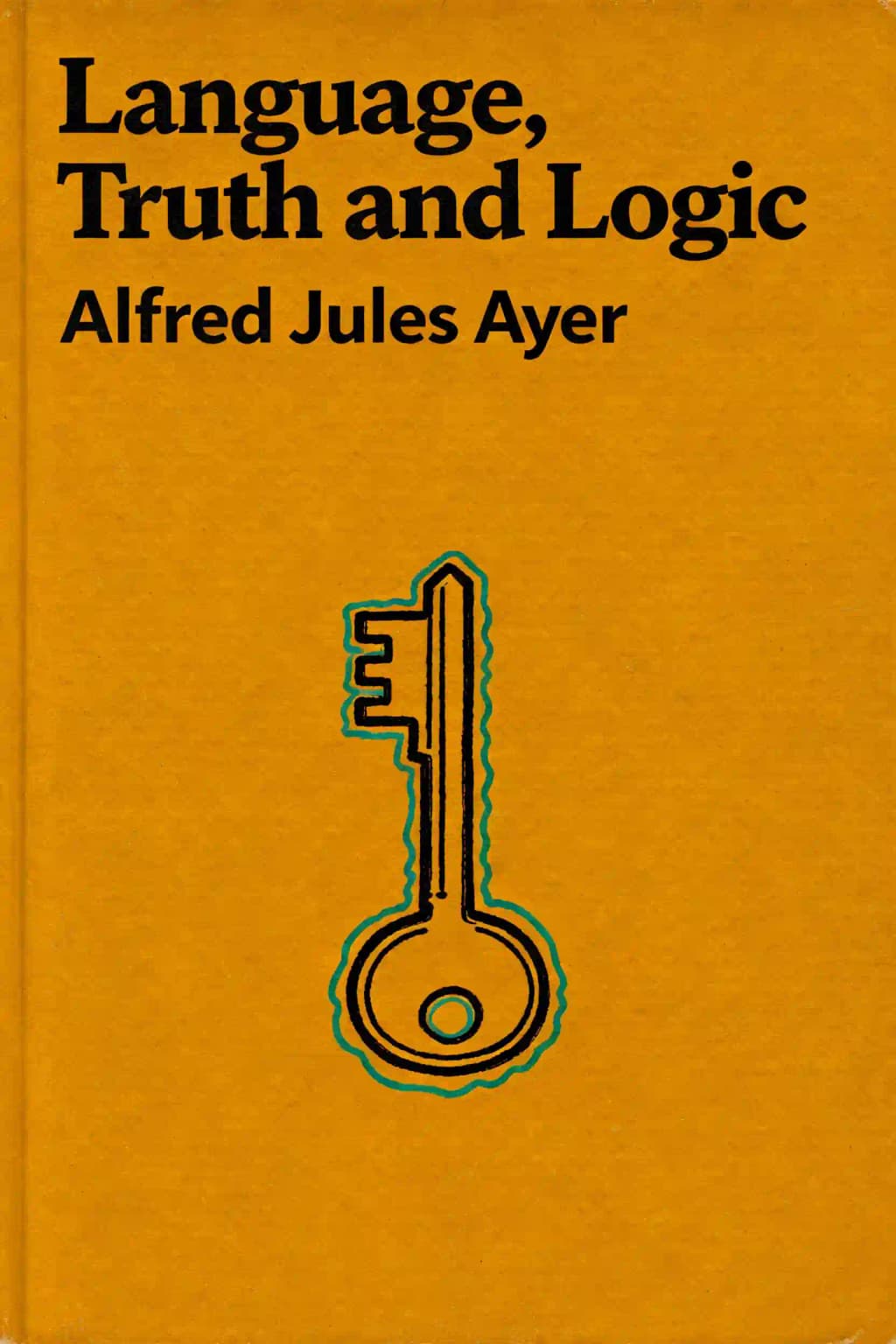
Ayer's revolutionary philosophy demolishes metaphysics and redefines truth through empirical verification. At just 24, he shook Anglo-American philosophy, earning Bertrand Russell's praise: "A delightful book... I should like to have written it myself." What makes a statement truly meaningful?
Sir Alfred Jules Ayer (1910–1989) was an influential British philosopher and a pioneer of logical positivism. He authored the seminal work Language, Truth and Logic, a foundational text in 20th-century analytic philosophy.
Educated at Eton and Oxford, Ayer studied under Gilbert Ryle and later immersed himself in Vienna’s logical positivist circles, shaping his rigorous empiricist approach. His 1936 manifesto, written at age 24, revolutionized philosophy by introducing the verification principle—declaring metaphysical claims meaningless unless empirically verifiable—and critiquing traditional epistemology through linguistic analysis.
Ayer served as Grote Professor at University College London and Wykeham Professor of Logic at Oxford. His wartime role in British intelligence underscored his analytical precision. Knighted in 1970, he also presided over the British Humanist Association, aligning his philosophical rejection of metaphysics with secular advocacy. His later work, The Problem of Knowledge (1956), further explored epistemology and perception.
Language, Truth and Logic remains a philosophy classic, translated worldwide and consistently ranked among the most impactful 20th-century philosophical texts, still required reading in university curricula.
Language, Truth, and Logic by Alfred Jules Ayer is a foundational text in logical positivism, arguing that meaningful statements must be either empirically verifiable (synthetic) or true by definition (analytic). Ayer dismisses metaphysics and theology as nonsensical, reduces ethics to emotional expressions, and champions scientific inquiry as the sole path to knowledge. The book introduced the "verification principle" to distinguish meaningful claims from pseudophilosophy.
This book is essential for philosophy students, scholars of epistemology, and readers interested in 20th-century analytic philosophy. It appeals to those exploring debates about empiricism, the limits of language, and the critique of metaphysics. Ayer’s clear prose also makes it accessible to general audiences curious about logical positivism’s radical ideas.
Yes—it remains a landmark work that shaped analytic philosophy and sparked enduring debates. While some arguments, like the verification principle, face criticism, the book’s rigor and clarity offer invaluable insight into empiricist thought. Its influence on philosophy of science and ethics ensures its relevance in modern discussions.
Key ideas include:
Ayer’s principle asserts that a proposition is meaningful only if it can be empirically tested (e.g., “water boils at 100°C”) or is analytically true (e.g., “all bachelors are unmarried”). Statements failing this test—like “God exists”—are deemed nonsensical. Critics argue the principle itself isn’t verifiable, undermining its validity.
The book popularized logical positivism in English-speaking academia, challenging traditional metaphysics and reshaping epistemology. It influenced analytic philosophy’s focus on language and science, spurring debates about meaning, truth, and the nature of philosophical inquiry. Its radical claims about ethics and religion remain contentious.
Critics highlight:
Ayer reduces ethics to emotive expressions (“boo/hurrah theory”), denying moral truths exist. Metaphysical claims about reality or divinity are dismissed as unverifiable “pseudo-propositions.” This stance sparked debates about philosophy’s scope and the role of subjectivity in ethics.
Ayer divides meaningful statements into:
This distinction underpins his rejection of metaphysics and defense of empiricism.
The book catalyzed analytic philosophy’s linguistic turn, emphasizing logical analysis over speculative metaphysics. It impacted philosophy of science (e.g., demarcating science from pseudoscience) and ethics, inspiring later thinkers like Gilbert Ryle and W.V.O. Quine, who both critiqued and built on Ayer’s ideas.
Its critiques of dogma and emphasis on clarity resonate in debates about misinformation and scientific skepticism. While logical positivism has waned, Ayer’s questions about meaning, truth, and the limits of knowledge remain central to philosophy, linguistics, and cognitive science.
著者の声を通じて本を感じる
知識を魅力的で例が豊富な洞察に変換
キーアイデアを瞬時にキャプチャして素早く学習
楽しく魅力的な方法で本を楽しむ
A sentence is factually significant to any given person, if, and only if, he knows how to verify the proposition which it purports to express—that is, if he knows what observations would lead him, under certain conditions, to accept the proposition as being true, or reject it as being false.
The traditional disputes of philosophers are, for the most part, as unwarranted as they are unfruitful.
Metaphysics fails because of the logic of language itself.
Philosophy becomes the logical analysis of concepts and propositions.
『Language, Truth and Logic』の核心的なアイデアを分かりやすいポイントに分解し、革新的なチームがどのように創造、協力、成長するかを理解します。
鮮やかなストーリーテリングを通じて『Language, Truth and Logic』を体験し、イノベーションのレッスンを記憶に残り、応用できる瞬間に変えます。
何でも質問し、学習スタイルを選び、自分に本当に響くインサイトを一緒に作れます。

"Instead of endless scrolling, I just hit play on BeFreed. It saves me so much time."
"I never knew where to start with nonfiction—BeFreed’s book lists turned into podcasts gave me a clear path."
"Perfect balance between learning and entertainment. Finished ‘Thinking, Fast and Slow’ on my commute this week."
"Crazy how much I learned while walking the dog. BeFreed = small habits → big gains."
"Reading used to feel like a chore. Now it’s just part of my lifestyle."
"Feels effortless compared to reading. I’ve finished 6 books this month already."
"BeFreed turned my guilty doomscrolling into something that feels productive and inspiring."
"BeFreed turned my commute into learning time. 20-min podcasts are perfect for finishing books I never had time for."
"BeFreed replaced my podcast queue. Imagine Spotify for books — that’s it. 🙌"
"It is great for me to learn something from the book without reading it."
"The themed book list podcasts help me connect ideas across authors—like a guided audio journey."
"Makes me feel smarter every time before going to work"

Language, Truth and Logicの要約をPDFまたはEPUBで無料でダウンロード。印刷やオフラインでいつでもお読みいただけます。
Imagine a world where most philosophical debates are revealed to be nothing but linguistic confusion-where centuries of metaphysical speculation collapse under the weight of a single question: "What observation would verify this claim?" This intellectual earthquake struck in 1936 when 26-year-old Alfred Jules Ayer published his revolutionary work. The slim volume delivered a devastating verdict: much of traditional philosophy was literally meaningless. Not wrong, but nonsensical. This wasn't just another philosophical theory-it was a demolition project that would transform how we think about knowledge, ethics, religion, and reality itself. The verification principle at its core-that meaningful statements must be either empirically verifiable or logically necessary-became both a weapon against obscurity and a tool for clarity. Though many of its specific claims have been challenged, its central insight continues to shape our intellectual landscape: if you can't specify what would count as evidence for your claim, perhaps you're not saying anything meaningful at all.
Ayer proposes that statements have literal meaning only if they're analytically true or empirically verifiable through sense experience. Otherwise, they're meaningless. Claims like "Reality is ultimately spiritual" fail this test since no observation could verify them. The verification principle distinguishes genuine questions from pseudo-questions. "Does the external world exist?" becomes meaningful only when we specify what observations would count as evidence. With metaphysics deemed meaningless, philosophy's role shifts to logical analysis - not special knowledge about reality but a method for clarifying thought. Philosophy functions as a critical activity that clarifies truth criteria. This view has historical precedent. Locke described himself as "an under-labourer in clearing the ground." Berkeley analyzed material things through sense-contents. Hume rejected metaphysics and focused on defining concepts. Philosophy provides "definitions in use," showing how sentences with certain symbols can be translated into equivalent ones without those symbols. Rather than building grand metaphysical systems, philosophers clarify concepts used in science and everyday life.
Armed with the verification principle, traditional metaphysics-from Plato's Forms to Hegel's Absolute Spirit-collapses into meaninglessness. These systems claimed knowledge beyond science, but what observations could verify claims about "ultimate reality"? Metaphysical confusion often stems from language's grammar. We discuss properties using words that seem to represent things themselves, leading philosophers to posit "substance" as distinct from properties. Similarly, "Being" emerges because existential and attributive propositions share grammatical structure. These errors arise from the superstition that every grammatical subject corresponds to a real entity. When no empirical entity exists, metaphysicians invent non-empirical worlds to house these supposed entities-explaining Heidegger's treatment of "Nothing" and problems concerning propositions and universals. Language tricks us in everyday speech too. We say "the average family has 1.5 children" without assuming an actual "average family" exists with half a child. Yet philosophers often interpret similar constructions by positing mysterious entities beyond experience. Perhaps the deepest philosophical problems are simply linguistic traps we set for ourselves.
How can mathematical and logical truths seem absolutely certain when knowledge comes from experience? Ayer's solution: these principles are universally true because abandoning them would contradict language rules themselves. They are analytic propositions or tautologies-true simply by virtue of their terms' meanings. Mathematical propositions, including geometry, are analytic-their validity follows from definitions. Geometries are logical systems whose axioms are definitions, not statements about physical space. The certainty of logic and mathematics stems from their tautological nature, recording our linguistic conventions. Their surprising quality emerges from our limited intellect; we cannot immediately grasp all implications of definitions and need calculation to discover complex tautologies. "2+2=4" doesn't tell us anything about the world; it merely reveals how we've defined those symbols. This view resolves a centuries-old philosophical puzzle. We know mathematical and logical truths with certainty not because they reveal profound insights about reality, but because they show the implications of our definitions and linguistic conventions.
When asking "What is truth?" we're essentially asking for a translation of "proposition p is true." The word "true" marks assertion, while "false" marks denial. To say a proposition is true is simply to assert it. Philosophers often mistakenly believe certain empirical propositions about immediate experience are absolutely certain. However, no sentence can consist purely of demonstrative symbols and remain intelligible. Description inherently exceeds what is immediately given. When testing hypotheses, we never verify a single hypothesis in isolation but a system of interconnected ones. If results contradict expectations, we can preserve the law by modifying auxiliary hypotheses or questioning the observation itself. A genuine hypothesis must remain potentially falsifiable, otherwise it becomes merely analytic. Hypotheses exist to anticipate sensations and enable predictions. All empirical propositions function as hypothetical rules for anticipating experiences. This view of knowledge is both humbling and liberating. While absolute certainty about empirical matters remains unattainable, we can develop increasingly reliable systems for predicting experience - an endless quest for better understanding, never complete but always improving.
Ayer makes a controversial claim about ethics: ethical statements are neither analytic nor empirically verifiable. Instead, they're expressions of emotion rather than factual claims. Saying "You acted wrongly in stealing" merely expresses moral disapproval, similar to exclaiming "You stole that money!" with horror. Unlike orthodox subjectivism, Ayer argues ethical statements express feelings directly without asserting their existence - like expressing boredom through tone rather than stating "I am bored." What appear to be disputes about values are often disputes about facts. In moral disagreements, we typically try to show others they've misunderstood motives, misjudged effects, or overlooked circumstances, hoping shared facts will lead to shared moral attitudes. When someone with different moral conditioning disagrees even after acknowledging all facts, argument becomes impossible. Though we may feel our moral system superior, we cannot argue for this superiority, as such judgments are themselves value judgments. This explains why moral disagreements often feel intractable - when factual disagreements are exhausted yet moral differences remain, we've reached the limits of rational argument.
Language, Truth and Logic sparked a philosophical revolution that still resonates today. Though many of Ayer's claims have been challenged - even by himself later - the book's central insights remain powerful. The verification principle transformed philosophical methodology by emphasizing clarity, precision, and empirical grounding. Ayer's emotive theory of ethics opened new avenues for understanding moral language, while his analysis of religious language clarified theological disputes. Ayer showed that philosophy could be clear and relevant without sacrificing depth. By insisting meaningful statements must connect with experience or logic, he helped philosophy escape what he viewed as metaphysical confusion. In a world increasingly dominated by scientific thinking, Ayer offered a vision of philosophy that complemented rather than competed with science - clarifying concepts, analyzing language, and dissolving pseudo-problems. When encountering a seemingly profound claim, ask yourself: "What observation would verify this?" This question - Ayer's razor - cuts through confusion, revealing whether you're dealing with genuine insight or empty words. In our age of information overload, this intellectual tool is more valuable than ever.